Capsicum Market Size, Share & Industry Analysis, By Product Type (Green Bell Pepper, Red Bell Pepper, Yellow Bell Pepper, and Others), By Nature (Conventional and Organic), By Processing Type (Whole/Unprocessed, Canned, Frozen, and Others), By Application (Food & Beverages, Pharmaceuticals, Cosmetics & Personal Care, and Others), and Regional Forecast, 2026-2034
 Download Free Sample
(Offer valid till 15th Oct 2026)

KEY MARKET INSIGHTS
 Listen to Audio Version
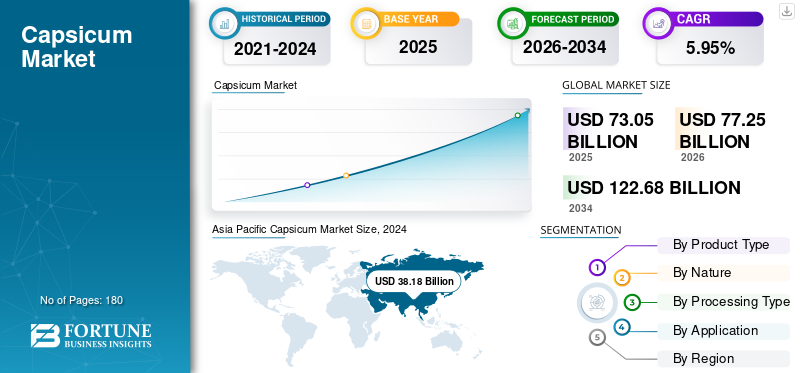
The global capsicum market size was valued at USD 73.05 billion in 2025. The market is projected to grow from USD 77.25 billion in 2026 to USD 122.68 billion by 2034, exhibiting a CAGR of 5.95% during the forecast period. The Asia Pacific dominated global market with a share of 52.27% in 2025.
Capsicum, also known as bell/chili pepper, belongs to the Solanaceae family, which also includes eggplants and tomatoes. This crop originates from South and Central America, where it was first cultivated nearly 6,000 years ago. Although bell peppers are consumed globally as a vegetable, they are botanically classified as a fruit. Today, it is cultivated in over 160 countries, with the Asia Pacific region being the largest consumer and producer. In terms of nutrition, bell pepper is recognized as a powerhouse of antioxidants and vitamins.
It also offers chlorophyll, fiber, and potassium, which support skin health and strengthen the immune system. With respect to usage, capsicum plays a key role in the food & beverage sector, its extract is used in stir-fries, curries, and salads. Beyond the food sector, its extracts are also used in personal care & cosmetics, nutraceuticals, and pharmaceuticals.
The rising popularity of organic products and the growing use of pepper in functional foods are the main factors driving its demand. Some of the major players include Lipman Family Farms, LEWIS TAYLOR FARMS, INC., Lange, and Neo Foods.
Download Free sample to learn more about this report.
Capsicum Market Key Takeaways
 Global Market Size & Forecast
- 2025 Market Size: USD 73.05 billion
- 2026 Market Size: USD 77.25 billion
- 2034 Forecast Market Size: USD 122.68 billion
- CAGR: 5.95% from 2026–2034
 Market Share
- Asia Pacific dominated the market with a 52.27% share in 2025.
- The Green Bell Pepper segment led the market by product type in 2025.
- The Organic segment is projected to register a 6.96% CAGR during the forecast period.
 Key Regional Highlights
Asia Pacific
The region leads the market due to strong demand for spicy cuisines, expanding foodservice industry, greenhouse and hydroponic farming.
North America
The region ranks third globally, driven by growing demand for ready-to-eat meals, increasing use of capsaicin in beverages and cosmetics.
Europe
The region is projected to grow at a 5.92% CAGR, supported by rising vegan food consumption and advancements in capsicum production technologies.
U.S.
The country remains the largest consumer in North America, supported by rising demand for flavorful foods.
Japan
Growing demand for fresh and processed vegetables, increasing health awareness.
Read More

MARKET DYNAMICS
MARKET DRIVERS
Rising Demand for Functional and Nutrient-Rich Foods Bolsters the Market’s Potential
The increasing consumer demand for functional/nutrient-rich foods is a crucial driver promoting the industry’s momentum. Capsicum is considered a valuable ingredient in health-centric diets due to its high fiber, carotenoids, and vitamin content. This pepper offers low-fat and calorie content, combined with health-promoting properties, which fit well with the clean-label trend. Moreover, the rising awareness of veganism has fueled its incorporation into daily diets. To maintain a healthy lifestyle, many individuals are turning toward plant-based nutrition, which continues to accelerate the use of peppers. Apart from this, its active compound, capsaicin, has analgesic and anti-inflammatory properties, which have led to its inclusion in functional drinks and supplements. Recognizing these advantages, companies are also focusing on introducing packaged, nutrient-rich meals and beverages that cater to evolving consumer demands.
MARKET RESTRAINTS
High Susceptibility to Diseases and Climatic Conditions to Hinder Market Expansion
One of the major difficulties in the market is the susceptibility of capsicum to chronic pant diseases. Capsicum plants are highly prone to various pathogens that affect numerous parts of the plant. Out of all, the soil-borne disease is considered a key concern that is difficult to control after its spread. Foliar and fruit disease is another pivotal infection, caused by fungal infections. Powdery mildew, bacterial spot, and anthracnose are a few common examples of foliar disease. Additionally, capsicum is susceptible to viral diseases caused by Tobacco Mosaic Virus, Cucumber Mosaic Virus, and Tomato Spotted Wilt Virus. As a result, the aforementioned factors inhibit the global capsicum market growth.
Climatic condition is another crucial challenge in the market. Sudden variations in climate, such as high/low temperatures, humidity, high winds, or drought, can substantially affect crop quality.
MARKET OPPORTUNITIES
Technological Advancements to Unlock Growth Possibilities
The adoption of advanced technology in the market opens numerous growth opportunities. To control weed growth, companies can utilize precision agriculture, which involves the use of fertigation and drip irrigation systems to deliver essential nutrients and water to the roots. This technique helps strengthen overall plant yield and health. Non-chemical preservation techniques (ozone fumigation and UV-C irradiation) are gaining popularity, as they are widely used to maintain vegetable quality and control post-harvest diseases. Moreover, automated sorting and grading machine systems can be employed to sort capsicum based on shape, color, and size, thereby minimizing manual work. Additionally, companies are focusing on producing capsicum varieties with improved resistance to both biotic and abiotic stresses.
CAPSICUM MARKET TRENDS
Growing Inclination Toward Veganism is the Ongoing Trend
The global industry is experiencing a phenomenal and growing trend of veganism. Today, many global consumers follow a vegan diet, which consists solely of plant-based foods, in order to maintain their health. This trend of veganism drives the incorporation of pepper into daily diets, as it is a common ingredient used in preparing vegan dishes. Moreover, the increasing burden of health ailments is another factor that boosts the need for plant-sourced ingredients. Like other vegetables, pepper offers essential nutrients, including antioxidants and vitamins, contributing to its high demand among the vegan population. Recognizing these advantages, the companies are focusing on introducing pepper-based vegan meals that can fulfill consumer requirements.
Download Free sample to learn more about this report.
Segmentation Analysis
By Product Type
Green Bell Pepper Segment Led the Market Due to Its Cost-Effectiveness
Based on product type, the market is distributed into green bell pepper, red bell pepper, yellow bell pepper, and others. The green bell pepper led the segment in 2025. In comparison to other bell peppers, green capsicum is economical and is harvested earlier. Moreover, it has a prolonged shelf life and better transport stability. Green bell peppers are also rich in Vitamin C and antioxidants compared to other bell peppers. Additionally, they are lower in calories than yellow and red peppers.
The yellow bell pepper segment is expected to flourish at a high CAGR of 7.79% during the study period.
By Nature
Conventional Segment Dominated the Market Owing to Its High Yield
On the basis of nature, the market is segmented into conventional and organic. The conventional bell pepper led the global market in 2025. Compared to organic methods, conventional farming allows the utilization of crop protection chemicals, leading to higher yields of pepper. Moreover, regular farming is cost-effective than organic cultivation, which improves its affordability among consumers. Additionally, regular capsicum has an extended shelf life, which further appeals to food processors and frozen food product firms. Additionally, conventional peppers are readily available and do not require additional certification.
The organic segment is expected to flourish at a high CAGR of 6.96% during the study period.
By Processing Type
Whole/Unprocessed Segment Leads the Market Due to Its Nutritional Quality
Depending on processing type, the market is distributed into whole/unprocessed, canned, frozen, and others. The whole/unprocessed category leads in the global marketplace in 2025. The fresh capsicum retains essential nutrients, particularly Vitamin C, polyphenols, and antioxidants. Moreover, it is free from synthetic stabilizers, preservatives, and sodium, which are mostly added to strengthen the shelf life of pickled or canned peppers. Additionally, it has a superior texture and taste, and is versatile for numerous culinary preparations, such as stir-fries, salads, and grilled recipes. Additionally, it is perceived to be a rich source of chlorophyll, an antioxidant that is often destroyed by drying or heating.
The others are anticipated to grow at a high CAGR of 7.64% during the study period.
By Application
To know how our report can help streamline your business, Speak to Analyst
Food & Beverages Led the Market Due to High Utilization of Pepper in Various Recipes
Based on application, the market is distributed into food & beverages, pharmaceuticals, cosmetics & personal care, and others. The food & beverages category led the industry in 2025. Bell pepper is recognized as an essential component in every cuisine, ranging from Mediterranean sauces, Mexican salsa, and Asian curries. When utilized in these recipes, capsicum adds flavor, color, as well as enhances the texture. Moreover, it offers numerous nutrients, such as capsaicinoids and antioxidants, which fulfill consumer demands. Additionally, it is utilized for its pungency in spice blends and chips. As a result, the aforementioned factors bolster the global capsicum market share.
The others segment is anticipated to grow at a high CAGR of 7.86% during the study period.
Capsicum Market Regional Outlook
On the basis of regions, the market is segmented into North America, Europe, Asia Pacific, South America, and the Middle East & Africa.
Asia Pacific
Asia Pacific Capsicum Market Size, 2024 (USD Billion) To get more information on the regional analysis of this market, Download Free sample
Asia Pacific dominated the market and held the highest share in 2025. In this region, the majority of consumers are looking for spicy ethnic cuisine, which favors the use of both processed/fresh peppers. The evolving foodservice sector is another main driver, as pepper is widely utilized in the preparation of salads and soups. Moreover, innovations such as hydroponic and greenhouse farming allow year-round production of pepper, promoting market expansion. Additionally, the growing home-cooking trend, particularly since the COVID-19 pandemic, has increased the use of capsicum. Additionally, the growing health-consciousness trend and the health benefits of pepper further appeal to a wide consumer base.
Other regions, such as Europe and North America, are expected to experience significant growth in the future. During the forecast period, Europe is anticipated to record a growth rate of 5.92%, the second-highest amongst all regions. The growing reliance on vegan products and advancements in production fuel the industry’s momentum. After Europe, North America ranked third in the global industry in 2025. The surging demand for ready-to-eat meals and high usage of the capsaicin ingredient in beverages are key factors propelling growth. Among all American countries, the U.S. is the leading consumer, followed by Canada and Mexico. The inclination toward flavorful and spicy food, along with the increasing use of pepper extracts in cosmetics, drives the nation’s potential.
South America and the Middle East & Africa are predicted to witness moderate growth during the forecast period. The rising use of capsaicin in pain-relief medicines and surging consumer preferences for canned pepper promote the region’s potential.
COMPETITIVE LANDSCAPE
Major Industry Player
Prominent Players in the Market are Launching New Items to Meet Consumer Demand
Active players in the global market include Lipman Family Farms, LEWIS TAYLOR FARMS, INC., Lange, Neo Foods, and others. All these companies are focusing on new launches that cater to consumer demand. Along with fulfilling demand, players can strengthen their global market position.
List of Key Capsicum Companies Profiled
- Lipman Family Farms (U.S.)
- LEWIS TAYLOR FARMS, INC. (U.S.)
- Mane Kancor Ingredients Private Limited (India)
- Titan Farms, LLC. (U.S.)
- Pero Family Farms Inc. (U.S.)
- Oakes Farms (U.S.)
- Southern Paprika Limited (New Zealand)
- Lange (U.S.)
- Neo Foods (India)
- BD Agro Foods (India)
KEY INDUSTRY DEVELOPMENTS
- September 2025: Evonik, a German-based specialty chemicals firm, introduced a “BoruCare,” capsin product, developed in collaboration with a French company, Heidi Botanicals. This ingredient is used to enhance the nutritional status and milk yield of cows.
- July 2020: Unibar, an American distributor of herbal products, announced the launch of CapZfuel, a safe and bioavailable capsaicin extract that helps in converting fat into energy.
REPORT COVERAGES
The global capsicum market report includes quantitative and qualitative insights into the market. It also offers a detailed global capsicum market analysis of sizing and growth rate for all possible market segments. Various key insights presented in the market research report are an overview of related markets, competitive landscape, recent industry developments such as mergers & acquisitions, the regulatory scenario in critical countries, and global capsicum market trends.
Request for Customization to gain extensive market insights.
Report Scope & Segmentation
|
ATTRIBUTE |
DETAILS |
|
Study Period |
2021-2034 |
|
Base Year |
2025 |
|
Estimated Year |
2026 |
|
Forecast Period |
2026-2034 |
|
Historical Period |
2021-2024 |
|
Unit |
Value (USD Billion) |
|
Growth Rate |
CAGR of 5.95% from 2026 to 2034 |
|
Segmentation |
By Product Type
|
|
By Nature
|
|
|
By Processing Type
|
|
|
By Application
|
|
|
By Geography North America (By Product Type, Nature, Processing Type, Application, and Country)
Europe (By Product Type, Nature, Processing Type, Application, and Country)
Asia Pacific (By Product Type, Nature, Processing Type, Application, and Country)
South America (By Product Type, Nature, Processing Type, Application, and Country)
Middle East & Africa (By Product Type, Nature, Processing Type, Application, and Country)
|
Frequently Asked Questions
Fortune Business Insights says that the global market size was valued at USD 73.05 billion in 2025.
The market is expected to grow at a CAGR of 5.95% during the global capsicum market forecast period (2026-2034).
By nature, the conventional segment led the market.
Rising demand for functional and nutrient-rich foods is a key factor bolstering the markets potential.
Lipman Family Farms, LEWIS TAYLOR FARMS, INC., Lange, and Neo Foods are a few of the top players in the market.
Asia Pacific held the highest share of the market.
Technological Advancements is likely to present key opportunities for the market.



- 2021-2034
- 2025
- 2021-2024
- 180
-
(Offer valid till 15th Oct 2026)
Get 30-60 hrs Free Customization
Expand Regional and Country Coverage, Segments Analysis, Company Profiles, Competitive Benchmarking, and End-user Insights.



















Related Reports
-
US +1 833 909 2966 ( Toll Free )
-
Get In Touch With Us