Capsule Hotel Market Size, Share & Industry Analysis, By Age Group (18-24 Years, 25-39 Years, 40-54 Years, 55+ Years), By Traveler Type (Solo, Group), By Booking Mode (Offline, Online), By Region, and Regional Forecast, 2026-2034
 Download Free Sample
Capsule Hotel Market Overview
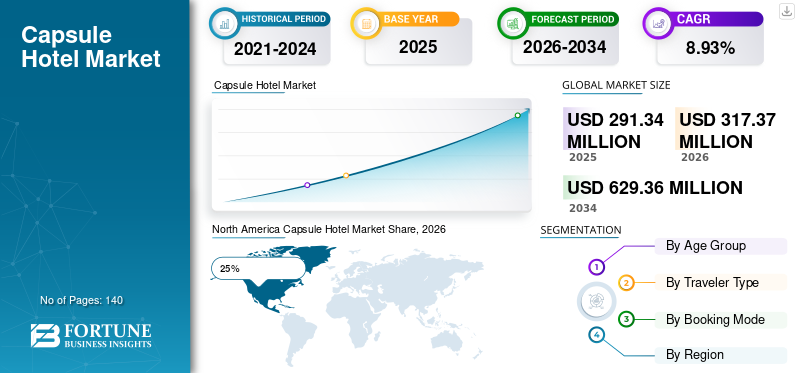
The capsule hotel market size was valued at USD 291.34 Million in 2025. The market is projected to grow from USD 317.37 Million in 2026 to USD 629.36 Million by 2034, exhibiting a CAGR of 8.93% during the forecast period.

The capsule hotel market is evolving as a specialized segment within the global hospitality industry, offering compact, technology-enabled accommodation designed for short-stay travelers, business commuters, backpackers, and budget-conscious tourists. Capsule hotels maximize space utilization while maintaining privacy, making them increasingly attractive in densely populated urban centers and transit hubs. The capsule hotel market report highlights growing demand for affordable lodging solutions that combine convenience, security, and modern digital services. Features such as self-check-in kiosks, smart locks, mobile booking integration, and modular interior designs are reshaping guest experiences. The capsule hotel market Analysis indicates that operators are focusing on premium pod concepts, wellness-oriented facilities, and sustainable construction methods to attract a broader customer base. Increasing urbanization, airport expansion projects, and the popularity of solo travel continue to support capsule hotel market growth and create new opportunities for operators worldwide.
The United States capsule hotel market is expanding across major metropolitan areas, transportation corridors, and tourism destinations. Demand is being driven by travelers seeking affordable accommodations in high-cost cities, airport transit passengers, remote workers, and young professionals. Operators are introducing larger capsule configurations, coworking zones, digital concierge services, and premium sleeping pods to appeal to a diverse customer base. The U.S. market emphasizes convenience, privacy, and technology integration, with mobile reservations and contactless access becoming standard offerings. Growing interest in experiential travel and space-efficient hospitality models is encouraging investors and hotel developers to explore capsule hotel concepts throughout urban and transit-focused locations.
Download Free sample to learn more about this report.
Capsule Hotel Market Key Takeaways
 Global Market Size & Forecast
- 2025 Market Size: USD 291.34 Million
- 2026 Market Size: USD 317.37 Million
- 2034 Forecast Market Size: USD 629.36 Million
- CAGR: 8.93% from 2026-2034
 Market Share
- The market in Asia-Pacific dominated with a revenue share of 44% in 2025.
- Solo travelers dominated by traveler type with the largest market share.
- Online booking dominated by booking mode with the largest market share.
 Key Regional Highlights
Asia-Pacific
Asia-Pacific led the market with a 44% share, supported by the popularity of capsule hotels and strong demand for affordable accommodations.
North America
North America accounted for 25% of the market, driven by growing interest in innovative lodging formats and budget-friendly travel.
Europe
Europe held a 22% share, supported by increasing adoption of compact accommodation concepts in major urban and tourist destinations.
U.S
The U.S. remains a key market, supported by growing demand for affordable, convenient, and technology-enabled accommodation options.
Japan
Japan accounted for approximately 35% of the Asia-Pacific market, supported by its established capsule hotel industry and strong consumer acceptance of compact lodging.
Read More

Capsule Hotel Market Latest Trends
The capsule hotel market trends indicate a strong movement toward smart hospitality ecosystems. Modern capsule hotels increasingly incorporate mobile-based check-in systems, biometric access controls, AI-powered customer support, and personalized climate settings within pods. These advancements improve operational efficiency while enhancing guest satisfaction. Operators are also investing in premium capsule designs featuring ergonomic bedding, noise reduction technology, and integrated entertainment systems.
Download Free sample to learn more about this report.
Another notable capsule hotel industry analysis trend is the expansion of capsule hotels beyond traditional city centers into airports, railway stations, business districts, and mixed-use commercial developments. Sustainability initiatives are gaining importance, with many facilities adopting energy-efficient lighting, recycled materials, and water-saving technologies. Hybrid accommodation models that combine coworking spaces, wellness areas, and social lounges are becoming more common. Additionally, online booking platforms continue to influence customer acquisition strategies, enabling operators to improve occupancy management and strengthen their competitive positioning. The capsule hotel market outlook remains favorable as travelers increasingly prioritize affordability, convenience, and digitally enabled lodging experiences.
Capsule Hotel Market Dynamics
DRIVER
Rising Demand for Affordable and Space-Efficient Accommodation
The primary driver of capsule hotel market growth is the increasing demand for affordable lodging solutions in urban environments where traditional hotel costs remain high. Travelers are seeking practical accommodations that provide privacy without requiring large room footprints. Capsule hotels address this demand by delivering essential amenities at competitive pricing levels while maintaining comfort and convenience.
The growth of solo travel, business commuting, and short-duration stays has further strengthened market demand. Many travelers prioritize location, accessibility, and functional design over expansive room sizes. Capsule hotels located near airports, train stations, and commercial districts offer an efficient alternative to conventional hotels. Operators are also leveraging technology to improve customer experiences through automated check-in processes and digital booking systems. These factors collectively support ongoing expansion within the capsule hotel market and enhance investor confidence in the segment.
RESTRAINT
Limited Space Compared with Traditional Accommodation Formats
A significant restraint affecting the capsule hotel market is the perception of limited personal space. Although capsule hotels are designed to maximize efficiency, some travelers continue to prefer larger rooms with additional amenities. This challenge is particularly evident among families, long-stay guests, and customers unfamiliar with pod-based accommodation concepts.
Market penetration can also be affected by cultural preferences in certain regions where traditional hotel experiences remain dominant. Privacy concerns, shared bathroom facilities, and limited storage space may discourage adoption among specific traveler groups. Furthermore, regulatory requirements regarding building safety, occupancy standards, and hospitality operations vary across countries, creating compliance complexities for operators. These factors can increase operational costs and slow expansion efforts in emerging markets, limiting the pace of adoption despite growing awareness of capsule hotel benefits.
OPPORTUNITY
Expansion into Airports and Transportation Hubs
One of the most significant capsule hotel market opportunities lies in transportation-focused accommodation. Airports, railway terminals, bus stations, and transit centers generate continuous demand for short-stay lodging solutions. Travelers experiencing layovers, flight delays, or overnight transit requirements increasingly seek affordable and convenient sleeping facilities.
Capsule hotels are uniquely positioned to serve this segment because of their compact footprint and operational flexibility. Many airport authorities and transportation operators are exploring partnerships with capsule hotel providers to improve passenger services. Additional opportunities exist within mixed-use developments, coworking ecosystems, and smart city projects. As urban populations continue to grow and mobility patterns evolve, operators can expand into previously underserved locations. Enhanced digital booking capabilities and premium pod offerings further strengthen revenue diversification opportunities and broaden customer reach across multiple traveler segments.
CHALLENGE
Increasing Competition from Alternative Accommodation Providers
The capsule hotel market faces growing competition from budget hotels, hostels, serviced apartments, and short-term rental platforms. These alternatives often provide greater room space and additional amenities, creating competitive pressure on capsule hotel operators. Differentiation therefore becomes essential for maintaining occupancy levels and customer loyalty.
Another challenge involves balancing affordability with service quality. Travelers increasingly expect seamless digital experiences, enhanced cleanliness standards, and modern amenities regardless of accommodation type. Meeting these expectations requires ongoing investments in technology, facility upgrades, and staff training. Operators must also adapt to changing traveler preferences and fluctuating tourism patterns. Maintaining profitability while delivering competitive pricing remains a key operational challenge, particularly in markets with high real estate costs and intense hospitality competition.
Capsule Hotel Market Segmentation
By Age Group
The 18–24 years segment represents the largest share of the capsule hotel market. Younger travelers are highly receptive to innovative lodging formats and frequently prioritize affordability over traditional luxury features. Students, backpackers, digital natives, and budget-conscious tourists are key contributors to demand within this category.
This demographic actively uses mobile booking applications and values social experiences integrated within accommodation facilities. Capsule hotel operators often target this age group through modern interior designs, community lounges, gaming zones, and digital engagement features. The segment remains central to capsule hotel market insights because it consistently demonstrates high acceptance of compact hospitality concepts and technology-enabled services. The increasing popularity of experiential travel further supports sustained demand among younger consumers.
The 25–39 years segment accounts for a substantial portion of the capsule hotel market share. This demographic includes young professionals, business travelers, and independent travelers who seek convenient accommodations in urban locations. Accessibility, efficiency, and digital functionality are key factors influencing booking decisions.
Many operators are introducing premium capsules equipped with workspaces, enhanced connectivity, and upgraded privacy features to attract this segment. The group frequently travels for professional commitments and short-term leisure trips, creating recurring demand patterns. Growth in remote work arrangements and flexible travel schedules continues to strengthen market opportunities among travelers within this age bracket.
Travelers aged 40–54 contribute a meaningful share of the capsule hotel market. Many individuals within this segment value practicality and location convenience, particularly during business travel or transit-related stays. Although adoption rates are lower than younger demographics, demand is increasing as capsule hotels introduce larger pod designs and premium amenities.
Enhanced privacy, improved bedding quality, and wellness-oriented features are encouraging greater acceptance among mature travelers. Operators focusing on business districts and transportation hubs often target this age group due to their frequent travel patterns and preference for efficient accommodation solutions.
The 55+ years segment represents a smaller but growing portion of the Capsule Hotel Industry Report. Adoption within this category is influenced by comfort expectations and familiarity with traditional hotel environments. However, premium capsule concepts are gradually attracting older travelers seeking cost-effective short-stay accommodations.
Facilities emphasizing accessibility, enhanced security, quiet environments, and premium service offerings are helping expand demand among this demographic. As awareness of capsule hotels increases globally, operators are expected to develop more age-inclusive accommodation models to capture additional market share.
By Traveler Type
Solo travelers dominate the capsule hotel market due to the format’s alignment with individual travel needs. Privacy, affordability, security, and location accessibility make capsule hotels particularly attractive for independent travelers. Business professionals, backpackers, and transit passengers represent major customer groups within this segment.
Operators frequently design facilities specifically for solo occupancy, incorporating personal entertainment systems, secure storage areas, and dedicated workspaces. The continued rise of independent travel and digital nomad lifestyles strengthens demand within this segment. capsule hotel market forecast assessments indicate that solo travelers will remain the primary customer base for operators across major global markets.
Group travelers represent a growing segment within the capsule hotel market. Although capsule hotels were originally designed for individual guests, many operators now offer clustered pod arrangements and shared social areas suitable for groups. Budget-conscious tourist groups, students, and event attendees contribute significantly to demand.
The segment benefits from affordability and centralized urban locations. Operators increasingly create communal lounges, coworking areas, and entertainment zones that encourage group interaction while maintaining individual sleeping spaces. These developments are expanding the appeal of capsule hotels beyond traditional solo traveler demographics.
By Booking Mode
Offline booking continues to maintain relevance in the capsule hotel market, particularly among walk-in guests and travelers requiring immediate accommodations. Transportation hubs and city-center locations often benefit from spontaneous booking activity generated by transit passengers and last-minute travelers.
Many operators retain front-desk reservation capabilities to accommodate customer preferences and support operational flexibility. Offline channels remain important in markets where digital adoption rates are comparatively lower or where travelers prefer direct interaction before booking accommodations.
Online booking represents the leading booking mode within the capsule hotel market. Mobile applications, digital travel platforms, and direct hotel websites enable travelers to compare options, review availability, and secure reservations efficiently. Convenience and transparency have made online booking the preferred channel for most customers.
Advanced reservation technologies, instant confirmations, and contactless check-in capabilities continue to support growth within this segment. Operators increasingly prioritize digital marketing and online distribution strategies to improve occupancy rates and customer acquisition. The segment remains a key contributor to overall capsule hotel market growth.
Capsule Hotel Market Regional Outlook
North America Capsule Hotel Market Share, 2026 (%)
To get more information on the regional analysis of this market, Download Free sample
North America
North America has emerged as a major growth region within the capsule hotel market. 25% Demand is concentrated in metropolitan cities, airport corridors, and tourism centers where accommodation costs are relatively high. Travelers increasingly seek alternatives that combine affordability with convenience. The region benefits from strong technology adoption and growing awareness of pod-based lodging concepts. Investors continue exploring expansion opportunities in transit-oriented developments and urban hospitality projects. Major cities are witnessing increased adoption among business travelers, digital nomads, and younger tourists seeking efficient accommodation solutions.
Europe
Europe continues to experience steady development within the capsule hotel market. 22% Strong tourism activity, extensive transportation networks, and rising demand for budget-friendly accommodation support market expansion. Operators are increasingly integrating capsule hotels into city-center locations and transportation hubs. Sustainability initiatives and innovative design concepts are also influencing regional growth. Travelers across Europe demonstrate growing acceptance of compact accommodation formats, particularly for short-duration stays and urban travel experiences.
Germany Capsule Hotel Market
Germany represents one of Europe’s most promising capsule hotel markets. 24% Demand is driven by business travel, trade exhibitions, and urban tourism. Cities such as Berlin, Munich, and Frankfurt provide attractive opportunities for operators because of high visitor volumes and transportation connectivity. German consumers increasingly value efficient accommodation solutions that offer privacy and digital convenience. Smart hospitality technologies and sustainable construction practices are particularly influential in market development.
United Kingdom Capsule Hotel Market
The United Kingdom capsule hotel market 21% is expanding through airport-focused developments and urban hospitality projects. London remains the primary growth center due to its international travel activity and premium accommodation costs. Capsule hotels are attracting business travelers, tourists, and transit passengers seeking affordable overnight stays. Technology-enabled guest services and premium pod concepts continue to enhance market competitiveness across the country.
Asia-Pacific
Asia-Pacific remains the largest regional market 44% for capsule hotels. The concept originated in Japan and has expanded across China, South Korea, Singapore, and other regional markets. Rapid urbanization, high population density, and extensive transportation infrastructure support widespread adoption. Travelers are highly familiar with compact accommodation formats, contributing to strong occupancy levels. Continuous innovation in pod design, digital services, and operational efficiency reinforces the region’s leadership position.
Japan Capsule Hotel Market
Japan serves as the innovation center of the global capsule hotel market. 35% The country pioneered the concept and continues to lead in design, technology integration, and operational excellence. Japanese operators frequently introduce advanced capsule configurations featuring smart controls, wellness amenities, and premium guest services. Strong domestic travel demand and extensive transportation networks support sustained market development.
China Capsule Hotel Market
China represents a rapidly expanding market 28% driven by urbanization, domestic tourism, and increasing demand for affordable accommodations. Major cities are witnessing significant investment in capsule hotel projects targeting business travelers and young professionals. Digital booking adoption, mobile payment integration, and smart hospitality technologies contribute to market growth. The country’s extensive transportation infrastructure creates additional opportunities for transit-focused capsule hotel developments.
Rest of World
The Rest of World region includes the Middle East, Africa, and Latin America, 9% where capsule hotel adoption remains in an earlier stage of development. Demand is increasing in tourism centers, airport environments, and urban business districts. Investors are exploring opportunities to introduce space-efficient accommodation models that align with evolving traveler preferences. Growth is supported by rising tourism activity and increasing awareness of alternative lodging concepts. While market penetration remains relatively limited, long-term expansion potential remains significant.
List of Top Capsule Hotel Companies
- Nine Hours
- The Pod Hotels
- First Cabin
- Book and Bed Tokyo
- The O Pod Hotel
- Petra Capsule Hostel
- Capsule Inn Osaka
- Cabana
- CityHub
- Bloc Hotel
Top Two Companies by Market Share
- Nine Hours – 14%
- First Cabin – 11%
Investment Analysis and Opportunities
The capsule hotel market research report identifies significant investment activity across urban hospitality, airport infrastructure, and mixed-use real estate developments. Investors are attracted by the operational efficiency of capsule hotels, which can accommodate a large number of guests within relatively compact spaces. This model improves space utilization while addressing demand for affordable lodging solutions.
Emerging opportunities include premium capsule concepts, wellness-focused facilities, airport accommodation projects, and smart hospitality platforms. Venture capital firms and hospitality investors are increasingly supporting technology integration initiatives involving AI-driven guest services, digital reservations, and automated facility management. Expansion into secondary cities and transportation hubs also offers attractive growth prospects. Strategic partnerships between real estate developers, travel operators, and capsule hotel brands are expected to generate additional market opportunities and strengthen long-term industry development.
New Product Development
Innovation remains a key competitive factor within the capsule hotel market. Operators are introducing next-generation sleeping pods equipped with smart lighting systems, personalized climate controls, integrated entertainment screens, and voice-enabled guest services. These developments enhance customer comfort while supporting operational efficiency.
New product development also includes modular capsule designs that can be adapted for airports, coworking environments, railway stations, and mixed-use developments. Advanced soundproofing materials, antimicrobial surfaces, and energy-efficient technologies are becoming standard features. Some operators are integrating wellness elements such as sleep monitoring systems, aromatherapy functions, and relaxation zones. These innovations help differentiate offerings while expanding the appeal of capsule hotels across broader customer segments.
Five Recent Developments (2023–2025)
- Nine Hours expanded smart capsule installations featuring automated check-in and digital access systems.
- First Cabin introduced upgraded premium pods targeting business travelers seeking enhanced privacy and comfort.
- Several airport-based capsule hotel projects were launched across Asia and Europe to serve transit passengers.
- CityHub expanded its digitally connected hospitality model with mobile concierge and app-based guest services.
- Multiple capsule hotel operators adopted sustainability initiatives including energy-efficient lighting and eco-friendly construction materials.
Report Coverage
The capsule hotel market report provides comprehensive analysis of industry trends, market dynamics, competitive positioning, segmentation, regional developments, and investment opportunities. The report evaluates factors influencing demand across age groups, traveler categories, and booking channels while examining the evolving competitive landscape.
Request for Customization to gain extensive market insights.
The scope includes assessment of technology adoption, smart hospitality innovations, operational strategies, and expansion opportunities across major regions. The report further analyzes market drivers, restraints, challenges, and emerging opportunities affecting industry development. Detailed coverage of regional markets, leading companies, customer preferences, and future growth prospects enables stakeholders to make informed strategic decisions. The Capsule Hotel Industry Report also highlights investment trends, product innovations, and changing traveler behaviors shaping the future direction of the market.
Frequently Asked Questions
Fortune Business Insights says that the global market value stood at USD 291.34 million in 2025 and is projected to reach USD 629.36 million by 2034.
The market is expected to exhibit a CAGR of 8.93% during the forecast period of 2026-2034.
The 18–24 years age group represented the largest segment, driven by younger travelers’ preference for affordable, innovative, and technology-enabled accommodation.
Key players include Nine Hours, The Pod Hotels, First Cabin, Book and Bed Tokyo, The O Pod Hotel, and Petra Capsule Hostel.
Major trends include smart hospitality technologies such as mobile check-in, biometric access, and AI-powered support, along with expansion into airports and transportation hubs. Asia-Pacific dominated the market with a 44% share.



- 2021-2034
- 2025
- 2021-2024
- 140
-

(Offer valid till 31st Oct 2026)
Get 30-60 hrs Free Customization
Expand Regional and Country Coverage, Segments Analysis, Company Profiles, Competitive Benchmarking, and End-user Insights.


















-
US +1 833 909 2966 ( Toll Free )
-
Get In Touch With Us