Carbon Credit Trading Platform Market Size, Share & Industry Analysis, By Type (Voluntary and Regulated), By System Type (Cap and Trade and Baseline and Credit), By End User (Energy & Utilities, Industrial Manufacturing, Transportation & Aviation, Consumer Goods & Retail, and Others), and Regional Forecast, 2026-2034
 Download Free Sample
Carbon Credit Trading Platform Market Size and Future Outlook
 Listen to Audio Version
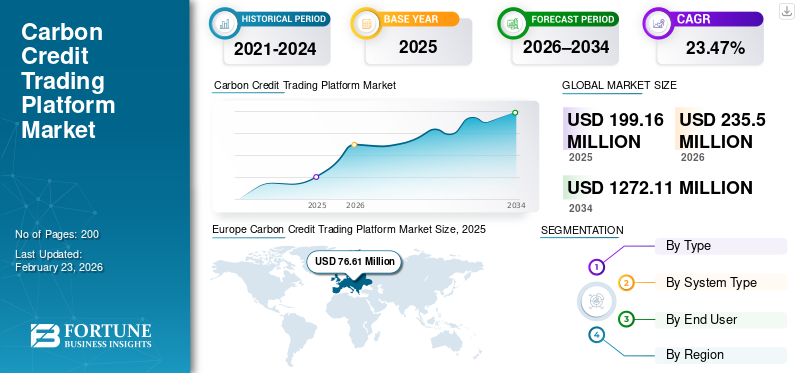
The global carbon credit trading platform market size was valued at USD 199.16 million in 2025. The market is projected to grow from USD 235.50 million in 2026 to USD 1,272.11 million by 2034, exhibiting a CAGR of 23.47% during the forecast period. Europe dominated the carbon credit trading platform market with a market share of 38.47% in 2025.
A key driver for the growth of carbon credit trading platforms is the increasing regulatory pressure on companies and countries to meet carbon emissions reduction targets under international agreements such as the Paris Agreement. As governments tighten regulations and set stricter emissions caps, companies are looking for cost-effective ways to comply. Carbon credit trading platforms offer a market-driven mechanism that allows businesses to purchase credits to offset their emissions. This growing need for compliance, combined with the expanding corporate sustainability goals, is driving the adoption of these platforms as a critical tool in the global decarbonization effort.
- For instance, in March 2024, Toucan Protocol announced the launch of the world’s first liquid market for biochar carbon credits, marking a milestone in carbon credit trading infrastructure. This digital marketplace enables automated, on‑demand trading of biochar removal credits, a form of carbon removal improving liquidity and access for project developers and buyers alike. The initiative is aimed at scaling climate finance by making it easier to buy, sell, and retire carbon credits, particularly for biochar projects that offer durable carbon sequestration.
Xpansiv, AirCarbon Exchange (ACX), Intercontinental Exchange (ICE), CME Group, and others are the key players operating in the market. Xpansiv is a digital trading platform that enables transparent, standardized trading of environmental commodities, including carbon credits, renewable energy certificates, and methane abatement credits. By leveraging data‑driven verification and real‑time pricing, Xpansiv enhances liquidity and trust in voluntary and compliance carbon markets, helping businesses efficiently manage carbon portfolios and accelerate their transition to lower emissions. Carbon trading platforms enable emissions reductions by helping organizations measure, manage, and offset carbon footprints across regulated and voluntary markets.
Download Free sample to learn more about this report.
Carbon Credit Trading Platform Market Key Takeaways
 Market Size & Forecast
- 2025 Market Size: USD 199.16 million
- 2026 Market Size: USD 235.50 million
- 2034 Forecast Market Size: USD 1,272.11 million
- CAGR: 23.47% from 2026–2034
 Market Share
- Europe dominated the carbon credit trading platform market with a 38.47% share in 2025.
- The voluntary segment is expected to grow at a CAGR of 24.08% during the forecast period.
- The baseline and credit segment is projected to grow at a CAGR of 24.05% during the forecast period.
 Key Regional Highlights
Europe
Europe led the market in 2025 with a valuation of USD 76.61 million and is projected to record the highest regional CAGR of 23.70%.
North America
North America held the second-largest market share in 2025 and is expected to reach USD 63.32 million in 2026.
Asia Pacific
Asia Pacific reached USD 45.58 million in 2025, making it the third-largest regional market.
U.S.
The market was valued at approximately USD 45.74 million in 2025, accounting for around 22.97% of global revenue.
Japan
The market reached approximately USD 7.85 million in 2025, representing about 3.94% of global revenue.
Read More

CARBON CREDIT TRADING PLATFORM MARKET TRENDS:
Institutionalization and Liquidity Growth in Carbon Credit Trading Platforms are Key Market Trends
One of the significant market trends is the institutionalization of the market, coupled with rising liquidity and standardized pricing. Historically, carbon markets were fragmented and characterized by bespoke, bilateral trades with limited transparency. However, as global regulatory frameworks tighten, particularly under mandates such as Article 6 of the Paris Agreement and evolving national compliance schemes, institutional investors, exchanges, and financial infrastructure providers are increasingly participating in carbon markets. This shift is driving the development of regulated, exchange‑supported carbon credit platforms that offer transparent pricing, verified credit standards, and improved market access.
Download Free sample to learn more about this report.
MARKET DYNAMICS
MARKET DRIVERS
Growing Regulatory Pressure for Carbon Emissions Reduction to Drive the Market Expansion
A key driver for carbon credit trading platform market growth is the rising regulatory pressure on companies to meet more stringent carbon emissions reduction targets. Governments worldwide are implementing policies to limit carbon emissions and accelerate the transition to a low-carbon economy. For instance, the European Union’s Emissions Trading System (EU ETS) and carbon pricing initiatives in countries such as Canada, Japan, and South Korea are pushing companies to buy carbon credits to meet regulatory standards. At the same time, voluntary carbon markets are growing rapidly as companies and industries adopt net-zero goals and ESG commitments.
According to World Bank’s State and Trends of Carbon Pricing 2021, in 2021, the global carbon markets grew by approximately 20%, reflecting the urgency with which businesses are seeking to offset emissions and meet targets. This increasing demand for carbon credits is driving the development of more efficient and transparent trading platforms, which allow businesses to buy, sell, and retire carbon credits efficiently while ensuring market integrity.
MARKET RESTRAINTS
Lack of Standardization and Transparency May Hamper Market Expansion
One of the key restraints for the growth of carbon credit trading platforms is the lack of standardization and transparency in carbon credit verification and pricing. The absence of universally accepted standards for carbon credit generation, measurement, and validation creates uncertainty and distrust among market participants. For instance, according to Integrity Council for the Voluntary Carbon Market (IC-VCM), in 2021, approximately 50% of voluntary carbon credits sold were sourced from projects with varying certification standards, leading to challenges in ensuring the environmental integrity of credits.
MARKET OPPORTUNITIES
Expansion of Voluntary Carbon Markets for Corporate Sustainability Goals to Provide New Opportunities
An emerging opportunity for carbon credit trading platforms is the rapid growth of voluntary carbon markets driven by corporate sustainability commitments. As businesses increasingly set net-zero emissions targets and integrate Environmental, Social, and Governance (ESG) factors into their operations, the demand for carbon credits to offset emissions has surged.
According to Net Zero Tracker Dataset, by 2025, nearly 50% of global corporations were expected to have net-zero pledges in place. This spurred a greater need for carbon credit trading platforms to provide accessible and verified credit options. Additionally, these trading platforms are well-positioned to tap into emerging sectors such as nature-based solutions, including forest conservation and regenerative agriculture, which are gaining traction as innovative methods for carbon sequestration. This shift presents an opportunity for platforms to expand their credit offerings and cater to new, high-demand sectors in the carbon market.
MARKET CHALLENGES
Market Fragmentation and Regulatory Uncertainty to Present Significant Challenges for Market Growth
A significant challenge for carbon credit trading platforms is the market fragmentation and regulatory uncertainty that affects their ability to scale and gain widespread adoption. The carbon credit market is still highly fragmented, with various platforms offering different types of credits, each with unique standards and verification processes. This lack of a unified, global framework makes it difficult for buyers and sellers to navigate the market confidently, leading to inefficiencies and a lack of trust.
Segmentation Analysis
By Type
Regulated Segment Dominated the Market due to Stability and Transparency
Based on the segmentation by type, the market is classified into voluntary and regulated.
In 2025, the regulated segment dominated the market share due to their stability, transparency, and trustworthiness. Governments and international bodies, such as the European Union Emissions Trading System (EU ETS), provide a clear regulatory framework that ensures compliance with carbon reduction targets. This reduces the risks associated with carbon credit transactions, as participants can rely on standardized rules, certifications, and enforcement mechanisms.
The voluntary segment is experiencing the highest growth and is expected to grow at a CAGR of 24.08% over the analysis period.
To know how our report can help streamline your business, Speak to Analyst
By System Type
Cap and Trade Segment Led the Market as it Limits Emissions and Ensures Economic Efficiency
On the basis of segmentation by system type, the market is classified into cap and trade and baseline and credit.
In 2025, the cap and trade segment dominated the global market due to its market-driven approach that balances emission reduction goals with economic efficiency. Under cap and trade systems, governments set an overall cap on emissions and allocate a limited number of carbon allowances to companies. The flexibility of trading allows companies to meet their emission reduction targets at the lowest cost, driving innovation and investment in cleaner technologies. This system has proven effective in creating clear carbon pricing signals, encouraging cost-effective compliance, and promoting global carbon reduction goals.
The baseline and credit segment is expected to grow at a CAGR of 24.05% over the forecast period.
By End User
Energy & Utilities Segment Dominated the Market due to its High Emission Levels
On the basis of segmentation by end user, the market is classified into energy & utilities, industrial manufacturing, transportation & aviation, consumer goods & retail, and others.
In 2025, the energy & utilities segment held the largest carbon credit trading platform market share due to its substantial carbon emissions, making it the primary target for regulatory carbon pricing mechanisms such as cap and trade systems. This sector is responsible for a significant portion of global greenhouse gas emissions, with electricity generation, oil and gas extraction, and natural gas distribution accounting for the largest emission contributors.
The consumer goods & retail segment is expected to grow at a CAGR of 25.66% over the forecast period.
Carbon Credit Trading Platform Market Regional Outlook
By geography, the market is categorized into North America, Europe, Asia Pacific, Latin America, and the Middle East & Africa.
Europe
Europe Carbon Credit Trading Platform Market Size, 2025 (USD Million)
To get more information on the regional analysis of this market, Download Free sample
Europe is projected to record a growth rate of 23.70% in the coming years, which is the highest among all regions, and reached a valuation of USD 76.61 million by 2025. Europe’s carbon credit trading platforms are fueled by the EU Emissions Trading System (EU ETS), the world’s largest carbon market. In 2020, the EU ETS covered over 40% of European Union emissions, driving the demand for carbon credits across multiple sectors. The European Green Deal, which aims to reduce emissions by 55% by 2030, further solidifies the EU’s commitment to stringent climate policies.
Germany Carbon Credit Trading Platform Market
In 2025, the Germany market reached a value of around USD 19.75 million and is estimated to hit around USD 23.73 million in 2026, representing roughly 9.92% of the global market revenues.
North America
North America held the second-highest share in 2025, valued at USD 53.77 million, and is anticipated to take the leading share in 2026 with a value of USD 63.32 million. The growth of carbon credit trading platforms in North America is primarily driven by strong regulatory frameworks, such as the U.S. Environmental Protection Agency’s (EPA) Clean Power Plan and California’s Cap-and-Trade Program, which place emissions reduction targets on industries. In 2021, California’s carbon market alone generated over USD 2.6 billion in allowances, showcasing its significance in the region. Additionally, the U.S. and Canadian governments have committed to net-zero emissions by 2050, driving the demand for voluntary carbon markets as companies look to meet corporate sustainability targets.
U.S. Carbon Credit Trading Platform Market
Based on North America’s strong contribution and the U.S. dominance within the region, the U.S. market can be analytically approximated at around USD 45.74 million in 2025, accounting for roughly 22.97% of the global market size.
Asia Pacific
The Asia Pacific market reached a value of USD 45.58 million in 2025 and secure the position of the third-largest region in the market. In the region, India and China reached USD 1.61 million and USD 17.59 million, respectively, in 2025.
The growth of carbon trading platforms in the Asia Pacific is driven by rapidly evolving regulatory frameworks and increasing corporate commitments to sustainability. In 2021, China launched its national carbon market, covering over 2,200 power companies, making it the world’s largest carbon market by emissions covered. This move is expected to drive USD 10 billion in carbon transactions by 2030. Additionally, India introduced a carbon pricing mechanism in 2023, aiming to curb emissions in key sectors such as cement and steel, which together account for 15% of global emissions.
Japan Carbon Credit Trading Platform Market
In 2025, the Japan market reached a value of around USD 7.85 million, accounting for roughly 3.94% of global market revenues. This market is driven by the country's commitment to achieving net-zero emissions by 2050, alongside expanding carbon pricing mechanisms and carbon offset projects.
China Carbon Credit Trading Platform Market
The China market is projected to be significant worldwide, with 2025 revenues reaching around USD 17.59 million, representing roughly 8.83% of the global market.
India Carbon Credit Trading Platform Market
The India market touched a value of around USD 1.61 million in 2025, accounting for roughly 0.81% of global revenues.
Latin America
Latin America is expected to witness moderate growth in this market during the forecast period. The regional market reached a valuation of USD 13.66 million in 2025. Latin America's carbon credit trading platforms are gaining traction due to growing corporate sustainability pledges and increasing regulatory support for carbon pricing across countries such as Mexico and Brazil. As the region focuses on renewable energy adoption and forest conservation efforts, the demand for verified carbon credits is rising steadily.
Brazil Carbon Credit Trading Platform Market
The Brazil market touched a value of around USD 5.27 million in 2025, representing roughly 2.64% of the global market.
Middle East & Africa
The Middle East & Africa market is expected to witness significant growth in this market during the forecast period. The regional market touched a valuation of USD 9.53 million in 2025. In the Middle East & Africa, carbon credit trading platforms are emerging as countries such as the UAE and South Africa implement carbon pricing initiatives to meet climate goals and attract green investments.
GCC Carbon Credit Trading Platform Market
The GCC market reached a value of around USD 3.11 million in 2025, representing roughly 1.56% of the global market.
COMPETITIVE LANDSCAPE
Key Industry Players
Leading Companies Proceed with Partnerships and Technological Advancements to Expand their Market Share
The global carbon credit trading platform market holds a consolidated market structure, constituting major players such as AirCarbon Exchange (ACX), Intercontinental Exchange (ICE), CME Group, and others. Companies operational in the market are adopting targeted growth strategies focused on strengthening their technical capabilities, product portfolios, expansion of manufacturing presence, and other areas.
- For instance, in October 2023, ACX launched the world’s first fully regulated carbon exchange and clearing house in the Abu Dhabi Global Market (ADGM). The platform executed its first trades between First Abu Dhabi Bank (FAB) and Helix Climate, providing a regulated market for voluntary carbon credits. This move aims to enhance market transparency, liquidity, and compliance in voluntary carbon markets, supporting businesses in meeting emission reduction targets.
Other key players in the global market include Carbon Trade Exchange (CTX), Carbonplace, Toucan Protocol, Regreener.earth, and others. These companies are anticipated to prioritize partnerships and new product launches to augment their global market share during the analysis period.
LIST OF KEY CARBON CREDIT TRADING PLATFORM COMPANIES PROFILED
- Xpansiv (U.S.)
- AirCarbon Exchange (ACX) (UAE)
- Intercontinental Exchange (ICE) (U.S.)
- CME Group (U.S.)
- European Energy Exchange (EEX) (Germany)
- Carbonmark (U.S.)
- Carbon Trade Exchange (CTX) (Australia)
- Carbonplace (U.K.)
- Toucan Protocol (U.S.)
- earth (Netherlands)
KEY INDUSTRY DEVELOPMENTS
- August 2025: Compliance Kart Pvt. Ltd. launched ENVR, a blockchain-powered voluntary carbon credit and I-REC trading platform, connecting verified buyers and sellers through digital transactions. The strategic objective/purpose was to improve transparency and market access. Capabilities involved/Technologies involved included blockchain, smart contracts, KYC/KYB verification, real-time negotiation, and carbon-credit trading.
- December 2025: NaaS Technology Inc. completed a 21,000-ton carbon-inclusive credit transaction with Kuaidian through its self-developed carbon asset trading platform in Wuhan. The strategic objective/purpose was to monetize carbon assets generated through EV charging. Capabilities involved/Technologies involved included AI analytics, digital ledger management, certification processing, transaction matchmaking, and carbon-credit settlement.
- December 2025: Novarra BBX, LLC launched its Carbon Credit Trading Desk, enabling institutional and corporate participants to source, trade, and settle voluntary carbon credits through integrated market connectivity. The strategic objective/purpose was to provide governed access to fragmented carbon markets. Capabilities involved/Technologies involved included registry verification, KYC/KYB controls, transaction monitoring, price discovery, and carbon-credit trading infrastructure.
- July 2026: Sustainable Green Team, Ltd. expanded its carbon-market verification platform through a strategic partnership supporting technology licensing, production scale-up, and multi-year credit purchases. The strategic objective/purpose was to increase verified carbon-credit supply and market participation. Capabilities involved/Technologies involved included environmental verification, physical measurement, certificate generation, supply-chain validation, and carbon-credit market infrastructure.
- March 2025: Carbonaires joined Carbonplace, expanding financing and access to high‑quality carbon removal credits through the Carbonplace platform. This partnership enhances Carbonplace’s capability to connect buyers with a diversified roster of credits, improving carbon credit market accessibility. Through global bank backing and centralized reporting tools, Carbonplace helps corporations and institutions streamline carbon procurement and retirement, reinforcing its role in scaling voluntary carbon markets.
- January 2025: ICE announced the launch of ICE GreenTrace™, an environmental registry technology designed to enhance carbon credit trading infrastructure. This service aims to support carbon markets with digital verification, making carbon credit transactions more efficient, secure, and transparent. The platform integrates AI and blockchain technology to track and manage carbon credits, fostering the global adoption of carbon trading.
- January 2025: Carbonmark launched Carbonmark Direct, a blockchain-enabled carbon credit issuance platform aimed at speeding up credit issuance and lowering transaction costs. By tokenizing carbon credits, it offers cost-efficient trading and facilitates fast transactions. The platform enables carbon removal credits, such as those from direct air capture, to be more easily bought and sold. This initiative positions Carbonmark at the forefront of digital carbon credit solutions for businesses.
- September 2024: Northern Trust officially launched its Northern Trust Carbon Ecosystem on its Matrix Zenith digital assets platform, enabling institutional buyers to digitally trade and retire carbon credits using blockchain technology. The platform supports full lifecycle credit transactions from issuance to settlement and facilitates secure, transparent access to voluntary carbon credits from project developers, marking a notable expansion in institutional carbon trading infrastructure.
- October 2021: Toucan launched infrastructure for tokenizing carbon credits, enabling millions of credits to be represented on the blockchain. The platform uses TCO2 tokens to facilitate carbon credit trading, improving market access.
REPORT COVERAGE
Request for Customization to gain extensive market insights.
Report Scope & Segmentation
|
ATTRIBUTE |
DETAILS |
|
Study Period |
2021-2034 |
|
Base Year |
2025 |
|
Estimated Year |
2026 |
|
Forecast Period |
2026-2034 |
|
Historical Period |
2021-2024 |
|
Growth Rate |
CAGR of 23.47% from 2026-2034 |
|
Unit |
Value (USD Million) |
|
Segmentation |
By Type, System Type, End User, and Region |
|
By Type |
|
|
By System Type |
|
|
By End User |
|
|
By Geography |
|
Frequently Asked Questions
Fortune Business Insights says that the global market value stood at USD 199.16 million in 2025 and is projected to reach USD 1,272.11 million by 2034.
In 2025, the market value stood at USD 53.77 million.
The market is expected to exhibit a CAGR of 23.47% during the forecast period of 2026-2034.
The regulated segment led the market by type in 2025.
The key factors driving the carbon credit trading market include regulatory pressure, corporate sustainability goals, and increasing demand for verified carbon offsets.
Xpansiv, AirCarbon Exchange (ACX), Intercontinental Exchange (ICE), and others are some of the prominent players in the market.
North America is anticipated to hold the dominant market share in 2026.
Major factors favoring carbon credit trading platform adoption include regulatory mandates, corporate net-zero commitments, and the need for transparent, efficient carbon offset transactions.



- 2021-2034
- 2025
- 2021-2024
- 200
Get 30-60 hrs Free Customization
Expand Regional and Country Coverage, Segments Analysis, Company Profiles, Competitive Benchmarking, and End-user Insights.



















Related Reports
-
US +1 833 909 2966 ( Toll Free )
-
Get In Touch With Us