Cartilage Repair Market Size, Share & Industry Analysis by Treatment (Cell-based Approaches {Autologous Chondrocyte Implantation (ACI), Stem Cell-based Therapy, and Others}, and Non–cell-based Approaches {Osteochondral Allograft Transplantation, Osteochondral Autograft Transplantation (OAT) / Mosaicplasty, and Others), By Material (Collagen-based Materials, Hyaluronic Acid-based Materials, Hydrogels, and Others), By Application (Knee Cartilage Repair, Hip Cartilage Repair, Ankle & Foot Cartilage Repair, Shoulder Cartilage Repair, and Others), By End-User, and Regional Forecast, 2026-2034
 Download Free Sample
Cartilage Repair Market Size and Future Outlook
 Listen to Audio Version
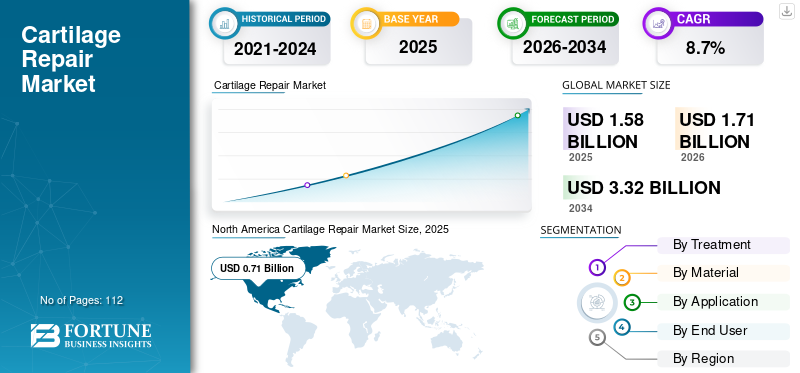
The global cartilage repair market size was valued at USD 1.58 billion in 2025 and is projected to grow from USD 1.71 billion in 2026 to USD 3.32 billion by 2034, exhibiting a CAGR of 8.7% during the forecast period. North America dominated the global cartilage repair market with a market share of 44.93% in 2025.
Cartilage repair therapies are prominently used to restore, regenerate, or replace damaged articular cartilage in joints without altering surrounding bone structures. In clinical practice, these treatments are utilized in sports injuries, osteoarthritis management, and traumatic cartilage defects. The market growth is driven by increasing sports-related injuries, rising prevalence of osteoarthritis among geriatric populations, and advancements in regenerative biologics. Moreover, cartilage repair techniques also help to preserve joint function and delay or prevent the need for total joint replacement.
Furthermore, the market encompasses several major players with Vericel Corporation, Zimmer Biomet Holdings, Inc., Stryker Corporation, Arthrex, Inc., and Smith & Nephew plc at the forefront. Robust focus on continual product development, emphasis on research and development activities, and strong geographic presence expansion have supported the dominance of these companies in the global market.
Download Free sample to learn more about this report.
Cartilage Repair Market KEY TAKEAWAYS
 Market Size & Forecast
- 2025 Market Size: USD 1.58 billion
- 2026 Market Size: USD 1.71 billion
- 2034 Forecast Market Size: USD 3.32 billion
- CAGR: 8.7% from 2026–2034
 Market Share
- North America dominated the cartilage repair market with a 44.93% share in 2025.
- The cell-based approaches segment is projected to grow at a CAGR of 9.5% during the forecast period.
- The hydrogel segment is projected to grow at a CAGR of 9.6% during the forecast period.
 Key Regional Highlights
North America
Valued at USD 0.71 billion in 2025, supported by the high incidence of sports injuries and advancements in regenerative medicine.
Europe
Projected to reach USD 0.41 billion by 2026, driven by continuous R&D activities and new product launches.
Asia Pacific
Projected to reach USD 0.73 billion by 2026, driven by expanding healthcare infrastructure and increasing adoption of regenerative therapies.
U.S.
Projected to reach USD 0.73 billion by 2026, supported by strong demand for regenerative medicine therapies.
Japan
Expected to witness steady growth, driven by increasing adoption of advanced regenerative treatments.
Read More

MARKET DYNAMICS
MARKET DRIVERS
Rising Prevalence of Degenerative Joint Disorders and Sports-Related Injuries to Accelerate Market Growth
The growing prevalence of degenerative joint disorders, along with sport-related injuries to drive the global cartilage repair market growth during the forecast period. Moreover, as the rate of the geriatric population is increasing, there is a high risk of cartilage degradation and joint pain across the globe. Such conditions often lead to reduced mobility and quality of life, prompting both patients and clinicians to seek restorative solutions that can delay or avoid total joint replacement. In addition, the considerable prevalence of osteoarthritis is also projected to have a positive impact on the market growth.
- For instance, according to a study published by Johns Hopkins Medicine in November 2025, an estimated 3.5 million people suffer from sports injuries per year in the U.S.
MARKET RESTRAINTS
High Cost of Cartilage Repair Procedures and Limited Reimbursement are Estimated to Hamper Market Growth
Cartilage repair procedures, especially those that involve cell-based implants and advanced scaffold or biologic materials, are expensive and often not fully covered by insurance in many countries. The total treatment cost increases when surgery, cell processing, imaging, and rehabilitation are included. Because of this, many patients and hospitals choose lower-cost options such as physical therapy, pain management, or basic arthroscopy instead of regenerative repair. Due to such factors adoption of cartilage repair therapies is projected to hamper.
MARKET OPPORTUNITIES
Increasing Use of Biologics in Early-Stage Cartilage Damage to Offer Substantial Growth Opportunities
The market is witnessing increasing utilization of biologic therapies such as Platelet-Rich Plasma and mesenchymal stem cells for treating early-stage cartilage damage and knee osteoarthritis. These biologics play a prominent role in reducing pain, improving joint lubrication, and offering support tissue repair, giving patients a non-surgical treatment option. In addition, there is clinical evidence about positive outcomes for cartilage repair therapies. Moreover, increasing adoption of such biologics due to better treatment outcomes is also projected to offer a considerable opportunity for market growth.
- For instance, in October 2023, AlloSource announced its first successful implantation of a cryopreserved osteochondral allograft in the UK.
CARTILAGE REPAIR MARKET TRENDS
Increasing Preference for Cell and Scaffold-Based Regenerative Cartilage Repair is one of the Prominent Key trends
There is a growing shift from traditional cartilage repair methods toward regenerative solutions that combine cells, scaffolds, and growth factors to help rebuild cartilage tissue more effectively. Techniques such as autologous chondrocyte implantation, matrix-induced cartilage repair, 3D scaffolds, and off-the-shelf allograft cartilage patches are being adopted in more orthopedic and sports medicine centers. Further, rising developments in 3D printing are expected to accelerate segment growth during the forecast period.
MARKET CHALLENGES
Uncertainty in Long-term Durability of Regenerated Cartilage to Offer Considerable Challenges
One of the considerable challenges in the global cartilage repair market is the uncertainty in the long-term durability of regenerated cartilage. While many regenerative and cell-based procedures show good short-term pain relief and functional improvement, there is still limited high-quality long-term evidence proving that the repaired tissue consistently behaves including natural hyaline cartilage over many years. In some cases, the new tissue may form as fibrocartilage, which is less durable and more prone to wear and tear. This variability makes surgeons cautious when deciding on the best procedure for younger, active patients who need strong outcomes to return to sports or physical work.
Download Free sample to learn more about this report.
Segmentation Analysis
By Treatment
Affordability and Availability of Non-Cell-Based Approaches to Drive Segment Growth
Based on segmentation by treatment, the market is classified into cell-based approaches and non–non-cell-based approaches.
To know how our report can help streamline your business, Speak to Analyst
The non-cell-based approaches segment held the highest global cartilage repair market share in 2025. Non–cell-based treatments are used to repair cartilage without growing new cells outside the body. These methods are usually simpler and more affordable than cell therapies. In addition, the procedure is comparatively simple, allowing healthcare professionals to conduct it in a normal environment without requiring special laboratories. Moreover, increasing number of new product launches is also projected to have a positive impact on the market growth.
- For instance, in August 2024, a group of researchers at Northwestern University announced the development of a new sticky substance from hyaluronic acid and peptide, which can regrow cartilage between joints.
The cell-based approaches segment is expected to grow at a CAGR of 9.5% over the forecast period.
By Material
Properties of Collagen-based Materials to Mimic Extracellular Matrix and Accelerate the Segment Growth
In terms of material, the market is categorized into collagen-based materials, hyaluronic acid-based materials, hydrogel, and others.
The collagen-based materials segment captured the largest share of the market in 2025. In 2026, the segment dominates with a 28.9% share. Collagen-based materials are widely used in cartilage repair because they mimic the body’s natural extracellular matrix. They encourage cells to attach, grow, and form new tissue while gradually breaking down as native cartilage fills in. In addition, increasing investments by market players is also projected to have a positive impact on the segment.
- For instance, in February 2022, Vericel Corporation announced its plan to open an advanced state-of-the-art facility for cell therapy manufacturing. The facility will focus on the development of autologous cultured chondrocytes on porcine collagen membrane products.
The hydrogel segment is expected to grow at a CAGR of 9.6% over the forecast period.
By Application
Substantial Prevalence of Knee Injuries to Accelerate Knee Cartilage Repair Segment Growth
In terms of application, the market is categorized into knee cartilage repair, hip cartilage repair, ankle & foot cartilage repair, shoulder cartilage repair, and other.
The knee cartilage repair segment captured the largest share of the market in 2025. In 2026, the segment is anticipated to dominate with a 73.9% share. Substantial prevalence of knee injuries is projected to accelerate segment growth during the forecast period. Moreover, robust focus on research and development activities is also projected to offer a favorable opportunity for segment growth.
- For instance, according to data published by the Knee Pain Centers of America in February 2025, an estimated 18% population in the age group 18-44 years suffer from knee pain each year.
The hip cartilage repair segment is expected to grow at a CAGR of 10.6% over the forecast period.
By End User
Hospitals & Orthopedic Clinics Segment Lead Due to High Procedure Volume and Availability of Resources
Based on end-user, the market is segmented into hospitals & orthopedic clinics, academic & research institutes, and others.
In 2025, the global market was dominated by the hospitals & orthopedic clinics segment in terms of end-user. These centers have skilled doctors, advanced imaging tools, and surgical facilities needed to perform complex joint repairs. Patients with knee or hip cartilage damage usually visit hospitals first for diagnosis and treatment planning. Orthopedic clinics, on the other hand, focus more on follow-up care, minor procedures, and rehabilitation.
In addition, the academic & research institutes segment is projected to grow at a CAGR of 8.7% during the study period.
Cartilage Repair Market Regional Outlook
By region, the market is categorized into Europe, North America, Asia Pacific, Latin America, and the Middle East & Africa.
North America
The North America dominated a substantial share in 2024 valuing at USD 0.66 billion and also took the leading share in 2025, with USD 0.71 billion. Certain factors, such as substantial occurrences of sports injuries and technological advancements in regenerative medicines, are estimated to play a vital role in maintaining major market share. In 2026, the U.S. market is estimated to reach USD 0.73 billion.
North America Cartilage Repair Market Size, 2025 (USD Billion)
To get more information on the regional analysis of this market, Download Free sample
- For instance, in January 2024, Smith and Nephew announced the acquisition of CartiHeal with an aim to consolidate its position in sports medicine for cartilage regeneration.
Europe
Europe held a substantial share of the global market in 2025. During the forecast period, European region is projected to record the growth rate of 7.7%, and touch a valuation of USD 0.41 billion in 2026. This is primarily due to the continual focus on research and development activities and new product launches. Backed by these factors, countries including U.K., Germany, and France are anticipated to record the valuation of USD 0.07 billion, USD 0.09 billion, and USD 0.07 billion, respectively, in 2026.
Asia Pacific
Asia Pacific is expected to exhibit the fastest CAGR during the forecast period. The market in Asia Pacific is estimated to reach USD 0.73 billion in 2026. In the region, India and China are estimated to reach USD 0.08 billion and USD 0.12 billion, respectively in 2026.
Latin America and Middle East & Africa
Over the forecast period, Latin America and Middle East & Africa regions would witness a moderate growth in this marketspace. Latin America market in 2026 is set to record USD 0.09 billion as its valuation. Consolidation of healthcare infrastructure, coupled with extensive investments for superior healthcare facilities, is further estimated to drive regional growth during the forecast period. In the Middle East & Africa, GCC is set to attain the value of USD 0.02 billion in 2026.
COMPETITIVE LANDSCAPE
Key Industry Players
Focus on New Product Launches and Development of New Technologies to Help Companies Maintain Their Market Position
The global cartilage repair market shows a semi-concentrated structure with numerous small- to mid-size companies actively operating across the globe. These players are actively involved in product innovation, strategic partnerships, and geographic expansion.
Vericel Corporation, Zimmer Biomet Holdings, Inc., Stryker Corporation, Arthrex, Inc., and Smith & Nephew plc are some of the dominating players in the market. A comprehensive range of regenerative medicines, extensive investments, and a strong distribution network are enabling players to consolidate their market share.
Apart from this, other prominent players in the market include Johnson & Johnson, Anika Therapeutics, Inc., Geistlich Pharma AG, MTF Biologics, and others. These companies are undertaking various strategic initiatives to enhance their market presence.
LIST OF KEY CARTILAGE REPAIR COMPANIES PROFILED
- Vericel Corporation (U.S.)
- Zimmer Biomet Holdings, Inc. (U.S.)
- Stryker Corporation (U.S.)
- Arthrex, Inc. (U.S.)
- Smith & Nephew plc (U.K.)
- Johnson & Johnson (U.S.)
- Anika Therapeutics, Inc. (U.S.)
- Geistlich Pharma AG (Switzerland)
- MTF Biologics (U.S.)
- AlloSource (U.S.)
KEY INDUSTRY DEVELOPMENTS
- November 2025: Anika Therapeutics announced the filing of its new candidate, Hyalofast Cartilage Repair Scaffold, for the last phase of Premarket Approval application (PMA).
- August 2024: Vericel Corporation announced the introduction of its new product, MACI Arthro, in the U.S.
- May 2024: Altach Biomedical Ltd. raised USD 1.39 million through rounds of series funding to develop treatments for cartilage injuries.
- February 2024: Smith and Nephew showcased their cartilage-based sports medicine products at AAOS 2024.
- March 2022: CO.DON AG and JOINT OPERATIONS LLP signed a strategic contract to distribute its product, Spherox, in the UK.
REPORT COVERAGE
The global market analysis provides an in-depth study of market size and forecast by all the market segments included in the report. It includes details on the market dynamics and market trends expected to drive the market over the forecast period. It offers information on technological advancements, new product launches, key industry developments, and details on partnerships, mergers, and acquisitions. The market research report also encompasses detailed competitive landscape with information on the market share and profiles of key operating players.
Request for Customization to gain extensive market insights.
Report Scope & Segmentation
| Attribute | Details |
| Study Period | 2021-2034 |
| Base Year | 2025 |
| Forecast Period | 2026-2034 |
| Historical Period | 2021-2024 |
| Growth Rate | CAGR of 8.7% from 2026-2034 |
| Unit | Value (USD Billion) |
| Segmentation | By Treatment, Material, Application, End User, and Region |
| By Treatment |
|
| By Material |
|
| By Application |
|
| By End User |
|
| By Region |
|
Frequently Asked Questions
Fortune Business Insights says that the global market value stood at USD 1.58 billion in 2025 and is projected to reach USD 3.32 billion by 2034.
In 2025, the market value stood at USD 0.71 billion.
The market is expected to exhibit a CAGR of 8.7% during the forecast period of 2026-2034.
In 2025, the non–non-cell-based approaches segment led the market by treatment.
The key factors driving the market are the rising incidence of wounds and growing product approvals due to substantial investments.
Vericel Corporation, Zimmer Biomet Holdings, Inc., Stryker Corporation, Arthrex, Inc., and Smith & Nephew plc are some of the prominent players in the market.
Europe dominated the market in 2025.
Growing awareness and rising demand for regenerative medicine are expected to favor product adoption.



- 2021-2034
- 2025
- 2021-2024
- 112
Get 30-60 hrs Free Customization
Expand Regional and Country Coverage, Segments Analysis, Company Profiles, Competitive Benchmarking, and End-user Insights.













.webp)






Related Reports
-
US +1 833 909 2966 ( Toll Free )
-
Get In Touch With Us