CBD Wine Market Size, Share & Industry Analysis, By Source (Hemp-Sourced CBD and Marijuana-Sourced CBD), By Wine Variant (Red Wine, White Wine, Rose Wine, and Sparkling Wine), By Product Type (Alcoholic CBD Wine and Non-Alcoholic CBD Wine), By Distribution Channel (Foodservice, and Retail {Supermarkets/Hypermarkets, Convenience Stores, Specialty Stores, Online Retail, and Others), and Regional Forecast, 2026-2034
 Download Free Sample
(Offer valid till 31st Oct 2026)

KEY MARKET INSIGHTS
 Listen to Audio Version
The global CBD wine market size was valued at USD 30.73 million in 2025. The market is projected to grow from USD 38.22 million in 2026 to USD 224.40 million by 2034, exhibiting a CAGR of 24.77% during the forecast period. North America dominated the global CBD wine market with a market share of 45.0% in 2025.
CBD wine is a novel beverage that combines dealcoholized conventional wine with cannabidiol extract, a non-psychoactive component produced from the cannabis plant. This extract is infused into the wine after fermentation, often utilizing nano-emulsification technology to create a stable CBD wine. With respect to flavor profiles, CBD, when added to wine, imparts notes of nuttiness, earthiness, and herbs. Most commercially available CBD wines are low-alcohol or non-alcoholic, and are typically available in glass bottles or cans. Globally, it is mainly consumed by individuals looking for wellness-oriented and relaxing alternatives to regular alcoholic beverages. Moreover, it especially appeals to consumers who follow a sober-curious lifestyle or are inclined toward functional drinks with additional advantages. In terms of consumption, this wine is prominent in countries where the awareness of CBD-infused product offerings is high. The U.S., U.K., and a few European countries are recognized as the leading consumers.
The increasing consumer preferences for health-promoting drinks, combined with their widespread availability, are propelling the market’s momentum. Some of the major players include Viv & Oak, House of Saka, and Rebel Wine Co., and others.
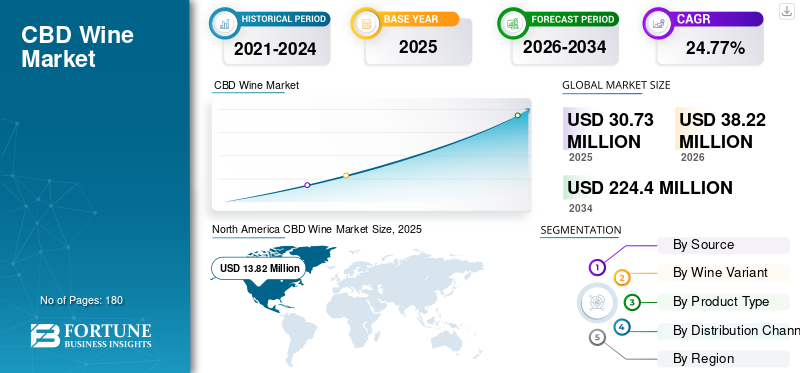
Download Free sample to learn more about this report.
MARKET DYNAMICS
MARKET DRIVERS
Surging Demand for Wellness-Oriented Beverages Fuels Market Potential
The global beverage industry is undergoing a rapid transformation as most consumers highly prioritize items that offer performance and health advantages. This sudden shift from conventional sugary drinks to functional beverages reflects a movement toward mindful consumption and preventive health. Cannabidiol, linked with relaxation and anti-stress qualities, aligns perfectly with this trend. Today, consumers of all age groups are looking for wellness-oriented wines that provide cognitive support, enhanced energy levels, and improved gut health. Moreover, the growing interest in plant-sourced ingredients is another factor that fuels its adoption rate. Nowadays, individuals are seeking beverages that are free from synthetic preservatives and additives. Thus, to fulfill the rising consumer needs, the manufacturers in the global market are launching new CBD-infused wines.
MARKET RESTRAINTS
High Production Cost and Limited Consumer Awareness Impede Market Expansion
One of the key hurdles in the global industry is high production prices. CBD wine manufacturing incurs higher costs than traditional wine production, primarily due to third-party testing, certification requirements, and the cost of CBD extraction. Procuring premium quality, legally compliant CBD with stable cannabidiol content is high-priced, especially when producing THC-free or low-THC formulations. Moreover, additional expenses come from regulatory documentation, stability testing, and specialized packaging. As a result, the aforementioned factors contribute to the finished product’s cost, potentially restricting mass-market adoption.
Minimal consumer awareness is another challenge in the industry. In spite of rising familiarity with CBD, consumer awareness of CBD-infused alcoholic drinks remains limited. Globally, most individuals associate cannabidiol with negative social perceptions, intoxication, and legal risk. Thus, such challenges inhibit the global CBD wine market share.
MARKET OPPORTUNITIES
Technological Advancements in Wine Market Open Growth Opportunities
The adoption of modern technologies in the wine market creates lucrative growth opportunities. To enhance the emulsion, manufacturers utilize advanced emulsion technology, which creates a consistent and stable mixture where CBD doesn’t easily separate. These techniques also strengthen the bioavailability of CBD and allow for efficient and faster absorption by the body. Moreover, to meet the demand of health-conscious consumers, producers are introducing alcohol-free wines that are produced using de-alcoholization technologies, such as reverse osmosis and vacuum distillation. Moreover, innovation in yeast strains allows beverage producers to manage the process of fermentation effectively. Besides this, companies are also gravitating toward data analytics and artificial intelligence techniques, which aid in determining flavor profiles and optimal CBD content.
CBD WINE MARKET TRENDS
Growing Product Innovation through Microdosing is a Current Trend
A major trend shaping the CBD wine industry is the spike in microdosing strategies designed to provide controlled effects while conserving the traditional wine-dining experience. This strategy involves incorporating precisely measured and small amounts of CBD, which are below the doses typically used in wellness supplements. This approach minimizes concerns regarding interactions between cannabidiol and alcohol and makes CBD-infused wines more acceptable among consumers. Product innovation is also expanding into hybrid categories that incorporate botanicals, such as adaptogens and chamomile, to enhance the drink’s overall wellness profile. By recognizing such advantages, companies are aiming to introduce microdose-based CBD wines that appeal to a large consumer base.
Download Free sample to learn more about this report.
Segmentation Analysis
By Source
Hemp-Sourced CBD Dominated Market Owing to Its Easy Commercialization
On the basis of source, the market is segmented into hemp-sourced CBD and marijuana-sourced CBD.
The hemp-sourced CBD led the global market in 2025. Hemp-derived CBD comprises minimal THC and easily aligns with international regulatory limits. Since these components do not produce psychoactive effects, regulators allow them freely in beverage and food applications. This tolerance allows producers to scale their manufacturing process worldwide. Moreover, the ease of commercialization and increased market availability are other factors that fuel the global CBD wine market growth.
The marijuana-sourced CBD segment is expected to flourish at a high CAGR of 19.57% during the study period.
By Wine Variant
Rose Wine Led Market Due to Its Superior Flavor Compatibility
Based on wine variant, the market is distributed into red wine, white wine, rose wine, and sparkling wine.
The rose wine dominated the market in 2025. Compared to other wines, rose wines naturally fit the refreshing and lighter profile preferred by the majority of consumers looking for functional drinks. Moreover, it is an ideal fit for low-alcohol and non-alcoholic CBD-infused wine formats, which fuels the segment’s momentum. Additionally, its dominance, especially in new product launches, further bolsters the global market share.
The white wine segment is expected to flourish at a CAGR of 24.19% during the study period.
To know how our report can help streamline your business, Speak to Analyst
By Product Type
Non-Alcoholic CBD Wine Led Market Due to Its High Product Availability
Depending on the product type, the market is segmented into alcoholic CBD wine and non-alcoholic CBD wine. The non-alcoholic CBD wine category led the market in 2025. In comparison to alcoholic wines, non-alcoholic wines have fewer regulatory restrictions, which makes them a suitable option for consumers. Moreover, these alcohol-free wines prioritize stress relief and relaxation over intoxication. As the majority of the population moves toward healthier drinking habits, these non-alcoholic wines fit easily into functional beverage and lifestyle moderation trends. Additionally, new product launches and broader distribution opportunities further strengthen market expansion.
The alcoholic CBD wine segment is anticipated to grow at a CAGR of 21.68% during the study period.
By Distribution Channel
Retail Dominated Market Due to Broader Market Reach
Based on distribution channel, the market is segmented into foodservice and retail (supermarkets/hypermarkets, convenience stores, specialty stores, online retail, and others).
The retail segment led the market in 2025. Retail outlets are recognized as one-stop-shop channels that offer an array of CBD wine and various international/local brands. Moreover, the easy accessibility and affordability of wines via retail channels are another key factor that strengthens the segment’s potential. Additionally, the option of bulk purchasing and freedom of selection further propel the market’s momentum.
The foodservice segment is anticipated to grow at a CAGR of 22.75% during the study period.
CBD Wine Market Regional Outlook
Based on region, the market is segmented into North America, Europe, Asia Pacific, South America, and the Middle East & Africa.
North America
North America CBD Wine Market Size, 2025 (USD Million) To get more information on the regional analysis of this market, Download Free sample
North America dominated the market, holding the highest share in 2025. The region benefits from the advanced regulatory framework for hemp-derived CBD and improved consumer interest in cannabidiol-based products. The sudden growth of the non-alcoholic drinks sector is another key factor that enhances the regional potential. Consumers, especially in American countries, are minimizing their intake of alcohol and are seeking drinks that boost cognitive well-being. Moreover, expanding the availability of cannabidiol-based wines via specialty stores and CBD stores adds value to the growth.
Additionally, the growing innovation in the craft beverage sector, coupled with well-developed supply chains, further propels the region’s growth. Among all the American countries, the U.S. is the leading nation, followed by Canada and Mexico. The rising prevalence of anxiety and stress and a fast-paced culture drive the nation’s growth.
Europe and Asia Pacific
Other regions, such as Europe and Asia Pacific, are expected to experience significant growth in the future. During the forecast period, Europe is anticipated to record a growth rate of 26.41%, which is the second-highest amongst all the regions. The rising trend of functional beverages and increasing demand for CBD-infused products are responsible for market expansion. After Europe, the Asia Pacific market ranked third in the global industry in 2025. The flourishing beverages industry and increasing awareness of the benefits of CBD propel growth.
South America and Middle East & Africa
Over the forecast period, South America, the Middle East, and Africa are predicted to witness moderate growth in the near term. The increasing availability of hemp-based CBD wines and base expansion are likely to drive the industry’s momentum.
COMPETITIVE LANDSCAPE
Major Industry Players
Key Players in Market are Investing Their Efforts in Launching New Products
Key players in the market include Viv & Oak, House of Saka, Rebel Wine Co., and others. All players in the global market are aiming to launch new products to cater to the increased demand. Through such launches, enterprises can enhance their market position and revenue generation.
List of Key CBD Wine Companies Profiled
- 66° Beverage Co. (U.S.)
- Hempfy Tellement Facile SA (Switzerland)
- Viv & Oak (U.S.)
- House of Saka (U.S.)
- Rebel Wine Co (U.K.)
- Bodegas Santa Margarita (Spain)
- CannaVines Wine (U.S.)
- Lagunitas (U.S.)
- Hexo Corporation (U.S.)
- Cry Baby Wine (U.S.)
KEY INDUSTRY DEVELOPMENTS
- August 2022: The 66° Beverage Company, an American beverage producer, revealed de-alcoholized wines for U.S.-based consumers. The product is available in three varieties, including white, red, and rose, and contains a low-alcohol content (0.5% ABV).
- July 2021: Republic National Distributing Company, a U.S.-based distributor of premium spirits and wine, announced its entry into the CBD sector. The firm signed agreements with Wyld CBD, a sparkling waters company in the U.S., Sati Soda, an American soda enterprise, and others.
- July 2021: Rebel Wine, a British first CBD-infused wine producer, announced the launch of a rose and white wine spritzer infused with 10 mg of organic hemp. This wine is available in cans and provides 73 and 69 calories per serving, respectively.
- May 2019: House of Saka, a California-based cannabis beverage producer, introduced the world’s first-ever sparkling cannabis rose wine. This beverage is composed of Napa Valley-sourced grapes.
REPORT COVERAGE
The global CBD wine market report includes quantitative and qualitative insights into the market. It also offers a detailed global market analysis of sizing and growth rate for all possible market segments. Various key insights presented in the market research report are an overview of related markets, competitive landscape, recent industry developments such as mergers & acquisitions, the regulatory scenario in critical countries, and global market trends.
Request for Customization to gain extensive market insights.
Report Scope & Segmentation
|
ATTRIBUTE |
DETAILS |
|
Study Period |
2021-2034 |
|
Base Year |
2025 |
|
Estimated Year |
2026 |
|
Forecast Period |
2026-2034 |
|
Historical Period |
2021-2024 |
|
Unit |
Value (USD Million) |
|
Growth Rate |
CAGR of 24.77% from 2026 to 2034 |
|
Segmentation |
By Source · Hemp-Sourced CBD · Marijuana-Sourced CBD |
|
By Wine Variant · Red Wine · White Wine · Rose Wine · Sparkling Wine |
|
|
By Product Type · Alcoholic CBD Wine · Non-Alcoholic CBD Wine |
|
|
By Distribution Channel · Foodservice · Retail o Supermarkets/Hypermarkets o Convenience Stores o Specialty Stores o Online Retail o Others |
|
|
By Region · North America (By Source, Wine Variant, Product Type, Distribution Channel, and Country) o U.S. (Product Type) o Canada (Product Type) o Mexico (Product Type) · Europe (By Source, Wine Variant, Product Type, Distribution Channel, and Country) o Germany (Product Type) o France (Product Type) o Italy (Product Type) o Spain (Product Type) o U.K. (Product Type) o Rest of Europe (Product Type) · Asia Pacific (By Source, Wine Variant, Product Type, Distribution Channel, and Country) o China (Product Type) o India (Product Type) o Japan (Product Type) o Australia (Product Type) o Rest of Asia Pacific (Product Type) · South America (By Source, Wine Variant, Product Type, Distribution Channel, and Country) o Brazil (Product Type) o Argentina (Product Type) o Rest of South America (Product Type) · Middle East & Africa (By Source, Wine Variant, Product Type, Distribution Channel, and Country) o UAE (Product Type) o South Africa (Product Type) o Rest of Middle East & Africa (Product Type) |
Frequently Asked Questions
Fortune Business Insights says that the global market size was valued at USD 30.73 million in 2025 and is set to reach USD 224.40 million by 2034.
The market is expected to grow at a CAGR of 24.77% during the forecast period (2026-2034).
By product type, the non-alcoholic CBD wine segment led the market.
Surging Demand for wellness-oriented beverages fuels the market’s potential.
Viv & Oak, House of Saka, and Rebel Wine Co. are among the top players in the market.
North America held the highest share of the market.
Technological advancements in the wine market open growth opportunities.



- 2021-2034
- 2025
- 2021-2024
- 180
-
(Offer valid till 31st Oct 2026)
Get 30-60 hrs Free Customization
Expand Regional and Country Coverage, Segments Analysis, Company Profiles, Competitive Benchmarking, and End-user Insights.




















Related Reports
-
US +1 833 909 2966 ( Toll Free )
-
Get In Touch With Us