Celtic Salt Market Size, Share & Industry Analysis, By Type (Coarse Celtic Salt, Fine Celtic Salt, Flavored Celtic Salt, and Others), By Nature (Conventional and Organic), By Application (Food & Beverage, Personal Care & Cosmetics, Health & Wellness, and Others), and Regional Forecast, 2026-2034
 Download Free Sample
(Offer valid till 31st Oct 2026)

KEY MARKET INSIGHTS
 Listen to Audio Version
The global Celtic salt market size was valued at USD 765.47 million in 2025 and is projected to grow from USD 810.55 million in 2026 to USD 1,300.82 million by 2034, exhibiting a CAGR of 6.09% during the forecast period. North America dominated the global celtic salt market with a market share of 39.3% in 2025.
Celtic salt, commonly referred to as Sel Gris, is an unrefined, naturally harvested salt collected from the coastal regions of France. This salt is produced using age-old solar evaporation methods that retain its naturally occurring trace minerals, including potassium, calcium, and magnesium. Unlike conventional table salt, Celtic salt preserves its natural moisture and is coarser in texture. Nutritionally, it comprises 80 trace minerals that aid in supporting the immune system. Moreover, minerals such as magnesium and potassium enhance immune defenses and promote digestive health.
Additionally, when consumed within limits, it may aid in improving blood pressure. Today, it is mainly used in food and beverages to strengthen flavor and texture. Apart from this, it is also utilized in cosmetics, supplements, and pet food. The increasing awareness of finishing salt and the growing demand for natural products are propelling the market’s momentum.
Some of the major players include Eden Foods, Le Marinier, Cornish Sea Salt, and others.
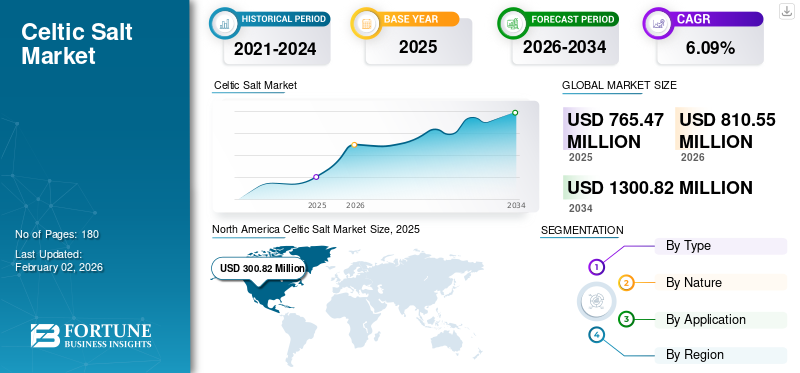
Download Free sample to learn more about this report.
Celtic Salt Market Key Takeaways
 Global Market Size & Forecast
- 2025 Market Size: USD 765.47 million
- 2026 Market Size: USD 810.55 million
- 2034 Forecast Market Size: USD 1,300.82 million
- CAGR: 6.09% (2026–2034)
 Market Share
- North America dominated the market with a 39.3% share in 2025.
- The flavored salt segment is projected to witness the fastest growth at a 9.12% CAGR during the forecast period.
- The health & wellness segment is expected to register the highest growth, expanding at a 9.12% CAGR during the forecast period.
 Key Regional Highlights
Asia Pacific
Asia Pacific ranked as the third-largest regional market in 2025 and is expected to witness significant growth during the forecast period.
North America
North America generated USD 300.82 million in 2025, maintaining its leading market position.
Europe
Europe is projected to register the second-highest growth rate at a 5.16% CAGR during the forecast period.
U.S.
U.S. market is projected to witness steady growth during the forecast period.
Japan
Japan is likely to witness sustained growth during the forecast period.
Read More

MARKET DYNAMICS
MARKET DRIVERS
Growing Consumer Health Awareness Fuels the Industry’s Potential
The surging consumer health awareness is a key driver responsible for market expansion. As the majority of consumers are moving away from refined flavorings and seeking substitutes perceived as healthier, Celtic salt positions itself as a clean-label option. In today’s era, individuals are aware of the adverse health effects caused by the consumption of artificial additives. To curb this scenario, consumers are gravitating toward less processed and mineral-rich salts. This salt offers all the essential minerals, such as calcium and potassium, which are linked with electrolyte balance and hydration. Moreover, the rising inclination toward organic components adds to the demand for Celtic salt. Additionally, the increasing trend of specialty or gourmet foods makes it a preferred choice amongst consumers. Considering such advantages, producers are aiming to introduce new products that cater to evolving consumer demands.
MARKET RESTRAINTS
Limited Harvesting Regions and Strong Competition from Substitutes Hinder the Market’s Potential
One of the key hurdles in the global industry is limited production capacity. Globally, Celtic salt is traditionally harvested from particular coastal salt marshes, specifically in France, where the combination of manual harvesting techniques and tidal flows creates the mineral-rich profile of salt. Moreover, the harvesting process is highly dependent on natural weather patterns, including stable tidal cycles and adequate sunlight, leading to fluctuations in output. These restrictions prevent salt producers from increasing supply to fulfill evolving consumer demands. As a result, challenges in expanding into new geographies owing to the requirement for particular conditions impede the global Celtic salt market growth.
Tough competition from salt substitutes is another difficulty in the market. The Celtic salts sector faces substantial pressure from an array of specialty and gourmet salts that are commonly recognized, inhibiting the industry’s momentum.
MARKET OPPORTUNITIES
Technological Advancements to Open Growth Opportunities
The utilization of advanced techniques in the sea salt market creates lucrative growth possibilities. To enhance shelf life, producers should use low-temperature dehydration systems, which are known to minimize moisture without hampering mineral integrity. Moreover, ion chromatography and Inductively Coupled Plasma Mass Spectrometry are gaining popularity and can be utilized to analyze mineral composition. Additionally, companies can adopt cold smoking technology and microencapsulation to produce flavored and stable salt blends. In addition, modern milling machines with precision sieving systems and variable speed grinders can be employed, as they allow the development of fine and coarse grades. Besides this, manufacturers should focus on digital ledger systems to track mineral content, moisture levels, and harvesting batches.
CELTIC SALT MARKET TRENDS
Surging Inclination toward Natural Cosmetics is the Prominent Trend
The global market is experiencing a growing and phenomenal trend of natural/organic cosmetics. In today’s time, most consumers are gravitating towards natural cosmetics, which are free from synthetic chemicals and additives. Celtic salt aligns well with this demand as it is minimally processed and has a high concentration of trace minerals. This salt, when used in personal care items, improves the hydration of skin and aids in collagen production. Moreover, it supports hair and nail growth and enhances circulation, which in turn contributes to hair growth. Additionally, it is used in face scrubs, which help in removing accumulated dead skin, promoting softer skin. Besides this, sea salt is proven beneficial in controlling acne and other skin conditions such as eczema and psoriasis.
Download Free sample to learn more about this report.
Segmentation Analysis
By Type
Coarse Celtic Salt Segment Led the Market Due to Its Denser Crystal Structure
On the basis of type, the market is segmented into coarse celtic salt, fine celtic salt, flavored celtic salt, and others. The coarse Celtic salt dominated the market in 2025. This salt undergoes minimal processing and preserves natural minerals such as potassium, calcium, and magnesium. Moreover, it has a slower melting rate compared to flavored/fine Celtic salt, which improves flavor release. Additionally, this salt has a denser crystal structure, which makes it suitable for preserving fish and curing meats. In addition, it has lower hygroscopicity and has a longer shelf life, which further adds value to its growth. As a result, such factors strengthen the global Celtic salt market growth rate.
The flavored salt segment is expected to flourish at a high CAGR of 9.12% during the study period.
To know how our report can help streamline your business, Speak to Analyst
By Nature
Conventional Segment Dominated the Market Owing to Its Cost-Effectiveness
Based on nature, the market is bifurcated into conventional and organic. The conventional segment leads the market in 2025. In comparison to organic items, traditional salt is more economical, which makes it accessible to general foodservice operators and consumers. Moreover, it is widely available across numerous retail channels and has a consistent supply, compared to organic. Additionally, this salt has a broader consumer acceptance, especially in price-sensitive markets. It is also naturally harvested and minimally processed, which further propels the segment’s growth.
The organic segment is expected to flourish at a high CAGR of 6.95% during the study period.
By Application
Food & Beverage Segment Led the Industry Due to Its High Usage of Celtic Salt in Various Recipes
Depending on application, the market is segmented into food & beverage, personal care & cosmetics, health & wellness, and others. The food & beverage segment dominated the market in 2025. For decades, Celtic salt has been recognized as a gourmet cooking salt that can be utilized in a range of broths, sauces, and soups. This salt has a strong flavor profile and is highly preferred by chefs due to its texture and clean-label appeal. Moreover, it is cost-effective in comparison to other grades, which enhances its adoption rate.
The health & wellness segment is anticipated to grow at a high CAGR of 9.12% during the study period.
Celtic Salt Market Regional Outlook
Based on regions, the market is segmented into North America, Europe, Asia Pacific, South America, and the Middle East & Africa.
North America
North America Celtic Salt Market Size, 2025 (USD Million) To get more information on the regional analysis of this market, Download Free sample
North America dominated the market and held the highest share in 2025. In this region, the growth is majorly driven by Americans’ strong focus on wellness, health, and clean-label nutrition. Most consumers are looking for mineral-rich rich unrefined salts as substitutes for regular table salt, which aligns with the additive-free Celtic salt. Moreover, the region has a well-developed specialty food and gourmet culture, which accelerates the use of sea salt. The region’s growth is also backed by robust e-commerce penetration, allowing a chunk of consumers to purchase the end product conveniently. Beyond culinary applications, the rising trend of mineral therapy and spa has augmented its demand in the region. Among all the American countries, the U.S. is the leading consumer, followed by Canada and Mexico. The increasing trend of artisanal salts and home cooking are key factor contributing to market expansion.
Europe and the Asia Pacific are expected to experience significant growth in the future. Europe is anticipated to record a growth rate of 5.16%, which is the second-highest amongst all the regions. The growing inclination towards clean-label beauty products and expanding processed food production improves regional momentum. The Asia Pacific market ranked third in the global industry in 2025. The surging demand for natural salts and growing sea salt players propel the industry’s share.
South America and the Middle East & Africa are predicted to witness moderate growth in the near term. The improved distribution channel and rising awareness of the health benefits of sea salt boost the growth.
COMPETITIVE LANDSCAPE
Major Industry Player
Active Players in the Market are Focusing on New Launches to Fulfill Health-Conscious Consumer Demands
Key players in the market include Eden Foods, Le Marinier, and Cornish Sea Salt. All these players in the market are aiming at new launches that help to fulfill health-conscious consumer demands. Via these launches, the companies can strengthen their position in the operating space.
List of Key Celtic Salt Companies Profiled
- Le Marinier (France)
- Celtic Sea Salt (U.S.)
- Le Guérandais (France)
- SaltWorks (U.S.)
- Altura Supply Company, LLC (U.S.)
- Cornish Sea Salt (U.K.)
- Mattisson Healthstyle (Netherlands)
- Eden Foods (U.S.)
- Blue Turtle Tea & Spice (U.S.)
- Eighteen Thirteen Six India Private Limited (India)
KEY INDUSTRY DEVELOPMENTS
- November 2025: Celt Salt, a subsidiary of a U.S.-based natural food startup, Nature’s Pantry, announced its aim to produce mineral-rich and authentic salt from the Celtic sea, based in France.
- May 2025: Slick Gorilla, a U.K.-based hair care brand, released a new scalp scrub composed of sea salt. This personal care product is vegan and can be used for all hair types.
- November 2024: Cornish Sea Salt, a British private company, launched the TekSalt product, which is packed with Celtic sea electrolytes and minerals. This product helps consumers attain lower sodium levels.
REPORT COVERAGES
The global Celtic salt market report includes quantitative and qualitative insights into the market. It also offers a detailed global Celtic salt market analysis of sizing and growth rate for all possible market segments. Various key insights presented in the market research report are an overview of related markets, competitive landscape, recent industry developments such as mergers & acquisitions, the regulatory scenario in critical countries, and global celtic salt market trends.
Request for Customization to gain extensive market insights.
Report Scope & Segmentation
|
ATTRIBUTE |
DETAILS |
|
Study Period |
2021-2034 |
|
Base Year |
2025 |
|
Estimated Year |
2026 |
|
Forecast Period |
2026-2034 |
|
Historical Period |
2021-2024 |
|
Unit |
Value (USD Million) |
|
Growth Rate |
CAGR of 6.09% from 2026 to 2034 |
|
Segmentation |
By Type · Coarse Celtic Salt · Fine Celtic Salt · Flavored Celtic Salt · Others |
|
By Nature · Conventional · Organic |
|
|
By Application · Food & Beverage · Personal Care & Cosmetics · Health & Wellness · Others |
|
|
By Geography · North America (By Type, Nature, Application, and Country) o U.S. (Nature) o Canada (Nature) o Mexico (Nature) · Europe (By Type, Nature, Application, and Country) o Germany (Nature) o France (Nature) o Italy (Nature) o Spain (Nature) o U.K. (Nature) o Rest of Europe (Nature) · Asia Pacific (By Type, Nature, Application, and Country) o China (Nature) o India (Nature) o Japan (Nature) o Australia (Nature) o Rest of Asia Pacific (Nature) · South America (By Type, Nature, Application, and Country) o Brazil (Nature) o Argentina (Nature) o Rest of South America (Nature) · Middle East & Africa (By Type, Nature, Application, and Country) o UAE (Nature) o South Africa (Nature) o Rest of the Middle East & Africa (Nature) |
Frequently Asked Questions
Fortune Business Insights says that the global market size was valued at USD 765.47 million in 2025.
The market is expected to grow at a CAGR of 6.09% during the global celtic salt market forecast period (2026-2034).
By nature, the conventional segment led the market.
Growing Consumer Health Awareness is a key factor fueling the industry’s potential.
Eden Foods, Le Marinier, and Cornish Sea Salt are among the top players in the market.
North America held the highest share of the market.
Technological advancements present the key opportunities in the market.



- 2021-2034
- 2025
- 2021-2024
- 180
-
(Offer valid till 31st Oct 2026)
Get 30-60 hrs Free Customization
Expand Regional and Country Coverage, Segments Analysis, Company Profiles, Competitive Benchmarking, and End-user Insights.




















Related Reports
-
US +1 833 909 2966 ( Toll Free )
-
Get In Touch With Us