Cementing Chemicals Market Size, Share & Industry Analysis, By Product Type (Fluid Loss Control Additives, Retarders, Dispersants & Friction Reducers, Extenders & Weighting Agents, Accelerators, and Others), By Application (Onshore, Offshore, Shale Gas, and Others), and Regional Forecast, 2026-2034
 Download Free Sample
Cementing Chemicals Market Size and Future Outlook
 Listen to Audio Version
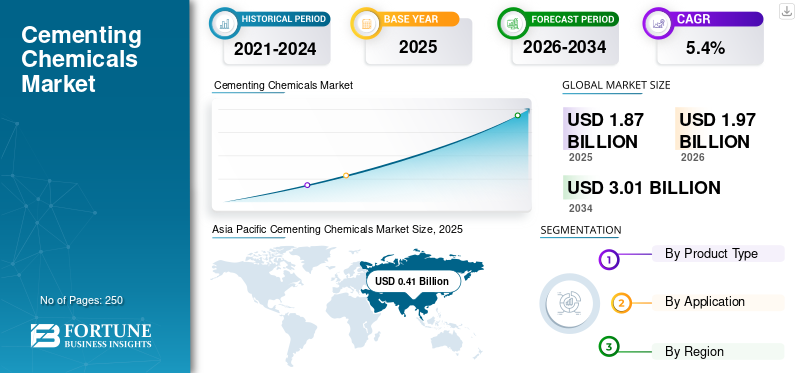
The global cementing chemicals market size was valued at USD 1.87 billion in 2025. The market is projected to grow from USD 1.97 billion in 2026 to USD 3.01 billion by 2034, exhibiting a CAGR of 5.4% during the forecast period. Asia Pacific dominated the cementing chemicals market with a market share of 21.93% in 2025.
Cementing chemicals are specialized oilfield additives used in well-cementing operations to modify the performance of the cement slurry during placement, setting, and long-term service in the wellbore. These chemicals are added to cement, water, and other slurry components to control fluid loss, setting time, viscosity, density, gas migration, strength development, and cement sheath integrity. Cementing chemicals are primarily used in onshore, offshore, and shale gas wells for primary cementing, remedial cementing, liner cementing, squeeze cementing, and plug & abandonment operations. The increasing demand for reliable well integrity, increasing offshore and deepwater drilling activity, growing shale gas development, and expanding plug & abandonment requirements are driving the global market. Complex wells, including high-pressure, high-temperature wells, gas-bearing formations, mature wells, and long horizontal shale gas wells, require advanced additives. Therefore, market growth is supported not only by drilling activity but also by the increasing use of higher-performance cementing chemical packages in complex, integrity-sensitive wells.
The global market is shaped by a mix of integrated oilfield service companies, specialty chemical producers, and cementing additive manufacturers. Key players in the market include Halliburton, Schlumberger, Baker Hughes, Chevron Phillips Chemical, Nouryon, and BASF. Continuous investments in advanced fluid-loss control additives, high-temperature retarders, CO₂-resistant cementing systems, latex- and polymer-based additives, and offshore/deepwater cementing solutions continue to strengthen supplier positioning.
Download Free sample to learn more about this report.
Cementing Chemicals Market Key Takeaways
 Global Market Size & Forecast
- 2025 Market Size: USD 1.87 billion
- 2026 Market Size: USD 1.97 billion
- 2034 Forecast Market Size: USD 3.01 billion
- CAGR: 5.4% from 2026–2034
 Market Share
- Asia Pacific dominated the market with a 21.93% share in 2025.
- Fluid loss control additives segment held the largest market share in 2025.
- Onshore segment held the largest market share in 2025.
 Key Regional Highlights
North America
The market reached USD 0.63 billion in 2025, driven by strong well construction, shale gas activity, and plug & abandonment demand.
Asia Pacific
The market reached USD 0.41 billion in 2025, driven by rising oil & gas drilling activity, offshore developments, and shale gas exploration.
Europe
The market reached USD 0.22 billion in 2025, supported by offshore North Sea activity, mature-field remediation, and carbon capture & storage projects.
U.S.
The market is projected to reach USD 0.53 billion by 2026, driven by shale gas and offshore drilling.
Japan
The market is expected to grow steadily, supported by advanced cementing chemical adoption.
Read More

CEMENTING CHEMICALS MARKET TRENDS
Shift toward High-Performance Cementing Additives is Reshaping Product Demand in Complex Well Environments
The global market is shifting from conventional additive packages toward high-performance additives designed for complex well environments. Offshore, deepwater, high-pressure/high-temperature, gas-bearing, and long horizontal wells require cement slurries with better fluid-loss control, extended pumpability, improved rheology, resistance to gas migration, and long-term cement sheath durability. This is increasing the use of specialty additives, such as advanced retarders, polymer-based fluid-loss control agents, latex additives, dispersants, expansion additives, and gas-migration control systems. As designs become deeper, longer, and more technically demanding, operators are focusing less on basic cement placement and more on cement integrity throughout the well's life. Therefore, a shift toward higher-value cementing chemical systems that can reduce cement failure risks, improve zonal isolation, and support reliable well performance under challenging downhole conditions will drive the product adoption.
MARKET DYNAMICS
MARKET DRIVERS
Download Free sample to learn more about this report.
Growing Need for Well Integrity and Zonal Isolation is set to Drive Market Growth
The growing focus on well integrity and zonal isolation is a major driver for the market. Cementing chemicals are used to ensure that cement slurry is properly placed, sets at the required time, develops sufficient strength, and creates an effective seal between the casing and formation. Poor zonal isolation can result in gas migration, water production, pressure communication between formations, casing corrosion, and long-term well integrity issues. As operators drill deeper, more complex, and higher-pressure wells, the need for reliable cementing performance is increasing. Fluid-loss additives, retarders, dispersants, gas-migration-control additives, extenders, and expansion additives are increasingly used to improve slurry stability and cement sheath performance. In mature fields, remedial cementing and plug & abandonment activities are also supporting demand. Therefore, stricter well integrity requirements and the need to reduce operational risks are expected to drive the global cementing chemicals market growth during the forecast period.
- Europe is aggressively diversifying its oil and gas supplies to replace Russian imports by 2027, focusing on LNG infrastructure, Mediterranean strategic partnerships, and accelerating domestic projects.
MARKET RESTRAINTS
Volatility in Oil & Gas Drilling Activity is Limiting Stable Demand for Cementing Chemicals
Volatility in oil and gas drilling activity remains a key restraint for the market. Cementing chemical demand is closely linked to new well construction, workover activity, offshore drilling programs, shale gas development, and plug & abandonment projects. When crude oil and natural gas prices decline, operators often reduce capital expenditures, delay drilling campaigns, and postpone the drilling of exploration or development wells. This directly reduces cementing job volumes and reduces consumption of additives such as retarders, accelerators, fluid-loss control agents, dispersants, and density-control materials. Smaller service providers and chemical suppliers are especially exposed to sudden changes in drilling activity and pricing pressure from operators. Although remedial cementing and abandonment work provide some stability in demand, they cannot fully offset major downturns in drilling cycles. Hence, cyclical upstream investment patterns continue to restrict steady growth in cementing chemical demand.
MARKET OPPORTUNITIES
Geothermal and Carbon Capture Wells are Creating New Growth Opportunities for Specialty Cementing Chemicals
Geothermal and carbon capture and storage wells are creating new opportunities for specialty cementing chemicals beyond conventional oil and gas applications. Geothermal wells operate under high-temperature and thermal-cycling conditions, requiring cementing additives that can maintain strength, stability, and zonal isolation over long operating periods. Similarly, carbon capture and storage wells require durable cement systems that can resist CO₂ exposure, prevent leakage, and support long-term subsurface containment. These applications create demand for high-temperature retarders, silica-based stabilizers, CO₂-resistant additives, expansion additives, fluid loss control agents, and advanced barrier systems. Although geothermal and CCS currently represent a smaller share of total cementing chemical consumption, they are expected to grow as governments and energy companies invest in low-carbon energy and emissions-reduction infrastructure. Therefore, suppliers that develop specialized cementing formulations for geothermal and CO₂ storage wells can capture emerging high-value demand.
Segmentation Analysis
By Product Type
Fluid Loss Control Additives Dominated the Market Owing to Their Critical Role in Slurry Stability and Formation Protection
Based on product type, the market is segmented into fluid loss control additives, retarders, dispersants & friction reducers, extenders & weighting agents, accelerators, and others.
Fluid loss control additives accounted for the largest share of the global market in 2025. These additives are widely used to prevent excess water loss from cement slurry into permeable formations, helping maintain slurry consistency, cement strength, and zonal isolation. Their use is especially important in primary cementing, remedial cementing, gas-bearing formations, and squeeze cementing jobs, where uncontrolled fluid loss can weaken cement placement and increase the risk of poor bonding. Strong adoption across onshore, offshore, and shale gas wells continues to support the segment’s dominance.
Retarder's ability to delay cement setting and maintain slurry pumpability during long placement operations has made it an ideal product segment in the market. These additives are highly important in deep, high-temperature, offshore, and complex casing programs where cement must remain workable until it reaches the target zone. Rising drilling activity in deeper reservoirs and HPHT environments is increasing the need for reliable set-time control. As operators focus on reducing premature setting risks and improving cement placement accuracy, the segment is projected to grow at a 5.5% CAGR during 2026-2034.
Extenders & weighting agents represent a smaller but technically important product group used to adjust cement slurry density based on formation pressure, fracture gradient, and wellbore stability requirements. Extenders help reduce slurry density in weak or depleted formations, while weighting agents increase density in high-pressure zones. Their use is especially relevant in offshore wells, mature fields, and formations where pressure control is critical. Although the segment is relatively low in value, it remains necessary for slurry design and is projected to grow at a CAGR of 5.1% during 2026-2034.
By Application
To know how our report can help streamline your business, Speak to Analyst
Onshore Segment Dominated the Market Due to High Conventional Land-Based Well Cementing Activity
Based on application, the market is segmented into onshore, offshore, shale gas, and others.
Onshore accounted for the largest global cementing chemicals market share in 2025. The segment includes cementing chemicals used in conventional land-based oil and gas wells, excluding shale gas wells, which are tracked separately. Onshore wells have a much larger global well count than offshore wells, creating substantial recurring demand for primary cementing, remedial cementing, and plug & abandonment activities. Cementing chemicals are used to support casing placement, zonal isolation, fluid-loss control, density adjustment, and cement sheath integrity. Continued drilling across mature and emerging onshore basins supports the segment’s leading position.
Offshore cementing chemicals are used in shallow-water, deepwater, and ultra-deepwater oil and gas wells. The segment’s growth is supported by higher chemical intensity per well compared with conventional onshore drilling. Offshore wells often involve complex pressure-temperature conditions, narrow drilling windows, gas migration risks, and strict well-integrity requirements. This increases demand for premium retarders, fluid-loss additives, dispersants, gas-migration control additives, spacers, and specialty cementing systems. Offshore activity in regions such as the Gulf of Mexico, the North Sea, Brazil, West Africa, and the Middle East is expected to support segment growth at a CAGR of 5.6% over the forecast period.
The other application segment includes geothermal wells, carbon capture and storage wells, underground gas or hydrogen storage wells, sidetrack plugs, kickoff plugs, and other niche wellbore isolation applications. Although smaller than oil and gas drilling applications, this segment is gaining attention as energy transition-related well construction expands. Geothermal wells require high-temperature cementing systems, while CCS wells require durable cement barriers that can resist CO₂ exposure and support long-term containment. As a result, the segment is projected to grow at a CAGR of 6.4% during 2026-2034.
Cementing Chemicals Market Regional Outlook
By region, the market is segmented into North America, Europe, Asia Pacific, Latin America, and the Middle East & Africa.
Asia Pacific
Asia Pacific Cementing Chemicals Market Size, 2025 (USD Billion)
To get more information on the regional analysis of this market, Download Free sample
Asia Pacific reached USD 0.41 billion in 2025 and is one of the fastest-growing regional markets, expanding at the highest CAGR of 6.0% during 2026-2034. Demand is supported by oil and gas drilling activity across China, India, Indonesia, Malaysia, and Australia & New Zealand. The region benefits from a broad mix of onshore conventional wells, offshore developments, and shale gas exploration, particularly in China. Rising energy demand, national upstream investments, and continued development of gas resources are increasing the need for cementing additives that support zonal isolation, slurry stability, density control, and gas migration management.
China Cementing Chemicals Market
China is projected to account for approximately USD 0.15 billion in 2026, representing around 7.8% of global demand. The market is supported by onshore gas development, shale gas activity, offshore exploration, and government-backed efforts to improve domestic energy security. Cementing chemical demand is driven by fluid-loss control, retardation, slurry dispersion, and gas-migration control requirements in both conventional and unconventional well construction.
To know how our report can help streamline your business, Speak to Analyst
India Cementing Chemicals Market
India is projected to reach USD 0.08 billion in 2026, representing nearly 4.0% of global demand. Demand is supported by onshore oil and gas drilling, gas exploration, and offshore activity along India’s producing basins. The country’s cementing chemical consumption is linked to continued upstream investment, redevelopment of mature fields, and the need for reliable casing cementation and zonal isolation in conventional wells.
North America
North America dominated the global market in 2025, reaching USD 0.63 billion, supported by strong well construction, shale gas activity, remedial cementing, and plug & abandonment demand across mature oil and gas basins. The region accounts for the largest share of global consumption due to high drilling intensity in the U.S. and Canada. Further, the consumption is particularly high across onshore conventional wells, shale gas wells, offshore Gulf of Mexico activity, and mature-field well integrity operations.
U.S. Cementing Chemicals Market
The U.S. market is estimated to reach USD 0.53 billion in 2026, accounting for approximately 27.1% of global demand. The country remains the single largest national market, driven by shale gas development, horizontal drilling, onshore conventional well activity, offshore Gulf of Mexico operations, and well integrity requirements across mature producing basins. Strong consumption of fluid-loss additives, retarders, dispersants, and gas-migration control chemicals supports its leading position.
Europe
Europe reached USD 0.22 billion in 2025, growing at a CAGR of 5.1% during 2026-2034. The region represents a smaller but technically demanding market, supported by offshore North Sea activity, mature-field remediation, plug & abandonment, geothermal development, and emerging carbon capture and storage wells. Cementing chemical demand is more specialty-driven than in high-volume onshore regions, with greater use of retarders, fluid-loss additives, gas-migration control systems, spacers, and long-term barrier additives.
Germany Cementing Chemicals Market
The Germany market is estimated to reach USD 0.02 billion in 2026, accounting for around 1.1% of global demand. The market is comparatively smaller and is supported by selective onshore oil and gas activity, geothermal wells, underground storage, and specialty wellbore cementing applications. Demand is more focused on performance additives for controlled settings, fluid-loss management, and long-term cement barrier integrity rather than large-scale drilling volume.
U.K. Cementing Chemicals Market
The U.K. market is set to reach a value of USD 0.05 billion in 2026, representing approximately 2.7% of global demand. Demand is mainly supported by offshore North Sea operations, mature-field well integrity, remedial cementing, and plug & abandonment activity. The country’s market is more closely tied to offshore and decommissioning-related cementing than to high-volume new onshore well construction.
Latin America
Latin America reached USD 0.22 billion in 2025 and is expected to grow at a CAGR of 5.8% during 2026-2034. The region’s demand is shaped by offshore developments in Brazil, shale gas and unconventional activity in Argentina, mature-field operations, and conventional drilling across other Latin American countries. Offshore projects increase the use of higher-value cementing additives. At the same time, onshore and shale gas activity support broader consumption of fluid-loss control agents, retarders, accelerators, dispersants, and density-control additives.
Brazil Cementing Chemicals Market
Brazil is set to record USD 0.10 billion in 2026, accounting for around 5.3% of global demand. The market is strongly influenced by offshore and pre-salt oil and gas activity, where cementing operations require advanced additives for deepwater, high-pressure, and technically challenging well environments.
Middle East & Africa
The Middle East & Africa market stood at USD 0.40 billion in 2025, supported by large-scale oil and gas drilling across GCC countries, Iraq, North Africa, and offshore West Africa. The region is projected to grow at a CAGR of 5.6% during 2026-2034, driven by sustained onshore drilling, gas field development, HPHT wells, offshore projects, and mature-field cementing requirements. Cementing chemicals are used extensively to support casing cementation, fluid loss control, density adjustment, slurry pumpability, and long-term well integrity. GCC countries remain the primary demand center, while Iraq and African producers continue to contribute to regional volume growth.
COMPETITIVE LANDSCAPE
Key Industry Players
Strategic Acquisitions, Specialty Product Launches, and Low-Carbon Cementing Solutions Intensify Market Competition
The global cementing chemicals market is moderately consolidated, with competition led by integrated oilfield service companies, specialty chemical producers, and regional cementing additive suppliers. Major players include Halliburton, Schlumberger, Baker Hughes, Chevron Phillips Chemical, BASF, and Nouryon. Recent developments indicate that companies are strengthening their positions through acquisitions, product innovation, capacity expansion, and the adoption of low-carbon cementing technologies. In addition, companies are focusing on fluid-loss control agents, retarders, dispersants, gas-migration additives, density-control materials, and specialty systems for offshore, shale gas, HPHT, geothermal, and carbon capture applications. Innovative product launches, technical support, regional supply reliability, and customized formulations remain key differentiators.
LIST OF KEY CEMENTING CHEMICALS COMPANIES PROFILED
- Halliburton (U.S.)
- Baker Hughes (U.S.)
- Chevron Phillips Chemical (U.S.)
- BASF (Germany)
- Clariant (Switzerland)
- Nouryon (U.S.)
- SNF (France)
- Elementis (U.K.)
- Elkem (Norway)
- Aubin Group (U.K.)
KEY INDUSTRY DEVELOPMENTS
- July 2025: SLB completed the acquisition of ChampionX, strengthening its chemicals and production-focused oilfield technology portfolio. ChampionX has a disclosed portfolio of cementing chemicals used for cement slurry design and well construction, making the acquisition relevant to the cementing chemicals competitive landscape.
- August 2024: Baker Hughes launched InvictaSet, an industry-first regenerative cement system designed to provide a durable cement sheath and improve well integrity across the well lifecycle. The technology was developed to reduce downtime associated with workovers and repairs of damaged conventional cement systems.
- June 2024: Impact Fluid Solutions announced the closing of its acquisition by Dorf Ketal Chemicals India Private Limited. Impact Fluid Solutions provides downhole fluid additives for drilling and cementing applications, and the acquisition expanded Dorf Ketal’s oil and gas chemical solutions portfolio.
- May 2024: Halliburton added the SentinelCem Pro cement system to its lost circulation solutions portfolio. The system is designed for offshore and remote locations, with single-sack packaging and simplified mixing that enable efficient cementing operations in severe-to-total-loss zones.
- January 2024: Nouryon completed a nearly 50% expansion of production capacity for its Levasil colloidal silica products at its Green Bay, Wisconsin, facility in the U.S. The expansion strengthened the company’s global footprint in colloidal silica manufacturing; Nouryon’s colloidal silica portfolio is used in applications such as optimized oilfield cementing.
REPORT COVERAGE
The global cementing chemicals market analysis provides an in-depth study of market size & forecast across all market segments included in the report. It includes details on the market dynamics and market trends expected to drive the market in the forecast period. It offers information on technological advancements, new product launches, key industry developments, and partnerships, mergers & acquisitions. The market research report also encompasses a detailed competitive landscape, including market share and profiles of key operating players.
Request for Customization to gain extensive market insights.
Report Scope & Segmentation
| ATTRIBUTE | DETAILS |
| Study Period | 2021-2034 |
| Base Year | 2025 |
| Estimated Year | 2026 |
| Forecast Period | 2026-2034 |
| Historical Period | 2021-2024 |
| Growth Rate | CAGR of 5.4% from 2026-2034 |
| Unit | Value (USD Billion) and Volume (Kiloton) |
| Segmentation | By Product Type, Application, and Region |
| By Product Type |
|
| By Application |
|
| By Region |
|
Frequently Asked Questions
Fortune Business Insights says that the global market size was valued at USD 1.87 billion in 2025 and is projected to reach USD 3.01 billion by 2034.
In 2025, Asia Pacific’s market value stood at USD 0.41 billion.
Recording a CAGR of 5.4%, the market is slated to exhibit steady growth during the forecast period.
The onshore application segment led in 2025.
The growing need for well integrity and zonal isolation is expected to drive market growth.
Halliburton, Schlumberger, Baker Hughes, Chevron Phillips Chemical, Nouryon, and BASF are among the prominent players in the market.
North America held the highest market share in 2025.
A shift toward higher-value cementing chemical systems and support for reliable well performance under challenging downhole conditions will favor product adoption.



- 2021-2034
- 2025
- 2021-2024
- 250
Get 30-60 hrs Free Customization
Expand Regional and Country Coverage, Segments Analysis, Company Profiles, Competitive Benchmarking, and End-user Insights.


















-
US +1 833 909 2966 ( Toll Free )
-
Get In Touch With Us