 Download Free Sample



Get a Quote
Receive a tailored pricing based on your needs.
- Choose license type
- Multiple user options
- Custom scope & coverage
- Fast turnaround
"Designing Growth Strategies is in our DNA"
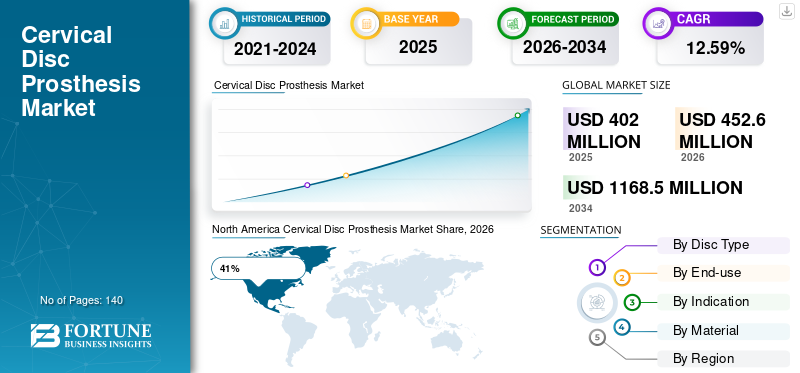
The global cervical disc prosthesis market size was valued at USD 402 million in 2025. The market is projected to grow from USD 452.6 million in 2026 to USD 1,168.5 million by 2034, exhibiting a CAGR of 12.59% during the forecast period.

The cervical disc prosthesis market is witnessing steady expansion due to the growing adoption of motion-preserving spinal procedures and increasing preference for artificial disc replacement over conventional spinal fusion surgeries. Cervical disc prosthesis devices are designed to maintain cervical spine mobility while reducing adjacent segment degeneration. Rising incidences of cervical degenerative disc disease, cervical radiculopathy, and spinal disorders are creating sustained demand across healthcare facilities. Technological advancements in biomaterials, implant design, and minimally invasive surgical techniques are further strengthening product adoption. The cervical disc prosthesis market report highlights increasing physician awareness, improved surgical outcomes, and growing investments in spinal healthcare infrastructure, contributing to broader market penetration across developed and emerging healthcare systems.
The United States accounts for 42% of the North American cervical disc prosthesis market share due to its advanced spinal care infrastructure and high volume of cervical spine procedures. More than 1.2 million spinal surgeries are performed annually across the country, creating a strong foundation for cervical disc prosthesis adoption. Favorable regulatory approvals, increased surgeon expertise, and widespread availability of advanced imaging technologies support market expansion. Hospitals and orthopedic centers are increasingly utilizing next-generation cervical disc implants to improve patient outcomes. Growing prevalence of sedentary lifestyles, workplace-related neck disorders, and age-associated cervical degeneration continues to stimulate demand. The USA Cervical Disc Prosthesis market expansion indicates strong utilization of motion-preserving technologies across major healthcare institutions.
Download Free sample to learn more about this report.
 Global Market Size & Forecast
 Market Share
 Key Regional Highlights
North America
North America led the market with a 41% share, supported by advanced spinal care infrastructure and growing adoption of cervical disc replacement procedures.
Europe
Europe accounted for 29% of the market, driven by established healthcare systems and increasing demand for advanced spinal implants.
Asia-Pacific
Asia-Pacific held a 23% share, supported by expanding healthcare infrastructure and rising prevalence of cervical spine disorders.
U.S
The U.S. remains a key market, supported by advanced spinal care facilities and strong adoption of motion-preserving cervical implants.
Japan
Japan accounted for approximately 31% of the Asia-Pacific market, supported by advanced healthcare infrastructure and growing demand for innovative spinal treatment solutions.
Read More

The cervical disc prosthesis market trends indicate a significant shift toward motion-preserving spinal treatments as healthcare providers seek alternatives to spinal fusion procedures. Manufacturers are increasingly introducing advanced implant designs that mimic natural cervical spine movement while enhancing durability and wear resistance. Three-dimensional imaging technologies and computer-assisted surgical planning are becoming standard tools for preoperative assessment, improving implant positioning accuracy.
Download Free sample to learn more about this report.
Another notable trend involves the growing use of titanium alloys and advanced polymer combinations that improve biocompatibility and long-term implant performance. Healthcare facilities are increasingly adopting minimally invasive surgical approaches, reducing hospitalization periods and accelerating patient recovery. Artificial intelligence-assisted surgical navigation systems are also gaining attention among spinal surgeons.
Rising Prevalence of Cervical Degenerative Disc Disorders
The primary growth driver for the cervical disc prosthesis market is the increasing prevalence of cervical degenerative disc disease and associated spinal conditions. Aging populations across major economies are contributing to a larger patient pool requiring surgical intervention. Clinical studies indicate that cervical disc degeneration affects millions of adults globally, particularly individuals above 45 years of age. Increased use of computers, smartphones, and sedentary work environments has also led to higher incidence of chronic neck pain and cervical spine disorders. Healthcare providers are increasingly recommending cervical disc prosthesis procedures due to their ability to preserve spinal motion. Improved surgical success rates exceeding 90% in selected patient populations further support adoption. The cervical disc prosthesis market analysis shows that rising awareness among patients regarding advanced spinal treatment options continues to strengthen procedural volumes across hospitals and orthopedic centers.
High Procedural and Implant Costs
Despite favorable clinical outcomes, high treatment costs remain a significant restraint for the Cervical Disc Prosthesis Industry. Cervical disc replacement procedures require specialized implants, advanced imaging technologies, and highly trained surgeons, increasing overall healthcare expenditure. In several developing countries, reimbursement coverage remains limited, restricting patient access to these procedures. Cost-sensitive healthcare systems often favor conventional fusion surgeries because of their lower upfront expenses. Furthermore, procurement costs associated with premium prosthetic devices create challenges for smaller healthcare facilities. Regulatory compliance requirements and extensive clinical testing also contribute to elevated manufacturing expenses. The cervical disc prosthesis market outlook indicates that affordability concerns continue to influence adoption rates in emerging economies despite growing demand for advanced spinal treatments.
Expansion of Minimally Invasive Spinal Surgery
The growing popularity of minimally invasive spinal surgery presents substantial opportunities for the cervical disc prosthesis market. Patients increasingly prefer procedures associated with reduced tissue damage, shorter hospitalization periods, and faster recovery times. Healthcare institutions are investing heavily in advanced surgical navigation systems and robotic-assisted platforms that improve implant placement accuracy. Emerging economies are expanding specialized spinal treatment centers, creating new commercial opportunities for implant manufacturers. Rising healthcare expenditure and improving access to advanced orthopedic procedures further strengthen market prospects. Increasing demand for outpatient spinal procedures is also encouraging development of next-generation cervical disc prostheses optimized for minimally invasive techniques. The cervical disc prosthesis market forecast suggests that technological innovation combined with expanding surgical capabilities will create significant growth avenues during the coming years.
Long-Term Clinical Evaluation Requirements
One of the major challenges facing the cervical disc prosthesis market is the need for extensive long-term clinical validation. Regulatory authorities require substantial evidence regarding implant durability, safety, and effectiveness before approving new products. Manufacturers must conduct lengthy clinical studies that often extend beyond five years, increasing development timelines and costs. Variations in patient anatomy and surgical techniques can also influence clinical outcomes, creating complexities in product evaluation. Healthcare providers remain cautious regarding newer implant technologies until sufficient long-term performance data become available. Additionally, post-market surveillance requirements impose additional responsibilities on manufacturers. The Cervical Disc Prosthesis industry report indicates that balancing innovation with rigorous regulatory compliance remains a key challenge for both established companies and new market entrants.
M-o-P cervical disc prostheses account for 61% of the cervical disc prosthesis market share. These implants utilize metallic endplates combined with advanced polymer cores designed to replicate natural cervical spine motion. The segment maintains strong market leadership due to favorable wear characteristics, established clinical evidence, and widespread surgeon familiarity. Modern polymer materials provide enhanced durability and reduced friction during cervical movement. Hospitals frequently prefer M-o-P implants because they demonstrate reliable long-term outcomes and broad patient compatibility. Continuous improvements in polymer engineering are reducing wear particle generation and improving implant longevity.
M-o-M cervical disc prostheses represent 39% of the cervical disc prosthesis market share. These devices utilize metallic articulating surfaces designed to provide robust structural support and long-term mechanical stability. The segment is particularly valued for its strength characteristics and resistance to deformation under repetitive spinal loading conditions. Technological advancements in metal processing and surface finishing techniques have improved implant performance and reduced wear concerns. M-o-M implants are frequently utilized in carefully selected patient populations requiring enhanced load-bearing capabilities.
To know how our report can help streamline your business, Speak to Analyst
Orthopedic & Trauma Centers account for 34% of the cervical disc prosthesis market share. These facilities play a critical role in the diagnosis and treatment of cervical spine disorders due to their specialized surgical expertise and dedicated spinal care departments. Increasing referrals for degenerative disc disease, traumatic cervical injuries, and motion-preserving spinal procedures are supporting demand within this segment. Many orthopedic centers are equipped with advanced imaging systems, intraoperative navigation technologies, and minimally invasive surgical platforms that improve procedural accuracy. Growing patient preference for specialized spinal treatment centers further strengthens segment expansion.
Hospitals hold 66% of the cervical disc prosthesis market share, making them the leading end-use segment. Large hospitals possess comprehensive surgical infrastructure, multidisciplinary care teams, and access to advanced spinal technologies that support cervical disc replacement procedures. The growing number of spinal surgeries performed in tertiary care hospitals contributes significantly to implant demand. Hospitals also benefit from established reimbursement frameworks and access to specialized neurosurgeons and orthopedic surgeons. Increasing patient admissions related to cervical degenerative disorders continue driving procedural growth.
Neck pain represents 57% of the cervical disc prosthesis market share by indication. Chronic neck pain associated with degenerative disc disease remains one of the most common reasons for cervical disc replacement procedures. Rising prevalence of sedentary lifestyles, prolonged screen exposure, and poor posture habits have significantly increased the number of patients seeking advanced treatment solutions. Cervical disc prostheses offer motion preservation benefits that help maintain spinal flexibility while alleviating pain symptoms. Clinical studies continue to demonstrate favorable patient satisfaction rates following cervical disc replacement for persistent neck pain.
Myelopathy accounts for 43% of the cervical disc prosthesis market share. Cervical myelopathy results from spinal cord compression caused by degenerative changes, herniated discs, or cervical spinal stenosis. The condition frequently leads to neurological symptoms, impaired motor function, and reduced quality of life. Growing diagnosis rates supported by advanced magnetic resonance imaging technologies are contributing to procedural demand. Cervical disc prostheses provide an effective treatment option for selected myelopathy patients while preserving spinal mobility.
Material-based segmentation shows titanium alloys, cobalt-chromium alloys, and advanced polymers as dominant components used in cervical disc prosthesis manufacturing. This segment accounts for 100% of implant production requirements and plays a vital role in determining device performance. Titanium-based materials contribute 48% of material utilization due to their excellent biocompatibility and corrosion resistance. Cobalt-chromium alloys account for 32%, offering superior mechanical strength and wear resistance. Advanced polymer materials represent 20%, providing flexibility and shock absorption characteristics. Continuous innovation in biomaterials is enhancing implant longevity and reducing complication risks. The cervical disc prosthesis market trends indicate increasing emphasis on material optimization to improve clinical outcomes and long-term device durability.
North America Cervical Disc Prosthesis Market Share, 2025 (%)
To get more information on the regional analysis of this market, Download Free sample
North America holds 41% of the global cervical disc prosthesis market share, making it the leading regional market. The region benefits from advanced healthcare infrastructure, widespread availability of specialized spine centers, and strong adoption of motion-preserving surgical procedures. The United States contributes the majority of regional demand due to a high volume of cervical spine surgeries and favorable reimbursement policies. Increasing prevalence of degenerative disc disease and chronic neck pain continues to support procedural growth. Hospitals and orthopedic facilities are rapidly adopting next-generation cervical disc implants with enhanced durability and biomechanical performance. Strong clinical evidence supporting artificial disc replacement over fusion in selected patients has strengthened surgeon confidence. Continuous investments in robotic-assisted surgery and navigation technologies further improve treatment outcomes. The presence of major industry participants and ongoing product innovation reinforce North America's dominant position in the cervical disc prosthesis market.
Europe accounts for 29% of the global cervical disc prosthesis market share and remains a major center for spinal healthcare innovation. The region benefits from established healthcare systems, growing awareness of motion-preserving therapies, and increasing adoption of advanced orthopedic technologies. Countries such as Germany, France, Italy, and the United Kingdom continue expanding access to cervical disc replacement procedures through public and private healthcare networks. Rising incidence of age-related spinal disorders and cervical degenerative diseases contributes significantly to market demand. Physicians increasingly recommend cervical disc prostheses due to favorable long-term clinical outcomes and preservation of spinal mobility. Research institutions and medical device manufacturers actively collaborate to develop innovative implant designs. Improved diagnostic technologies allow earlier detection of cervical conditions. Growing investments in healthcare modernization and specialized spine treatment programs continue supporting cervical disc prosthesis market growth throughout Europe.
Germany represents 27% of the European cervical disc prosthesis market share and serves as one of the region’s most influential markets. The country benefits from a highly developed healthcare system, advanced orthopedic facilities, and strong clinical expertise in spinal surgery. German hospitals perform a significant number of cervical disc replacement procedures annually, supported by advanced diagnostic imaging and surgical navigation technologies. Growing prevalence of cervical degenerative disc disorders among the aging population continues driving procedural demand. Healthcare providers increasingly prefer motion-preserving implants that help maintain natural spinal movement. Continuous investments in medical research and implant development strengthen market expansion. The presence of specialized spine centers enhances treatment accessibility across the country. Strong surgeon training programs and adoption of minimally invasive procedures further contribute to Germany’s leadership within the European Cervical Disc Prosthesis Industry.
The United Kingdom accounts for 18% of the European cervical disc prosthesis market share. Demand is driven by increasing awareness of cervical disc replacement as an alternative to spinal fusion and expanding access to specialized spinal care services. Healthcare institutions are investing in advanced orthopedic technologies and modern surgical infrastructure to improve patient outcomes. Rising cases of chronic neck pain and cervical disc degeneration continue supporting market growth. Surgeons are increasingly utilizing motion-preserving implants due to their ability to maintain cervical mobility while reducing stress on adjacent spinal segments. Public and private healthcare providers are expanding spinal treatment programs to accommodate growing patient volumes. Clinical education initiatives are enhancing physician awareness regarding artificial disc replacement benefits. Ongoing technological innovation and favorable treatment outcomes position the United Kingdom as a significant contributor to the regional cervical disc prosthesis market.
Asia-Pacific holds 23% of the global cervical disc prosthesis market share and is emerging as one of the fastest-developing regions for spinal healthcare. Rapid healthcare infrastructure development, increasing healthcare expenditure, and growing awareness of advanced surgical treatments are supporting market expansion. Large populations across China, Japan, India, and South Korea create substantial demand for cervical spine interventions. Rising prevalence of cervical degenerative disorders associated with aging and sedentary lifestyles is increasing the patient pool. Governments are investing in hospital modernization and expanding access to specialized orthopedic care. The growing number of trained spinal surgeons is improving procedural availability throughout the region. Medical tourism activities in several countries also contribute to implant adoption. Strategic collaborations between global manufacturers and regional healthcare providers are accelerating technology transfer and market penetration within the Cervical Disc Prosthesis Industry.
Japan represents 31% of the Asia-Pacific cervical disc prosthesis market share. The country is recognized for its advanced healthcare technologies, strong medical research capabilities, and highly skilled orthopedic surgeons. An aging population significantly contributes to the increasing prevalence of cervical degenerative disc disease and related spinal conditions. Japanese healthcare institutions continue adopting innovative cervical disc prostheses designed to improve mobility and long-term patient outcomes. Advanced imaging systems and precision-guided surgical techniques support procedural success. Research activities focusing on biomaterials and implant performance further strengthen technological development. Patients increasingly prefer motion-preserving treatment options that enable faster recovery and improved quality of life. Strong healthcare standards and widespread access to specialized spine centers position Japan as a leading market for cervical disc replacement technologies in Asia-Pacific.
China accounts for 24% of the Asia-Pacific cervical disc prosthesis market share and represents the largest market within the region. Rapid healthcare modernization, increasing hospital capacity, and rising healthcare spending continue driving demand for advanced spinal treatments. The country’s large population creates significant opportunities for cervical disc replacement procedures. Growing awareness regarding minimally invasive spine surgery and motion-preserving technologies is encouraging broader adoption among healthcare providers. Government initiatives aimed at improving healthcare accessibility support expansion of orthopedic and spinal care services. Domestic manufacturers are increasing investments in implant development while international companies continue strengthening their market presence. Enhanced surgeon training programs and improved diagnostic capabilities contribute to procedural growth. The China cervical disc prosthesis market outlook remains favorable due to ongoing healthcare reforms and expanding treatment availability.
The Rest of World region accounts for 7% of the global cervical disc prosthesis market share and includes Latin America, the Middle East, and Africa. Although smaller in size, these markets are demonstrating gradual growth due to improving healthcare infrastructure and increasing awareness of advanced spinal treatment options. Governments and private healthcare providers are investing in modern hospitals and specialized orthopedic facilities to enhance patient care. Rising diagnosis rates of cervical degenerative disorders are generating demand for innovative treatment solutions. International medical device companies are expanding distribution networks and strengthening regional partnerships to improve product availability. Medical tourism activities in selected countries are contributing to procedural volumes. Training initiatives for orthopedic and neurosurgeons are increasing expertise in cervical disc replacement techniques. Continued healthcare modernization and greater access to advanced technologies are expected to support long-term cervical disc prosthesis market development across these regions.
Investment activity in the cervical disc prosthesis market is being shaped by the shift toward motion-preserving spine care, higher procedure acceptance, and the commercialization of next-generation cervical implants. Capital is flowing toward companies that combine implant innovation with digital surgery, navigation, and robotic ecosystems, because those platforms improve workflow confidence and strengthen surgeon loyalty. Medtronic’s continued spine ecosystem expansion and DePuy Synthes’ launch of VELYS Spine show how large strategics are linking implant portfolios with enabling technologies.
For investors, the most attractive opportunities are in premium cervical disc lines, post-market evidence generation, and bundled spinal solutions that reduce procedural variability. The market also offers upside in mid-sized manufacturers that have already achieved clinical adoption but still have room for geographic expansion. Orthofix’s cervical disc business demonstrates that even niche artificial disc assets can generate meaningful sales, though the company’s 2025 decision to exit the M6-C line also signals the importance of portfolio discipline and profitability targets.
New product development in the cervical disc prosthesis market is centered on motion preservation, biomechanical durability, and better alignment with minimally invasive spine surgery. The most competitive products now emphasize improved kinematics, lower wear profiles, and easier insertion through refined instrumentation. Globus Medical’s Simplify Cervical Disc remains a notable benchmark because the company states that it is the only cervical total disc replacement to achieve clinical superiority at primary endpoints for one-level disease, reinforcing the commercial value of clinical differentiation.
Development efforts are also moving beyond the implant itself into the broader surgical ecosystem. Medtronic expanded its AiBLE spine surgery ecosystem in September 2024, and DePuy Synthes introduced its first active spine robotics and navigation platform in 2024, both of which reflect how implant companies are integrating imaging, planning, and navigation into their product strategy. Those ecosystems can support cervical disc adoption by improving placement precision and reducing procedural friction.
This cervical disc prosthesis market report covers the full commercial and clinical landscape for artificial cervical disc replacement, including product design, end-use demand, indication patterns, material innovation, regional adoption, and company positioning. It evaluates the market from a B2B perspective, with emphasis on hospital procurement behavior, spine-center purchasing trends, surgeon adoption patterns, and the competitive role of major manufacturers. The scope includes motion-preserving cervical disc systems used for degenerative disc disease, neck pain, and myelopathy, along with the procedural ecosystem that supports implantation.
Request for Customization to gain extensive market insights.
The report also covers market dynamics such as clinical preference for mobility-preserving surgery, long-term implant performance expectations, regulatory scrutiny, and the influence of robotic and navigation platforms on adoption. Regional coverage includes North America, Europe, Asia-Pacific, and Rest of World, with the United States remaining the most commercially important national market in the segment. The analysis also accounts for competitive intensity among large spine-device players and specialized artificial disc manufacturers.
Fortune Business Insights says that the global market value stood at USD 402 million in 2025 and is projected to reach USD 1,168.5 million by 2034.
The market is expected to exhibit a CAGR of 12.59% during the forecast period of 2026-2034.
M-o-P cervical disc prostheses led the disc type segment with a 61% market share, supported by favorable wear characteristics, established clinical evidence, and widespread surgeon familiarity.
Key players include Medtronic, Plc, DePuy Synthes (Johnson & Johnson Inc.), Stryker Corporation, Zimmer Biomet, Globus Medical, Inc., and NuVasive, Inc.
Major trends include motion-preserving implant designs and advanced 3D imaging/computer-assisted surgical planning, along with growing adoption of minimally invasive procedures. North America dominated with a 41% market share.


(Offer valid till 31st Oct 2026)
Get 30-60 hrs Free Customization
Expand Regional and Country Coverage, Segments Analysis, Company Profiles, Competitive Benchmarking, and End-user Insights.













.webp)






Get In Touch With Us
US +1 833 909 2966 ( Toll Free )
Receive a tailored pricing based on your needs.
Discuss your questions with our industry experts.
Have questions? Get quick answers before you purchase.

