 Download Free Sample



Get a Quote
Receive a tailored pricing based on your needs.
- Choose license type
- Multiple user options
- Custom scope & coverage
- Fast turnaround
"Designing Growth Strategies is in our DNA"
 Listen to Audio Version
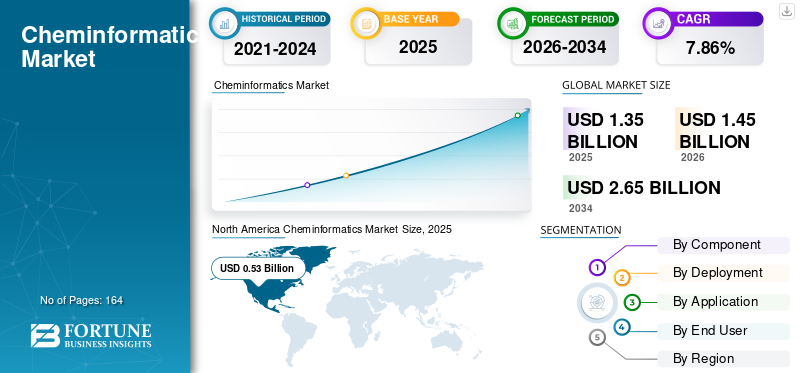
The global cheminformatics market size was valued at USD 1.35 billion in 2025 and is projected to grow from USD 1.45 billion in 2026 to USD 2.65 billion by 2034, exhibiting a CAGR of 7.86% during the forecast period. North America dominated the cheminformatics market with a market share of 39.25% in 2025.
Cheminformatics employs digital technologies and data-oriented approaches to archive, locate, examine, and understand chemical structures, reactions, and molecular characteristics. The market is expanding with increasing demand for quicker and more affordable drug discovery, broader application of compound registration and structure search technologies, rising application of cheminformatics in pharmaceutical and biotechnology firms, and a growing interest in AI-assisted molecular design and reaction planning processes.
Important participants include Schrödinger, Inc., Certara, Dassault Systèmes, and Siemens (Dotmatics), among others. These firms concentrate on enhancing research efficiency, minimize duplication, speed up hit-to-lead and lead optimization processes, and facilitate improved decision-making throughout chemistry-focused R&D.
Download Free sample to learn more about this report.
 Market Size & Forecast
 Market Share
 Key Regional Highlights
North America
North America reached USD 0.53 billion in 2025, supported by strong pharmaceutical and biotechnology R&D activity, high software spending, and early adoption of AI-enabled discovery platforms.
Europe
Europe is projected to expand at a CAGR of 6.27% through 2034, driven by a well-established pharmaceutical industry, strong academic research networks, and public research funding initiatives.
Asia Pacific
Asia Pacific is expected to attain a market value of USD 0.38 billion in 2026, fueled by growing pharmaceutical production, expanding CRO/CDMO capabilities, and improving digital research infrastructure.
U.S.
The U.S. market is projected to reach approximately USD 0.52 billion in 2026, accounting for around 35.7% of global revenue due to its advanced drug discovery ecosystem and significant R&D investments.
Japan
Japan’s market is estimated at approximately USD 0.08 billion in 2026, representing about 5.4% of global revenues, supported by strong pharmaceutical research capabilities and increasing adoption of digital chemistry solutions.
Read More

Increasing Adoption of Artificial Intelligence and Machine Learning in Drug Discovery is a Significant Market Trend
The rising integration of artificial intelligence and machine learning in drug discovery is becoming a key trend, as these technologies assist researchers in quickly analyzing extensive chemical and biological datasets and efficiently identifying potential molecules. Models based on AI and ML are utilized to enhance virtual screening, property forecasting, lead refinement, and synthesis strategy, which minimizes manual work and accelerates early discovery processes. This trend is similarly boosting the need for unified cheminformatics platforms that can merge curated chemical data, predictive modeling, and workflow automation within a single setting. As biotech and pharmaceutical firms aim to reduce attrition and enhance R&D efficiency, AI-driven cheminformatics tools are increasingly vital in routine discovery choices. The trend is additionally reinforced by increasing interest in cloud-based deployment, simplifying model training, collaboration, and access across multiple sites. It is also prompting vendors to move from fundamental data management tools to more intelligence-driven discovery platforms. In general, AI and machine learning are transforming cheminformatics from a supportive role to a more strategic decision-making component in contemporary drug discovery.
Download Free sample to learn more about this report.
Rising Pharmaceutical R&D Spending is Propelling Market Growth
Increasing investment in pharmaceutical R&D significantly propels the market as larger research budgets elevate the need for tools that enhance discovery efficiency, minimize experimental burdens, and aid in superior molecule selection. With the expansion of drug company pipelines, there is a growing necessity for enhanced capabilities in compound registration, structure searching, virtual screening, lead optimization, and property prediction to handle increased volumes of chemistry data. Increased R&D spending also promotes the use of cloud-based and collaborative cheminformatics platforms that link discovery teams across locations. Moreover, businesses are utilizing these tools to enhance productivity, minimize failure risk, and accelerate early-stage development schedules. This directly aids funding for cheminformatics software, content/database platforms, and associated services. With growing investments in discovery infrastructure by pharmaceutical companies, the market benefits from both new implementations and the enhancement of current platforms. In general, increased R&D expenditures enhance the demand for more digital, data-oriented chemistry workflows throughout the drug discovery process.
High Cost of Implementation to Limit Market Growth
The significant expense of implementation is a major limitation in the cheminformatics market, as numerous purchasers require more than merely software licenses; they must also invest in deployment, integration, data migration, customization, validation, training, and continuous support. This complicates adoption for small and mid-sized biotech companies, academic institutions, and budget-conscious research organizations. Often, purchasers are required to integrate new cheminformatics tools with existing ELN, LIMS, screening, and compound registration systems, raising project complexity and overall ownership expenses. Significant initial expenses may postpone buying choices, decrease the scale of initial implementations, or lead companies to implement only specific modules instead of entire platforms. The constraint is more pronounced in emerging markets and smaller end-user groups where IT budgets are restricted. It also hampers migration from legacy systems since replacement expenses can be substantial even when the long-term benefits are evident. Consequently, the cost of implementation continues to be a significant obstacle for wider and quicker cheminformatics market growth.
Rising Drug Discovery Investment to Offer Strong Growth Opportunities
The rise in investment for drug discovery and development is generating a significant market opportunity for cheminformatics, as increased funding amplifies the demand for digital tools that assist researchers in identifying, screening, and optimizing molecules more effectively. With investments in discovery infrastructure by pharmaceutical and biotechnology firms rising, there is a corresponding increase in the need for compound registration, structure search, virtual screening, lead optimization, and predictive modeling platforms. This generates additional chances for cheminformatics providers to offer software, databases/content platforms, and associated services throughout early-stage R&D processes. Increased investment in discovery also fosters the use of cloud-based and collaborative chemistry platforms, particularly when organizations aim to link global research groups and enhance data-driven decision-making. Moreover, increased funding for cutting-edge research centers frequently coincides with a broader application of AI- and simulation-based discovery instruments. This is particularly crucial as businesses aim to minimize timelines, enhance hit quality, and decrease costly wet-lab iterations. Consequently, boosting investment in drug discovery is creating new revenue possibilities for both established and emerging end users within the cheminformatics sector.
Lack of Skilled Personnel in Low and Middle Income Countries Pose Prominent Challenge to Market Growth
The absence of qualified professionals in low- and middle-income nations poses a significant obstacle for the cheminformatics market growth, as effective implementation relies on individuals proficient in chemistry, data analysis, molecular modeling, and digital research processes. In numerous LMICs, the number of trained specialists remains insufficient, hindering the implementation of advanced cheminformatics platforms and limiting the effective utilization of features such as virtual screening, property prediction, and reaction planning. This similarly heightens reliance on outside vendors or partners for execution, training, and continued support, elevating the overall expense of adoption. Moreover, less robust local talent pipelines may hinder research institutes, biotech companies, and new pharmaceutical firms from developing internal computational discovery skills. The issue extends beyond just cheminformatics: the WHO has indicated that LMICs struggle with inadequate biomanufacturing capabilities and a lack of qualified personnel, highlighting that specialized scientific expertise is a persistent limitation in numerous lower-resource markets.
For instance, in February 2024, the World Health Organization (WHO) launched its Biomanufacturing Workforce Training Initiative specifically to strengthen health resilience and address the shortage of qualified workforce capacity affecting LMICs.
Software Segment Dominated Due to its Central Role in Core Cheminformatics Workflows
In terms of component, the market is divided into software, databases/content platforms, and services.
The software segment captured the largest global cheminformatics market share in 2025 owing to its key role in various important processes such as compound registration, structure search, virtual screening, lead optimization, ADME/property prediction, and chemistry data management. Moreover, software platforms serve as the primary operating layer enabling users to access, analyze, and utilize chemical information, positioning them as the leading revenue source in pharmaceutical, biotechnology, academic, and industrial research environments. The segment also gained from increased demand for cloud-based collaboration, AI-supported molecular design, and integrated discovery settings that enhance research speed and lessen manual workload. Moreover, software typically represents the initial significant investment in cheminformatics implementation, whereas databases and services frequently develop alongside the established software infrastructure. This directly enabled increased investment in enterprise platforms, chemistry design tools, and predictive discovery applications, assisting software in retaining its dominant market share.
The services segment is anticipated to rise with a CAGR of 11.00% over the forecast period.
To know how our report can help streamline your business, Speak to Analyst
Strong Demand for Data Control and Internal System Integration Supports On-premise Deployment
Based on deployment, the market is classified into on-premise, cloud/web-based, and hybrid.
The on-premise segment led the global market in 2025 and is set to hold 45.3% share in 2026. Prominent factors supporting this dominance include significant inclination of pharmaceutical, biotechnology, and major research institutions to maintain sensitive chemistry data, compound libraries, and discovery processes within their own IT infrastructures. These users frequently manage sensitive molecular data and exclusive research initiatives, thus internal deployment ensures improved oversight of security, access, validation, and compliance standards. On-premise systems continued to be popular as many organizations had existing legacy infrastructure and opted to incorporate new cheminformatics tools with current internal databases, ELNs, and laboratory systems instead of completely transitioning to cloud.
The cloud/web-based segment is anticipated to rise with a CAGR of 11.29% over the forecast period.
Rising Need for Faster Candidate Selection Supported Segmental Dominance
On the basis of application, the market is divided into compound registration & search, hit discovery & virtual screening, lead optimization, ADME/toxicity /property prediction, reaction planning & synthesis design, chemical data management & decision support, and others.
The compound registration & search segment captured the largest global cheminformatics market share in 2025 owing to its essential role in organizing, storing, and retrieving chemical structures across research workflows. This application is usually the first layer of cheminformatics adoption as companies need to identify unique compounds, avoid duplication, maintain clean structure records, and enable fast access to chemistry data before moving into advanced modeling tasks. It is also widely used across pharmaceutical, biotechnology, academic, and industrial research settings, which supports a larger installed base than more specialized applications. In addition, growing compound volumes and the need for faster structure-based decision-making have further strengthened demand for compound registration & search application. This directly supported higher spending on registration systems, similarity search tools, and searchable compound collections, helping compound registration & search maintain its leading market share. Furthermore, the segment is set to hold a 22.1% market share in 2026.
The reaction planning & synthesis design segment is anticipated to rise with a CAGR of 10.57% over the forecast period.
Pharmaceutical & Biotechnology Companies Segment Dominated the Market due to Strong Use of Cheminformatics in Drug Discovery
Based on end user, the market is segmented into pharmaceutical & biotechnology companies, academic & research institutes, chemical companies, CROs & CDMOs, and others.
The pharmaceutical & biotechnology companies segment dominated the cheminformatics market share by end user in 2025 and is anticipated to hold a 49.2% share in 2026. High use of cheminformatics tools across various workflows, generation of large volumes of molecular and experimental data, higher R&D budgets, and greater demand for faster and more cost-effective discovery are prominent factors supporting the segment’s growth.
The CROs & CDMOs are projected to witness 10.97% growth rate during the forecast period.
Based on geography, the market is segmented into Asia Pacific, Europe, Latin America, North America, and the Middle East & Africa.
North America Cheminformatics Market Size, 2025 (USD Billion)
To get more information on the regional analysis of this market, Download Free sample
The North American market dominated by attaining USD 0.49 billion in 2024 and maintained its dominance in 2025 with USD 0.53 billion. The region has the strongest concentration of pharmaceutical and biotechnology R&D, high software spending capacity, and early adoption of AI-enabled discovery tools. It also benefits from large public and private biomedical research funding and a mature ecosystem for cloud-based scientific software.
The U.S. market led the North American region and is projected to be approximately USD 0.52 billion in 2026, representing about 35.7% of the global market.
Europe’s market size is anticipated to grow at a CAGR of 6.27% during the forecast period supported by its strong pharmaceutical base, well-established academic research network, and major public research funding programs.
In 2026, the U.K. is estimated to account USD 0.08 billion, representing roughly 5.3% of global revenues.
Germany’s market size is projected to reach approximately USD 0.09 billion in 2026, equivalent to around 6.0% of the global sales.
In 2026, Asia Pacific is expected to reach a valuation of USD 0.38 billion with rapid expansion in pharmaceutical and biotech activity, rising CRO/CDMO capabilities, and improving digital research infrastructure.
Japan’s market is estimated at around USD 0.08 billion, accounting for roughly 5.4% of global revenues in 2026.
China is projected to reach revenues of around USD 0.10 million in 2026, representing roughly 7.1% of global sales.
In 2026, the Indian market is estimated to account USD 0.04 billion, representing roughly 2.9% of global revenues.
The Latin America and the Middle East & Africa regions are likely to witness a slower growth over the study period. The market is growing due to gradual digital transformation, improving regulatory and health-system modernization, and rising interest in stronger pharmaceutical access and innovation systems. Latin America’s market is estimated at around USD 0.06 billion in 2026.
In the Middle East & Africa region, the GCC market is projected to reach approximately USD 0.03 billion in 2026, representing about 2.1% of global revenues.
Focus on Platform Upgrades and Integrated Discovery Workflows by Key Players to Propel Market Progress
The global market is moderately consolidated, with firms such as Schrödinger, Inc., Certara, Dassault Systèmes, and Siemens (Dotmatics) having substantial market presence. These firms focus on robust software collections in molecular design, compound registration, structure searches, predictive modeling, and cooperative chemistry processes. Strategic improvements in products, development of cloud-native platforms, AI-driven discovery functionalities, and closer integration of chemistry information with decision-support tools are aiding these companies in solidifying their market position.
Other notable players include OpenEye Scientific, Optibrium, Cresset, BioSolveIT, and Molecular Discovery. These companies are expected to prioritize new product development, workflow expansion, cloud-based capabilities, and strategic collaborations to strengthen their position.
The global cheminformatics market analysis includes a thorough evaluation of the market size and forecasts for every segment highlighted in the report. It offers insights into the market dynamics and trends expected to drive the market throughout the forecast period. It provides understanding of essential factors, including technological progress, product innovations, the regulatory environment, and the launch of new products. Additionally, it details partnerships, mergers & acquisitions, technological advancements, as well as key developments in the industry within the market. The report also provides an in-depth competitive landscape, including information on market share and profiles of key active players.
Request for Customization to gain extensive market insights.
| ATTRIBUTE | DETAILS |
| Study Period | 2021-2034 |
| Base Year | 2025 |
| Estimated Year | 2026 |
| Forecast Period | 2026-2034 |
| Historical Period | 2021-2024 |
| Growth Rate | CAGR of 7.86% from 2026-2034 |
| Unit | Value (USD Billion) |
| Segmentation | By Component, Deployment, Application, End User, and Region |
| By Component |
|
| By Deployment |
|
| By Application |
|
| By End User |
|
| By Region |
|
According to Fortune Business Insights, the global market value stood at USD 1.35 billion in 2025 and is projected to reach USD 2.65 billion by 2034.
In 2025, North Americas market value stood at USD 0.53 billion.
The market is expected to exhibit a CAGR of 7.86% during the forecast period of 2026-2034.
By component, the software segment is expected to lead the market.
Rising need for faster and more cost-effective drug discovery, and wider use of compound registration and structure search platforms, are primarily driving market expansion.
Schrodinger, Inc., Dassault Systèmes, and Certara are some of the prominent players in the global market.
North America dominated the market in 2025 by holding the largest market share.

Get 30-60 hrs Free Customization
Expand Regional and Country Coverage, Segments Analysis, Company Profiles, Competitive Benchmarking, and End-user Insights.













.webp)






Related Reports
Get In Touch With Us
US +1 833 909 2966 ( Toll Free )
Receive a tailored pricing based on your needs.
Discuss your questions with our industry experts.
Have questions? Get quick answers before you purchase.

