Child Care Market Size, Share & Industry Analysis, By Care Settings (Center-Based Child Care, Home-Based Group/Family Child Care, and In-Home Individual Child Care), By Service Arrangement (Regular Full-Day Care, Regular Part-Day Care, Before- and After-School Care, and Temporary & Drop-In Care), By Age Group (Children Below School-Entry Age and School-Age Children), By Provider Ownership (Private For-Profit Providers, Public/Government Providers, and Nonprofit and Community Providers), and Regional Forecast, 2026-2034
 Download Free Sample
(Offer valid till 15th Oct 2026)

Child Care Market Size & Future Outlook
 Listen to Audio Version
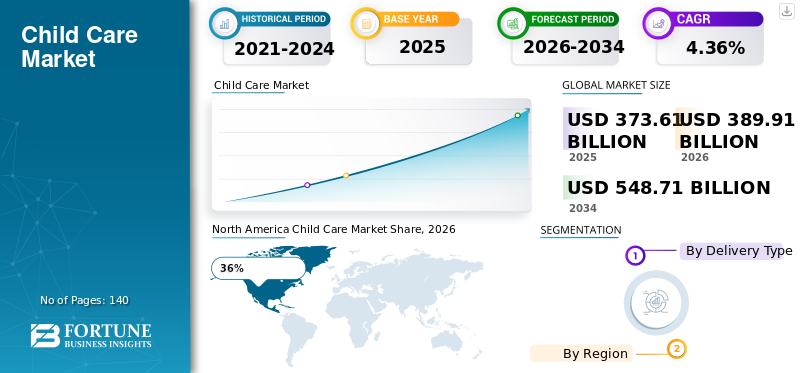
The global child care market size was valued at USD 568.59 billion in 2025 and is projected to grow from USD 598.17 billion in 2026 to USD 963.99 billion by 2034, exhibiting a CAGR of 6.1% during the forecast period. Asia Pacific dominated the child care market with a market share of 40.38% in 2025.
The market comprises center-based daycare and preschool facilities, home-based group and family care, in-home individual care such as nannies and babysitters, and temporary, backup and drop-in care services catering to children from infancy through school age. The market growth is driven by rising urbanization, increasing dual-income households, growing female workforce participation, expanding employer-sponsored care benefits, and greater awareness of the developmental value of early childhood education. Moreover, technological advancements in childcare management software, digital parent communication tools, and AI-enabled operational analytics are also projected to have a positive impact on market growth.
- For instance, in April 2026, Kids & Company acquired Friends for Life Childcare, adding 11 centers in Nova Scotia and expanding its presence in Atlantic Canada.
Furthermore, many key industry players, such as KinderCare Learning Companies, Inc., Bright Horizons Family Solutions Inc., Busy Bees Nurseries Ltd., and Babilou Family are operating in the market and are focusing on developing various services with improved efficiency.
Download Free sample to learn more about this report.
Child Care Market Key Takeaways
 Global Market Size & Forecast
- 2025 Market Size: USD 568.59 billion
- 2026 Market Size: USD 598.17 billion
- 2034 Forecast Market Size: USD 963.99 billion
- CAGR: 6.1% (2026–2034)
 Market Share
- Asia Pacific dominated the market with a 40.38% share in 2025.
- The In-home Individual Child Care segment is projected to grow at a 6.1% CAGR.
- The Temporary & Drop-in Care segment is projected to grow at an 8.4% CAGR.
 Key Regional Highlights
Asia Pacific
Asia Pacific is estimated to reach USD 242.34 billion in 2026, securing the dominant position in the market.
North America
North America reached USD 89.24 billion in 2025, maintaining a substantial market position.
Europe
Europe is projected to reach USD 187.13 billion in 2026, growing at a 5.2% rate.
U.S.
U.S. market is analytically approximated at around USD 79.71 billion in 2026, accounting for roughly 13.3% of global sales.
Japan
Japan market is estimated at approximately USD 27.70 billion in 2026, accounting for roughly 4.6% of global revenues.
Read More

CHILD CARE MARKET TRENDS
Adoption of AI-Enabled Child Care Management Platforms is a Significant Key Trend in Market
Child care providers are increasingly integrating artificial intelligence and cloud-based management platforms into daily center operations, from automated attendance and staff-to-child ratio monitoring to billing, enrollment, and real-time parent communication. This shift is reducing administrative burden on center directors and educators, freeing up time for direct child engagement while improving compliance reporting and operational transparency for parents. The trend is also raising baseline expectations among families, who increasingly view mobile app access, digital daily reports, and instant messaging with caregivers as standard rather than premium features.
- For instance, in July 2026, Procare Solutions rolled out AI-powered analytics across its childcare management software, which providers using the platform credited with a considerable gain in administrative workflow efficiency.
MARKET DYNAMICS
MARKET DRIVERS
Download Free sample to learn more about this report.
Rising Female Workforce Participation and Dual-Income Households to Drive Market Growth
Growing participation of women in the global workforce, combined with a steady rise in dual-income households, continues to expand the global child care market growth. As per Industry, the global female workforce participation is estimated at over 52.8%, with roughly 65% of families now relying on professional child care to support both parents' employment. As more parents pursue uninterrupted careers, demand is rising for full-day, center-based, and employer-linked care options that align with standard working hours. This shift is further reinforced by changing family structures and reduced availability of informal, relative-provided care in urbanizing economies, pushing more families toward formal child care arrangements and structured early education programs that support both parental employment and early childhood development.
Market Drivers - Impact & CAGR Contribution (2026–2034)
| Rank | Market Drivers | Overall Impact Rank | CAGR Contribution (2026–2034) (2026-2034) |
Impact: 2026-2028 | Impact: 2029-2031 | Impact: 2032-2034 |
|---|---|---|---|---|---|---|
| 1 | Rising parental workforce participation and prevalence of dual-income households | High | 2.1% | High | High | High |
| 2 | Expansion of government subsidies, childcare entitlements and publicly supported capacity | High | 1.8% | High | High | Medium |
| 3 | Expansion and formalization of organized child care in underpenetrated markets | High | 1.5% | Medium | High | High |
| 4 | Growing recognition of early childhood development and school-readiness benefits | Medium | 1.4% | Medium | High | High |
| 5 | Growth of employer-sponsored, backup and flexible child care programs | Medium | 1.2% | Medium | High | High |
| 6 | Others | Low | 0.7% | Low | Low | Low |
| Total Positive Growth Contribution | 8.70% | |||||
Source: Fortune Business Insights
Download Free sample For In-Depth Market Drivers & Impact Forecasts
MARKET RESTRAINTS
High Cost of Care and Persistent Workforce Shortages to Restrict Market Growth
The affordability of professional child care remains a significant restraint: Care.com's 2026 Cost of Care Report found that the average parent now spends 20% or more of household income on child care, nearly triple the 7% threshold the U.S. Department of Health and Human Services defines as affordable. At the same time, providers continue to face chronic staffing shortages and high educator turnover. These workforce pressures constrain providers' ability to expand capacity or open new centers even where parental demand is strong, and in some cases have forced existing centers to cap enrollment or reduce operating hours, limiting overall market expansion.
Market Restraints - Impact & Negative CAGR Contribution (2026–2034)
| Rank | Market Restraints | Overall Impact Rank | Negative CAGR contribution (2026–2034) (2026-2034) |
Impact: 2026-2028 | Impact: 2029-2031 | Impact: 2032-2034 |
|---|---|---|---|---|---|---|
| 1 | High childcare fees and affordability pressure on households | High | -1.1% | High | High | Medium |
| 2 | Shortage of qualified caregivers, employee turnover, and rising personnel costs | High | -0.8% | High | High | Medium |
| 3 | Licensing requirements, staff-to-child ratios, and limited provider capacity | Medium | -0.5% | Medium | Medium | Medium |
| 4 | Others | Low | -0.2% | Low | Low | Low |
| Negative Impact | -2.60% | |||||
Source: Fortune Business Insights
Download Free sample For In-Depth Market Restraints & Risk Analysis
MARKET OPPORTUNITIES
Expansion of Employer-Sponsored and Backup Care Benefits to Offer Significant Market Opportunities
A growing number of employers are introducing or expanding child care benefits, including on-site and near-site centers, subsidized tuition, and backup or drop-in care for days when a family's regular arrangement falls through. This corporate and policy momentum by authorities, alongside emerging public-private cost-sharing models in several regions, is opening new revenue channels for providers and is particularly well suited to expanding temporary, backup, and drop-in care formats that complement traditional full-day enrollment.
MARKET CHALLENGES
Complex and Fragmented Regulatory Requirements Across Jurisdictions to Challenge Market Growth
Child care providers must navigate licensing standards, staff-to-child ratio rules, health and safety codes, and curriculum requirements that vary considerably across countries, states, and municipalities. Meeting and maintaining compliance across multiple jurisdictions adds administrative cost and operational complexity for multi-site operators, and can slow the pace at which new centers are licensed and opened. In addition, stringent regulatory and legislative scrutiny of large for-profit operators is also expected to offer substantial challenge for market growth.
- For instance, in March 2026, U.S. Senator Jeff Merkley launched an investigation into private equity ownership of major child care chains, requesting detailed information from KinderCare Learning Companies, Learning Care Group, and their private equity owners on staffing, pricing, and investment practices.
Segmentation Analysis
By Care Settings
Greater Structure, Safety Oversight, and Educational Programming Boosted Center-Based Child Care Segment Growth
Based on care settings, the market is divided into center-based child care, home-based group/family child care, and in-home individual child care.
Center-based child care segment held leading market share in 2025. Center-based facilities offer structured curricula, trained educators, peer socialization, and regulated safety and health oversight that many working parents view as difficult to replicate in home-based or individual care arrangements. In addition, continued investments, staff training, and implementation of enrichment programs as compared to other care facilities to boost segment growth during the forecast period.
The in-home individual child care segment is anticipated to rise with a CAGR of 6.1% over the forecast period.
To know how our report can help streamline your business, Speak to Analyst
By Service Arrangement
Alignment with Standard Working Hours Fueled Regular Full-Day Care Segment Growth
Based on service arrangement, the market is segmented into regular full-day care, regular part-day care, before- and after-school care, and temporary & drop-in care.
In 2025, the regular full-day care segment dominated the global market. Full-day programs match the schedules of dual-income and full-time working parents most closely, offering consistent daily coverage that supports uninterrupted employment without the need for supplemental care arrangements. This need is highlighted by U.S. Bureau of Labor Statistics data, showing both parents are employed in 66.5% of families with children, a structure that leaves little room for part-day or intermittent care. This consistency, combined with the ability of full-day programs to accelerate segment growth by 2034.
The temporary & drop-in care segment is anticipated to rise with a CAGR of 8.4% over the forecast period.
By Age Group
Higher Enrollment Intensity Among Younger Children to Boost Children Below School-Entry Age Segment Growth
Based on age group, the market is segmented into children below school-entry age and school-age children.
In 2025, the children below school-entry age segment dominated the global child care market share. Infants, toddlers, and preschool-age children require the most intensive supervision and caregiver-to-child attention of any age group, translating into higher per-child service intensity and spend relative to school-age programs.
- For instance, according to a data published by the U.S. National Center for Education Statistics, an estimated 60% of children under age 5, roughly 12.3 million children, are in some form of regular child care arrangement.
The school-age children segment is anticipated to rise with a CAGR of 10.0% over the forecast period.
By Provider Ownership
Greater Scale and Multi-Site Expansion Capacity Led to Private For-Profit Providers Segment Growth
Based on provider ownership, the market is segmented into private for-profit providers, public/government providers, and nonprofit and community providers.
In 2025, the private for-profit providers’ centers segment held the highest market share. Large for-profit chains benefit from access to private capital for center acquisitions and new openings, standardized curricula and branding across multi-site networks, and greater flexibility to invest in technology, marketing, and staff recruitment than many public or non-profit operators. This scale advantage has supported continued consolidation activity, with larger operators acquiring independent centers to expand their footprint across regions. Furthermore, the segment is set to hold 45.6% share in 2026.
In addition, public/government providers segment is projected to grow at a CAGR of 6.1% during the forecast period.
Child Care Market Regional Outlook
By geography, the market is categorized into Europe, North America, Asia Pacific, Latin America, and the Middle East & Africa.
Asia Pacific
Asia Pacific Child Care Market Size, 2025 (USD Billion)
To get more information on the regional analysis of this market, Download Free sample
Asia Pacific is estimated to reach USD 242.34 billion in 2026 and secure the dominant position in the market. The market growth is attributed to rapid urbanization, rise in dual-income households, and increasing disposable incomes.
Japan Child Care Market
The Japanese market is estimated at around USD 27.70 billion in 2026, accounting for roughly 4.6% of global revenues.
China Child Care Market
China’s market is projected to be one of the largest globally, with 2026 revenues estimated at around USD 94.44 billion, representing roughly 15.8% of global sales.
India Child Care Market
The Indian market is estimated at around USD 26.08 billion in 2026, accounting for roughly 4.4% of global revenues.
North America
North America held a substantial share of the market in 2024, valued at USD 85.22 billion, and reached USD 89.24 billion in 2025, reflecting continued market growth across the region. The market in North America is expected to increase due to high parental employment rates and significant investments by government authorities.
U.S. Child Care Market
Based on North America’s strong contribution and the U.S. dominance within the region, the U.S. market can be analytically approximated at around USD 79.71 billion in 2026, accounting for roughly 13.3% of global sales.
Europe
Europe is projected to record a growth rate of 5.2% in the coming years, and reach a valuation of USD 187.13 billion by 2026. The region is estimated to witness considerable market growth due to structured government backing, and strict quality and safety regulations.
U.K. Child Care Market
The U.K. market is estimated at around USD 15.56 billion in 2026, representing roughly 2.6% of global revenues.
Germany Child Care Market
Germany’s market is projected to reach approximately USD 62.55 billion in 2026, equivalent to around 10.5% of global sales.
Latin America and Middle East & Africa
The Latin America and Middle East & Africa regions are expected to witness moderate growth in this market during the forecast period. The Latin America market is set to reach a valuation of USD 44.63 billion in 2026. The growth in Latin America is driven by rising demand for affordable organized child care among working families. In the Middle East & Africa, the market is growing due to increasing investments in child care and expansion of daycare facilities.
GCC Child Care Market
The GCC is set to reach a value of USD 11.99 billion in 2026.
South Africa Child Care Market
The South Africa’s market is projected to reach around USD 4.0 billion in 2026, representing roughly 0.66% of global revenues.
COMPETITIVE LANDSCAPE
Key Industry Players
Product Innovation and Strategic Expansion by Key Players to Strengthen Market Growth
The global child care market has a semi-consolidated competitive structure, comprising prominent players such as KinderCare Learning Companies, Inc., Bright Horizons Family Solutions Inc., Busy Bees Nurseries Ltd., and Babilou Family. These companies hold significant market positions due to their established multi-site center networks, strong employer partnerships, structured early-education curricula, and continued investment in digital and AI-enabled classroom and parent-communication platforms. Market participants are increasingly focusing on center acquisitions, employer-sponsored program expansion, curriculum development, and advanced childcare management technology to improve operational efficiency, enrollment experience, and educational outcomes.
- For instance, in May 2026, Brightwheel launched new AI-powered Family Friendly Reports tools, helping educators craft clear, HighScope-aligned family communications and translate updates across families' language preferences.
Other notable players in the global market Learning Care Group, Inc., Goodstart Early Learning Ltd., G8 Education Limited, and JP-HOLDINGS, INC. These companies are expected to prioritize collaborations to increase their global market share during the forecast period.
LIST OF KEY CHILD CARE COMPANIES PROFILED IN REPORT
- KinderCare Learning Companies, Inc. (U.S.)
- Bright Horizons Family Solutions Inc. (U.S.)
- Busy Bees Nurseries Ltd. (U.K.)
- Babilou Family (France)
- Learning Care Group, Inc. (U.S.)
- Goodstart Early Learning Ltd. (Australia)
- G8 Education Limited (Australia)
- JP-HOLDINGS, INC. (Japan)
- Kids & Company (Canada)
- EtonHouse International Education Group (Singapore)
KEY INDUSTRY DEVELOPMENTS
- July 2026: Illinois officially launched the Department of Early Childhood (IDEC), consolidating childcare, preschool, early intervention, and home-visiting programs to streamline services and strengthen support for young children and families statewide.
- June 2026: Learning Care Group's La Petite Academy brand acquired Security Benefit Academy in Topeka, Kansas, bringing the center into its nationwide network.
- June 2026: Bright Horizons and Huggies piloted a new program across Boston-area centers to divert waste from landfills and convert it to energy.
- February 2026: Busy Bees North America expanded into Washington State, acquiring seven Kids N Us Early Learning Schools and six Birch Tree Academy locations across the greater Seattle area.
- February 2026: KinderCare Learning Companies published its seventh annual Confidence Index, conducted with The Harris Poll, reporting that child care has overtaken retirement benefits as one of the most important workplace benefits for working parents.
REPORT COVERAGE
The global child care market analysis includes a comprehensive study of the market size & forecast by all the market segments included in the report. It includes details on the market dynamics and market trends expected to drive the market over the forecast period. It provides information on key aspects, including an overview of technological advancements, the regulatory environment, and product launches. Additionally, it details partnerships, mergers & acquisitions, as well as key industry developments and investments by key regions. The global market research report also provides a depth competitive landscape with information on the market share and profiles of key operating players.
Request for Customization to gain extensive market insights.
Report Scope & Segmentation
| ATTRIBUTE | DETAILS |
| Study Period | 2021-2034 |
| Base Year | 2025 |
| Estimated Year | 2026 |
| Forecast Period | 2026-2034 |
| Historical Period | 2021-2024 |
| Growth Rate | CAGR of 6.1% from 2026-2034 |
| Unit | Value (USD Billion) |
| Segmentation | By Care Settings, Service Arrangement, Age Group, Provider Ownership, and Region |
| By Care Settings |
|
| By Service Arrangement |
|
| By Age Group |
|
| By Provider Ownership |
|
| By Region |
|
Frequently Asked Questions
According to Fortune Business Insights, the global market value stood at USD 568.59 billion in 2025 and is projected to reach USD 963.99 billion by 2034.
In 2025, the North America’s market value stood at USD 89.24 billion.
The market is expected to exhibit a CAGR of 6.1% during the forecast period of 2026-2034.
By care settings, the center-based child care segment is expected to lead the market.
Rising female workforce participation and dual-income households to drive market growth.
KinderCare Learning Companies, Inc., Bright Horizons Family Solutions Inc., Busy Bees Nurseries Ltd., and Babilou Family are the major players in the global market.
Asia Pacific held the largest market share in 2025.



- 2021-2034
- 2025
- 2021-2024
- 115
-
(Offer valid till 15th Oct 2026)
Get 30-60 hrs Free Customization
Expand Regional and Country Coverage, Segments Analysis, Company Profiles, Competitive Benchmarking, and End-user Insights.



















Related Reports
-
US +1 833 909 2966 ( Toll Free )
-
Get In Touch With Us