 Download Free Sample



Get a Quote
Receive a tailored pricing based on your needs.
- Choose license type
- Multiple user options
- Custom scope & coverage
- Fast turnaround
"Smart Strategies, Giving Speed to your Growth Trajectory"
 Listen to Audio Version
The China digital signature market tracking report size was valued at USD 220.00 million in 2024. The market is projected to grow from USD 276.70 million in 2025 to USD 1,501.90 million by 2032, exhibiting a CAGR of 23.40% during the forecast period.
A digital signature uses cryptographic technology to create a digital certificate that verifies the authenticity and integrity of an electronic document. It is a secure, encrypted, and legally recognized method of signing documents electronically, which confirms that the signer’s identity and the document has not been altered.
The Chinese government is increasingly focusing on the development of the digital economy. As part of this initiative, it plans to expand the adoption of electronic signature solutions across sectors such as transportation, finance, human resources, and real estate. This trend is gaining momentum and is likely to boost market growth.
The market is dominated by established players, such as eSign, Qiyue Suo, Shang Shang Qian (BestSign), FaDaDa, and Tencent E-Sign. These companies are focusing on new product launches and investment in R&D activity to expand their product portfolio.
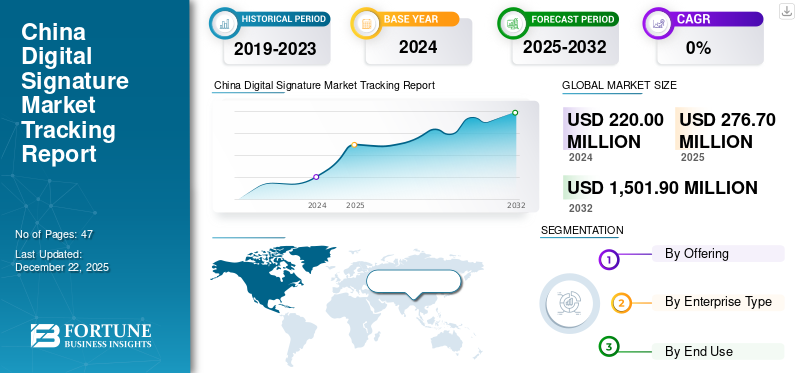
Download Free sample to learn more about this report.
Increasing Popularity of AI-powered Electronic Signature Tool Among Users Fuels Market Growth
The integration of generative AI into China’s electronic signature market is emerging as a key trend, with advancements in automation, identity verification, fraud prevention, and user experience. While still in its early stages, the adoption of generative AI is gaining momentum across the public and private sectors, fueled by the government’s push for digitization and secure e-governance.
Within digital signature platforms, AI models are increasingly being used to simulate, detect, and flag deepfake attempts or fraudulent ID documents in real-time. These systems also support biometric verification methods, such as facial recognition and voice authentication, which are becoming increasingly integral components of digital signing platforms in China.
With Legal Support and Policy Promotion, China’s Electronic Signature Market Gains Momentum
China recognizes and supports the use of electronic signatures through the Electronic Signature Law (ESL), which was enacted in 2004 and later amended. The Electronic Signature Law (ESL) ensures that data messages and electronic signatures are legally binding, providing a solid legal framework for their use. The government is actively promoting the adoption of electronic signature, particularly in e-government services.
Key aspects of China's electronic signature law:
The growing adoption of digital signature solutions across various industries also plays a vital role in fueling the China digital signature market tracking report growth. For instance,
Network Inconsistency and Lack of Communication Infrastructure May Hinder Market Growth
Chinese law generally does not identify foreign digital signature services such as “DocuSign”. Only electronic signatures from government-approved service providers are considered legally valid. While electronic signatures can carry the same legal effect as wet signatures under Chinese law, wet signatures are still regarded as the safest option for legal enforcement.
Thus, this preference can create a hurdle for the adoption of digital signatures and restrict market growth in China.
Growing Adoption of Innovative Technologies to Create Lucrative Opportunities for Market Players
The adoption of AI technology in electronic signature software significantly enhances biometric authentication processes, such as facial and voice recognition by improving accuracy and fraud resistance, especially in remote work and digital signing scenarios.
Further, Blockchain enables smart contracts that automatically execute actions when certain conditions are met, such as payment release or delivery confirmation. This reduces the need for intermediaries and speeds up the entire document signing and validation process. By removing the reliance on manual verification or paper-based records, blockchain also cuts down administrative costs and processing time.
As a result, the integration of these technologies is creating a favorable environment for the electronic signature market in China, offering lucrative opportunities for market expansion.
China’s rapid digital transformation across key industries, including government, finance, healthcare, and education, has contributed to the growth of digital signature software. The Chinese government is digitizing services from business registration to tax filing, all of which require secure, authenticated interactions between citizens, businesses, and government agencies. For instance,
The broader digital acceleration in China, driven by technologies such as cloud and Blockchain has created a significant trend for the adoption of digital signatures in China. These technologies are becoming essential for secure digital transformation. China’s commitment to this shift is boosting efficiency and reinforcing data security, legal validity, and trust in the digital economy.
Rising Popularity of Pay-As-You-Go Pricing Model Boosted Public Cloud Software Offering
Based on offering, the market is divided into public cloud software, software license, and software maintenance.
The public cloud software segment accounted for the largest China digital signature market tracking report share in 2024, as it offers a pay-as-you-go pricing model, which makes it attractive for SMEs and startups. This model helps businesses to launch services quickly from any remote location. Furthermore, public cloud software is compatible with various technologies, such as AI, Blockchain, and big data analytics and they support mobile-first approaches, enabling remote signing via apps and browsers.
Software license is anticipated to grow at the highest CAGR during the forecast period, driven by the rising demand for large enterprises, the BFSI sector, and government entities in China. These organizations prefer licensed software as it provides full control over data storage and access. Additionally, they are easy to implement with companies following high-security IT infrastructure requirements.
The hardware segment is expected to capture 47.6% of the market share in 2025.
Surging Demand for Fraud Prevention and Improved Security Encouraged the Businesses/enterprises Segment Growth
Based on enterprise type, the market is bifurcated into enterprises/businesses (large enterprises and SMEs) and government entities.
Enterprises/businesses captured the largest market share in 2024. The presence of advanced encryption and authentication features in electronic signature platforms enhances security and reduces fraud risks in business/enterprise contracts and deals. Additionally, electronic signature software would enable businesses/enterprises to invest the money they save in order to help their businesses grow larger and more successful. Enterprises/businesses are estimated to capture 78% of the market share in 2025.
Government entities are expected to grow at the highest CAGR of 29.40% during the forecast period (2025-2032). Government officials are increasingly using digital signing platforms to secure emails and other forms of electronic communications. Its platforms ensure authenticity and confidentiality, which further boosts segment growth.
Increasing Demand for Faster Transaction Times Boosted BFSI Segment Growth
Based on end-use, the market is categorized into legal services, BFSI, healthcare, real estate, education, manufacturing, and cross-border trade.
The BFSI (banking, financial services, and insurance) segment accounted for the largest market share in 2024. Banking institutions are increasingly adopting cloud-hosted electronic signature platforms owing to their lower upfront costs, rapid feature updates, and seamless scalability. These platforms help reduce paperwork, accelerate transaction times, and lower operational costs, which is important for the BFSI sector to handle a large volume of agreements. This segment is anticipated to hit 26% of the market share in 2025.
Healthcare is anticipated to grow at the highest CAGR of 30.20% during the forecast period (2025-2032). Many hospitals in the country are now integrating e-signing devices and modules directly into their Hospital Information Systems (HIS) and Electronic Health Record (EHR) platforms. This integration enables hospital staff to scan documents, update patient records, and manage consent workflows seamlessly within existing software.
To know how our report can help streamline your business, Speak to Analyst
Key Market Players Are Focusing on Partnership and Acquisition Strategies to Expand Their Customer Base
Key players are expanding their geographical presence by offering industry-specific services. Major players are strategically focusing on acquisitions and collaborations with Chinese players to maintain their dominance across the country. Top market participants are launching new solutions to increase their consumer base. An increase in constant R&D investments for product innovations is enhancing market expansion. Hence, top companies are rapidly adopting these strategic initiatives to sustain competitiveness in the evolving market landscape.
To know how our report can help streamline your business, Speak to Analyst
eSign, Qiyue Suo, Shang Shang Qian (BestSign), FaDaDa, and Tencent E-Sign are the largest players in the market. The China digital signature market tracking report is consolidated, with the top 5 players accounting for around 67% of the market share. Among the top 5 players, eSign dominated the market by capturing (34%-35%) market share in China.
….and more
January 2025: The Contract Lock electronic signature solution enabled Northeast Normal University to complete a full-stack localization transformation, covering the operating system, CPU, database, and middleware. It also supported the signing of national secret algorithms such as SM2/SM3/SM4, enhancing compliance and security.
July 2024: The “Starry Sky Flagship Edition", an integrated electronic signature, was launched as a collaboration between Kingdee Cloud Starry Sky Flagship Edition and FaDaDa. This solution aims to serve a broad range of industries such as finance, automobiles, medical care, manufacturing, transportation and warehousing, financial leasing, construction, consumer goods retail, and real estate.
July 2023: Zhejiang Dahua Technology Co., Ltd partnered with Shangshangqian to implement electronic signatures for corporate logistics. This initiative supports the sector’s shift toward low-carbon and digital operations, accelerating value and efficiency transformation.
April 2023: Shangshangqian launched the industry's first exclusive AI product, "Hubble“. Hubble helps customers to summarize the contents of the contract during initialization.
September 2021: eSign completed the first E-round financing with an amount of USD 185.5 million (1.2 billion yuan) in China's electronic signature industry. In the same month, the company acquired Jinge Technology.
Key players operating in the market, such as eSign, Qiyue Suo, Shang Shang Qian (BestSign), FaDaDa, and Tencent E-Sign, aim to expand their businesses by integrating novel technologies in their electronic signature services. For instance,
Additionally, funding rounds focused on technology enhancements indicate investor confidence in the sector’s innovation potential. For instance,
The report provides a detailed analysis of the market and focuses on key aspects such as leading companies, service types, and leading applications of the product. Besides, the report offers insights into the market trends and highlights key industry developments. In addition to the factors above, the report encompasses several factors that contributed to the growth of the market in recent years.
Request for Customization to gain extensive market insights.
|
ATTRIBUTE |
DETAILS |
|
Study Period |
2019-2032 |
|
Base Year |
2024 |
|
Forecast Period |
2025-2032 |
|
Historical Period |
2019-2023 |
|
Growth Rate |
CAGR of 27.3% from 2025 to 2032 |
|
Unit |
Value (USD Million) |
|
Segmentation |
By Offering, Enterprise Type, End Use |
|
Segmentation |
By Offering
By Enterprise Type
By End Use
|
The market is expected to reach USD 1,501.9 million by 2032.
In 2024, the market was valued at USD 220.0 million.
The market is projected to grow at a CAGR of 27.3% during the forecast period.
By offering, the public cloud software segment led the market.
Legal support and policy promotion a key factors driving market expansion.
eSign, Qiyue Suo, Shang Shang Qian (BestSign), FaDaDa, and Tencent E-Sign are the top players in the market.
By end use, the healthcare sector is expected to grow with the highest CAGR during the forecast period.

Get 30-60 hrs Free Customization
Expand Regional and Country Coverage, Segments Analysis, Company Profiles, Competitive Benchmarking, and End-user Insights.




















Related Reports
Get In Touch With Us
US +1 833 909 2966 ( Toll Free )
Receive a tailored pricing based on your needs.
Discuss your questions with our industry experts.
Have questions? Get quick answers before you purchase.

