Chloroprene Rubber Market Size, Share & Industry Analysis, By Application (Automotive, Electrical & Electronics, Construction, Textile, and Others), and Regional Forecast, 2026-2034
 Download Free Sample
KEY MARKET INSIGHTS
 Listen to Audio Version
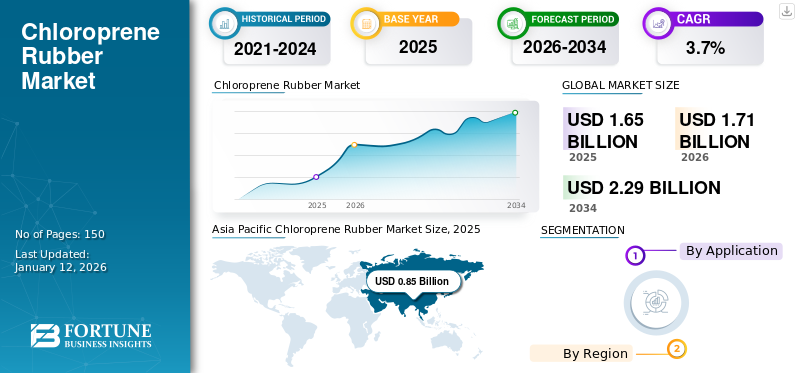
The global chloroprene rubber market size was valued at USD 1.65 billion in 2025 and is projected to grow from USD 1.71 billion in 2026 to USD 2.29 billion by 2034 at a CAGR of 3.7% during the forecast period of 2026-2034. Asia Pacific dominated the chloroprene rubber market with a market share of 51.20% in 2025.
Chloroprene rubber (also known as neoprene) is valued for its excellent resistance to heat, weathering, oil, flame, and chemicals, making it a preferred material in applications requiring durability and performance. Automotive is the largest end-use sector, as the product is essential for manufacturing gaskets, seals, hoses, and belts due to its superior thermal stability, durability, and resistance to heat, oil, and chemicals. Increasing product adoption in the automotive industry will drive the market growth. Showa Denko K.K., Denka Group, Lanxess AG, Asahi Kasei Chemicals Corporation, and ARLANXEO are the key players operating in the market.
Download Free sample to learn more about this report.
Chloroprene Rubber Market KEY TAKEAWAYS
 Global Market Size & Forecast
- 2025 Market Size: USD 1.65 billion
- 2026 Market Size: USD 1.71 billion
- 2034 Forecast Market Size: USD 2.29 billion
- CAGR: 3.7% from 2026–2034
 Market Share
- Asia Pacific dominated the chloroprene rubber market with a 51.20% share in 2025.
- The automotive segment is projected to hold a 5.85% share in 2026.
- Electrical & electronics remained a key application segment, driven by demand for insulation and wire coatings.
 Key Regional Highlights
Asia Pacific
Asia Pacific generated USD 0.85 billion with a 51.20% market share in 2025.
Europe
Europe reached USD 0.42 billion, accounting for 25.20% of the global market in 2025.
North America
North America recorded USD 0.28 billion, representing 17.00% of the global market in 2025.
U.S.
The market reached USD 0.24 billion in 2025, supported by automotive and EV demand.
Japan
The market was valued at USD 0.06 billion in 2025.
Read More

Chloroprene Rubber Market Trends
Growing Environmental Concerns and Sustainability Initiatives to Boost Market Growth
With growing environmental concerns, manufacturers are looking to produce more eco-friendly variants of their products, focusing on sustainable practices and materials in the production process. Growing trend toward developing products from bio-based feedstocks, such as biomass and plant-derived materials, reducing reliance on petrochemicals and lowering greenhouse gas emissions. These bio-based neoprene variants offer a sustainable alternative and are increasingly attractive to environmentally conscious industries and consumers.
Download Free sample to learn more about this report.
Market Dynamics
Market Drivers
Increasing Demand For Automotive Components Made From Chloroprene Rubber Drives Market Growth
The increasing demand for automotive components made from chloroprene rubber due to its excellent durability, weather resistance, and flexibility, fuels the chloroprene rubber market growth. The product is widely used in the automotive industry for manufacturing critical components such as gaskets, seals, hoses, belts, bushings, and mounts. Its superior thermal stability, resistance to heat, oil, chemicals, and weathering make it indispensable for parts exposed to harsh operating conditions. Automotive manufacturers increasingly prioritize materials that can withstand extreme temperatures, chemical exposure, and mechanical stress. The product’s unique properties enable it to meet these stringent requirements, supporting its growing adoption in automotive applications.
Market Restraints
Volatility in Raw Material Prices May Limit Market Growth
Volatility in raw material prices is a significant factor that may constrain the market growth. The product is derived from petrochemical feedstocks, making its production costs highly sensitive to fluctuations in crude oil and related raw material prices.
Geopolitical tensions, supply chain disruptions, and currency fluctuations can compound raw material price volatility, especially in regions that import petrochemical feedstocks. While larger companies may absorb these cost increases or invest in alternative sourcing, smaller manufacturers often struggle to remain competitive, potentially limiting overall market growth.
Market Opportunities
Expansion in High-Performance Applications will Create Significant Growth Opportunities
The rising demand for high-performance materials in aerospace, marine, and electronics industries can lead to new applications for neoprene, expanding its market reach. This growth is driven by the product’s unique combination of mechanical strength, thermal stability, chemical resistance, and durability, making it an ideal material for demanding environments.
Research and development are enhancing neoprene’s properties, such as reinforcing with advanced fillers (e.g., zirconia), leading to composites with significantly improved strength, modulus, and thermal stability. These innovations expand the product’s suitability for even more demanding applications.
Market Challenges
Environmental Regulations Could Lead to Several Market Challenges
Increasingly stringent environmental regulations concerning the production and disposal of products can pose significant compliance challenges, potentially increasing production costs. The costs of compliance with stringent environmental standards can be prohibitive, especially for smaller manufacturers, who may struggle to afford the necessary upgrades or process changes. Larger companies are generally better positioned to absorb these costs, but overall, increased regulatory pressure can impact profitability and market competitiveness.
Furthermore, governments globally enforce stricter standards on emissions and waste from neoprene production, particularly targeting volatile organic compounds (VOCs) and hazardous air pollutants. These regulations require companies to implement advanced emission control systems and cleaner production technologies, often demanding significant capital investment. Hence, these stringent regulations may hinder the market significantly.
Impact of COVID-19
Stalled Supply Chain Due to COVID-19 Pandemic Hampered Market Growth
The COVID-19 pandemic led to widespread halts in manufacturing activities, particularly in Europe, where stalled industrial output directly affected the product market. This slowdown was especially pronounced in sectors such as automotive and transportation, major product end-users.
The pandemic caused interruptions in raw materials and logistics supply, leading to delays and increased costs for product manufacturers. This further constrained market growth and affected the availability of finished products.
Trade Protectionism and Geopolitical Impact
Protectionist Policies and Trade Barriers to Restrict Market Growth
Rising protectionist policies and trade barriers in major markets have complicated the cross-border trade of the product and its raw materials. These restrictions can increase costs for manufacturers reliant on imports, impacting production timelines and overall market stability.
The automotive, construction, and electronics sectors, major consumers of neoprene, are sensitive to these geopolitical and trade factors. Fluctuating raw material availability and pricing can delay production and increase costs downstream, affecting overall market growth and investment decisions.
Research and Development (R&D) Trends
Blending Recycled Products to Create Opportunities for Market Growth
Advanced recycling technologies are being developed to reuse neoprene waste, blend it with other rubbers, and create new materials with reduced environmental impact. This includes using neoprene waste as a blend component with natural rubber and other synthetic rubbers, which helps reduce overall waste and production costs. This will create growth opportunities for the market.
Segmentation Analysis
By Application
Automotive Segment Dominated Market Due to Increasing Use of Various Plastic and Polymer-based Medical Devices
On the basis of application, the market is segmented into automotive, electrical & electronics, construction, textile, and others.
To know how our report can help streamline your business, Speak to Analyst
The automotive segment accounted for the dominant global chloroprene rubber market share of 5.85% in 2026. The product is widely used for manufacturing hoses, gaskets, seals, belts, and O-rings due to its resistance to heat, oils, chemicals, and its durability under harsh operating conditions. The growth of the automotive industry, especially the demand for fuel-efficient and durable vehicles, continues to drive this segment.
The product is used for insulation, flexible cables, wire coatings, and components in electrical and electronic devices. Its dielectric properties, flame resistance, and ability to withstand high temperatures and harsh environments make it ideal for these applications. It is also used in special connecting wires, electric welders, and portable electrical equipment.
The construction segment also registers positive growth during the forecast period. Due to its weather, ozone, and UV resistance, the product is used in roofing membranes, waterproof seals, bridge bearings, window seals, and other architectural rubber products. The ongoing global construction growth, particularly in emerging markets, boosts product demand.
Chloroprene Rubber Market Regional Outlook
By region, the market is segmented into North America, Europe, Asia Pacific, Latin America, and the Middle East & Africa.
Asia Pacific
Asia Pacific Chloroprene Rubber Market Size, 2025 (USD Billion)
To get more information on the regional analysis of this market, Download Free sample
Asia Pacific accounted for USD 0.85 billion in 2025, representing 51.20% of the global market share, and is projected to reach USD 0.88 billion in 2026. China is a major driver due to its expanding industrial and automotive sectors. China is expected to reach USD 0.46 billion in 2025. Rapid industrialization, urbanization, growing automotive and construction sectors, and infrastructure investments are boosting the market in this region. Government initiatives to improve automotive facilities further contribute to market expansion in this region. India is poised to grow with a valuation of USD 0.46 billion in 2025, while Japan is expected to be valued at USD 0.06 billion in 2025, while Japan is poised to attain USD 0.09 billion in the same year.
To know how our report can help streamline your business, Speak to Analyst
North America
The North America market generated USD 0.28 billion in 2025, representing 17.00% of the global market landscape, and is expected to reach USD 0.29 billion in 2026. The North America chloroprene rubber market is expected to grow significantly, driven by increasing demand from the automotive and construction industries. The U.S. held the largest revenue share within North America in 2024, fueled by demand from the automotive and construction sectors. The shift toward electric vehicles also increases the need for high-performance materials, including neoprene. The U.S. market is poised to grow with a valuation of USD 0.24 billion in 2025.
Europe
Europe contributed 25.20% to the global market in 2025, with a valuation of USD 0.42 billion, and is projected to reach USD 0.43 billion in 2026. The region is also a positive contributor to the market. Germany led the European market in 2024, driven by a strong manufacturing base and automotive industry. The U.K. market continues to expand, predicted to be valued at USD 0.06 billion in 2025. The automotive sector's demand for lightweight and high-performance components drives the need for the product. Germany is expected to gain USD 0.13 billion in 2025, while France is forecast to stand at USD 0.08 billion in the same year.
Middle East & Africa and Latin America
In 2025, the Middle East & Africa held 4.20% of the global market, reaching a valuation of USD 0.07 billion, and is projected to grow to USD 0.07 billion in 2026. The market is expected to be driven by automotive, construction, and electrical and electronic applications. The growing automotive aftermarket and easy availability of raw materials are likely to provide the necessary thrust for growth. The GCC market is forecasted to gain USD 0.03 billion in 2025. Latin America contributed approximately USD 0.04 billion to the global market in 2025, accounting for 2.30% share, and is expected to reach USD 0.04 billion in 2026.
Competitive Landscape
Key Market Players
Key Players Adopted an Expansion Growth Strategy to Maintain Their Dominance in Market
In terms of the competitive landscape, the market represents the presence of emerging and established companies. Showa Denko K.K., Denka Group, Lanxess AG, Asahi Kasei Chemicals Corporation, and ARLANXEO are the major players in this market. These companies possess substantial production capabilities and manufacture products for industry-specific applications. They are also expanding their manufacturing capacity and sales and distribution network globally.
List of Key Chloroprene Rubber Companies Profiled
- Resonac Corporation (Japan)
- Denka Group (Japan)
- Zenith Industrial Rubber Products Pvt. Ltd (India)
- Asahi Kasei Chemicals Corporation (Japan)
- ARLANXEO (Netherlands)
- Milagro Rubber Company, Inc. (U.S.)
- SEDO Chemicals Neoprene GmbH (Germany)
- Qingdao Nova Rubber (China)
- Wealth Ocean Inc. (U.S.)
- Sundow Polymers Co., Ltd. (China)
KEY INDUSTRY DEVELOPMENTS
- October 2021: Nike announced its collaboration with Liverpool F.C., honoring the team's colors by introducing new football footwear. The Air Huarache combines red, white, black, and yellow, featuring a red and white checkerboard pattern on a solid red neoprene base. This base also incorporates off-white overlays and white and yellow neoprene positioned in the center of the shoes’ tongues.
REPORT COVERAGE
The report provides a detailed analysis of the market. It focuses on key aspects, such as leading companies, types, compositions used to produce products, and applications. Besides this, it offers insights into the market and current industry trends and highlights key industry developments. In addition to the factors mentioned above, it encompasses several factors contributing to the market's growth.
Request for Customization to gain extensive market insights.
Report Scope & Segmentation
|
ATTRIBUTE |
DETAILS |
|
Study Period |
2021-2034 |
|
Base Year |
2025 |
|
Estimated Year |
2026 |
|
Forecast Period |
2026-2034 |
|
Historical Period |
2021-2024 |
|
Unit |
Value (USD Billion) and Volume (Kiloton) |
|
Growth Rate |
CAGR of 3.7% from 2026 to 2034 |
|
Segmentation |
By Application
|
|
By Region
|
Frequently Asked Questions
Fortune Business Insights says that the global market size was valued at USD 1.65 billion in 2025 and is projected to record a valuation of USD 2.29 billion by 2034.
In 2025, the Asia Pacific market value stood at USD 1.65 billion.
Recording a CAGR of 3.7%, the market will exhibit steady growth during the forecast period of 2026-2034.
By application, the automotive segment led the market in 2025.
Increasing demand for automotive components made from chloroprene rubber is a key factor driving market growth.
Asia Pacific captures the highest market share.



- 2021-2034
- 2025
- 2021-2024
- 150
Get 30-60 hrs Free Customization
Expand Regional and Country Coverage, Segments Analysis, Company Profiles, Competitive Benchmarking, and End-user Insights.


















Related Reports
-
US +1 833 909 2966 ( Toll Free )
-
Get In Touch With Us