 Download Free Sample



Get a Quote
Receive a tailored pricing based on your needs.
- Choose license type
- Multiple user options
- Custom scope & coverage
- Fast turnaround
"Designing Growth Strategies is in our DNA"
 Listen to Audio Version
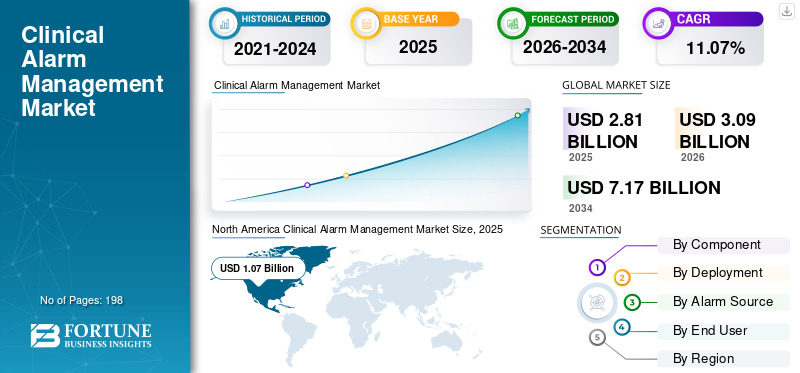
The global clinical alarm management market size was valued at USD 2.81 billion in 2025 and is projected to grow from USD 3.09 billion in 2026 to USD 7.17 billion by 2034, exhibiting a CAGR of 11.07% during the forecast period. North America dominated the clinical alarm management market with a market share of 38.08% in 2025.
Clinical alarm management systems are employed to collect, prioritize, direct, and escalate alarms produced by various connected clinical devices. These solutions aid in minimizing alarm fatigue, enhancing caregiver response rates, promoting patient safety, and bolstering workflow efficiency in hospitals, ambulatory surgical facilities, and post-acute care environments. The market is growing as healthcare organizations boost investments in alarm management solutions, tools for clinical communication and collaboration, middleware for medical device integration, alarm analytics, and clinical surveillance systems to handle increasing alarm levels in ICUs, emergency departments, operating rooms, telemetry units, and general wards. The market is further bolstered by rising demand for both centralized and decentralized alarm workflows, heightened adoption of mobile alerting and virtual nursing approaches, an increased emphasis on minimizing non-actionable alarms, and growing utilization of cloud-based and hybrid solutions that enhance interoperability, reporting, and overall alarm visibility across the enterprise.
Key players operating in the global market include Stryker, GlobeStar Systems, Inc., Ascom, Koninklijke Philips N.V., Baxter, and others. These firms are focusing on platform enhancement, medical device and EHR integration, alarm analytics expansion, clinical surveillance capabilities, strategic acquisitions, and workflow automation initiatives to strengthen their market presence.
Download Free sample to learn more about this report.
 Global Market Size & Forecast
 Market Share
 Key Regional Highlights
North America
North America reached USD 1.07 billion in 2025, driven by strong hospital IT infrastructure, clinical communication platform adoption, and increasing focus on patient safety.
Europe
Europe expected to grow at a 10.11% CAGR during the forecast period, supported by hospital digitalization, interoperability programs, and connected clinical workflows.
Asia Pacific
Asia Pacific projected to reach USD 0.74 billion by 2026, emerging as the fastest-growing region due to hospital expansion, smart hospital investments, and connected monitoring adoption.
U.S.
The market is projected to reach USD 1.04 billion by 2026, accounting for approximately 33.7% of global revenues.
Japan
The market is projected to reach USD 0.18 billion by 2026, accounting for approximately 5.7% of global revenues.
Read More

Increasing Adoption of Connected Medical Devices is a Major Trend
The growing use of interconnected medical devices is emerging as a significant trend in the clinical alarm management industry. Hospitals are employing additional patient monitors, ventilators, infusion pumps, nurse call systems, smart beds, telemetry systems, and wearable monitoring devices, leading to a rise in the volume of alarms produced throughout care environments. With the rise of alarm sources, hospitals require middleware and alarm management systems that can gather device information, eliminate non-actionable alerts, and direct essential notifications to the appropriate caregiver. This is also raising the need for clinical communication platforms, as alarms must now be sent via mobile devices, badges, dashboards, and centralized monitoring systems.
The trend is particularly prominent in ICUs, emergency departments, telemetry units, operating rooms, and virtual monitoring systems, where numerous devices link to each patient. Consequently, vendors are concentrating on device compatibility, immediate alert distribution, and monitoring features to assist hospitals in diminishing alarm fatigue and enhancing response times. Throughout the forecast period, this trend is anticipated to facilitate increased adoption of middleware for medical device integration, alarm analytics, and platforms for clinical surveillance. These factors are supporting the overall global clinical alarm management market growth.
Download Free sample to learn more about this report.
Rising Alarm Fatigue across Hospitals to Boost Market Growth
Rising alarm fatigue is one of the strongest drivers for the market, as hospitals are dealing with a high number of alarms from patient monitors, ventilators, infusion pumps, telemetry systems, nurse call systems, and other connected devices. Many of these alarms are non-actionable or low priority, which can make clinicians less responsive and increase the risk of delayed intervention. This is pushing hospitals to adopt alarm management platforms that can filter unnecessary alarms, prioritize critical alerts, route alarms to the right caregiver, and escalate alerts when there is no response. The need is especially high in ICUs, emergency departments, telemetry units, operating rooms, and high-acuity wards where alarm volumes are heavy. As hospitals focus more on patient safety, staff efficiency, and nurse burnout reduction, demand is increasing for alarm analytics, clinical communication platforms, and medical device integration middleware. Therefore, alarm fatigue is directly supporting the growth of software-led alarm management solutions across hospitals and health systems.
High Implementation and Integration Complexity to Limit Market Growth
Significant complexity in implementation and integration serves as a key limitation for the market, as these systems need to interface with various hospital technologies simultaneously, such as patient monitors, ventilators, infusion pumps, nurse call systems, telemetry systems, EHRs, mobile devices, and hospital networks. Numerous hospitals continue to rely on outdated infrastructure and equipment from various vendors, complicating interoperability and prolonging deployment time. When alarms are not integrated correctly, hospitals could encounter repeated alerts, postponed notifications, overlooked alarms, or diminished caregiver confidence in the system. This also heightens the demand for personalization, interface evaluations, clinical process reengineering, cybersecurity assessments, and employee training, which elevates overall implementation expenses. Consequently, smaller hospitals and facilities with restricted IT resources might postpone adoption or only implement alarm management in specific departments. This complexity may hinder market penetration despite a strong demand for reducing alarm fatigue.
Expansion of Remote Monitoring and Clinical Surveillance to Generate New Growth Prospects
The growth of remote monitoring and clinical oversight is establishing a significant opportunity for the clinical alarm management sector. Hospitals are progressively moving away from bedside-only monitoring to centralized monitoring units, virtual care centers, and comprehensive surveillance systems. This generates a need for platforms capable of gathering alerts from connected devices, assessing real-time patient information, prioritizing notifications, and escalating urgent alarms to the appropriate care team. The potential is particularly substantial in telemetry, ICU, step-down units, and virtual nursing programs, as hospitals need to oversee more patients while having fewer staff.
With healthcare systems grappling with workforce shortages and increased patient acuity, remote monitoring can enhance response times, minimize unnecessary bedside distractions, and promote safer patient care. This is anticipated to boost the uptake of clinical monitoring systems, alarm analysis tools, middleware for medical device integration, and cloud/hybrid alarm management solutions. All these factors are expected to drive the market growth in the coming years.
High Upfront Cost and Unclear ROI for Smaller Facilities Pose a Prominent Challenge to Market Growth
Significant initial expenses and ambiguous return on investment continue to be major hurdles for the market, particularly for smaller hospitals, ASCs, long-term care facilities, and post-acute care providers. These facilities might require investment not just in alarm management software, but also in device integration, interface creation, mobile communication tools, training for staff, cybersecurity measures, and continuous support. In contrast to large health systems, smaller facilities may lack sufficient monitored beds or organization-wide use cases to warrant a significant implementation budget promptly. Measuring the financial return is challenging as advantages such as a decrease in missed alarms, enhanced response times, lower nurse workload, and improved patient safety are often indirect. Consequently, purchasers might postpone adoption, initiate with restricted departmental implementations, or select more affordable basic alerting solutions rather than comprehensive alarm management systems. This obstacle can hinder market penetration despite a significant clinical demand for reducing alarm fatigue. All the factors cumulatively affect the market growth.
Software/Platforms Segment Dominated Due to Need for Real-time Alarm Routing and Integrated Clinical Workflows
In terms of component, the market is divided into software/platforms, and services.
The software/platforms segment led the global clinical alarm management market share in 2025. Hospitals are increasingly dependent on these platforms to minimize alarm fatigue, deliver actionable alerts to the appropriate caregiver, and enable quicker responses throughout ICUs, emergency departments, operating rooms, telemetry units, and general wards. The prevalence of this segment is further reinforced by the increasing utilization of clinical communication platforms, medical device integration middleware, alarm analytics dashboards, and clinical surveillance systems. As a result, ongoing software licenses, platform subscriptions, and organization-wide alarm management modules maintain the software/platforms segment's lead in terms of market value.
The services segment is anticipated to rise with a CAGR of 9.69% over the forecast period.
To know how our report can help streamline your business, Speak to Analyst
Strong Need for Local Device Connectivity and Real-time Alarm Reliability Allowed On-premise Segment to Dominate
Based on deployment, the market is classified into cloud-based, on-premise, and hybrid.
The on-premise segment accounted for the dominant market share in 2025, driven by the high reliability, low latency, and uninterrupted access within ICUs, emergency departments, operating rooms, and telemetry units of these solutions. Additionally, on-premise systems also allow hospitals to maintain greater control over patient data, device interfaces, cybersecurity settings, and clinical workflow configuration. Furthermore, the segment is set to hold 40.7% share in 2026.
The cloud-based segment is anticipated to rise with a CAGR of 15.31% over the forecast period.
High Alarm Volume from Bedside and Multiparameter Monitors Boosted Patient Monitoring Systems Segment Growth
On the basis of alarm source, the market is divided into patient monitoring systems, ventilators, infusion pumps, nurse call systems, telemetry systems, and others.
In 2025, the market share was primarily led by the patient monitoring systems segment. This is due to bedside monitors, multiparameter monitors, central monitoring stations, and vital-sign monitors being used across high-acuity and general care settings. The dominance of this segment is further supported by the growing use of continuous monitoring and connected patient monitoring platforms that require alarm routing, escalation, and analytics. Furthermore, the segment is set to hold 32.8% share in 2026.
The telemetry systems segment is anticipated to rise with a CAGR of 13.19% over the forecast period.
Hospitals & ASCs Led Demand Due to High Alarm Burden Across Acute-care Settings
Based on end user, the market is segmented into hospitals & ASCs, long-term care & post-acute care facilities, and others.
The hospitals & ASCs segment dominated the market share in 2025. The dominance of the segment is attributed to the fact that these facilities manage the highest concentration of alarm-generating devices, including patient monitors, ventilators, infusion pumps, telemetry systems, nurse call systems, anesthesia machines, and recovery-room monitoring equipment. The dominance of this segment is further supported by larger IT budgets, stronger medical device integration needs, and enterprise-wide clinical communication programs in hospitals and health systems. Furthermore, the segment is set to hold 82.4% share in 2026.
Long-term care & post-acute care facilities are projected to grow at a 16.91% CAGR during the forecast period.
Based on region, the global market is divided into Latin America, Asia Pacific, Europe, North America, and the Middle East & Africa.
North America Clinical Alarm Management Market Size, 2025 (USD Billion)
To get more information on the regional analysis of this market, Download Free sample
North America was valued at USD 0.98 billion in 2024 to dominate the clinical alarm management industry. In 2025, the region maintained its dominance, with a market valuation of USD 1.07 billion. North America is expanding due to high adoption of clinical communication platforms, strong hospital IT infrastructure, and greater focus on patient safety. The region has a large base of acute-care hospitals using patient monitors, telemetry systems, nurse call systems, and connected medical devices, which creates strong demand for alarm routing and analytics.
The U.S. market led the North American region and is projected to be approximately USD 1.04 billion in 2026, representing about 33.7% of global revenues.
The market in Europe is set to grow at a CAGR of 10.11% during the forecast period. Europe’s growth is supported by increasing hospital digitalization, stronger interoperability programs, and the adoption of connected clinical workflows across Western European healthcare systems.
The U.K. market in 2026 is estimated at around USD 0.16 billion, representing roughly 5.2% of global revenues.
The German market size is projected to reach approximately USD 0.19 billion in 2026, equivalent to around 6.0% of global sales.
The Asia Pacific market size is expected to reach a valuation of USD 0.74 billion in 2026. Asia Pacific is expected to show the fastest growth due to hospital expansion, rising smart hospital investments, and growing adoption of connected monitoring in Asian countries. Additionally, the region has a large patient base and expanding private hospital chains, creating opportunities for new clinical communication, device integration, and surveillance deployments.
The Japanese market in 2026 is estimated at around USD 0.18 billion, accounting for roughly 5.7% of global revenues.
China’s market is projected to reach USD 0.24 billion in 2026, representing roughly 7.6% of global sales.
The Indian market in 2026 is estimated at around USD 0.08 billion, accounting for roughly 2.5% of global revenues.
The growth in the Latin America and Middle East & Africa regions is anticipated to be moderate in the coming years. The growth is driven mainly by private hospitals and large urban health systems in countries. Additionally, New hospital projects, smart hospital programs, digital health initiatives, and command-center models are increasing demand for connected alarm workflows, remote monitoring, and clinical surveillance. The Latin America market in 2026 is estimated at around USD 0.20 billion.
In the Middle East & Africa region, the GCC market is projected to reach approximately USD 0.08 billion in 2026, representing about 2.6% of global revenues.
Integrated Alarm Platforms and Clinical Communication Capabilities to Support Players’ Market Positions
The global clinical alarm management market reflects a moderately fragmented competitive landscape, consisting of major companies such as Stryker, GlobeStar Systems, Inc., Ascom, Koninklijke Philips N.V., and Baxter, representing a significant portion of market revenue. The considerable market presence of these companies is owing to their broad portfolios, focus on integrated solutions, which is anticipated to strengthen their competitive position across the forecast period.
Other significant participants include TigerConnect, Masimo, Spok, and GE Healthcare, among others. These firms are also emphasizing mobile-first clinical communication, cloud/hybrid deployments, alarm analytics, centralized monitoring, technological advancements, and device interoperability to reduce alarm fatigue, improve response times, and expand enterprise-wide adoption.
The global clinical alarm management market analysis includes a thorough evaluation of the market size and forecasts for every segment highlighted in the report. It offers insights into the market dynamics and trends expected to drive the market throughout the forecast period. It provides an understanding of key factors, including technological progress, product innovations, the regulatory environment, and new product launches. Additionally, it details partnerships, mergers & acquisitions, and key developments in the industry within the market. The global market forecast report also provides an in-depth competitive landscape, including market share and profiles of key players.
Request for Customization to gain extensive market insights.
| ATTRIBUTE | DETAILS |
| Study Period | 2021-2034 |
| Base Year | 2025 |
| Estimated Year | 2026 |
| Forecast Period | 2026-2034 |
| Historical Period | 2021-2024 |
| Growth Rate | CAGR of 11.07% from 2026-2034 |
| Unit | Value (USD Billion) |
| Segmentation | By Component, Deployment, Alarm Source, End User, and Region |
| By Component |
|
| By Deployment |
|
| By Alarm Source |
|
| By End User |
|
| By Region |
|
According to Fortune Business Insights, the global market value stood at USD 2.81 billion in 2025 and is projected to reach USD 7.17 billion by 2034.
In 2025, the market value in North America stood at USD 1.07 billion.
The market is expected to exhibit a CAGR of 11.07% during the forecast period of 2026-2034.
By component, the software/platforms segment led the market in 2025.
Rising alarm fatigue across hospitals and growing focus on patient safety and regulatory compliance are primarily driving market expansion.
Stryker, GlobeStar Systems, Inc., Ascom, Koninklijke Philips N.V., and Baxter are some of the prominent players in the global market.
North America dominated the market in 2025.

Get 30-60 hrs Free Customization
Expand Regional and Country Coverage, Segments Analysis, Company Profiles, Competitive Benchmarking, and End-user Insights.













.webp)






Related Reports
Get In Touch With Us
US +1 833 909 2966 ( Toll Free )
Receive a tailored pricing based on your needs.
Discuss your questions with our industry experts.
Have questions? Get quick answers before you purchase.

