Clinical Trial Supply Logistics Market Size, Share & Industry Analysis, By Service (Logistics & Distribution, Storage & Retention), By Phase, By Therapeutic Area (Oncology, Cardiovascular Diseases), By End Use, and Regional Forecast, 2026-2034
 Download Free Sample
Clinical Trial Supply Logistics Market Overview
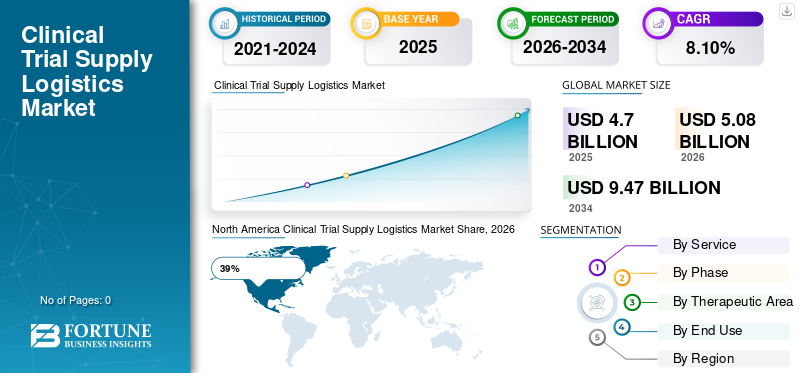
The clinical trial supply logistics market size was valued at USD 4.7 Billion in 2025. The market is projected to grow from USD 5.08 Billion in 2026 to USD 9.47 Billion by 2034, exhibiting a CAGR of 8.10% during the forecast period. The market in North America dominated with a revenue share of 39% in 2025.

The clinical trial supply logistics market plays a crucial role in ensuring the timely movement, storage, packaging, labeling, retention, and distribution of investigational medicinal products across global clinical research networks. The market supports pharmaceutical companies, biotechnology firms, contract research organizations, and research institutions conducting multi-site studies. Increasing clinical trial complexity, rising biologics development, temperature-sensitive drug transportation requirements, and decentralized clinical trial models are expanding demand for specialized logistics solutions. clinical trial supply logistics market Analysis indicates growing adoption of real-time monitoring systems, predictive inventory management, and digital supply chain visibility tools. The clinical trial supply logistics market Report highlights the importance of regulatory compliance, product integrity, and efficient global distribution networks.
Download Free sample to learn more about this report.
Clinical Trial Supply Logistics Market Key Takeaways
 Global Market Size & Forecast
- 2025 Market Size: USD 4.70 Billion
- 2026 Market Size: USD 5.08 Billion
- 2034 Forecast Market Size: USD 9.47 Billion
- CAGR: 8.10% from 2026-2034
 Market Share
- The market in North America dominated with a revenue share of 39% in 2025.
- Logistics & Distribution dominated by service with a market share of approximately 68%.
- Phase III trials dominated by phase with a market share of approximately 41%.
 Key Regional Highlights
North America
North America led the market with a 39% share, supported by advanced clinical research infrastructure and strong pharmaceutical development activity.
Europe
Europe accounted for 29% of the market, driven by established clinical trial networks and increasing demand for specialized logistics services.
Asia-Pacific
Asia-Pacific held a 24% share, supported by expanding clinical research activities and growing pharmaceutical development.
U.S
The U.S. remains a key market, supported by extensive clinical trial activity and advanced pharmaceutical research infrastructure.
Japan
Japan accounted for approximately 24% of the Asia-Pacific market, supported by established clinical research capabilities and growing demand for specialized supply chain services.
Read More

Clinical Trial Supply Logistics Market Latest Trends
The clinical trial supply logistics market Trends are increasingly shaped by decentralized clinical trials, personalized medicine programs, and biologic drug development. Pharmaceutical sponsors are seeking logistics providers capable of managing direct-to-patient shipments, remote trial participation, and temperature-controlled transportation. Demand for advanced cold-chain solutions has increased as gene therapies, cell therapies, and biologics require highly controlled handling conditions throughout the supply chain.
Download Free sample to learn more about this report.
Another major trend in the clinical trial supply logistics market Outlook is the integration of digital technologies. Real-time shipment tracking, blockchain-enabled documentation, artificial intelligence-based demand forecasting, and cloud-based inventory management platforms are improving operational efficiency. clinical trial supply logistics market Research Report findings also indicate increasing outsourcing of supply chain operations to specialized service providers. Companies are investing in automated storage systems, predictive analytics, and risk-management platforms to reduce wastage, improve compliance, and maintain product quality across international clinical trial networks.
Clinical Trial Supply Logistics Market Dynamics
DRIVER
Rising Number of Global Clinical Trials
The primary growth driver for the clinical trial supply logistics market Growth is the continuous increase in clinical research activities worldwide. Pharmaceutical and biotechnology companies are accelerating drug development programs for oncology, cardiovascular diseases, rare diseases, immunology, and neurological disorders. As clinical studies become larger and more geographically dispersed, the need for efficient logistics and supply chain management becomes increasingly important.
Clinical trial supply logistics market Insights indicate that multicountry trials require sophisticated transportation networks, customs management, temperature-controlled shipping, and inventory monitoring systems. Growing biologics research further increases demand for specialized cold-chain logistics solutions. The expansion of decentralized clinical trials has also created new requirements for direct-to-patient delivery services and remote inventory management. Logistics providers capable of ensuring product integrity, regulatory compliance, and timely delivery are experiencing stronger demand from pharmaceutical sponsors and contract research organizations.
RESTRAINT
Complex Regulatory and Compliance Requirements
One of the major restraints affecting the clinical trial supply logistics market is the complex regulatory environment governing clinical research materials. Different countries maintain varying import, export, labeling, packaging, storage, and transportation requirements for investigational products. Compliance failures can result in shipment delays, protocol deviations, and increased operational costs.
Clinical trial supply logistics industry report findings suggest that logistics providers must continuously adapt to changing regulations while maintaining documentation accuracy and audit readiness. Temperature-sensitive products require extensive monitoring and validation procedures throughout transportation and storage. Regulatory inspections, customs clearances, and product traceability requirements add operational complexity. Smaller logistics providers often face challenges in maintaining compliance across multiple jurisdictions, limiting their ability to compete effectively in global clinical supply operations.
OPPORTUNITY
Growth of Personalized Medicine and Biologics
A major clinical trial supply logistics market Opportunity lies in the rapid expansion of personalized medicine, cell therapies, gene therapies, and biologics development. These therapies require specialized transportation conditions, cryogenic storage capabilities, and highly controlled handling procedures. As pharmaceutical pipelines increasingly shift toward advanced therapies, logistics providers can expand their service offerings.
Clinical trial supply logistics market Forecast assessments indicate strong demand for ultra-low temperature storage facilities, real-time monitoring technologies, and customized patient delivery solutions. Precision medicine programs often involve small patient populations located across multiple regions, requiring highly flexible logistics networks. Companies investing in advanced cold-chain infrastructure, digital monitoring platforms, and specialized packaging solutions are positioned to capitalize on this emerging opportunity while strengthening their competitive position within the market.
CHALLENGE
Managing Temperature-Sensitive Supply Chains
The most significant challenge facing the clinical trial supply logistics market is maintaining product stability throughout complex global supply chains. Many investigational products require strict temperature ranges during storage and transportation. Any temperature excursion can compromise product integrity and affect clinical trial outcomes.
Clinical trial supply logistics market Research Report evaluations indicate that biologics, vaccines, gene therapies, and cell therapies require specialized handling procedures. Managing these requirements across international borders, multiple distribution centers, and diverse transportation modes creates operational difficulties. Unexpected weather conditions, customs delays, infrastructure limitations, and transportation disruptions further increase risks. Logistics providers must continuously invest in monitoring systems, validated packaging technologies, and contingency planning strategies to maintain product quality and regulatory compliance.
Clinical Trial Supply Logistics Market Segmentation
By Service
The Logistics & Distribution segment dominates the clinical trial supply logistics market Share with approximately 68% of the overall market. This segment encompasses transportation, shipment tracking, inventory allocation, customs management, site delivery, and direct-to-patient distribution activities. Increasing globalization of clinical trials has significantly expanded demand for specialized distribution services.
Clinical trial supply logistics market Analysis indicates that logistics and distribution providers play a critical role in ensuring investigational products reach research sites within required timelines. The growth of decentralized trials and personalized medicine programs has further increased the need for flexible transportation networks. Real-time tracking technologies, route optimization software, and predictive analytics are improving operational performance while reducing supply chain risks.
Storage & Retention accounts for approximately 32% of the clinical trial supply logistics market Size. This segment includes warehousing, cold storage, inventory retention, sample preservation, and long-term document management services. Increasing development of temperature-sensitive therapies has strengthened demand for specialized storage infrastructure.
Clinical trial supply logistics market Opportunities are particularly strong within this segment due to expanding biologics pipelines and growing regulatory requirements for product retention. Advanced storage facilities equipped with automated monitoring systems, environmental controls, and backup power solutions help maintain product integrity. Pharmaceutical sponsors increasingly partner with specialized storage providers to ensure compliance and improve inventory visibility throughout clinical trial operations.
To know how our report can help streamline your business, Speak to Analyst
By Phase
Phase III trials represent approximately 41% of the clinical trial supply logistics market. These studies involve large patient populations across multiple locations, creating substantial logistics requirements. Clinical Trial Supply Logistics Industry Analysis indicates that Phase III trials require extensive inventory planning, site distribution, and temperature-controlled transportation services.
The complexity of multinational Phase III studies drives demand for sophisticated supply chain management solutions. Logistics providers support patient recruitment efforts through efficient product allocation and timely distribution. Digital inventory management platforms help sponsors optimize supply levels while minimizing wastage and ensuring protocol compliance.
By Therapeutic Area
Oncology accounts for approximately 36% of the clinical trial supply logistics market. Cancer research continues to generate significant clinical trial activity, creating demand for specialized logistics services. Many oncology therapies require temperature-controlled transportation, precise inventory management, and patient-specific distribution models.
Clinical trial supply logistics market Trends reveal increasing use of personalized cancer treatments and immunotherapies. These developments require advanced logistics capabilities, including cryogenic transportation and direct-to-patient delivery solutions. Logistics providers supporting oncology trials must maintain strict chain-of-custody documentation and product traceability throughout the supply chain.
Cardiovascular diseases represent approximately 32% of the clinical trial supply logistics market. The high prevalence of cardiovascular conditions continues to drive extensive research activities across global clinical trial networks. Large patient populations and multicenter studies create significant logistics requirements.
Clinical trial supply logistics market Insights indicate that cardiovascular trials frequently involve extensive site networks and large-scale product distribution programs. Efficient logistics management helps sponsors maintain consistent product availability, reduce trial delays, and improve patient participation. Digital supply chain technologies are increasingly used to optimize inventory planning and shipment coordination.
By End Use
Pharmaceutical companies hold approximately 42% of the clinical trial supply logistics market Share. These organizations conduct large numbers of clinical studies and require comprehensive logistics support throughout development programs. Outsourcing logistics functions allows pharmaceutical companies to focus on research and regulatory activities.
Clinical trial supply logistics market Growth within this segment is driven by increasing drug development activity, globalization of clinical research, and adoption of decentralized trial models. Pharmaceutical sponsors increasingly seek integrated logistics solutions that combine storage, distribution, tracking, and regulatory support services.
Clinical Trial Supply Logistics Market Regional Outlook
North America Clinical Trial Supply Logistics Market Share, 2026 (%)
To get more information on the regional analysis of this market, Download Free sample
North America
North America 39% leads the clinical trial supply logistics market due to advanced healthcare infrastructure, strong pharmaceutical research activity, and high clinical trial volumes. The region benefits from extensive cold-chain networks, specialized logistics providers, and widespread adoption of digital supply chain technologies. Increasing biologics development and decentralized clinical trial adoption continue supporting market expansion. Regulatory standards encourage investment in quality assurance systems and advanced monitoring solutions. Pharmaceutical companies and research organizations rely heavily on specialized logistics providers to manage complex clinical supply chains and ensure product integrity across trial locations.
Europe
Europe remains 29% a major clinical trial supply logistics market region supported by strong pharmaceutical manufacturing capabilities and extensive clinical research infrastructure. Cross-border clinical trials create demand for sophisticated logistics solutions capable of navigating diverse regulatory environments. Advanced cold-chain facilities, specialized transportation networks, and increasing biologics research strengthen regional demand. European pharmaceutical sponsors increasingly outsource logistics activities to specialized service providers. Digitalization initiatives and regulatory harmonization efforts contribute to improved supply chain efficiency and operational transparency across the region.
Germany clinical trial supply logistics market
Germany represents approximately 28% of the European clinical trial supply logistics market. The country serves as a major pharmaceutical manufacturing and logistics hub, supporting extensive clinical research activities. Strong infrastructure, advanced warehousing facilities, and strategic geographic positioning enable efficient distribution across Europe. German organizations increasingly invest in temperature-controlled storage, automated inventory systems, and digital tracking technologies. Growing biologics research and precision medicine programs continue expanding demand for specialized logistics services. The country's regulatory framework and high-quality transportation networks further support market development.
United Kingdom clinical trial supply logistics market
The United Kingdom accounts for approximately 22% of the European clinical trial supply logistics market. The country maintains a strong clinical research environment supported by pharmaceutical companies, biotechnology firms, and academic institutions. Increasing adoption of decentralized clinical trials has strengthened demand for direct-to-patient delivery services and digital supply chain platforms. Logistics providers are expanding cold-chain capabilities and inventory management solutions to support growing biologics development. Continued investment in clinical research infrastructure contributes to market expansion and service innovation.
Asia-Pacific
Asia-Pacific is emerging 35% as a significant clinical trial supply logistics market due to increasing clinical trial activity, expanding pharmaceutical industries, and growing healthcare investments. Countries across the region are attracting multinational clinical studies through large patient populations and supportive research environments. Demand for specialized logistics services is increasing alongside biologics development and precision medicine initiatives. Logistics providers are expanding regional warehousing networks and cold-chain infrastructure to support market growth.
Japan clinical trial supply logistics market
Japan holds approximately 24% of the Asia-Pacific clinical trial supply logistics market. The country benefits from advanced healthcare infrastructure, strong pharmaceutical innovation, and rigorous quality standards. Increasing biologics research and personalized medicine development create demand for specialized logistics services. Japanese organizations emphasize product integrity, supply chain visibility, and regulatory compliance. Investment in digital monitoring systems and automated storage technologies continues supporting market advancement.
China clinical trial supply logistics market
China represents approximately 35% of the Asia-Pacific clinical trial supply logistics market. Rapid growth in pharmaceutical research, expanding biotechnology investment, and increasing clinical trial activity drive demand for logistics services. The country has developed extensive warehousing and transportation infrastructure capable of supporting large-scale clinical research programs. Cold-chain logistics, digital tracking systems, and specialized storage facilities are receiving significant investment. China's growing role in global drug development continues strengthening demand for clinical trial supply logistics solutions.
Rest of World
The Rest of World 8% region includes Latin America, the Middle East, and Africa. Increasing clinical research activity and pharmaceutical investment are supporting market development across these regions. Logistics providers are expanding service capabilities to address growing demand for temperature-controlled transportation, inventory management, and regulatory support. Emerging clinical trial destinations require reliable supply chain infrastructure to support international studies. Continued investment in healthcare systems and research capabilities is creating new opportunities for specialized logistics providers.
List of Top Clinical Trial Supply Logistics Companies
- Thermo Fisher Scientific Inc.
- UPS Healthcare
- Piramal Pharma Solutions
- DHL
- Parexel International
- Almac Group
- Movianto
- UDG Healthcare
- FedEx
- Catalent, Inc.
Top Two Companies by Market Share
- Thermo Fisher Scientific Inc. – 14%
- DHL – 11%
Investment Analysis and Opportunities
Investment activity in the clinical trial supply logistics market is increasingly directed toward cold-chain infrastructure, digital supply chain platforms, and decentralized clinical trial support services. Pharmaceutical sponsors require logistics partners capable of managing complex global supply chains while maintaining regulatory compliance and product integrity. Investors are focusing on facilities equipped with automated monitoring systems, temperature-controlled storage environments, and advanced inventory management technologies.
clinical trial supply logistics market Opportunities are particularly strong in biologics, gene therapies, and cell therapies. These segments require specialized transportation and storage solutions that command premium service demand. Strategic partnerships between pharmaceutical companies and logistics providers are becoming more common as sponsors seek integrated supply chain capabilities. Expansion into emerging clinical trial markets and investment in direct-to-patient delivery services also present attractive opportunities for industry participants.
New Product Development
Innovation within the clinical trial supply logistics market is centered on intelligent packaging systems, real-time monitoring devices, and advanced cold-chain technologies. Companies are introducing smart containers equipped with sensors that continuously monitor temperature, humidity, and location throughout transportation. These solutions improve visibility and reduce the risk of product loss.
Another important development involves artificial intelligence-driven inventory management platforms that predict demand fluctuations and optimize distribution planning. Automated warehousing systems, blockchain-enabled documentation platforms, and cloud-based logistics management tools are also gaining traction. clinical trial supply logistics market Trends indicate growing interest in sustainable packaging materials and reusable temperature-controlled shipping solutions. These innovations help improve efficiency, reduce waste, and strengthen regulatory compliance across clinical research supply chains.
Five Recent Developments (2023-2025)
- Thermo Fisher Scientific expanded global clinical supply chain capabilities with additional temperature-controlled logistics infrastructure.
- DHL enhanced specialized healthcare logistics services focused on biologics and advanced therapy medicinal products.
- UPS Healthcare increased investment in cold-chain storage and transportation facilities supporting clinical research.
- Catalent expanded clinical supply packaging and distribution capabilities for global trial programs.
- Almac Group strengthened digital supply chain visibility solutions through advanced tracking and monitoring technologies.
Report Coverage
The clinical trial supply logistics market Report provides comprehensive analysis of service categories, therapeutic areas, clinical trial phases, end-user segments, and regional performance. The report evaluates supply chain trends, technological developments, competitive strategies, and investment opportunities influencing market expansion.
Request for Customization to gain extensive market insights.
Clinical trial supply logistics market Research Report coverage includes logistics and distribution services, storage and retention operations, oncology research logistics, cardiovascular trial support, and pharmaceutical end-user demand patterns. The study examines regional developments across North America, Europe, Asia-Pacific, and Rest of World markets. Additionally, the report analyzes digital transformation initiatives, cold-chain infrastructure expansion, decentralized trial logistics models, and emerging opportunities associated with biologics, gene therapies, and personalized medicine programs. The scope also includes competitive benchmarking of leading market participants and assessment of evolving customer requirements within the global clinical research ecosystem.
Frequently Asked Questions
Fortune Business Insights says that the global market value stood at USD 4.7 billion in 2025 and is projected to reach USD 9.47 billion by 2034.
The market is expected to exhibit a CAGR of 8.10% during the forecast period of 2026-2034.
Logistics & Distribution was the leading service segment, accounting for approximately 68% of the market, driven by growing demand for transportation, shipment tracking, site delivery, and direct-to-patient distribution.
Key players include Thermo Fisher Scientific Inc., UPS Healthcare, Piramal Pharma Solutions, DHL, Parexel International, and Almac Group.
Major trends include the adoption of decentralized clinical trials and advanced cold-chain solutions, along with increasing use of real-time tracking, AI-based forecasting, and cloud-based inventory management. North America dominated with a 39% market share.



- 2021-2034
- 2025
- 2021-2024
- 0
-

(Offer valid till 15th Oct 2026)
Get 30-60 hrs Free Customization
Expand Regional and Country Coverage, Segments Analysis, Company Profiles, Competitive Benchmarking, and End-user Insights.













.webp)






-
US +1 833 909 2966 ( Toll Free )
-
Get In Touch With Us