Cloud Database Market Size, Share & Industry Analysis, By Type (SQL and NoSQL), By Deployment (Public Cloud, Private Cloud, and Hybrid Cloud), By Service Model (Database as a Service (DBaaS) and Managed Database Services), By End-user (BFSI, IT and Telecom, Retail, Healthcare, Manufacturing, Energy & Utilities, and Others), and Regional Forecast, 2026-2034
 Download Free Sample
KEY MARKET INSIGHTS
 Listen to Audio Version
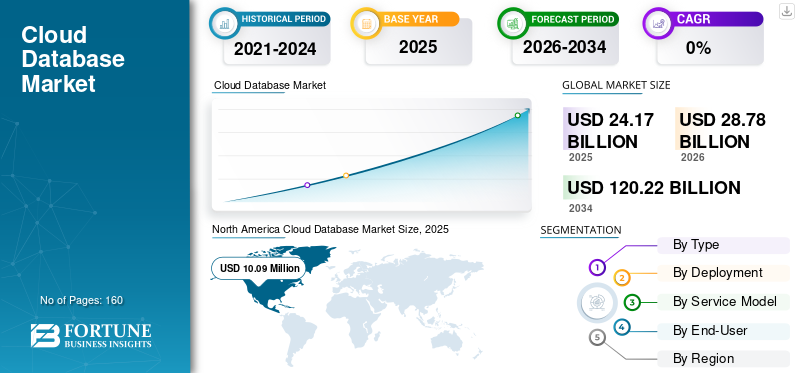
The global cloud database market size was valued at USD 24.17 billion in 2025 and is projected to grow from USD 28.78 billion in 2026 to USD 120.22 billion by 2034, exhibiting a CAGR of 19.6% during the forecast period. North America dominated the global cloud database market with a market share of 45.09% in 2025.
The cloud database market refers to platforms that deliver database management capabilities through cloud environments, allowing organizations to store and manage data without maintaining physical infrastructure. These cloud databases and dbaas solutions are used across various industries, including BFSI, IT and telecom, retail, healthcare, manufacturing, energy & utilities, and others, to support transactional systems, analytics, application development, and real-time data processing. Rising digital transformation efforts, the need for scalable and cost-effective data management, and an increasing preference for managed database services support the market's growth.
Key participants in the cloud database market include Amazon Web Services Inc., Microsoft Corporation, Google LLC, Oracle Corporation, IBM Corporation, Alibaba Group Holding Limited, Tencent Holdings Limited, MongoDB Inc., Snowflake Inc., and SAP SE.
CLOUD DATABASE MARKET KEY TAKEAWAYS
 Market Size & Forecast
- 2025 Market Size: USD 24.17 Billion
- 2026 Market Size: USD 28.78 Billion
- 2034 Forecast Market Size: USD 120.22 Billion
- CAGR: 19.6% from 2026–2034
 Market Share
- North America dominated the cloud database market with a 45.09% share in 2025.
- The SQL segment held the largest share by type in 2025.
- The Database as a Service (DBaaS) segment accounted for the leading share by service model in 2025.
 Key Regional Highlights
North America
North America led the global market, supported by advanced digital infrastructure and strong enterprise cloud adoption.
Europe
Europe held the second-largest share due to increasing demand for secure and compliant cloud database solutions.
Asia Pacific
Asia Pacific is projected to register the fastest growth, driven by rapid cloud adoption, AI investments, and digital transformation initiatives.
U.S.
Strong presence of major cloud service providers and high investment in data-driven technologies continue to drive market growth.
Japan
Increasing adoption of cloud computing, analytics, and enterprise digital transformation is supporting cloud database market expansion.
Read More

Download Free sample to learn more about this report.
MARKET DYNAMICS
MARKET DRIVERS:
Rising Digital Transformation Accelerates Adoption of Cloud Databases
Rising digital transformation efforts are prompting organizations to modernize their data infrastructure and move away from traditional databases and dbaas. For instance,
- According to DOIT Software, 90% of businesses are pursuing digital initiatives, highlighting why digital transformation has increased the adoption of cloud-based databases.
As companies adopt cloud computing technology, they require database platforms that offer greater scalability, automation, and seamless integration with evolving digital workflows. Cloud databases support these needs by enabling efficient data management, faster application deployment, and improved accessibility across distributed environments. As a result, digital transformation remains a central factor propelling the widespread shift toward cloud-based database solutions.
MARKET RESTRAINTS:
Security, Migration, Connectivity, and Vendor Lock-In Challenges to Impact Market Expansion
Security-related issues remain a notable restraint for the market, as firms are cautious about placing sensitive data in cloud environments without strong protection and compliance measures. Migration from legacy systems also poses challenges, since it often requires significant time, financial resources, and specialized expertise. For instance,
- According to CIO Axis, 61% of organizations identify security and compliance challenges as key barriers, highlighting their impact on slowing cloud database migration.
Performance can also be affected by reliance on stable internet connectivity, as service interruptions can disrupt access to cloud databases and hinder core operations. Vendor lock-in concerns further exacerbate these limitations by reducing flexibility and increasing the long-term costs associated with transitioning to alternative platforms.
MARKET OPPORTUNITIES:
Growing Adoption of AI-Ready Databases Unlocks New Market Opportunities
The increasing adoption of AI-ready databases is creating a notable opportunity for cloud database market growth, as organizations increasingly require data platforms that support machine learning and real-time analytics. For instance,
- According to the 2025 AI Index from Stanford HAI, 78% of organizations reported using AI, emphasizing the growing need for AI-ready cloud databases that support advanced analytics.
These systems enable the faster processing of large and complex datasets, helping enterprises gain deeper insights and enhance their decision-making capabilities. Cloud-based AI-optimized databases also integrate smoothly with analytics tools, improving efficiency and accelerating digital innovation. As demand for intelligent data infrastructure grows, vendors offering AI-driven capabilities are well-positioned to capture significant future expansion.
Cloud Database MARKET TRENDS:
Rising Adoption of Multi-Cloud Database Strategies to Strengthen Market Expansion
The rising adoption of multi-cloud database strategies has emerged as a significant trend, driven by the need for greater flexibility and reduced dependence on a single service provider. For instance,
- According to MoldStud, over 80% of enterprises are pursuing multi-cloud strategies to avoid vendor lock-in and enhance resilience.
By distributing workloads across multiple cloud platforms, enterprises can enhance resilience, improve availability, and optimize performance according to specific operational requirements. This approach also helps mitigate risks associated with outages, pricing shifts, or vendor-specific limitations, ensuring stronger continuity. As organizations prioritize agility and long-term control of their data environments, multi-cloud database architectures are expected to gain further traction in the market.
Download Free sample to learn more about this report.
SEGMENTATION ANALYSIS
By Type
SQL Dominates owing to its Reliability for Core Transactional Workloads
Based on type, the market is divided into SQL and NoSQL.
SQL leads the market as it remains the preferred choice for structured, mission-critical transactional workloads that require strong consistency and reliability.
NoSQL is expected to grow at the fastest rate of 20.5%, as it supports highly flexible and scalable data models that are well-suited for modern applications, big data processing, and real-time analytics.
By Deployment
Public cloud Segment Leads due to its Low Cost and On-Demand Infrastructure
Based on deployment, the market is divided into public cloud, private cloud, and hybrid cloud.
Public cloud accounts for the largest share as it offers cost-efficient, on-demand infrastructure with broad access to managed database services.
Hybrid cloud is projected to grow at the highest CAGR of 20.8%, as enterprises seek a balance of regulatory control, data security, and cloud scalability across mixed environments.
By Service Model
Database as a Service Segment Holds the Maximum Share due to its Fully Managed Model
Based on service model, the market is divided into Database as a Service (DBaaS) and managed database services.
Database as a Service dominates and records the highest CAGR of 19.9% due to its fully managed nature, which reduces operational burden and accelerates database deployment. As more data is generated across digital systems, cloud databases offer organizations a reliable platform to store and process it.
Managed database services hold the second-largest share as they allow organizations to maintain familiar database engines while gaining cloud-based management support.
By End-user
BFSI is the dominant segment due to the Rising Need for Secure and Scalable Data Handling
By end-user, the market is segmented into BFSI, IT and telecom, retail, healthcare, manufacturing, energy & utilities, and others.
BFSI holds the maximum share, as financial institutions rely heavily on secure, scalable databases to manage high volumes of sensitive transactional data.
Retail is projected to grow at the maximum CAGR of 22.5%, as cloud databases enable real-time analytics, omnichannel operations, and personalized customer engagement.
To know how our report can help streamline your business, Speak to Analyst
Cloud Database Market Regional Outlook
By geography, the market is categorized into North America, South America, Europe, the Middle East & Africa, and Asia Pacific.
North America
North America holds the largest cloud database market share due to its highly developed cloud ecosystem, supported by strong enterprise adoption, advanced digital infrastructure, and the presence of major cloud service providers. Additionally, the U.S. mature regulatory environment and significant investment in data-driven technologies further reinforce its leadership.
North America Cloud Database Market Size, 2025 (USD Million)
To get more information on the regional analysis of this market, Download Free sample
Europe
Europe holds the second-largest share, as large enterprises in the region prioritize secure and compliant cloud database solutions, driven by strict data protection regulations and growing digital transformation initiatives. Its strong industrial base and rising use of analytics applications contribute to steady market expansion.
Asia Pacific
Asia Pacific is expected to grow at the highest CAGR due to rapid cloud adoption across emerging economies, rising digitalization, and significant investment in AI, analytics, and modern application development. The expanding presence of global and regional cloud providers further accelerates market momentum in the region.
Middle East & Africa
The Middle East & Africa are projected to grow at the second-highest CAGR, as governments and enterprises increase cloud spending to modernize their IT infrastructure and improve service delivery across key sectors. Expanding data center investments and supportive national digital strategies are also boosting adoption.
South America
South America is expected to experience an average growth rate as cloud database adoption continues to rise steadily. However, economic constraints and slower digital maturity are expected to limit the pace of expansion. The growing demand from enterprises for scalable data solutions supports long-term market growth.
To know how our report can help streamline your business, Speak to Analyst
COMPETITIVE LANDSCAPE
Key Industry Players:
Key Players Launch New Solutions to Strengthen their Market Position
Players launch new solutions to enhance their positioning by leveraging technological advancements, addressing diverse consumer needs, and staying ahead of competitors. They prioritize portfolio enhancement through strategic collaborations, acquisitions, and partnerships to strengthen their offerings. Such strategic launches enable the technology companies to maintain and expand their market share in a rapidly evolving landscape.
LIST OF KEY CLOUD DATABASE COMPANIES PROFILED:
- Amazon Web Services, Inc. (U.S.)
- Microsoft Corporation (U.S.)
- Google LLC (U.S.)
- Oracle Corporation (U.S.)
- IBM Corporation (U.S.)
- Alibaba Group Holding Limited (China)
- Tencent Holdings Limited (China)
- MongoDB Inc. (U.S.)
- Snowflake Inc. (U.S.)
- SAP SE (Germany)
KEY INDUSTRY DEVELOPMENTS:
- In October 2025, Oracle and Google Cloud announced enhancements to Oracle Database at Google Cloud to help customers innovate faster and lower costs. The update adds embedded AI features, expands regional availability, and launches a new partner program.
- In October 2025, MariaDB plc released MariaDB Enterprise Platform 2026 as a unified solution for next-generation intelligent applications. The platform combines transactional, analytical, and AI vector engines into a single, high-performance system.
- In August 2025, Oracle integrated OpenAI GPT-5 across its database portfolio and SaaS applications to enhance automation and reasoning capabilities. This deployment unites enterprise data with advanced AI models to improve workflow intelligence.
- In July 2025, AWS and Oracle made Oracle Database at AWS generally available, allowing customers to run Oracle Autonomous Database and Oracle Exadata Database Service on dedicated Oracle infrastructure hosted on AWS. The rollout will begin in Northern Virginia and Oregon, with plans for wider expansion.
- In April 2025, Toshiba Digital Solutions Corporation launched GridDB Cloud for managing IoT and high-frequency big data workloads. The service became available in 26 countries and regions worldwide.
REPORT COVERAGE
Request for Customization to gain extensive market insights.
REPORT SCOPE & SEGMENTATION
|
ATTRIBUTE |
DETAILS |
|
Study Period |
2021-2034 |
|
Base Year |
2025 |
|
Forecast Period |
2026-2034 |
|
Historical Period |
2021-2024 |
|
Growth Rate |
CAGR of 19.6% from 2026-2034 |
|
Unit |
Value (USD Billion) |
|
Segmentation |
By Type, By Deployment, By Service Model, By End-user, and By Region |
|
ByType |
· SQL · NoSQL |
|
By Deployment |
· Public Cloud · Private Cloud · Hybrid Cloud |
|
By Service Model |
· Database as a Service (DBaaS) · Managed Database Services |
|
By End-user |
· BFSI · IT and Telecom · Retail · Healthcare · Manufacturing · Energy & Utilities · Others (Media & Entertainment) |
|
By Geography |
· North America (By Type, By Deployment, By Service Model, By End-user, and By Country) o U.S. (End-user) o Canada (End-user) o Mexico (End-user) · South America (By Type, By Deployment, By Service Model, By End-user, and By Country) o Brazil (End-user) o Argentina (End-user) o Rest of South America · Europe (By Type, By Deployment, By Service Model, By End-user, and By Country) o U.K. (End-user) o Germany (End-user) o France (End-user) o Italy (End-user) o Spain (End-user) o Russia (End-user) o Benelux (End-user) o Nordics (End-user) o Rest of Europe · Middle East & Africa (By Type, By Deployment, By Service Model, By End-user, and By Country) o Turkey (End-user) o Israel (End-user) o GCC (End-user) o North Africa (End-user) o South Africa (End-user) o Rest of Middle East & Africa · Asia Pacific (By Type, By Deployment, By Service Model, By End-user, and By Country) o China (End-user) o India (End-user) o Japan (End-user) o South Korea (End-user) o ASEAN (End-user) o Oceania (End-user) o Rest of Asia Pacific |
Frequently Asked Questions
Fortune Business Insights says that the global market value stood at USD 24.17 billion in 2025 and is projected to reach USD 120.22 billion by 2034.
In 2025, the market value stood at USD 10.09 billion.
The market is expected to exhibit a CAGR of 19.6% during the forecast period (2026-2034).
By end-user, the BFSI sector leads the market.
Rising digital transformation is the key factor driving the market.
Amazon Web Services, Inc., Microsoft Corporation, and Google LLC are some of the prominent players in the market.
North America dominates the market.
Key factors that support product adoption include expanding digital transformation efforts, rising demand for scalable data solutions, and growing reliance on analytics-driven operations.



- 2021-2034
- 2025
- 2021-2024
- 160
Get 30-60 hrs Free Customization
Expand Regional and Country Coverage, Segments Analysis, Company Profiles, Competitive Benchmarking, and End-user Insights.




















-
US +1 833 909 2966 ( Toll Free )
-
Get In Touch With Us