Cocktail Mixers Market Size, Share & Industry Analysis, By Product Type (Carbonated Mixers, Non-Carbonated Mixers, Syrups & Concentrates, and Others), By Nature (Conventional and Organic), By Distribution Channel (On-Trade and Off-Trade {Supermarkets/Hypermarkets, Convenience Stores, Specialty Stores, Online Retail, and Others}), and Regional Forecast, 2026-2034
 Download Free Sample
(Offer valid till 15th Oct 2026)

KEY MARKET INSIGHTS
 Listen to Audio Version
The global cocktail mixers market size was valued at USD 11.29 billion in 2025. The market is projected to grow from USD 12.00 billion in 2026 to USD 20.06 billion by 2034, exhibiting a CAGR of 6.63% during the forecast period. Europe dominated the global cocktail mixers market with a market share of 35.61% in 2025.
Cocktail mixers are alcohol-free liquids, primarily added to spirits to balance flavors, dilute them, and strengthen the texture of drinks. These mixers range from artisanal syrups and basic sodas to juices, serving as essential components in both professional mixology and home bartending. With respect to applications, they are utilized across a broad range of applications in non-alcoholic and alcoholic beverages. In the alcoholic sector, they are combined with rum, whiskey, gin, and tequila. In the non-alcoholic category, mixers are used in flavored sparkling and low-alcohol drinks. Geographically, this market is well-established in Europe and North America, supported by an increasing number of bars and restaurants, as well as a strong cocktail culture.
Companies such as Jimmy’s Cocktails, Fever Tree, Keurig Dr Pepper Inc., and Dabur are among the key players operating in this market. New product developments are a primary strategy employed by players to enhance their market image.
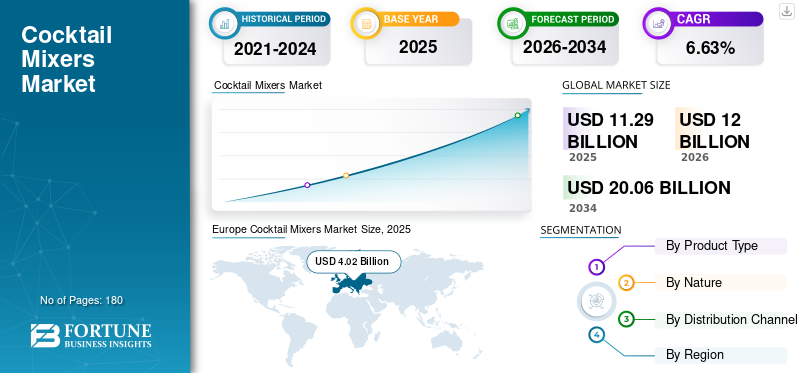
Download Free sample to learn more about this report.
Cocktail Mixers Market Key Takeaways
 Global Market Size & Forecast
- 2025 Market Size: USD 11.29 billion
- 2026 Market Size: USD 12.00 billion
- 2034 Forecast Market Size: USD 20.06 billion
- CAGR: 6.63% from 2026-2034
 Market Share
- Europe dominated the cocktail mixers market with a 35.61% share in 2025.
- The syrups & concentrates segment is projected to grow at a CAGR of 9.20% during the forecast period.
- The organic segment is projected to grow at a CAGR of 9.16% during the forecast period.
 Key Regional Highlights
North America
North America reached USD 2.96 billion in 2025, making it the second-largest regional market.
Asia Pacific
Asia Pacific reached USD 2.52 billion in 2025, supported by strong growth in India and China.
Europe
Europe reached USD 4.02 billion in 2025 and maintained its leading position in the global market.
U.S.
The U.S. market was valued at USD 2.47 billion in 2025, accounting for approximately 21.84% of global sales.
Japan
Japan's cocktail mixers market reached USD 0.58 billion in 2025, representing around 5.12% of global revenue.
Read More

COCKTAIL MIXERS MARKET TRENDS
Rising Inclination toward Health-Oriented Mixers is the Key Trend
The global market is witnessing an evolving and phenomenal trend of health-oriented mixers. Today, most consumers are highly mindful of the nutritional value of drinks consumed, along with alcohol. Health-oriented mixers are known to provide refreshment and flavor while reducing negative attributes, such as preservatives, synthetic additives, and high sugar content. This trend is primarily associated with changing drinking patterns, including the sober-curious movement, and a spike in moderation drinking. As a result, cocktail mixers made with functional ingredients, botanical extracts, and fruit essence are gaining huge popularity. These non-alcoholic mixers are marketed with claims such as 'clean label' and 'natural,' which align directly with the increasing demands of health conscious consumers.
Download Free sample to learn more about this report.
MARKET DYNAMICS
MARKET DRIVERS
Surging Popularity of Cocktail Culture Bolsters the Usage of Mixers
The increasing popularity of cocktail culture is a substantial driver boosting the consumption of cocktail mixers. In today’s time, cocktails have shifted from being just an occasional bar drink to lifestyle expressions, linked with social interaction and creativity. Increasing disposable incomes, as well as large exposure to beverage trends through social media and travel, have remarkably improved consumers' interest in mixed drinks across both emerging and developed markets. At present, most consumers seek personalized drinking options instead of traditional variety, fueling demand for mixers that enhance drinking experiences and offer unique flavor variety. Beyond out-of-home popularity, the consumption of cocktails has also increased within home settings. During social gatherings, individuals at home often prefer ready-to-use innovative cocktail mixers, which minimize preparation complexity and reduce additional effort.
MARKET RESTRAINTS
High Sugar Content and Tough Competition from Fresh Ingredients Hamper Market’s Potential
One of the key difficulties in the global market is the high content of sugar in cocktail mixers. Globally, the majority of consumers are becoming aware of the health ailments linked with high sugar intake. Traditional mixers such as flavored juices, tonic water, and syrups mostly contain excessive amounts of added sugars to mask alcohol bitterness and improve the taste. With increasing concerns about metabolic health, obesity, and diabetes, most individuals are actively minimizing the consumption of sugary drinks, which directly affects the global cocktail mixers market share.
Increasing competition from fresh/homemade ingredients is another challenge in the industry. Today, most individuals prefer fresh cocktails made using natural components such as syrups, herbs, and juices. This evolving trend further restricts the use of packaged mixers, hindering growth.
MARKET OPPORTUNITIES
Utilization of Modern Technology in the Cocktail Market Creates Growth Prospects
The use of advanced technologies in the mixer market presents various growth opportunities. To extend their shelf life, producers should utilize mild pasteurization technologies and High-Pressure Processing (HPP). These allows manufacturers to preserve the nutritional quality and taste, along with the shelf life of products. Alternative sweetening technology is another key technique gaining traction globally. Most producers utilize acidity-balancing systems and flavor modulators to minimize sugar content without hampering the taste. Additionally, cold-processing and micro-extraction methods are being used by enterprises to retain volatile flavor components, which closely resemble those of fresh ingredients. Along with this, digital processes and automation are enhancing both quality consistency as well as manufacturing efficiency.
Segmentation Analysis
By Product Type
Carbonated Mixers Dominate the Market Due to Their Superior Taste
Based on product type, the market is segmented into carbonated mixers, non-carbonated mixers, syrups & concentrates, and others.
The carbonated mixers segment dominated the global market in 2025. These mixers are compatible with a variety of spirits, including tequila, rum, and vodka, unlike ready-to-use mixes, which are mostly recipe-specific. In comparison to non-carbonated mixers, it has a long-standing consumer familiarity and is widely utilized in both off-trade and on-trade settings. Moreover, carbonated mixers align well with low-sugar and clean-label options without hampering the taste. Additionally, this enhances visual appeal via effervescence and bubbles, thereby improving the overall quality of cocktails. As a result, the aforementioned factors propel the global cocktail mixers market growth.
The syrups & concentrates segment is projected to grow at a CAGR of 9.20% over the forecast period.
To know how our report can help streamline your business, Speak to Analyst
By Nature
Conventional Segment Leads Market Owing to Its Cost-Effectiveness
Based on nature, the market is distributed into conventional and organic.
In 2025, the conventional segment led market and holds the largest share. Conventional mixers are mostly produced at a larger scale and are easily available across all retail channels such as supermarkets, e-commerce platforms, and specialty stores. Secondly, it has a prolonged shelf life due to the high usage of stabilizers and preservatives. Moreover, traditional mixers have lower production costs compared to organic variants, which adds value. In comparison to organic mixers, conventional items face limited certification and regulatory requirements, supporting the segment’s growth.
The organic segment is projected to grow at a CAGR of 9.16% over the forecast period.
By Distribution Channel
Off-Trade Category Led in the Market Because of Its Wider Product Assortment
Based on distribution channel, the market is segmented into off-trade (supermarkets/hypermarkets, convenience stores, specialty stores, online retail, and others) and on-trade.
The off-trade segment accounted for the largest market share in 2025. In comparison to on-trade channels, off-trade channels have a more stable and broader consumer base throughout the year. New product launches and faster innovation are another factor that benefits off-trade growth. E-commerce outlets offer trial opportunities and better visibility for new formats and flavors, which captivate consumers' attention. Moreover, most consumers purchase mixers more frequently for home use through off-trade channels.
The on-trade segment is projected to grow at a CAGR of 5.70% over the forecast period.
Cocktail Mixers Market Regional Outlook
By geography, the market is categorized into Europe, North America, Asia Pacific, South America, and the Middle East & Africa.
Europe
Europe Cocktail Mixers Market Size, 2025 (USD Billion)
To get more information on the regional analysis of this market, Download Free sample
Europe is projected to dominate the global market in 2025, recording a growth rate of 6.40% in the coming years and reached USD 4.02 billion in 2025. The rising demand for craft cocktails and premium mixers is a key factor promoting regional growth.
Germany Cocktail Mixers Market
Germany’s market in 2025 is estimated at around USD 0.97 billion, representing roughly 8.59% of the global revenue.
U.K. Cocktail Mixers Market
The U.K. cocktail mixers market approximately reached USD 0.87 billion in 2025, equivalent to around 7.69% of the global sales.
North America
The market in North America reached USD 2.96 billion in 2025 and is the second leading region. The market in North America is expected to grow due to the increasing health consciousness and growing demand for low-sugar mixers.
U.S. Cocktail Mixers Market:
Based on North America’s strong contribution and the U.S.’s dominance within the region, the U.S. market value approximated at around USD 2.47 billion in 2025, accounting for roughly 21.84% of global cocktail mixers sales.
Asia Pacific
Asia Pacific reached USD 2.52 billion in 2025 and secured the position of the third-largest region. In the region, India and China achieved substantial growth in 2025.
India Cocktail Mixers Market
The India cocktail mixers market in 2025 reached USD 0.39 billion, accounting for approximately 3.44% of the global revenue. The augmented cocktail culture and rising availability of a wide range of mixers are the driving factors in the regional market.
China Cocktail Mixers Market
China's market is projected to be one of the largest worldwide, with revenues achieved at USD 0.81 billion in 2025, representing roughly 7.20% of the global sales.
Japan Cocktail Mixers Market
Japan’s cocktail mixers market in 2025 hit USD 0.58 billion, accounting for approximately 5.12% of the global revenues.
South America and the Middle East & Africa
The South America and the Middle East & Africa are expected to witness moderate growth in the market space during the forecast period. South America’s market size reached USD 0.97 billion in 2025. The rising tourism and surging party culture drive the regional growth. The Middle East & Africa’s market size reached USD 0.82 billion in 2025.
South Africa Cocktail Mixers Market
The South Africa cocktail mixers market reached USD 0.32 billion in 2025, representing roughly 2.82% of global cocktail mixers revenues.
COMPETITIVE LANDSCAPE
Key Industry Players
New Product Launches Help Key Firms to Improve Their Market Position
The market exhibits a fragmented structure, with intense competition among market players operating in this segment. In the global market, key companies are primarily adopting new product launches as the main strategy. Via this approach, players can cater to rising consumer demands and enhance their brand image.
LIST OF KEY COCKTAIL MIXERS COMPANIES PROFILED
- Fever Tree (U.K.)
- Dabur (India)
- Bittermilk Bottling Co., (U.S.)
- Mix Me Co., (U.S.)
- Jimmy’s Cocktails (India)
- Keurig Dr Pepper Inc. (U.S.)
- Bartisans (India)
- Svami (India)
- Hella Cocktail Co. (U.S.)
- Q Mixers (U.S.)
KEY INDUSTRY DEVELOPMENTS
- June 2025: Dabur, a fast-moving consumer goods firm in India, expanded its portfolio by launching “Real Cheers,” a range of cocktail mixers. This line comprises four variants; ginger ale, tonic water, green apple, and jamuntini.
- May 2025: Bittermilk Bottling Co., an American handcrafted premium cocktail mixer producer, launched a new mixer, “Bittermilk No.8,” which can be used in the preparation of margaritas. This mixer can be easily purchased from Amazon and other selected retailers.
- October 2024: Mix Me Co., a Miami-based cocktail mixer brand, released single-serve and natural mixers, and is free from synthetic flavors, sweeteners, and colors.
- February 2024: Jimmy’s Cocktails, a renowned Indian brand, introduced a new line of martini cocktail mixers: espresso martini, green apple, and popstar, for Indian consumers.
- March 2023: Fever Tree, a British manufacturer of high-grade drink mixers, revealed a range of mixers, which includes classic margarita, espresso martini, and classic mojito. All these mixers are produced using Kenyan coffee beans, Mexican limes, and Italian blood oranges.
REPORT COVERAGE
Request for Customization to gain extensive market insights.
Report Scope & Segmentation
|
ATTRIBUTE |
DETAILS |
|
Study Period |
2021-2034 |
|
Base Year |
2025 |
|
Estimated Year |
2026 |
|
Forecast Period |
2026-2034 |
|
Historical Period |
2021-2024 |
|
Growth Rate |
CAGR of 6.63% from 2025-2034 |
|
Unit |
Value (USD Billion) |
|
Segmentation |
By Product Type, Nature, Distribution Channel, Region |
|
By Product Type |
· Carbonated Mixers · Non-Carbonated Mixers · Syrups & Concentrates · Others |
|
By Nature |
· Conventional · Organic |
|
By Distribution Channel |
· On-Trade · Off-Trade o Supermarkets/Hypermarkets o Convenience Stores o Specialty Stores o Online Retail o Others |
|
By Geography |
North America (By Product Type, Nature, Distribution Channel, and Country) o U.S. (By Nature) o Canada (By Nature) o Mexico (By Nature) Europe (By Product Type, Nature, Distribution Channel, and Country) o Germany (By Nature) o U.K. (By Nature) o Spain (By Nature) o France (By Nature) o Italy (By Nature) o Rest of Europe (By Nature) Asia Pacific (By Product Type, Nature, Distribution Channel, and Country) o China (By Nature) o India (By Nature) o Australia (By Nature) o Japan (By Nature) o Rest of the Asia Pacific (By Nature) South America (By Product Type, Nature, Distribution Channel, and Country) o Brazil (By Nature) o Argentina (By Nature) o Rest of South America (By Nature) Middle East & Africa (By Product Type, Nature, Distribution Channel, and Country) o South Africa (By Nature) o UAE (By Nature) o Rest of the Middle East & Africa (By Nature) |
Frequently Asked Questions
Fortune Business Insights says that the global market value stood at USD 11.29 billion in 2025 and is projected to reach USD 20.06 billion by 2034.
In 2025, North Americas market value stood at USD 2.96 billion.
The market is expected to exhibit a CAGR of 6.63% during the forecast period.
By nature, the conventional segment led the global market in 2025.
Surging popularity of cocktail culture bolsters the usage of mixers.
Jimmys Cocktails, Fever Tree, Keurig Dr Pepper Inc., and Dabur are among the key players in the cocktail mixers market.
Europe held the largest market share in 2025.
Rising inclination toward health-oriented mixers is the key trend.



- 2021-2034
- 2025
- 2021-2024
- 180
-
(Offer valid till 15th Oct 2026)
Get 30-60 hrs Free Customization
Expand Regional and Country Coverage, Segments Analysis, Company Profiles, Competitive Benchmarking, and End-user Insights.




















Related Reports
-
US +1 833 909 2966 ( Toll Free )
-
Get In Touch With Us