Cocoa Butter Market Size, Share & Industry Analysis, By Product Type (Natural, Deodorized, and Semi-Deodorized), By Application (Food & Beverages [Chocolate & Confectionery, Bakery & Desserts, Dairy & Frozen Desserts, Functional Foods, and Others], Cosmetics & Personal Care [Skin Care and Hair Care], and Pharmaceuticals), By Form (Powder, Blocks, and Liquid), and Regional Forecast, 2026–2034
 Download Free Sample
(Offer valid till 30th Sep 2026)

Cocoa Butter Market Size and Future Outlook
 Listen to Audio Version
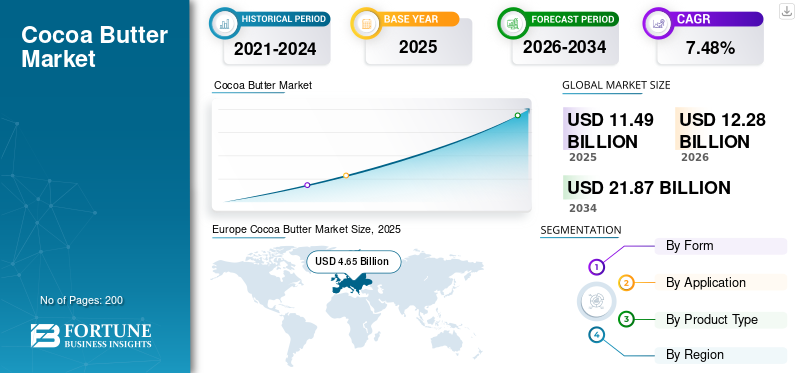
The global cocoa butter market size was valued at USD 11.49 billion in 2025. The market is projected to grow from USD 12.28 billion in 2026 to USD 21.87 billion by 2034, exhibiting a CAGR of 7.48% during the forecast period. Europe dominated the cocoa butter market with a market share of 40.47% in 2025.
Cocoa butter is derived from cocoa beans during chocolate processing. It is a critical fat ingredient widely used across chocolate & confectionery, bakery, cosmetics, pharmaceuticals, and personal care formulations. The market benefits structurally from rising premium chocolate consumption, increasing natural cosmetic formulations, and growing pharmaceutical-grade excipient demand. Cocoa butter’s superior melting profile, oxidative stability, and emollient properties continue to reinforce its indispensability across both food and non-food product applications. Consumers are increasingly preferring sustainably and ethically sourced cocoa butter driven by rising demand for ethical and traceable supply chains amid climate challenges in cocoa-producing regions.
The global cocoa butter industry is dominated by Barry Callebaut Group, Cargill, Incorporated, Olam Group, ECOM Agroindustrial Corp., Fuji Oil Holdings Inc., and others.
Download Free sample to learn more about this report.
Cocoa Butter Market Key Takeaways
 Global Market Size & Forecast
- 2025 Market Size: USD 11.49 billion
- 2026 Market Size: USD 12.28 billion
- 2034 Forecast Market Size: USD 21.87 billion
- CAGR: 7.48% from 2026–2034
 Market Share
- Europe dominated the cocoa butter market with a 40.47% share in 2025.
- The deodorized cocoa butter segment led the market with USD 6.01 billion in 2025.
- The food & beverages segment dominated the market with USD 7.76 billion in 2025.
 Key Regional Highlights
Europe
Europe led the market with USD 4.65 billion in 2025 and is projected to grow at a 6.16% CAGR.
Asia Pacific
Asia Pacific reached USD 2.74 billion in 2025 and is expected to register the fastest CAGR of 10.17%.
North America
North America recorded USD 2.67 billion in 2025 and is projected to expand at a 6.76% CAGR.
U.S.
The market was valued at USD 2.09 billion in 2025, driven by strong chocolate and cosmetics demand.
Japan
The market is expected to witness steady growth, supported by rising demand for premium chocolate and personal care products.
Read More

Cocoa Butter Market Trends
Rising Premium Chocolate and Clean-Label Confectionery Demand
The cocoa butter market is strongly influenced by the global shift toward premium, artisanal, and clean-label chocolate products. Cocoa butter’s ability to deliver smooth texture, gloss, and snap makes it irreplaceable in high-end confectionery. Growing consumer preference for single-origin chocolates, reduced cocoa butter equivalents (CBEs), and natural fat formulations continues to elevate demand across developed and emerging markets.
- According to the International Cocoa Organization (ICCO) and the Food and Agriculture Organization (FAO), global cocoa grindings exceeded 5 million metric tons in 2023, directly supporting cocoa butter production growth.
MARKET DYNAMICS
Market Drivers
Download Free sample to learn more about this report.
Structural Expansion in Global Chocolate, Bakery and Premium Confectionery Consumption Drive Market Growth
The global cocoa butter market is fundamentally driven by the structural expansion of chocolate and confectionery consumption, particularly within premium, artisanal, and specialty product launches categories. Cocoa butter is a non-substitutable fat in high-quality chocolate manufacturing due to its unique polymorphic crystallization behavior, precise melting point close to human body temperature, and ability to impart gloss, snap, and mouthfeel. As consumer awareness shifts toward single-origin chocolates, reduced cocoa butter equivalent (CBE) formulations, organic chocolates, and indulgent dessert products, demand for high-purity cocoa butter continues to accelerate.
- According to data from the Centre for the Promotion of Imports from developing countries (CBI), the global average chocolate consumption is estimated at 0.9 kg per capita per year, while European nations consume significantly more, with a regional average of approximately 5.0 kg per capita per year.
Market Restraints
Volatility in Cocoa Bean Prices and Climate-Driven Supply Risks to Restrain Market Growth
One of the most significant restraints affecting the global cocoa butter market is the high volatility of cocoa bean prices, which directly influences processing margins and downstream product pricing. Cocoa production is heavily concentrated in West Africa, particularly Côte d’Ivoire and Ghana, regions highly vulnerable to climate variability, rainfall inconsistency, pest infestations, and plant disease outbreaks. Supply disruptions caused by El Niño (unusual warming of Pacific waters) events, aging cocoa trees, and reduced farm productivity create pronounced fluctuations in cocoa bean availability, resulting in unstable cocoa butter pricing and procurement uncertainty for processors and manufacturers.
- According to the International Cocoa Organization (ICCO), the above factors caused significant supply deficits, as global production declined by nearly 11% in 2022/23 and further volatility expected, driving up prices.
Market Opportunities
Strong Growth Potential in Emerging Markets and Local Chocolate Manufacturing Creates Growth Prospects
Emerging economies in the Asia Pacific, Latin America, and the Middle East present substantial global cocoa butter market growth opportunities as local chocolate manufacturing, bakery chains, and cosmetic production capacities expand. Rising disposable incomes, urbanization, and exposure to westernized food habits are driving cocoa butter demand for chocolate and cocoa-based products. Governments in India, China, Indonesia, and Vietnam are actively promoting domestic food processing industries, indirectly boosting cocoa butter consumption through localized value addition.
SEGMENTATION ANALYSIS
By Product Type
Deodorized Cocoa Butter Dominates due to Extensive Chocolate Manufacturing Use
By product type, the market is segmented into natural, deodorized, and semi-deodorized cocoa butter.
The deodorized segment dominated the global cocoa butter market share in 2025 with USD 6.01 billion, supported by its neutral flavor profile and widespread use in mass and premium chocolate formulations.
Natural cocoa butter is gaining traction in cosmetics, while semi-deodorized cocoa butter is projected to grow at a CAGR of 7.82% over the forecast period, driven by balanced aroma retention for specialty applications.
To know how our report can help streamline your business, Speak to Analyst
By Application
Food & Beverages is the Leading Application due to Chocolate and Confectionery Consumption
By application, the market is segmented into food & beverages, cosmetics & personal care, and pharmaceuticals.
The food & beverages segment dominated in 2025 with USD 7.76 billion, driven by chocolate, bakery, and dessert manufacturing.
Cosmetics & personal care is the fastest-growing segment at a CAGR of 9.12% during the forecast period, facilitated by rising clean beauty and premium skincare demand.
By Form
Blocks Segment to Dominate the Market due to Industrial Handling and Storage Efficiency
By form, the market is segmented into blocks, liquid, and powder.
The blocks segment led the market in 2025 with USD 7.15 billion, supported by ease of storage, transportation efficiency, and large-scale chocolate processing.
Liquid cocoa butter is the fastest-growing segment at a CAGR of 9.06% during the forecast period, driven by increasing use in cosmetics, pharmaceuticals, and automated food processing systems.
Cocoa Butter Market Regional Outlook
Regionally, the report covers the global market analysis across North America, Europe, Asia Pacific, South America, and the Middle East & Africa.
Europe
Europe Cocoa Butter Market Size, 2025 (USD Billion)
To get more information on the regional analysis of this market, Download Free sample
Europe dominated the global market with USD 4.65 billion in 2025 and is projected to grow at a CAGR of 6.16%, owing to strong chocolate heritage and clean-label regulations.
Germany Cocoa Butter Market
Germany reached USD 1.12 billion in 2025, driven by large-scale confectionery production and pharmaceutical applications.
North America
North America accounted for USD 2.67 billion in 2025 and is projected to grow at a CAGR of 6.76%, supported by premium chocolate demand and advanced cosmetic manufacturing.
U.S. Cocoa Butter Market
The U.S. dominated the region with USD 2.09 billion in 2025, driven by high chocolate consumption and natural cosmetic product penetration.
Asia Pacific
Asia Pacific represented USD 2.74 billion in 2025 and is the fastest-growing region, registering a CAGR of 10.17%, fueled by rising chocolate consumption and cosmetics manufacturing.
China Cocoa Butter Market
China accounted for USD 0.94 billion in 2025, expanding at a CAGR of 11.63%, supported by domestic chocolate brands and personal care demand.
India Cocoa Butter Market
India’s market was valued at USD 0.43 billion in 2025, and is fastest growing at a CAGR of 12.73%, driven by bakery expansion and cosmetic exports.
South America and the Middle East & Africa
South America accounted for USD 0.86 billion in 2025, growing at a CAGR of 8.29%, supported by proximity to cocoa cultivation. The Middle East & Africa reached USD 0.58 billion in 2025, expanding at a CAGR of 5.06%, driven by food processing and pharmaceutical demand.
UAE Cocoa Butter Market
The UAE market was valued at approximately USD 0.14 billion in 2025. The UAE serves as a regional hub for chocolate processing, private-label confectionery, bakery chains, and luxury dessert brands, particularly in Dubai and Abu Dhabi, driving steady industrial demand for high-quality cocoa butter, especially deodorized and specialty grades.
COMPETITIVE LANDSCAPE
Key Industry Players
Key Players Focus on Cocoa Value Chain Integration to Optimize Cocoa Butter Extraction
The global cocoa butter market is moderately fragmented, with competition centered on cocoa bean sourcing, processing efficiency, fat fractionation, and downstream integration. Processors prioritize high-quality, sustainably sourced cocoa beans to optimize cocoa butter extraction via pressing from cocoa mass.
Key Players in the Global Cocoa Butter Market
|
Rank |
Company Name |
|
1 |
Barry Callebaut Group |
|
2 |
Cargill, Incorporated |
|
3 |
Olam Group |
|
4 |
ECOM Agroindustrial Corp. |
|
5 |
Fuji Oil Holdings Inc. |
List of Key Cocoa Butter Companies Profiled
- Barry Callebaut Group (Switzerland)
- Cargill, Incorporated (U.S.)
- Olam Group (Singapore)
- ECOM Agroindustrial Corp. (Switzerland)
- Fuji Oil Holdings Inc. (Japan)
- JB Foods Limited (Thailand)
- Guan Chong Berhad (Malaysia)
- Blommer Chocolate Company (U.S.)
- Puratos Group (Belgium)
- Nederland S.A. (Netherlands)
KEY INDUSTRY DEVELOPMENTS
- November 2025: Amyra Chocolate, a company from Oxapampa in Peru's Pasco region, developed an innovative line of natural cosmetic products using cocoa derivatives. Launched in 2023, this range leverages cocoa butter for its hydrating and skin-regenerating properties.
- December 2022: Himalaya Wellness recently launched a new campaign for its upgraded Cocoa Butter Intensive Serum Body Lotion, emphasizing deep moisturization for resilient skin. Partnering with India's Women's Ice Hockey Team, the #StrongWomenSoftSkin initiative highlights the product's serum-lotion blend for 48-hour hydration in extreme conditions.
- December 2022: Pronatec AG, a Swiss organic ingredients specialist, launched a 100% traceable fair trade organic cocoa butter, produced at its dedicated facility near Schaffhausen. This food-grade cocoa butter is made from organic beans sourced from small-scale farmers, ensuring full traceability without child labor or pesticides. Deodorized naturally without pressure or additives, it offers low free fatty acid (FFA) levels for extended shelf life and stability in premium cosmetics.
- August 2021: Cargill Beauty expanded its portfolio with sustainable cocoa butter, a nature-derived emollient sourced responsibly to meet demand for eco-friendly cosmetics.
REPORT COVERAGE
The global cocoa butter market industry report analyzes the market in depth and highlights crucial aspects such as global market trends, supply chain, market dynamics, prominent companies, investment in research and development, and end-use. Besides this, the research report also provides insights into the global market analysis and highlights significant industry developments.
Request for Customization to gain extensive market insights.
Report Scope & Segmentation
| ATTRIBUTE | DETAILS |
| Study Period | 2021-2034 |
| Base Year | 2025 |
| Estimated Year | 2026 |
| Forecast Period | 2026-2034 |
| Historical Period | 2021-2024 |
| Growth Rate | CAGR of 7.48% from 2026 to 2034 |
| Unit | Value (USD Billion) |
|
Segmentation |
By Form
|
|
By Application
|
|
|
By Product Type
|
|
|
By Region
|
Frequently Asked Questions
As per Fortune Business Insights, the global market was valued at USD 11.49 billion in 2025 and is anticipated to reach USD 21.87 billion by 2034.
At a CAGR of 7.48%, the global market will exhibit steady growth over the forecast period.
By form, the blocks segment led the market.
Europe held the largest market share in 2025.
Structural growth in global chocolate, bakery, and premium confectionery consumption drive market growth.
Barry Callebaut Group, Cargill, Incorporated, Olam Group, ECOM Agroindustrial Corp., Fuji Oil Holdings Inc., and others are the leading companies in the market.
Prevalence of premium chocolate and clean-label confectionery demand to be a prominent trend in the market.



- 2021-2034
- 2025
- 2021-2024
- 200
-
(Offer valid till 30th Sep 2026)
Get 30-60 hrs Free Customization
Expand Regional and Country Coverage, Segments Analysis, Company Profiles, Competitive Benchmarking, and End-user Insights.



















Related Reports
-
US +1 833 909 2966 ( Toll Free )
-
Get In Touch With Us