Coffee Roaster Market Size, Share & Industry Analysis, By Product Type (Drum and Hot Air), By Capacity (Small Capacity (Up to 5 kg), Medium Capacity (5-30 kg), and Large Capacity (Above 30 kg)), By Operation Mode (Manual, Semi-Automatic, and Fully-Automatic), By Application (Residential, Commercial, and Industrial), and Regional Forecast, 2026-2034
 Download Free Sample
(Offer valid till 30th Sep 2026)

Coffee Roaster Market Size and Future Outlook
 Listen to Audio Version
The global coffee roaster market size was valued at USD 1.96 billion in 2025 and is projected to grow from USD 2.06 billion in 2026 to USD 3.41 billion by 2034, exhibiting a CAGR of 6.46% during the forecast period. Europe dominated the coffee roaster market with a market share of 32.14% in 2025.
The market for coffee roaster is mainly fueled by the increase in global coffee consumption, growing number of specialty cafes, and consumers' rising preference for freshly roasted, high, and quality coffee. The market is being supported by an increasing demand for small and mid-sized roasters, especially in urban areas, as artisanal and craft roasting is becoming more popular. New technology such as automated roasting systems, precision temperature controls, and energy efficient equipment help improve consistency and efficiency in operations. Moreover, the development of the home brewing culture and the rise of e-commerce channels are attracting more customers to compact and commercial coffee roasters. The market is also benefiting from emerging markets and sustainability-focused roasting solutions. Moreover, demand for industrial roasters is increasing because of the global coffee consumption keeps growing, and large coffee processors are expanding their capacity to serve retail, foodservice, and private, label channels.
- For instance, according to the USDA’s Coffee: World Markets and Trade report, the coffee consumption has grown significantly in emerging economies such as China by almost 150% over the last ten years, indicating growing coffee demand and simultaneously for coffee roasters as well.
Furthermore, major market players operating in the market include Giesen Coffee Roasters, Diedrich Manufacturing, Probat Group, Loring Smart Roast, and Bühler Group. These players are stressing on product upgradation, which includes development of automated, advanced, energy-efficient, and digitally controlled roasting systems. These highly innovative coffee roasters achieve reduced emissions, consistent quality, and optimized operating costs, aligning with rising demand and sustainability goals from specialty coffee manufactures.
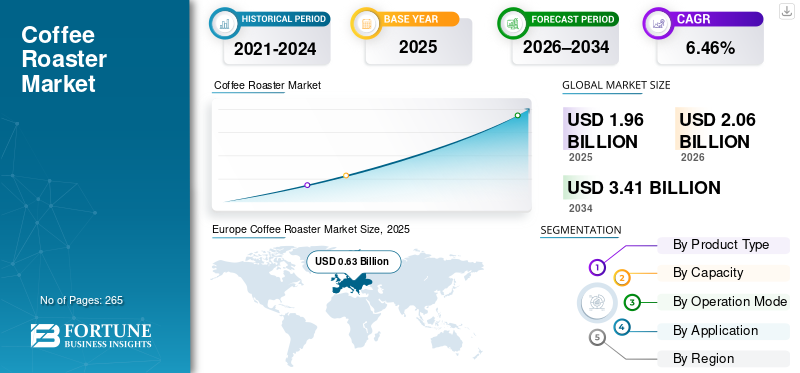
Download Free sample to learn more about this report.
Coffee Roaster Market KEY TAKEAWAYS
 Market Size & Forecast
- 2025 Market Size: USD 1.96 billion
- 2026 Market Size: USD 2.06 billion
- 2034 Forecast Market Size: USD 3.41 billion
- CAGR: 6.46% from 2026–2034
 Market Share
- Europe dominated the coffee roaster market with a 32.14% share in 2025.
- Drum coffee roasters accounted for the leading market share in 2025.
- The fully automatic segment dominated the global market in 2025.
 Key Regional Highlights
Europe
Europe held the largest market share in 2025, valued at USD 0.63 billion, and is expected to maintain its leadership with USD 0.66 billion in 2026.
North America
North America reached a market value of USD 0.56 billion in 2025 and is projected to grow at a CAGR of 6.04% during the forecast period.
Asia Pacific
Asia Pacific was valued at USD 0.46 billion in 2025, securing its position as the third-largest regional market.
U.S.
U.S. The U.S. remained the leading country market, reaching a valuation of USD 0.49 billion in 2025.
Japan
Japan Growing coffee consumption, increasing café culture, and demand for premium roasting equipment continue to support market expansion.
Read More

COFFEE ROASTERS MARKET TRENDS
Expansion of Energy-Efficient and Smart Roasting Systems Usage
Due to the increased focus on sustainability, rising energy costs, and stricter emission standards, roasters are integrating energy-efficient and digitally enabled systems. Thus, manufacturers are integrating roasting systems with automation, data analytics, and precise temperature control. Such a trend guarantees the repeatability of the roast, reduction of fuel and emission levels, and improvement of the productivity of the operation; making smart roasting solutions increasingly attractive to both small-scale specialty and huge coffee producers.
Download Free sample to learn more about this report.
MARKET DYNAMICS
MARKET DRIVERS
Expansion of Specialty Coffee Culture is Boosting the Market Growth
The coffee roaster market growth is significantly influenced by the fast development of specialty coffee culture, which is largely due to consumers' growing readiness to pay for high-quality, ethically sourced, and freshly roasted coffee. As coffee shops and micro-roasters grow in both urban and emerging markets, there is an increasing demand for sophisticated roasting machines that can provide accurate control over roast profiles and the uniformity of flavor. This change results in more use of small to medium-sized roasters, thus, it prompts manufacturers to come up with customizable, high, performance roasting solutions.
MARKET RESTRAINTS
High Capital Requirement and Operational Costs to Obstruct Market Growth
The coffee roaster market growth faces some limitations due to the steep initial investment of commercial roasting equipment and continuous costs of energy, maintenance, and skilled labor. Consequently, small and emerging coffee businesses might postpone or not go for equipment upgrades at all, thus, limiting the adoption rate, and the overall market growth might get slow especially in price-sensitive and developing regions.
MARKET OPPORTUNITIES
Escalating Demand for Premium Coffee Experience and Emerging Coffee-Consumption to Create Growth Aspects
The demand for roasted coffee is driven by various factors including increased urbanization, lifestyles influenced by the west and growth of cafe culture in emerging economies. As the coffee culture spreads in developing regions like Asia, Pacific and South America, local coffee roasters are adopting in, house roasting to improve quality and profit. This decision gives a great chance to equipment manufacturers to offer small, scalable, and low, priced coffee roasting machines to satisfy new market entrants' needs.
MARKET CHALLENGES
Compliance with Environmental and Emission Regulations to Pose as a Critical Challenge in Market Growth
Stricter environmental regulations in terms of emissions, energy consumption, and air quality pose a significant challenge in the coffee roaster market growth. The manufacturers of roasters and the users of the machines have to invest in highly tech filters, afterburners, and clean technologies as the governments set tougher rules. This results in the equipment becoming more complicated and the cost going up, which may discourage smaller roasters from making changes and the market penetration may become slow, especially in the regions where the regulations are very strict.
Segmentation Analysis
By Product Type
Superior Flavor Control and Widespread Commercial Adoption to Propel Segmental Growth of Drum Coffee Roasters
According to product type, the market is segregated into drum and hot air.
The drum coffee roasters are expected to take-up for the leading market share. The high segmental share is primarily attributed to the greater flexibility in developing flavor profiles, enhanced heat control, and longer roast times that are critical in specialty and premium coffee. Consequently, these roasters are broadly embraced by specialty roasteries, cafes, and commercial roasting facilities. Moreover, strong demand from professional users and higher average selling price further contribute to their large revenue share compared to hot air coffee roasters.
The hot air segment is projected to upsurge with a CAGR of 7.52% over the forecast period.
To know how our report can help streamline your business, Speak to Analyst
By Operation Mode
Efficiency, Consistency, and Scalability Features Boosted Fully Automatic Segment Growth
Based on operation mode, the market is segmented into manual, semi-automatic, and fully-automatic.
In 2025, fully automatic segment dominated the global market. This dominance of the segment was due to their precision control over roasting parameters, reduce reliance on skilled labor, and ensure consistent quality across batches. As coffee businesses scale-up their operations to fulfil rising demand, automation helps achieve higher throughput and operational efficiency. Moreover, fully automatic systems command higher prices and are preferably chosen by coffee chains and commercial roasters, leading to their revenue generation.
The fully-automatic i.e. electric coffee roaster segment is projected to grow at the highest CAGR of 7.80% over the forecast period.
By Capacity
Balanced Throughput and Broad Commercial Adoption to Drive Medium Capacity Demand
Based on the capacity, the market is segmented into small capacity (up to 5 kg), medium capacity (5-30 kg), and large capacity (above 30 kg).
The medium capacity segment is predicted to witness a dominating market share over the forecast period. Their optimal balance between operational flexibility, high volume production, and cost contributes to their highest market share. As independent roasteries, café chains, and local coffee brands expand, these systems complete daily roasting needs without the high capital investment of large-capacity units. Their extensive adoption across commercial applications and comparatively higher unit sales volume contribute to their higher market share.
The small capacity segment is projected to grow at a CAGR of 7.43% over the forecast period.
By Application
Expansion of Café Networks and Specialty Roasting to Augment Demand in Commercial Applications
The market, based on application, is divided into residential, commercial, and industrial.
The commercial application dominated the global market. This high market share was driven by rapid expansion of small-to-mid-sized roasteries, cafes, and specialty coffee shops. Commercial entities demand technologically smart and advanced, reliable, and high-capacity equipment to ensure supreme quality coffee and fulfil daily rising demand.
In addition, residential application is projected to grow at the fastest CAGR of 8.37% during the study period.
Coffee Roaster Market Regional Outlook
By geography, the market is categorized into Europe, North America, Asia Pacific, South America, and the Middle East and Africa.
Europe
Europe Coffee Roaster Market Size, 2025 (USD Billion)
To get more information on the regional analysis of this market, Download Free sample
Europe held the dominant coffee roaster market share in 2025, valuing at USD 0.63 billion, and is also expected to maintain the leading share in 2026, with USD 0.66 billion. The region’s growth is led by strong consumer preference for artisanal, premium, and sustainably roasted coffee and well established specialty coffee culture.
U.K Coffee Roaster Market
The U.K. market in 2025 reached around USD 0.07 billion, representing roughly 3.78% of global market revenues.
Germany Coffee Roaster Market
Germany’s market is reached approximately USD 0.06 billion in 2025, equivalent to around 5.66% of global market sales.
North America
North America is projected to record a growth rate of 6.04% in the coming years, which is the third highest among all regions, and reached a valuation of USD 0.56 billion by 2025. Dense network of micro-roasteries and cafes, supplemented by higher per-capita coffee consumption, and deeply rooted specialty coffee culture in the region supplemented the regional market growth.
U.S. Coffee Roaster Market
As per the North America’s contribution and leading position, U.S. dominates the North Americas region, with valuation of the country reaching USD 0.49 billion in 2025, taking-up 24.88% of the global market sales.
Asia Pacific
Asia Pacific reached USD 0.46 billion in 2025 and secured the position of the third-largest region in the market. In the region, India and China both reached USD 0.15 billion and USD 0.14 billion, respectively in 2025.
Japan Coffee Roaster Market
The Japan market in 2025 was valued at around USD 0.04 billion, accounting for roughly 1.95% of global market revenues. Increasing adoption of precision-controlled roasting equipment to fulfill consumer’s preferences for craftsmanship and consistency and escalating demand for specialty coffee drives the country’s market growth.
China Coffee Roaster Market
China’s market in 2025 is reached around USD 0.15 billion, representing roughly 7.74% of global market sales.
India Coffee Roaster Market
The India market in 2025 was valued around USD 0.14 billion, accounting for roughly 7.33% of global market revenues.
South America and Middle East & Africa
The South America and Middle East & Africa regions are expected to witness moderate growth in this market space during the forecast period. The South America market reached a valuation of USD 0.17 billion in 2025. The region’s strong position as a major coffee producer, growing domestic coffee consumption, and rising investments in local value-added roasting equipment to improve margins and product differentiation drives market growth. In the Middle East & Africa, the UAE is reached a value of USD 0.04 billion in 2025. Also, Saudi Arabia is also one of the prominent markets in the region which is expected to grow significantly over the forecast period.
South Africa Coffee Roaster Market
The South Africa market is reached around USD 0.03 billion in 2025, representing roughly 1.34% of global market revenues.
COMPETITIVE LANDSCAPE
Key Industry Players
Sustainability-Led Differentiation and Product Innovation By Prominent Market Players is Driving Intense Competition
The key players’ in the global coffee roaster market faces severe competition due to constant investment on product innovation, automation, digital controls, and energy-efficient roasting technologies. As carbon emission and sustainability compliance becomes critical, manufacturers are integrating heat recovery systems and low-emission burners to meet regulatory standards. This in turn offers them higher-value offerings and stronger differentiation, permitting players to attract commercial and residential buyers and specialty roasters. Moreover, strategic collaborations and expansions, after-sales services, and customization further enhance competitive positioning and customer retention.
LIST OF KEY COFFEE ROASTERS COMPANIES PROFILED
- Probat Group (Germany)
- Bühler Group (Switzerland)
- Giesen Coffee Roasters (Netherlands)
- Loring Smart Roast (U.S.)
- Diedrich Manufacturing Inc. (U.S.)
- Toper Coffee Roasters (Turkey)
- IMA Coffee (Petroncini brand) (Italy)
- Neuhaus Neotec (Germany)
- Coffed Srl (IMF Roasters) (Italy)
- Mill City Roasters (U.S.)
KEY INDUSTRY DEVELOPMENTS
- June 2025: Probat Group merged several brands of its subsidiaries under the single PROBAT brand as part of a strategic realignment to create a stronger global brand identity and outspread its impact beyond coffee roasting into wider food processing sectors.
- March 2025: Giesen Coffee Roasters expanded its global service and showroom network, including new experience centers and partner-led facilities in Europe and Asia, to support specialty roasters and improve customer engagement.
- September 2024: Bhler Group joined forces with several coffee industry participants to develop and promote sustainable, low-emission coffee roasting solutions, thus reflecting the company's comprehensive sustainability and decarbonization This partnership strengthens Bhler's stance in the market for environmentally friendly roasting technologies.
- May 2024: To have strong foothold in the market, Loring Smart Roast expanded its presence in Asia Pacific region by solidifying its distributor partnerships in Japan and Southeast Asia.
- February 2024: Probat Group acquired AC Horn Manufacturing in Texas to reinforce its manufacturing capabilities and widen its technology portfolio. This acquisition has helped the company enhance its competitive position and also expand its markets for food processing equipment supporting vertical integration and streamlining production efficiencies.
REPORT COVERAGE
Request for Customization to gain extensive market insights.
Report Scope & Segmentation
|
ATTRIBUTE |
DETAILS |
|
Study Period |
2021-2034 |
|
Base Year |
2025 |
|
Estimated Year |
2026 |
|
Forecast Period |
2026-2034 |
|
Historical Period |
2021-2024 |
|
Growth Rate |
CAGR of 6.46% from 2026-2034 |
|
Unit |
Value (USD Billion) |
|
Segmentation |
By Product Type, Capacity, Operation Mode, Application, and Region |
|
By Product Type |
· Drum · Hot Air |
|
By Capacity |
· Small Capacity (Up to 5 kg) · Medium Capacity (5–30 kg) · Large Capacity (Above 30 kg) |
|
By Operation Mode |
· Manual · Semi-Automatic · Fully Automatic |
|
By Application |
· Residential · Commercial · Industrial |
|
By Region |
· North America (By Product Type, Capacity, Operation Mode, Application, and Country) o U.S. (By Product Type) o Canada (By Product Type) o Mexico (By Product Type) · Europe (By Product Type, Capacity, Operation Mode, Application, and Country/Sub-region) o Germany (By Product Type) o U.K. (By Product Type) o France (By Product Type) o Spain (By Product Type) o Italy (By Product Type) o Rest of Europe (By Product Type) · Asia Pacific (By Product Type, Capacity, Operation Mode, Application, and Country/Sub-region) o China (By Product Type) o Japan (By Product Type) o India (By Product Type) o Australia (By Product Type) o Rest of Asia Pacific (By Product Type) · South America (By Product Type, Capacity, Operation Mode, Application, and Country/Sub-region) o Brazil (By Product Type) o Argentina (By Product Type) o Rest of South America (By Product Type) · Middle East & Africa (By Product Type, Capacity, Operation Mode, Application, and Country/Sub-region) o South Africa (By Product Type) o UAE (By Product Type) o Rest of Middle East & Africa (By Product Type) |
Frequently Asked Questions
According to Fortune Business Insights, the global market value stood at USD 1.96 billion in 2025 and is projected to reach USD 3.41 billion by 2034.
In 2025, the market value for North America stood at USD 0.56 billion.
The market is expected to exhibit a CAGR of 6.46% during the forecast period.
By product type, the drum coffee roaster segment is expected to lead the market.
Increase in global coffee consumption, the growing number of specialty cafes, and consumers' rising preference for freshly roasted, high, quality coffee are driving market expansion.
Giesen Coffee Roasters, Diedrich Manufacturing, Probat Group, Loring Smart Roast, and Bühler Group are the major players in the global market.
Europe dominated the market in 2025.



- 2021-2034
- 2025
- 2021-2024
- 265
-
(Offer valid till 30th Sep 2026)
Get 30-60 hrs Free Customization
Expand Regional and Country Coverage, Segments Analysis, Company Profiles, Competitive Benchmarking, and End-user Insights.



















Related Reports
-
US +1 833 909 2966 ( Toll Free )
-
Get In Touch With Us