Coffee Substitute Market Size, Share & Industry Analysis, By Product Type (Chicory-based Coffee Substitute, Grain-based Coffee Substitute, Herbal & Root-based Coffee Substitute, Fruit & Seed-based Coffee Substitute, and Others), By Form (Powder/Granules, Liquid Concentrates, and Ready-to-Drink), By Nature (Organic and Conventional), By Distribution Channel (B2B and B2C [Supermarkets & Hypermarkets, Convenience Stores, Specialty Health Stores, Online Retail, and Others]), and Regional Forecast, 2026-2034
 Download Free Sample
(Offer valid till 15th Oct 2026)

Coffee Substitute Industry Analysis 2026-2034
 Listen to Audio Version
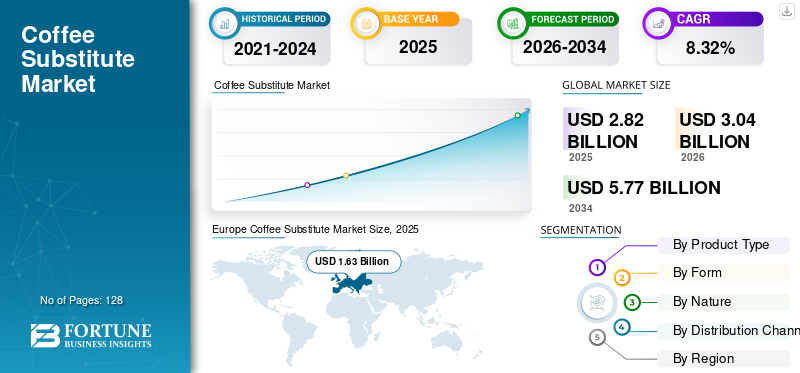
The global coffee substitute market size was valued at USD 2.82 billion in 2025 and is projected to grow from USD 3.04 billion in 2026 to USD 5.77 billion by 2034, exhibiting a CAGR of 8.32% during the forecast period. Europe dominated the coffee substitute market with a market share of 57.80% in 2025.
The coffee substitute market is evolving from a traditional caffeine-free beverage niche into a broader ingredient platform shaped by supply resilience, sensory science, formulation economics, and changing beverage formats. Chicory remains an important commercial foundation because European legislation specifically recognizes chicory and chicory extracts used in coffee substitutes. Roasting conditions are also subject to food-safety controls because thermal processing can influence acrylamide formation.
The market is nevertheless broadening beyond conventional chicory and cereal formulations. Research published in 2025 identifies roots, seeds, fruits, and other plant materials as potential substitute inputs, while highlighting sensory replication, safety, and process efficiency as persistent development challenges.
For B2B buyers, the commercial proposition is increasingly practical. Food manufacturers evaluate ingredient consistency, roasting behavior, flavor performance, processing compatibility, regulatory status, and supply reliability. Foodservice operators add preparation consistency and cost control to that decision set.
Technology is becoming more important at the formulation stage. Recent scientific research points toward artificial intelligence, non-thermal processing, and advanced process optimization as potential tools for improving flavor, safety, and sustainability. These technologies remain less mature than conventional roasting and extraction systems, so their investment case requires careful validation.
The market outlook is therefore positive but selective. Established ingredients retain advantages in regulatory familiarity and manufacturing know-how, while emerging inputs compete through differentiated sensory profiles, sustainability narratives, and potentially stronger supply economics.
Market size and market share estimates should be treated cautiously because publicly available commercial estimates use different definitions and methodologies. The more defensible market analysis is based on formulation adoption, production capability, regulatory progress, B2B partnerships, and application expansion.
Coffee substitutes refer to beverages formulated to replicate the taste, aroma, color, mouthfeel, and brewing experience of coffee without relying fully on roasted coffee beans. These products are generally made from roasted chicory root, barley, rye, malted grains, dandelion root, burdock root, figs, dates, carob, acorns, soy, lupin, and other plant-based ingredients.
The adverse effects of excessive caffeine consumption, including sleep disruption, anxiety, acidity, digestive discomfort, increased heart rate, and stimulant sensitivity, are encouraging health-conscious consumers to shift toward caffeine-free and low-caffeine beverages. This trend is supporting demand for chicory-based, grain-based, herbal, and root-based coffee substitutes in the global market.
The global market demand is supported by the presence of leading companies and brands such as Nestlé S.A., Leroux, World Finer Foods, Teeccino Caffé Inc., Dandy Blend, The Hain Celestial Group, AyurSome Foods, Anthony’s Goods, Lima Food, and Naturata AG. These companies maintain an active position in roasted cereal beverages, chicory products, herbal coffee alternatives, caffeine-free beverages, and natural health-focused drink mixes.
Download Free sample to learn more about this report.
Coffee Substitute Market Key Takeaways
 Global Market Size & Forecast
- 2025 Market Size: USD 2.82 billion
- 2026 Market Size: USD 3.04 billion
- 2034 Forecast Market Size: USD 5.77 billion
- CAGR: 8.32% (2026–2034)
 Market Share
- Europe dominated the market with a 57.80% share in 2025.
- The chicory-based coffee substitute segment held the largest market share, valued at USD 0.97 billion in 2025.
- The ready-to-drink segment is projected to witness the fastest growth, expanding at an 11.02% CAGR during the forecast period.
 Key Regional Highlights
Asia Pacific
Asia Pacific accounted for USD 0.54 billion in 2025 and is projected to reach USD 1.30 billion by 2034, registering the fastest growth at a 10.21% CAGR.
North America
North America generated USD 0.41 billion in 2025 and is projected to reach USD 0.88 billion by 2034, growing at an 8.86% CAGR.
Europe
Europe generated USD 1.63 billion in 2025 and is projected to reach USD 3.08 billion by 2034.
U.S.
U.S. market reached USD 0.32 billion in 2025.
Japan
Japan market is projected to witness steady growth during the forecast period.
Read More

Key Market Dynamics
Market Trends
Rising Demand for Caffeine-free, Digestive-friendly, and Functional Coffee Alternatives to Shape Industry Trends
A major trend shaping the market is the shift from simple “coffee replacement” products toward caffeine-free and wellness-positioned beverages. Consumers are increasingly looking for products that deliver the roasted, bitter, full-bodied sensory experience of coffee without caffeine-related concerns such as acidity, jitters, sleep disruption, or digestive discomfort. As a result, demand is growing for chicory coffee, dandelion root coffee, roasted barley beverages, fig-based coffee alternatives, mushroom blends, and herbal coffee mixes.
The market is moving toward formulation engineering rather than simple coffee imitation. Commercial developers increasingly combine multiple plant inputs to balance aroma, bitterness, color, mouthfeel, cost, and supply resilience. Recent research found that mixtures of chicory, sugar beet, peas, and other ingredients can produce more acceptable sensory profiles than individual substitutes.
Another trend is greater scientific control of roasting. Lupin-based coffee substitutes, for example, require sufficient thermal treatment for flavor formation, while higher temperatures can materially increase acrylamide formation. This makes roasting optimization both a sensory and food-safety issue.
Technology is moving beyond conventional process development. A 2025 review identifies artificial intelligence and emerging non-thermal technologies, including high-pressure processing, pulsed electric fields, ultrasound, and pulsed light, as potential tools for improving substitute quality, safety, and sustainability. These approaches remain earlier-stage than established roasting systems.
Chicory-based substitutes are gaining traction as chicory root naturally contains inulin, a prebiotic fiber associated with digestive wellness positioning. This allows brands to market these products as caffeine-free alternatives and as gut-health-oriented beverages.
- For instance, brands such as Teeccino and Dandy Blend position their products around caffeine-free consumption, roasted flavor, herbal ingredients, and digestive-friendly benefits. These attributes make such products suitable for evening use and for consumers seeking to reduce their coffee intake.
Market Drivers
Download Free sample to learn more about this report.
Rising Coffee Price Volatility is Supporting Demand for the Product
One of the important drivers of the global market is the increasing volatility and upward pressure in coffee prices. As conventional coffee becomes more expensive due to weather disruptions, crop uncertainty, logistics costs, and supply-demand imbalance, consumers and manufacturers are becoming more open to lower-cost and non-coffee beverage alternatives such as chicory coffee, roasted barley drinks, rye-based beverages, dandelion coffee, herbal coffee blends, and cereal-based coffee substitutes.
- According to the International Coffee Organization, the ICO Composite Indicator Price averaged 299.61 U.S. cents/lb in December 2024, representing a 10.7% increase compared with November 2024. The same report noted that the 2024 annual average stood at 229.34 U.S. cents/lb, around 40% higher than the previous year. This sharp price movement shows how coffee has become more exposed to cost pressure and price instability.
The strongest market driver is formulation flexibility. Food manufacturers can combine roasted chicory, cereals, roots, and other plant materials to create beverages with coffee-like sensory characteristics while reducing dependence on coffee as the sole roasted-input source. European rules explicitly recognize roasted chicory and other roasted coffee substitutes, supporting established commercial treatment of the category.
Supply economics reinforce this proposition. Coffee substitutes give procurement teams additional raw-material options when coffee prices, availability, or sourcing conditions become less attractive. The benefit is not automatic: substitute ingredients must deliver predictable flavor, yield, and processing performance before purchasing teams will change established formulations.
Regulatory clarity is another driver. European legislation provides defined categories for coffee substitutes and establishes specific food-safety expectations for cereal- and chicory-based products. This gives manufacturers a clearer compliance pathway while making roasting control a core production requirement.
Market Restraints
Taste Matching Challenges and Strong Preference For Regular Coffee Limit Market Expansion
A major restraint affecting the global coffee substitute market growth is the difficulty of matching the full sensory profile of conventional coffee. Coffee has a complex combination of bitterness, roasted aroma, acidity, body, aftertaste, and crema characteristics that are difficult to reproduce using chicory, barley, rye, dandelion root, figs, dates, or herbal blends. As a result, many coffee substitutes are accepted by wellness-focused or caffeine-sensitive consumers, but they may struggle to convert regular coffee drinkers who expect strong aroma, roast intensity, and a familiar mouthfeel.
The principal restraint is sensory parity. Coffee substitutes must reproduce enough aroma, bitterness, body, color, and aftertaste to generate repeat consumption. Alternative ingredients can perform well individually yet lose acceptance when incorporated into commercial formulations. This creates a qualification barrier for B2B manufacturers, where reformulation costs and consumer testing can outweigh the initial ingredient advantage.
Roasting control is another material constraint. High-temperature processing is essential for developing roasted flavor, but it also creates acrylamide-management requirements. European Union rules require food businesses producing coffee substitutes to identify critical roasting conditions and incorporate appropriate controls into food-safety systems.
In addition, grain-based coffee substitutes made from barley, rye, malt, or wheat face labeling challenges among gluten-sensitive consumers.
- In the U.S., FDA rules allow a product to be labeled “gluten-free” only if it contains less than 20 parts per million gluten and does not contain wheat, rye, barley, or their crossbred hybrids unless processed to remove gluten. These requirements create additional formulation and labeling challenges for roasted cereal beverage manufacturers targeting clean-label, allergen-conscious, or gluten-free consumer segments.
Market Opportunities
Ready-to-drink and Functional Coffee Alternatives to Create New Growth Potential
One major opportunity in the global market lies in the expansion of ready-to-drink and functional coffee alternatives. Traditionally, coffee substitutes were mainly consumed as hot brewed products made from chicory, barley, rye, malt, dandelion root, or herbal blends. However, brands now have an opportunity to introduce these products in convenient RTD formats such as chicory lattes, roasted barley drinks, herbal iced coffee alternatives, oat-based caffeine-free beverages, and gut-health-focused functional drinks.
The most attractive opportunity is not another generic caffeine-free beverage; it is the industrialization of differentiated substitute ingredients that solve a measurable formulation, sourcing, or processing problem.
Ingredient diversification is the first opportunity. Research is expanding beyond established chicory and cereals toward lupin, tamarind seed, date seed, legumes, roots, and other underutilized materials. Recent studies demonstrate that these inputs can generate roasted aromas and coffee-like sensory characteristics, although replication remains incomplete.
Hybrid formulations offer a more commercially practical pathway. Blending substitute ingredients with coffee can reduce dependence on conventional beans while retaining recognizable sensory characteristics. This approach also gives manufacturers greater control over formulation economics and product positioning.
A second opportunity is process optimization. Roasting remains the critical conversion step because temperature directly affects aroma generation, amino-acid degradation, and acrylamide formation. The 2025 lupin study demonstrates the trade-off clearly: flavor development requires substantial heat, while excessive thermal intensity increases process-contaminant concerns.
- For instance, in August 2023, San Francisco-based Minus Coffee made a sustainable "beanless" cold brew that sidesteps the use of traditional coffee crops through an innovative fermentation process. Their specific recipe aims to replicate the traditional coffee experience with significantly reduced water and carbon emissions. The signature brew relies on a proprietary blend of roasted upcycled ingredients, including date seeds, sunflower seeds, millet malt, chicory, carob, and roasted lentils.
Market Segmentation Analysis
By Product Type
Chicory-based Coffee Substitute Segment Dominated the Market Due to Its Strong Coffee-like Taste, Caffeine-free Positioning, and Long-standing Household Use
Based on product type, the market is segmented into chicory-based coffee substitute, grain-based coffee substitute, herbal & root-based coffee substitute, fruit & seed-based coffee substitute, and others.
Chicory-based Coffee Substitute
The chicory-based coffee substitute segment dominated the global coffee substitute market share, valued at USD 0.97 billion in 2025, owing to its strong roasted flavor, natural caffeine-free profile, mild bitterness, and long history of use as a coffee extender and replacement. Chicory is widely used in instant powders, granules, roasted blends, soluble beverage mixes, and coffee-chicory combinations due to its ability to provide color, body, and roasted notes.
Chicory is the most established product archetype because its roasting behavior, bitterness, color contribution, and historical use provide manufacturers with a familiar technical foundation. Demand comes from beverage formulators, foodservice suppliers, private-label producers, and brands targeting caffeine-free consumption. European legislation provides a defined framework for chicory and chicory extracts, reducing regulatory uncertainty for established applications. Adoption depends on roast consistency, inulin content, particle size, solubility, aroma, and compatibility with blending systems.
Grain-based Coffee Substitute
Grain-based substitutes use roasted barley, rye, wheat, malt, oats, or related cereals to create color, toasted notes, and a familiar beverage profile. Their commercial advantage is manufacturing familiarity and broad raw-material availability. Food manufacturers can use existing roasting, milling, blending, and instantization infrastructure with limited process redesign.
Demand is strongest where affordability and familiar taste outweigh premium positioning. Procurement teams evaluate grain prices, moisture, storage requirements, allergen controls, and batch consistency. Gluten considerations can restrict some applications, particularly where wheat, barley, or rye are used. Roasting conditions also require disciplined control because thermal processing affects both sensory performance and acrylamide formation.
Through 2034, grain-based products should remain important in value-oriented formulations and institutional foodservice. Competitive differentiation will depend on controlled roasting, allergen management, clean labeling, and blends that narrow the sensory gap with coffee.
Herbal & Root-based Coffee Substitute
Herbal and root-based products include dandelion, burdock, roasted roots, botanicals, and blended plant materials. Their strongest demand comes from specialty beverage brands and consumers seeking caffeine-free products with distinctive botanical positioning. For B2B buyers, the appeal is formulation differentiation rather than simple cost substitution.
Adoption is constrained by flavor variability, ingredient familiarity, regulatory status, and supply fragmentation. Botanical ingredients can require more extensive specification work than established cereals or chicory. Manufacturers must also distinguish permitted food use from unsupported health claims, especially when products are marketed around wellness.
The segment offers innovation potential through blending and controlled roasting. Suppliers that combine botanical expertise with sensory analytics can create differentiated profiles while reducing batch variability. Through 2034, the segment should gain share within premium and functional beverage portfolios, but mass-market penetration will depend on repeatable flavor and scalable sourcing.
Fruit & Seed-based Coffee Substitute
The fruit & seed-based coffee substitute segment is projected to grow at the fastest CAGR of 10.67% from 2026 to 2034, supported by growing interest in fig, date, carob, acorn, lupin, and seed-based coffee-like beverages. Fruit and seed-based substitutes use materials such as dates, figs, carob, acorns, tamarind seeds, or other agricultural by-products. The category is attractive because it can connect beverage innovation with circular-economy objectives and regional ingredient availability.
Demand is driven by brands seeking novel sensory profiles, upcycling narratives, and differentiated raw-material sources. Yet procurement teams will scrutinize seasonal availability, contamination controls, preprocessing requirements, and food-safety validation. Some materials also require additional roasting or treatment before achieving acceptable beverage characteristics.
To know how our report can help streamline your business, Speak to Analyst
By Form
Powder/Granules Segment Dominated the Market Due to Its Longer Shelf Life, Easy Preparation, and Strong Suitability for Household Consumption
Based on form, the market is segmented into powder/granules, liquid concentrates, and ready-to-drink.
Powder/Granules
The powder/granules segment dominated the global market, valued at USD 2.21 billion in 2025, due to its convenience, longer shelf life, lower storage cost, ease of transportation, and suitability for instant beverage preparation. Powder and granule formats are especially common in chicory, grain, barley, malt, and herbal coffee substitutes as they dissolve easily in hot water or milk and fit established household consumption habits.
Powder and granule formats remain operationally attractive because they offer relatively efficient transportation, storage, dosing, and shelf-life management. They fit established instant beverage manufacturing and foodservice preparation systems, making them particularly suitable for B2B procurement.
Manufacturers evaluate particle size, bulk density, dissolution, moisture stability, packaging compatibility, and flavor retention. Production economics also favor concentrated dry ingredients when freight and warehouse costs are high. The principal limitation is preparation dependence: consumers and operators must still control water temperature, dosage, and mixing.
Liquid Concentrates
Liquid concentrates offer formulation flexibility and can provide rapid preparation for foodservice, beverage manufacturing, and ready-to-serve applications. Their commercial appeal increases where speed, dosing precision, and flavor consistency matter more than storage efficiency.
The major constraints are water content, packaging weight, shelf stability, microbial control, and logistics economics. Manufacturers must establish robust preservation and filling systems while managing transport costs. Buyers therefore compare the convenience advantage against higher supply-chain complexity.
Through 2034, liquid concentrates should gain adoption where centralized beverage preparation and precise dosing justify the additional logistics burden. Partnerships with foodservice operators and beverage manufacturers can accelerate qualification.
Ready-to-Drink
The ready-to-drink segment, valued at USD 0.39 billion in 2025, is projected to grow at the fastest CAGR of 11.02% from 2026 to 2034.
Ready-to-drink formats shift competition from ingredient performance toward finished-product economics. They offer immediate consumption, portion control, and consistent sensory delivery without requiring brewing equipment. This makes them relevant to convenience, workplace, travel, and foodservice channels.
B2B buyers focus on formulation stability, packaging compatibility, shelf life, filling economics, and distribution velocity. The format also faces intense competition from conventional coffee, tea, functional beverages, and other non-alcoholic products.
By Nature
Conventional Segment Dominated the Market Due to Its Wider Availability, Competitive Pricing, and Strong Presence Across Mass Retail Shelves
Based on nature, the market is segmented into organic and conventional.
Organic
The organic segment, valued at USD 0.69 billion in 2025, is projected to grow at the fastest CAGR of 9.64% from 2026 to 2034. Organic substitutes target premium buyers seeking certified agricultural inputs and tighter production controls. Demand is strongest where retailers and brands use organic credentials as part of broader sourcing strategies. Adoption depends on certification, segregation, traceability, and reliable availability of compliant raw materials.
The principal constraint is cost. B2B buyers require a defensible premium.
Conventional
The conventional segment dominated the global coffee substitute market, valued at USD 2.13 billion in 2025, owing to its broad availability, established raw material sourcing, lower price point, and strong presence across supermarkets, hypermarkets, convenience stores, and mainstream retail beverage shelves. Conventional chicory and grain-based products are widely used by price-sensitive consumers and foodservice buyers who require consistent taste and affordable formulations.
Conventional substitutes benefit from broader raw-material availability, established processing infrastructure, and lower procurement complexity. They remain attractive for mass-market formulations and foodservice applications where consistent quality and cost discipline are primary requirements.
The segment faces increasing scrutiny over ingredient sourcing, processing aids, and environmental practices. Manufacturers therefore need stronger traceability even without organic certification.
By Distribution Channel
B2C Segment Dominated the Market Due to High Household Consumption of Instant Powders
Based on distribution channel, the market is segmented into B2B and B2C.
B2C
The B2C segment dominated the global market, valued at USD 1.96 billion in 2025, due to high household consumption of instant powders, roasted chicory, grain coffee, herbal coffee, and wellness beverage alternatives. Within B2C, supermarkets & hypermarkets remained the largest sub-channel, valued at USD 1.05 billion in 2025, owing to strong shelf visibility, broad consumer reach, and established beverage aisles. Convenience stores support impulse and RTD beverage purchases, while online retail is projected to grow at the fastest CAGR of 11.00% during 2026-2034.
B2C remains relevant because consumer demand determines pull-through. Brands must manage education, packaging, distribution, and repeat purchase. Online channels can help niche formulations reach consumers without immediate national retail distribution. However, consumer trial does not guarantee sustained adoption. Taste, preparation convenience, price, and perceived value remain decisive.
B2B
The B2B segment was valued at USD 0.86 billion in 2025 and is expected to grow at a CAGR of 7.44%, supported by rising demand from cafés, hotels, restaurants, foodservice operators, private-label manufacturers, and beverage formulators that use coffee substitutes in drink mixes, bakery products, and functional beverage applications.
B2B is strategically important because industrial buyers can generate recurring volume and influence formulation standards. Customers include beverage manufacturers, private-label producers, cafés, hotels, foodservice operators, and ingredient distributors. Adoption is governed by technical qualification, delivered cost, sensory performance, regulatory documentation, and supply continuity.
The procurement cycle is longer than consumer retail. Buyers often require samples, pilot runs, quality audits, and documentation. This raises switching costs once qualification is complete.
Through 2034, B2B opportunity should expand as manufacturers seek alternative inputs and new beverage formats. Suppliers with technical sales teams, application laboratories, and dependable logistics will be better positioned than commodity traders.
Regional Insights
Regionally, the market is studied across North America, Europe, Asia Pacific, South America, and the Middle East & Africa.
North America Coffee Substitute Market Analysis
Europe Coffee Substitute Market Size, 2025 (USD Billion)
To get more information on the regional analysis of this market, Download Free sample
North America was valued at USD 0.41 billion in 2025 and is projected to reach USD 0.88 billion by 2034, growing at a CAGR of 8.86% during the forecast period. Growth is driven by rising demand for caffeine-free coffee alternatives, digestive-friendly beverages, organic chicory products, herbal coffee, grain-based coffee substitutes, and ready-to-drink wellness beverages across the U.S. and Canada.
North America represents a developing opportunity for coffee substitutes, supported by growing product experimentation, premium beverage innovation, and demand for caffeine-free alternatives. The market is more fragmented than mature European substitute categories. Manufacturers increasingly compete through formulation quality, convenience, and differentiated ingredients. Commercial adoption should remain concentrated in specialty beverages, natural-product channels, and foodservice applications before broader mainstream penetration develops.
United States Coffee Substitute Market
The U.S. dominates the North American market, valued at approximately USD 0.32 billion in 2025, supported by strong consumer demand for caffeine-free beverages, acid-free coffee alternatives, herbal coffee blends, organic products, and ready-to-drink functional beverages.
The United States offers the region’s broadest commercialization opportunity because of its large packaged-beverage sector, sophisticated specialty-food channels, and established interest in functional and caffeine-free products. B2B buyers prioritize scalable ingredients, consistent flavor, clean processing, and regulatory documentation. Emerging substitutes can gain traction through ready-to-drink beverages, instant formats, and hybrid formulations that reduce coffee dependence without requiring complete sensory replacement.
Europe Coffee Substitute Market Analysis
Europe dominated the global market and was valued at USD 1.63 billion in 2025. The region is projected to reach USD 3.08 billion by 2034, growing at a CAGR of 7.34% during the forecast period. Growth is supported by the long-standing cultural use of chicory coffee, grain coffee, malt coffee, roasted barley beverages, and cereal-based hot drinks across countries such as Germany, France, Italy, Spain, Poland, and the U.K.
Europe remains the most structurally established region for coffee substitutes, supported by longstanding consumption of chicory and cereal-based roasted beverages. Regulatory frameworks provide clearer treatment of established substitute categories and processing controls. Manufacturers compete through sensory consistency, formulation refinement, and ingredient provenance. The region should remain a reference market for product qualification, premium formulations, and innovation in caffeine-free roasted beverages.
Germany Coffee Substitute Market
Germany market was valued at approximately USD 0.36 billion in 2025, supported by strong consumer familiarity with grain coffee, malt coffee, chicory blends, and caffeine-free hot beverages. Germany represents a significant European market because roasted cereal and chicory beverages have established consumer familiarity. Manufacturers benefit from developed food-processing infrastructure and sophisticated retail distribution.
Commercial opportunity increasingly centers on premium ingredients, organic positioning, and controlled roasting. B2B buyers emphasize consistent specifications, food-safety documentation, and dependable supply. Innovation is likely to focus on blends that improve aroma and mouthfeel.
United Kingdom Coffee Substitute Market
The U.K. market was valued at approximately USD 0.25 billion in 2025, driven by demand for caffeine-free coffee alternatives, digestive wellness beverages, herbal coffee blends, and clean-label hot drinks. The United Kingdom presents an innovation-oriented opportunity shaped by specialty beverages, wellness positioning, and established foodservice channels. Substitute products compete with coffee, tea, functional beverages, and caffeine-reduced formulations.
Manufacturers require strong sensory differentiation and convenient preparation formats. Ready-to-drink and instant products offer attractive development pathways, while ingredient suppliers can differentiate through traceability, formulation support, and consistent industrial-scale processing.
Asia-Pacific Coffee Substitute Market Analysis
Asia Pacific was valued at USD 0.54 billion in 2025 and is projected to reach USD 1.30 billion by 2034, growing at the fastest CAGR of 10.21% during the forecast period. Growth is driven by rising urbanization, increasing health benefits, growing café culture, expanding packaged beverage consumption, and the rapid development of online grocery and wellness retail channels.
Asia-Pacific offers substantial long-term opportunity because manufacturers can draw on diverse agricultural inputs, including grains, roots, seeds, and botanicals. Adoption will vary sharply by country and beverage culture. Japan and South Korea favor technically refined products, while emerging Southeast Asian markets offer greater experimentation potential. Regional suppliers can benefit from localized formulations, but quality standardization and scalable processing remain critical commercialization requirements.
Japan Coffee Substitute Market
Japan provides a technically sophisticated environment for alternative roasted beverages, with consumers accustomed to diverse tea, grain, and functional beverage formats. Commercial success requires exceptional consistency, restrained flavor profiles, and convenient preparation. Manufacturers can leverage advanced roasting, extraction, and packaging capabilities to develop premium products. The principal opportunity lies in differentiated formulations rather than direct imitation of conventional coffee.
China Coffee Substitute Market
China was valued at approximately USD 0.14 billion in 2025, supported by fast growth in packaged beverages, wellness drinks, e-commerce, and café-style consumption. China presents a developing opportunity supported by expanding beverage innovation, urban consumption, and interest in diversified functional formats.
Domestic manufacturers can leverage broad agricultural resources for grain, root, seed, and botanical formulations. Market adoption remains sensitive to taste and price. B2B suppliers should prioritize localized sensory profiles, scalable ingredient sourcing, and partnerships with established beverage manufacturers rather than relying solely on imported formulations.
India Coffee Substitute Market
India was valued at approximately USD 0.18 billion in 2025, supported by rising demand for health-focused beverages, herbal drinks, roasted grain beverages, and natural caffeine-free products.
Latin America and the Middle East & Africa Coffee Substitute Market Analysis
South America was valued at USD 0.09 billion in 2025 and is projected to reach USD 0.18 billion by 2034, growing at a CAGR of 8.16% during the forecast period. Growth in the region is driven by beverage diversification, rising retail availability of natural products, and increasing consumer interest in affordable coffee alternatives. Although South America is a major coffee-producing region, price-sensitive consumers and wellness-focused buyers are supporting demand for roasted cereal, chicory, and herbal coffee alternatives.
Latin America presents a more complex substitution environment because coffee has deep agricultural, cultural, and commercial significance. Direct replacement may therefore face stronger consumer resistance than in non-coffee-centered markets. Opportunities are more credible in hybrid beverages, caffeine-reduced formulations, and products using regional agricultural by-products. Local sourcing, affordability, and familiar sensory profiles will be central to commercial adoption across the region.
The Middle East & Africa market was valued at USD 0.15 billion in 2025 and is projected to reach USD 0.34 billion by 2034, growing at a CAGR of 9.78% during the forecast period. Growth is supported by expanding modern retail, increasing demand for non-caffeinated beverages, rising consumption of herbal drinks, and growth in specialty health-oriented beverage categories. The region also has a strong cultural acceptance of herbal infusions and plant-based beverages, which supports product adoption in both household and foodservice channels.
The Middle East and Africa offer emerging opportunities through caffeine-free beverages, herbal formulations, and locally sourced grains, roots, and seeds. Adoption remains constrained by fragmented distribution and uneven processing infrastructure. Suppliers can gain advantage through regional partnerships, shelf-stable formats, and ingredients suited to local preferences. Foodservice and institutional channels may provide practical entry points before wider retail expansion.
Brazil Coffee Substitute Market
Brazil dominates the South American market, valued at approximately USD 0.05 billion in 2025, supported by its mature coffee culture, growing retail beverage diversification, and rising demand for affordable caffeine-free alternatives.
Coffee Substitute Industry Competitive Landscape
Key Players Focus on Caffeine-free Positioning and Organic Certification to Expand their Product Portfolio
The competitive landscape of the global market is shaped by factors such as product formulation, ingredient sourcing, taste similarity to coffee, caffeine-free positioning, organic certification, digestive wellness claims, retail availability, and online brand visibility. Companies are expanding their product portfolios with ingredients such as roasted chicory, barley, rye, malt, dandelion root, carob, fig, date, mushroom, and multi-ingredient herbal blends designed to offer a coffee-like flavor experience without the caffeine content of conventional coffee.
The market is also witnessing stronger activity across online retail, where smaller brands can reach caffeine-sensitive consumers, wellness buyers, and plant-based beverage users without depending entirely on physical shelf space. As competition intensifies, companies are expected to continue investing in improved solubility, smoother taste, low-acid formulations, RTD products, and hybrid beverage formats that combine coffee substitute ingredients with plant milk, botanicals, and functional ingredients.
The coffee substitute industry remains fragmented, with competition distributed across established ingredient processors, specialty beverage companies, organic-product brands, and emerging formulation developers. Market share is influenced less by manufacturing scale alone and more by sensory performance, ingredient consistency, sourcing economics, regulatory readiness, and access to established distribution.
Strategic partnerships are becoming important because emerging ingredients frequently lack established processing and distribution infrastructure. Ingredient developers can therefore partner with roasters, beverage manufacturers, foodservice operators, and research institutions to accelerate qualification and commercial validation.
Technology is creating another competitive layer. Recent research highlights artificial intelligence, advanced sensory analysis, and emerging processing technologies as potential tools for improving formulation development and process control. These capabilities remain unevenly commercialized, creating an opportunity for technically capable suppliers to build differentiation before the market becomes standardized.
Barriers to entry remain meaningful. New suppliers must prove food safety, sensory repeatability, raw-material consistency, production scalability, and commercial economics before major B2B buyers change qualified formulations.
The market outlook therefore favors companies that combine ingredient innovation with industrial execution. Novelty can attract initial interest, but repeat procurement depends on consistent performance, reliable supply, and competitive delivered cost.
List of Key Coffee Substitute Companies Profiled
- Nestlé S.A. (Switzerland)
- Leroux (France)
- World Finer Foods, LLC (U.S.)
- Teeccino Caffé Inc. (U.S.)
- Dandy Blend (U.S.)
- The Hain Celestial Group, Inc. (U.S.)
- Anthony’s Goods (U.S.)
- Naturata AG (Germany)
- Lima Food (Belgium)
- AyurSome Foods (India)
Key Industry Developments:
- June 2026: The U.K. speciality coffee brand Lost Sheep Coffee expanded its ready-to-drink iced coffee range with a new Sugar Cane Iced Decaf Latte with Fibre. The product combines speciality-grade decaf coffee, skimmed milk, chicory root fibre, and 4.3g sugar per 100g, positioning it as a more functional RTD coffee option rather than only a convenience-led iced latte.
- August 2025: Prefer Brews, a Singapore-based coffee company, raised USD 4.2 million in pre-Series A funding to expand bean-free coffee and cocoa globally. The round was co-led by At One Ventures and Chancery Hill Capital, and the company also announced partnerships with Ajinomoto and The Coffee Ferm.
- January 2025: Minus Coffee launched Minus Instant Vanilla Oat Milk Latte, a beanless instant coffee alternative made with upcycled ingredients such as date seeds and grape seeds. The product contains 50 mg of caffeine, 6 grams of plant-based protein, and L-theanine.
- March 2025: Spadel, through its venture fund The Source, acquired a stake in Cherico, a French startup focused on bringing chicory-based beverages back into mainstream consumption. The strategic purpose was to provide financial and strategic support for scaling a locally sourced, caffeine-free alternative to coffee. The capability involved was Cherico’s chicory-based beverage platform, supported by European cultivation and positioning around lower-input alternative beverages.
- December 2025: Nexture expanded its coffee-reduction and coffee-replacement ingredient portfolio, positioning roasted chicory, barley malt, carob, ginseng, and other roasted materials for dairy, dairy-alternative, and ice-cream applications. The strategic purpose was to give food manufacturers flexible coffee-reduction solutions across multiple product categories. Capabilities involved included alternative roasted raw materials, upcycled ingredients, caffeine-free surrogates, and formulation systems for hybrid coffee applications.
- February 2026: Koppie advanced toward commercial-scale production, announcing a 1,000-ton capacity pathway and completion of product development for business-to-business applications. The strategic purpose was to provide manufacturers with a scalable hybrid coffee ingredient that can reduce dependence on conventional coffee while retaining familiar sensory profiles. Capabilities involved included Koppie beans, espresso and filter blends, concentrate for ready-to-drink beverages, ice cream, bakery applications, and origin-specific sensory matching.
- August 2025: Food Safety and Standards Authority of India (FSSAI) updated regulatory specifications for coffee and coffee-chicory products, including defined labeling requirements for coffee-chicory mixtures. The strategic purpose was to strengthen product identity and transparency in a category where chicory is widely used as a blending ingredient. The development involved standardized composition declarations and regulatory controls governing coffee-chicory products sold in India.
Report Coverage
The global coffee substitute market industry report analyses the market in depth and highlights crucial aspects such as global coffee substitute market trends, market dynamics, supply chains, prominent companies, investment in research and development, and end-use. Besides this, the report also provides insights into the global coffee substitute market analysis and highlights significant industry developments.
Request for Customization to gain extensive market insights.
Report Scope & Segmentation
| ATTRIBUTE | DETAILS |
| Study Period | 2021-2034 |
| Base Year | 2025 |
| Estimated Year | 2026 |
| Forecast Period | 2026-2034 |
| Historical Period | 2021-2024 |
| Growth Rate | CAGR of 8.32% from 2026 to 2034 |
| Unit | Value (USD Billion) |
|
Segmentation |
By Product Type
|
|
By Form
|
|
|
By Nature
|
|
|
By Distribution Channel
|
|
|
By Region
|
Frequently Asked Questions
Fortune Business Insights says that the global market was valued at USD 2.82 billion in 2025 and is anticipated to reach USD 5.77 billion by 2034.
At a CAGR of 8.32%, the global market will exhibit steady growth over the forecast period.
By form, the powder/granules segment led the market.
Europe held the largest market share in 2025.
Rising coffee price volatility is a key factor driving the market.
Nestlé S.A., Leroux, World Finer Foods, Teeccino Caffé Inc., and Dandy Blend are the leading players in the market.
Rising demand for caffeine-free, digestive-friendly, and functional coffee alternatives is a key industry trend.



- 2021-2034
- 2025
- 2021-2024
- 128
-
(Offer valid till 15th Oct 2026)
Get 30-60 hrs Free Customization
Expand Regional and Country Coverage, Segments Analysis, Company Profiles, Competitive Benchmarking, and End-user Insights.




















Related Reports
-
US +1 833 909 2966 ( Toll Free )
-
Get In Touch With Us