Biofertilizers Market Size, Share & Industry Analysis, By Type (Nitrogen Fixing, Phosphate Solubilizers, and Others), By Microorganism (Rhizobium, Azotobacter, Azospirillum, Pseudomonas, Bacillus, VAM, and Others), By Form (Liquid, Powder/Dry, Carrier Based and Encapsulated/Gel based), By Application (Seed Treatment, Soil Treatment, and Others), By Crop Type (Cereals, Pulses & Oilseeds (Pulses, Oilseeds), Fruits & Vegetables (Fruits, Vegetables), Fiber Crops, Turfs and Ornamentals and Others), and Regional Forecast, 2026-2034
 Download Free Sample

(Offer valid till 15th Nov 2026)

Biofertilizers Market Size & Share
 Listen to Audio Version
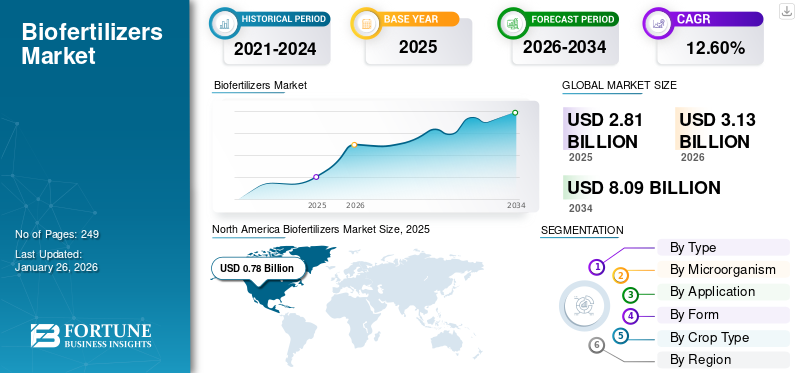
The global biofertilizers market size was valued at USD 2.81 billion in 2025 and is projected to grow from USD 3.13 billion in 2026 to USD 8.09 billion by 2034, exhibiting a CAGR of 12.60% during the forecast period. Asia Pacific dominated the biofertilizers market with a market share of 17.96% in 2025.
Biofertilizers, also known as bioinoculants, are defined as living microbes that amplify plant nutrition by colonizing the rhizosphere when applied via soil or seed. Microorganisms such as cyanobacteria, nitrogen-fixing soil bacteria, phosphate-solubilizing bacteria, and molds are majorly utilized in the production of biological fertilizers. These compounds hasten the microbial processes within the soil, intensifying the availability of nutrients in a form easily absorbed by plants. In addition, they enhance crop yield and soil fertility and preserve the plants against diseases and pests. The adoption of such sustainable practices is helpful in transforming the agricultural sectors across the world.
Furthermore, the market encompasses several major players which include Novozymes A/s, Lallemand Inc., and BioWorks Inc., among others. Innovative product launch, and geographic presence expansion have supported the growth of these companies in the global market. Several countries have introduced subsidies to make such products affordable for the farmers which further contribute to the biofertilizers market growth.
The biofertilizers market comprises crop-specific microbial inputs rather than a universal substitute for mineral fertilizers. Commercial performance depends on whether selected organisms establish near roots, perform their intended function, and remain viable through storage and application. Outcomes vary with crop genetics, soil chemistry, moisture, temperature, and native microbial communities.
Nitrogen-fixing inoculants have established applications in compatible legumes, including pulses and oilseeds. Free-living and associative bacteria target broader crop groups, although their effectiveness depends on strain characteristics and growing conditions. Phosphate-solubilizing products improve access to certain soil phosphorus reserves; they do not create additional phosphorus. These distinctions are essential when evaluating product claims and fertilizer-substitution potential.
Demand reflects input-cost pressures, soil-health priorities, nutrient-use efficiency goals, and efforts to diversify crop-management practices. Adoption becomes easier when products fit existing seed-treatment or soil-application operations. Agronomist recommendations, dealer support, and field demonstrations can strengthen confidence. Conversely, uncertain returns, handling requirements, limited shelf life, and inconsistent results can discourage repeat purchases.
Competition increasingly depends on demonstrated field performance rather than microbial counts alone. Manufacturers need reliable strain identification, contamination controls, stability testing, appropriate carriers, and evidence across relevant crops and environments. Liquid formulations can simplify dosing, while dry and carrier-based products may suit distribution systems without refrigeration. No format is inherently superior; formulation must match organism biology and application conditions.
The strongest opportunities lie in validated crop-specific solutions, integrated nutrient programs, and partnerships connecting microbial discovery with manufacturing, distribution, and field advisory services. Durable commercial advantage will depend on reliable performance under practical farming conditions, not biological novelty alone.
Download Free sample to learn more about this report.
Global Biofertilizers Industry Key Takeaways
 Market Size & Forecast
- 2025 Market Size: USD 2.81 billion
- 2026 Market Size: USD 3.13 billion
- 2034 Forecast Market Size: USD 8.09 billion
- CAGR: 12.60% from 2026–2034
 Market Share
- Asia Pacific dominated the biofertilizers market with a 17.96% share in 2025.
- The nitrogen-fixing segment is projected to lead with a 75.40% market share in 2026.
- The seed treatment application segment accounted for 59.42% of the market in 2026.
 Key Regional Highlights
North America
North America generated USD 0.78 billion in 2025, accounting for 27.58% of global revenue, driven by strong demand for organic farming inputs.
Europe
Europe reached USD 0.56 billion in 2025 and is expected to witness robust growth due to stricter regulations on chemical fertilizer usage.
Asia Pacific
Asia Pacific recorded USD 0.50 billion in 2025, supported by expanding agricultural activities and rising food demand across emerging economies.
U.S.
The market is projected to reach USD 0.65 billion by 2026, supported by innovation and product launches from leading agtech companies.
Japan
The biofertilizers market is forecast to reach USD 0.02 billion by 2026, driven by increasing adoption of sustainable agricultural practices.
Read More

Market Trends
Government Push for Scientifically Validated Products Is One Of The Significant Market Trends
Farmers have significant doubts about the efficacy of biofertilizers. They have raised complaints with the government regarding the limited efficacy and low yield from using such products. Some of the products sold in developing economies, such as India, are mislabeled or unverified and have poor efficacy; hence, the government has adopted stringent measures and directed countries to publish scientific studies that prove the efficacy of such products.
- For instance, in July 2025, the Agriculture Minister of India stated that the companies must publish scientific evidence on their product’s efficacy before launching them in the market.
The biofertilizers market is moving toward formulations designed around specific crops, microbial functions, and application conditions. Rather than relying on broad claims about soil improvement, manufacturers increasingly need evidence linking strain selection to measurable outcomes, such as nutrient uptake, root development, crop establishment, or yield stability under defined conditions.
Multi-strain products represent one development area. Combining organisms with complementary functions may broaden potential benefits, but compatibility cannot be assumed. Strains can compete, differ in storage requirements, or respond differently to environmental stress. Product developers therefore need to validate both biological interactions and performance after formulation.
Formulation engineering is another important trend. Liquid products can support convenient dosing and mechanized application, while powders and carrier-based formulations may offer advantages in transport and storage. Encapsulation and protective carriers are being explored to improve survival and release behavior. Commercial value depends on verified shelf life and field performance, not formulation complexity alone.
Integration with precision agriculture is also gaining relevance. Soil testing, crop-specific nutrient plans, and localized application can help determine where microbial inputs may provide value. Digital advisory tools may improve application timing and record outcomes, although data quality and farmer access remain important limitations.
Download Free sample to learn more about this report.
MARKET DYNAMICS
MARKET DRIVERS
Expansion in Production of Horticulture Crops and Cereal Crops to Support Biological Products Growth
Biofertilizers can be used for the production of high-value crops such as horticulture crops. The use of intensive cultivation practices and the widespread use of chemical fertilizers have impacted soil fertility. Thus, creating an urgent need to adopt non-chemical alternatives, such as biofertilizers, for crop production. The use of these products helps to improve soil fertility and increase microbial content by replenishing the population of microorganisms in agricultural soils. Thus, using such products in combination with other products can improve crop yields and maintain soil health. Adoption of eco-friendly farming practices is another crucial factor which is supporting the increasing demand for biofertilizers.
- As per data provided by the Press Information Bureau of India, horticulture production in India grew from 342 million tons in 2021-23 to 352.23 million tons in 2023-24.
Demand for biofertilizers reflects the need to improve nutrient-use efficiency while managing costs and environmental pressure. Microbial products can complement mineral fertilizers by fixing atmospheric nitrogen, mobilizing soil nutrients, or supporting root development. Their value is strongest when the organism, crop, and soil conditions are well matched.
Legume production provides an established use case. Rhizobium strains form symbiotic relationships with compatible legumes, making inoculant choice and seed handling important. Interest is extending to cereals, horticulture, and crops where growers seek better nutrient access and root-zone support. Results in these settings are more variable and require field evidence.
Policy attention to soil health, nutrient losses, and sustainable farming can encourage adoption, particularly when extension services and demonstration plots translate biological claims into guidance. Retailers and agronomy advisers can reduce uncertainty by explaining storage, application timing, compatibility, and realistic expectations.
MARKET RESTRAINTS
Limited Shelf Life of Natural Fertilizers Impacts Efficacy of Such Products
One of the major manufacturing challenges faced by biofertilizer manufacturers is the storage and maintenance of microorganisms used in the final products. The survival rate of these microorganisms impacts the efficacy of biological fertilizers; hence, proper storage of such microorganisms is required. For instance, biological fertilizer packets should ideally be stored in a cool and dry place, away from heat and sunlight. Thus, strong technical knowledge and an advanced logistics system are required to improve and maintain the efficacy of such products.
Biofertilizer performance remains sensitive to biological, environmental, and operational conditions. Microorganisms must survive formulation, storage, transport, and application before establishing an effective relationship with plant roots or soil nutrients. Heat, moisture, ultraviolet exposure, and unsuitable handling can reduce viability, weakening field performance even when the original formulation meets specifications.
Soil characteristics create another constraint. Acidity, salinity, nutrient availability, moisture stress, and competition from native microorganisms can influence inoculant establishment. A strain that performs well in one location may produce weaker results elsewhere. This variability complicates product standardization and makes broad performance claims difficult to substantiate.
Farmer adoption can also be limited by uncertain returns. Biological inputs may require changes in application timing, storage practices, or nutrient-management programs. Where results are inconsistent or benefits are difficult to distinguish from weather and management effects, growers may hesitate to repurchase.
Manufacturing quality adds commercial risk. Producers need dependable strain identification, contamination controls, viable-cell testing, and shelf-life validation. Carrier materials and formulation methods must protect organisms without undermining application convenience. Smaller manufacturers may face cost and technical barriers when building these capabilities.
Regulatory requirements differ across jurisdictions and product categories. Registration, permissible claims, quality standards, and evidence requirements can increase commercialization time and expense. Distribution networks must also manage expiry dates and suitable storage conditions. These constraints favor suppliers that combine sound microbiology with rigorous quality assurance, local agronomic evidence, and practical farmer support.
MARKET OPPORTUNITIES
Increase in Area Under Organic Cultivation to Create Opportunity for Market Expansion
Organic food cultivation significantly over the past few years globally. The major factors contributing to the growth in areas under organic cultivation include an increase in demand for healthier and sustainable food products, growing consumer awareness about environmental sustainability, and risk association with the consumption of chemicals and pesticides. People prefer organic food products which support health benefits and environmental sustainability.
Agricultural biologicals can be easily applied to crops and adopted in diverse farming practices. As agricultural biologicals such as biopesticides, bio stimulants, and biofertilizers support organic cultivation, the demand for such products is expected to increase. Increasing adoption of such agricultural practices is driving the demand for such products across different countries.
- As per data provided by the Economic Research Survey, the number of organic farms operating in the country increased by 90% in 2011 compared to 2021 which totaled at about 17,445 farms.
- Moreover, the organic trade association (OTA) stated that the sales of organic food products in the U.S. market was USD 65.0 billion in 2024.
The strongest opportunities in the biofertilizers market lie in crop-specific products that solve identifiable nutrient-management problems. Legume inoculants offer an established foundation, while cereal systems, horticulture, and oilseed production provide opportunities for further development. Expansion depends on locally validated performance, suitable microbial strains, and clear evidence of economic benefit under commercial farming conditions.
Formulation technology creates another avenue for differentiation. Protective carriers, encapsulation, and improved drying methods may help preserve microbial viability during storage and transport. Developers that demonstrate longer usable shelf life without sacrificing field performance could serve distributors and growers operating across varied climates. These improvements must be supported by stability testing rather than assumed from formulation design.
Integrated biological input programs also offer potential. Combining compatible biofertilizers with soil testing, nutrient planning, and selected organic amendments can help growers manage nutrient availability more systematically. Such programs require compatibility checks and clear application guidance. They should complement appropriate nutrient management rather than promise complete replacement of conventional fertilizers.
Emerging markets offer opportunities where agricultural advisory networks, cooperatives, and local input retailers can improve access and farmer confidence. Partnerships with seed companies may also support inoculant delivery through established treatment channels. However, distribution scale must be matched with quality controls and appropriate storage.
Market Segmentation Analysis
The biofertilizers market is best evaluated through the interaction of microbial function, organism, formulation, application method, and crop economics. These dimensions overlap, but they answer different commercial questions. Type indicates the intended nutrient-related function; microorganism identifies the biological agent; form affects stability and handling; application determines delivery to the crop; and crop type shapes the value proposition. Market comparisons should therefore avoid treating each category as independent or assuming that a product performs equally across all crops and environments.
By Type
Nitrogen-Fixing Fertilizers to be Sought-after Owing to Ability to Generate Higher Yield
On the basis of type, the market is divided into phosphate solubilizers and nitrogen-fixing.
To know how our report can help streamline your business, Speak to Analyst
Nitrogen Fixing
The nitrogen-fixing segment is projected to dominate the market with a share of 75.40% in 2026, as it provides all the important nutrients that cannot be acquired from the air. Farmers have widely used nitrogen-fixing, phosphate-solubilizing biological fertilizers to produce high-demand crops such as wheat, rice, oilseeds, and others. Biological fertilizers containing nitrogen can correct the nitrogen level in the soil, aiding in the growth of the crop. Nitrogen bio-fertilizers are broadly classified into free-living, symbiotic, and associative symbiotic.
Nitrogen-fixing biofertilizers support biological conversion of atmospheric nitrogen into forms that plants can use, directly or through microbial associations. The most established commercial use is in legumes, where compatible Rhizobium strains form nodules and exchange fixed nitrogen for plant-derived carbon. This established crop relationship gives the segment a clearer agronomic basis than many newer applications.
For non-legume crops, free-living or associative nitrogen-fixing organisms are used with the aim of supporting nitrogen availability or plant growth. Outcomes depend strongly on soil conditions, crop variety, microbial establishment, and local management. These products should not be assumed to replace synthetic nitrogen at a fixed rate without local field evidence.
Commercial differentiation rests on strain identity, viable counts at expiry, compatibility with seed treatments, and clear crop-specific instructions. Suppliers that link product recommendations to planting windows and regional agronomy can strengthen repeat use. The category’s long-term potential depends on measured nutrient contribution and economic benefit, rather than nitrogen-fixation claims alone.
Phosphate Solubilizers
Phosphate-solubilizing biofertilizers target the limited availability of phosphorus held in certain soil compounds. Selected bacteria and fungi can release organic acids or other compounds that change phosphorus availability near roots. Their function differs from nitrogen fixation: they mobilize existing phosphorus rather than add new phosphorus to the field.
Adoption is shaped by soil chemistry, phosphorus reserves, pH, crop demand, and fertilizer history. A product may offer limited benefit where available phosphorus is already sufficient, or where the soil contains little phosphorus to mobilize. Field trials should measure crop response under relevant nutrient conditions and should not infer universal fertilizer replacement.
Manufacturers can differentiate through validated strain combinations, soil-specific recommendations, and evidence from multi-location trials. Product claims should explain the conditions under which nutrient mobilization is likely. This precision can improve customer trust and reduce disappointment caused by applying the product where phosphorus availability is not the main production constraint.
Others
By Microorganism
Rhizobium Dominates Segment Owing to High Efficacy in Crop Production
In terms of microorganism, the market is divided into rhizobium, azotobacter, azospirillum, pseudomonas, bacillus, VAM, and others.
Rhizobium
Rhizobium is the leading variant of microorganism used in agriculture due to its enormous importance in providing the major nitrogen source in soil. The Rhizobium segment is expected to account for 69.97% of the market share in 2026.
Apart from being an excellent nitrogen-fixing agent, rhizobium exerts plant growth-promoting traits and supports the insolubilization of inorganic phosphate. Furthermore, its rising demand is mainly due to its ability to ensure success in achieving crop productivity and reducing the need for synthetic fertilizers that are expensive and harmful to the environment.
Azotobacter
The azotobacter segment is expected to grow at a CAGR of 11.90% over the forecast period. Azotobacter products are commonly positioned for non-leguminous crops and general plant-growth support. Their performance can vary with soil conditions, organic matter, moisture, and competition from native organisms. Because the biological pathway differs from the symbiotic relationship in legumes, expected benefits should be assessed by crop and local management system rather than extrapolated from Rhizobium results.
Azospirillum
Azospirillum is associated with roots of several grasses and cereals and is often marketed for root development and improved nutrient acquisition. It is relevant to cereal systems, but field results should guide product choice and application timing.
Pseudomonas
Selected Pseudomonas strains are used in products aimed at nutrient mobilization, root-zone interactions, and plant-growth promotion. Strain-level identification, safety assessment, stability, and crop-specific performance are essential to credible product positioning.
Bacillus
Bacillus-based products receive commercial attention partly because some strains form resilient spores that can support formulation and storage. Product evaluation should focus on viable potency, intended mechanism, and demonstrated performance after application.
Vesicular-Arbuscular Mycorrhiza (VAM)
Vesicular-arbuscular mycorrhiza, often grouped under arbuscular mycorrhizal fungi, forms associations with plant roots and can extend access to soil resources, particularly phosphorus. Commercial products may be more sensitive to handling and establishment conditions than some bacterial inoculants.
By Form
Dry Segment to Emerge as Dominant Due to High Efficacy
Based on form, the market is segmented into liquid, powder/dry, carrier-based, and encapsulated/gel based.
Powder/Dry
Powder and dry formulations can reduce shipping weight and may suit distribution networks where refrigeration is limited. Moisture control and protection from heat remain important.
The dry segment is expected to retain its dominance during the forecast period in the global market. This is attributed to the easier applicability and high effectiveness on the products. Such form of products represents the most widely used type cultivated globally. Furthermore, the segment is set to hold 53.98% share in 2025.
Liquid
Liquid biofertilizers offer convenient metering, mixing, and integration with certain seed-treatment or irrigation systems. They can be attractive to commercial farms with established application equipment. Their weakness is sensitivity to formulation chemistry, temperature, contamination, and storage duration. Viability must be verified through the stated shelf life, not only at production. In addition, liquid form is projected to grow at a CAGR of 12.85% during the study period.
Carrier Based
Carrier-based products use materials such as peat, lignite, composted materials, or other suitable substrates to support microbial survival and delivery. Carrier quality affects moisture retention, pH, contamination risk, handling, and shelf life.
Encapsulated/Gel Based
Encapsulation and gel-based formulations aim to protect microorganisms, regulate release, or improve contact with roots. They may offer advantages under specific storage or field conditions, but introduce manufacturing complexity and cost.
By Application
Foliar Treatment Segment Holds Major Share Due to High Effectiveness
On the basis of application, the market is divided into seed treatment and soil treatment.
Seed Treatment
The seed treatment segment held the share of 58.85% in 2024. The seed treatment application segment dominated the global market with a market share of 59.42% in 2026 due to wide utilization in administering these fertilizers. Crop and plant seeds are subjected to biological fertilizer treatment to avoid viral or bacterial attacks, significantly reducing crop yield. Further, biological fertilizers applied to the seeds promote atmospheric nitrogen fixation and make them readily available for the crop.
Seed treatment places microbial inputs close to the emerging root system and can fit existing planting workflows. It generally requires relatively small product quantities per hectare, which can support efficient logistics. However, seed-applied organisms may be harmed by chemical treatments, drying, prolonged storage, or unsuitable temperatures. Compatibility instructions and treatment timing are therefore central to performance.
Soil Treatment
Soil application is useful when a product’s intended function requires broader placement or when seed treatment is impractical. Delivery may occur through in-furrow placement, soil incorporation, or irrigation systems, subject to formulation compatibility. Application economics depend on dose, equipment, labor, and the size of the treated area.
Others
The segment of application is set to flourish with a growth rate of 12.70% growth across the forecast period. Soil fertilizers help to enhance soil fertility and boost the crop yields through supplying essential nutrients directly into the soil.
To know how our report can help streamline your business, Speak to Analyst
By Crop
Cereals Segment to Lead Owing to High Demand for Organic Cereals
In terms of crop type, the market is divided into cereals, pulses & oilseeds, fruits & vegetables, fiber crops, turf and ornamentals, and others.
Cereals
At present, the application of organic fertilizers in the production of cereal grains is high compared to other crop types. The cereal segment is anticipated to retain its dominant position throughout the forecast period. Cereal grains are widely consumed across the world. The high demand for organic cereals in both developed as well as developing economies due to the potential health benefits offered is boosting the industry growth of organic cereals. In numerous experiments and field trials, the application of biological fertilizers on cereal crops has significantly increased their yields by nearly 60%-85%.
Cereals offer a large potential use base because of their extensive cultivation, but adoption is complicated by diverse production systems and high nitrogen demand. Microbial products may support nutrient acquisition or root development, yet performance must be assessed alongside fertilizer management, water availability, and yield targets. Growers are unlikely to adopt at scale without reliable field evidence and a clear cost-benefit case. The cereals crop type segment dominated the global market with a market share of 1.4% in 2026. In addition, cereals are projected to grow at a CAGR of 12.59% during the study period.
Pulses
Pulses provide a natural market for crop-compatible Rhizobium inoculants. Adoption can be supported by established agronomic practices and the direct relevance of symbiotic nitrogen fixation.
Oilseeds
Oilseed crops vary in their compatibility with particular microbial products and in their nutrient requirements. Opportunities include inoculation of compatible legumes and use of selected organisms intended to support root function or nutrient access.
Fruits
Fruit production often involves perennial root systems, high-value crops, and intensive nutrient management. Growers may be willing to test biological inputs where they can be integrated with fertigation, orchard management, or soil-health programs.
Vegetables
Vegetable growers may value biological inputs for transplant establishment, root development, and nutrient management, especially in intensive production. Short crop cycles can enable relatively rapid observation, but results remain sensitive to cultivar, irrigation, soil conditions, and disease pressure.
Fiber Crops
Cotton and other fiber crops present opportunities for selected microbial inputs, particularly where growers seek improved root development or nutrient-use efficiency. Commercial uptake depends on regional agronomy, planting methods, seed-treatment practices, and the cost of application at scale.
Turfs and Ornamentals
Turf and ornamental applications differ from broad-acre farming because visual quality, root establishment, and maintenance costs can drive purchasing decisions. Nurseries, landscapers, sports facilities, and grounds managers may value biological products when they fit regular maintenance programs.
Regional Insights
By region, the market is categorized into Europe, North America, Asia Pacific, South America, and the Middle East & Africa.
North America Biofertilizers Market Analysis
North America Biofertilizers Market Size, 2025 (USD Billion)
To get more information on the regional analysis of this market, Download Free sample
North America held the dominant share in 2023 valuing at USD 0.70 billion and also took the leading share in 2024 with USD 0.78 billion. The exceptional growth of the region’s market is a clear indication of the product’s popularity across the agri department and among stakeholders. Other major factors contributing to the biofertilizer’s market are the soaring demand and production of organic products. North America generated USD 0.78 billion, contributing 27.58% to global market revenue, and is projected to grow to USD 0.86 billion in 2026.
- For instance, in March 2025, one of the leading agtech companies of the U.S., Pivot Bio, launched products named PROVEN and RETURN which ensures steady supply of nitrogen to the cotton plants.
North America’s biofertilizers market is shaped by commercial farming, soil-health priorities, and demand for more efficient nutrient management. Adoption varies by crop, production system, and grower familiarity with microbial inputs. Established legume inoculation provides a practical base, while broader use depends on local field evidence. Product registration, quality assurance, dealer expertise, and compatibility with existing fertilizer programs influence purchasing decisions across major production regions overall.
United States Biofertilizers Market
The U.S. market is projected to reach USD 0.65 billion by 2026. In 2025. The United States market spans soybean and other legume inoculants, specialty crop applications, and microbial products positioned for nutrient-use efficiency. Large farms often require dependable supply, equipment compatibility, and measurable returns per acre. University extension trials and independent agronomic advice can influence adoption. Suppliers must demonstrate consistent product viability and clarify how biological inputs complement conventional fertility programs across differing soils and climates in practice.
Europe biofertilizers Market Analysis
Europe anticipated to witness a notable growth in the coming years. Europe held the dominant share in 2023 valuing at USD 0.50 billion and also took the leading share in 2024 with USD 0.55 billion. Growing stringency on the use of chemical fertilizers, coupled with surging awareness related to harmful hazards associated with synthetic fertilizers, has led to the increased usage of biological fertilizers. The Europe market accounted for USD 0.56 billion in 2025, representing 19.70% of the global industry, and is expected to reach USD 0.62 billion in 2026.
Europe’s market is influenced by soil-health objectives, nutrient-management policy, and efforts to reduce environmental impacts from agriculture. Adoption is uneven because crop systems, farm sizes, and national regulatory approaches differ. Demand favors products with credible performance data, traceable quality, and clear application guidance. Manufacturers also face scrutiny over permissible claims, product classification, and evidence supporting nutrient-related benefits in specific farming conditions across member states nationally.
The most common biological fertilizers utilized in the European market are Rhizosum PK, Rhizosum K, Cedomon, and Cerall. During the forecast period, the European region is projected to record a growth rate of 11.89%, which is the second highest amongst all the regions and touch the valuation of USD 0.62 billion in 2025. This is primarily due to the advancing research capabilities in these regions leading to high demand for these enzymes. Backed by these factors, countries including Spain anticipate to record the valuation of USD 0.10 billion, Germany to record USD 0.06 billion, and Italy to record USD 0.08 billion in 2025.
Germany Biofertilizers Market
The Germany market is projected to reach USD 0.06 billion by 2026. Germany’s biofertilizers market is linked to intensive crop production, soil stewardship, and interest in biological agricultural inputs. Adoption depends on demonstrated value within established fertilizer and crop-protection programs. Farmers and advisers are likely to scrutinize reliability, handling, and economic returns. Suppliers need crop-specific trials and clear compliance documentation, particularly where products make defined nutrient-related claims or are combined with other agricultural inputs under regional conditions.
United Kingdom Biofertilizers Market
The UK market is projected to reach USD 0.04 billion by 2026. The United Kingdom market reflects interest in soil health, input efficiency, and biological approaches within arable and horticultural production. Adoption depends on agronomic evidence and practical fit with farm operations. Retailers, agronomists, and demonstration trials can shape confidence, while inconsistent field outcomes remain a barrier. Suppliers must explain application timing, storage needs, and the role of microbial products within balanced nutrient-management plans and regional conditions.
Asia-Pacific Biofertilizers Market Analysis
After Europe, the market in Asia Pacific is estimated to reach USD 0.56 billion in 2025 and secure the position of third-largest region in the market. The region is a key market for agricultural products due to high population and strong demand for food products. In this region, India and China are both estimated to reach USD 0.12 billion and USD 0.29 billion each in 2025.
Asia-Pacific offers diverse growth conditions, from intensive smallholder agriculture to highly mechanized farms. Demand is supported by nutrient-management needs, soil-health initiatives, and established use of microbial inoculants in selected crops. Market development differs sharply by country, infrastructure, and farmer access to advice. Reliable manufacturing, affordable pack sizes, local strain suitability, and extension support are central to sustained adoption across varied production systems and distribution networks.
The India market is projected to reach USD 0.13 billion by 2026. Asia Pacific recorded a market size of USD 0.5 billion in 2025, capturing 17.96% of the global market share, and is projected to reach USD 0.56 billion in 2026.
Japan Biofertilizers Market
The Japan market is projected to reach USD 0.02 billion by 2026. Japan’s market is influenced by intensive horticulture, rice production, aging farm demographics, and a strong focus on reliable crop management. Biological inputs must fit established cultivation practices and demonstrate consistent value. Ease of handling, quality assurance, and compatibility with fertilizers are important purchase considerations. Suppliers may find opportunities in specialty crops and high-value production, provided field evidence supports clear agronomic benefits under specific local conditions.
China Biofertilizers Market
The China market is projected to reach USD 0.33 billion by 2026. China’s biofertilizers market reflects great agricultural demand, soil-quality priorities, and efforts to improve fertilizer efficiency. Adoption spans different crops and farm structures, making local validation important. Domestic production capacity and distribution reach can support availability, while product quality and performance consistency remain critical. Companies need to match microbial strains and application guidance to regional soils, climate, crop systems, and regulatory requirements and rural distribution networks.
Latin America and South America Biofertilizers Market Analysis
Over the forecast period, South America and Middle East & Africa regions would witness a moderate growth in this marketspace. The South America market in 2025 is set to record USD 0.53 billion as its valuation. However, poor logistics and a lack of farmer’s knowledge are key factors responsible for the slow growth of the region. In Middle East & Africa, South Africa is set to attain the value of USD 0.06 billion in 2025. Latin America accounted for USD 0.47 billion in 2025, representing 16.99% of the global market share, and is projected to reach USD 0.53 billion in 2026.
Latin America’s market is supported by extensive soybean and other crop production, established biological input use in some farming systems, and interest in nutrient efficiency. Local agronomic conditions shape which strains and application methods perform reliably. Distribution networks and farmer technical knowledge influence repeat adoption. Suppliers can compete through field validation, dependable product quality, and integration with large-scale planting and seed-treatment operations at commercial scale.
Middle East & Africa Biofertilizers Market Analysis
The Middle East & Africa market generated USD 0.21 billion in 2025, representing 7.48% of the global market landscape, and is expected to reach USD 0.23 billion in 2026. The Middle East and Africa contain highly varied farming systems, including irrigated production and rain-fed agriculture exposed to stress. Biofertilizer adoption depends on product stability, locally relevant trials, affordability, and reliable distribution. Extension services and input dealers can help translate product claims into practice. Suppliers must account for storage conditions and ensure formulations retain viability through transport and use locally.
Biofertilizers Industry Competitive Landscape
Wide Range of Product Offerings and Strong Distribution Network of Key Companies Supported their Leading Position
Market players have realized the product's future growth potential. They are continuously trying to innovate and launch products in the market in order to meet the farmers' demand for solutions to increase crop resilience and nutrient use efficiency.
For instance, in November 2023, Yara International ASA, announced the launch of YaraAmplix, a new brand of products. The new portfolio contains natural ingredients, such as seaweed and plant extracts, which deliver targeted effects, such as improved nutrient use efficiency, crop yield, and enhanced tolerance to abiotic stress and quality.
Many other large and small market players are embarking on strategies, such as merger and acquisition, research & development, collaboration with the government, and others to establish their prominence in the market. Innovative companies are focusing on developing environmentally friendly agricultural inputs to help farmers produce high-quality organic products.
Competition spans microbial strain developers, agricultural input manufacturers, regional inoculant specialists, and distributors with biological portfolios. Strength depends less on the number of organisms offered than on validated performance, production consistency, shelf life, and support under local farming conditions.
Established participants include Novonesis, Lallemand Plant Care, Rizobacter, T. Stanes, and regional biological-input suppliers. Their positions differ by geography, crop focus, formulation capability, and distribution reach. Some concentrate on microbial inoculants; others combine biologicals with seed treatment, crop nutrition, or agronomic services. Portfolio breadth can expand channel access, but does not by itself prove superior efficacy.
Regional specialists can compete through locally adapted strains, retailer relationships, and field trials reflecting nearby soils and cropping calendars. This advantage matters where storage conditions and application practices differ across markets. Expansion beyond a home region, however, requires robust quality systems, regulatory knowledge, and dependable manufacturing capacity.
Differentiation increasingly rests on strain selection, microbial compatibility, carrier design, contamination prevention, and viable counts through expiry. Liquid formulations may simplify application, while dry and carrier-based products can ease logistics. Encapsulation and multi-strain combinations offer development pathways, but add complexity and require evidence that organisms remain stable and function together. Cross-season commercial field trials remain essential for validating product performance.
Partnerships connect university research with commercial fermentation, formulation, and distribution. Seed companies, fertilizer dealers, cooperatives, and agronomy networks can embed inoculants in established farm workflows. Strong agreements clarify strain ownership, product claims, quality responsibilities, and field testing.
LIST OF KEY BIOFERTILIZERS COMPANIES PROFILED
- Bayer AG (Germany)
- Syngenta AG (Switzerland)
- UPL Limited (India)
- Gowan Group (U.S.)
- BASF SE (Germany)
- Marrone Bio Innovations (U.S.)
- SEIPASA S.A. (Spain)
- I. Industries (India)
- Novozymes A/S (Denmark)
- Koppert Biological Systems (Netherlands)
KEY INDUSTRY DEVELOPMENTS
February 2025: BioConsortia and Hodder and Taylors: Commercial agreement for AlwaysN. BioConsortia partnered with New Zealand seed company Hodder and Taylors to introduce AlwaysN microbial seed treatment for maize, cereals, brassicas, and pasture. The initiative aims to improve nitrogen-use efficiency and reduce reliance on synthetic nitrogen inputs. Its technology uses selected nitrogen-fixing microorganisms designed to colonize plant roots, supported by microbial selection methods and formulation technology intended to maintain shelf stability.
February 2025: Embrapa and Coopavel: Launch of Azoscoop corn inoculant. Brazilian agricultural research institution Embrapa and cooperative Coopavel launched Azoscoop, a liquid inoculant developed for maize. The product contains selected Azospirillum brasilense strains Ab-V5 and Ab-V6. Its purpose is to support root development, nutrient uptake, and more efficient nitrogen fertilizer use. The development also established Coopavel’s Biocoop facility as a local production platform for microbial agricultural inputs.
February 2026: Kula Bio: Launch of soluble-powder biological products. Kula Bio introduced Kula-NSP and Kula-NextSP, shelf-stable soluble-powder formulations within its nitrogen-fixing biological product portfolio. The launch addresses practical barriers associated with transporting, storing, and applying microbial inputs. The dry-format technology is intended to support scalable production and expand distribution options for biological nitrogen solutions.
March 2026: Rovensa Next: Launch of Otimais Duo in Brazil. Rovensa Next introduced a dual-microbial inoculant combining Azospirillum brasilense Ab-V5 and Pseudomonas fluorescens BR14810. The product is designed to support nitrogen fixation, phosphorus solubilization, root development, and nutrient-use efficiency in crops including maize and soybean. Its development reflects a strategy of combining complementary microbial functions within conventional fertilizer programs.
August 2026: ICAR-NBAIM and BhuMicroGen Agrinoculants: Commercial technology transfer. India’s National Bureau of Agriculturally Important Microorganisms transferred three biofertilizer technologies—BioNPK, BioGrow, and BioPhos—to BhuMicroGen Agrinoculants for commercial production and wider farmer access. The agreement aims to move research-developed microbial solutions into commercial distribution. The transferred portfolio addresses nutrient management and soil health through biological formulations intended to support more resource-efficient crop production.
REPORT COVERAGE
Request for Customization to gain extensive market insights.
Report Scope & Segmentation
|
ATTRIBUTE |
DETAILS |
|
Study Period |
2021–2034 |
|
Base Year |
2025 |
|
Estimated Year |
2026 |
|
Forecast Period |
2026-2034 |
|
Historical Period |
2021–2024 |
|
Growth Rate |
|
|
Unit |
Value (USD Billion) |
|
Segmentation |
By Type · Nitrogen Fixing · Phosphate Solubilizers · Others |
|
By Microorganism · Rhizobium · Azotobacter · Azospirillum · Pseudomonas · Bacillus · VAM · Others |
|
|
By Application · Seed Treatment · Soil Treatments · Others |
|
|
By Form · Liquid · Powder/Dry · Carrier Based · Encapsulated/Gel based |
|
|
By Crop Type Cereals · Pulses & Oilseeds o Pulses o Oilseeds · Fruits & Vegetables o Fruits o Vegetables · Fiber Crops · Turf & Ornamentals · Others |
|
|
By Region · North America (By Type, Microorganism, Application, Form, Crop Type, and Country) o U.S. (By Application) o Canada (By Application) o Mexico (By Application) · Europe (By Type, Microorganism, Application, Form, Crop Type, and Country/Sub-region) o Germany (By Application) o U.K. (By Application) o France (By Application) o Spain (By Application) o Italy (By Application) o Russia (By Application) o Rest of Europe (By Application) · Asia Pacific (By Type, Microorganism, Application, Form, Crop Type, and Country/Sub-region) o China (By Application) o Japan (By Application) o India (By Application) o Australia (By Application) o Rest of Asia Pacific (By Application) · South America (By Type, Microorganism, Application, Form, Crop Type, and Country/Sub-region) o Brazil (By Application) o Argentina (By Application) o Rest of Latin America (By Application) · Middle East & Africa (By Type, Microorganism, Application, Form, Crop Type, and Country/Sub-region) o Israel (By Application) o South Africa (By Application) · Rest of the Middle East & Africa (By Application) |
Frequently Asked Questions
Fortune Business Insights says that the global market value stood at USD 2.81 billion in 2025 and is projected to reach USD 8.09 billion by 2034.
In 2025, the market value stood at USD 2.81 billion.
The market is expected to exhibit a CAGR of 12.60% during the forecast period.
The nitrogen fixing segment is expected to be the leading segment based on type during the forecast period.
The expansion in the production of horticulture crops and cereal crops supports market growth.
Novozymes A/s, Lallemand Inc., and BioWorks Inc., among others are some of the prominent key players in the market.
North America dominated the market in 2025.
Proliferating demand for sustainable crop production inputs to support market growth is the current trend.


- 2021-2034
- 2025
- 2021-2024
- 249
-
(Offer valid till 15th Nov 2026)
Get 30-60 hrs Free Customization
Expand Regional and Country Coverage, Segments Analysis, Company Profiles, Competitive Benchmarking, and End-user Insights.














-
US +1 833 909 2966 ( Toll Free )
-
Get In Touch With Us