Biofertilizers Market Size, Share & Industry Analysis, By Type (Nitrogen Fixing, Phosphate Solubilizers, and Others), By Microorganism (Rhizobium, Azotobacter, Azospirillum, Pseudomonas, Bacillus, VAM, and Others), By Form (Liquid, Powder/Dry, Carrier Based and Encapsulated/Gel based), By Application (Seed Treatment, Soil Treatment, and Others), By Crop Type (Cereals, Pulses & Oilseeds (Pulses, Oilseeds), Fruits & Vegetables (Fruits, Vegetables), Fiber Crops, Turfs and Ornamentals and Others), and Regional Forecast, 2026-2034
 Download Free Sample
(Offer valid till 15th Oct 2026)

KEY MARKET INSIGHTS
 Listen to Audio Version
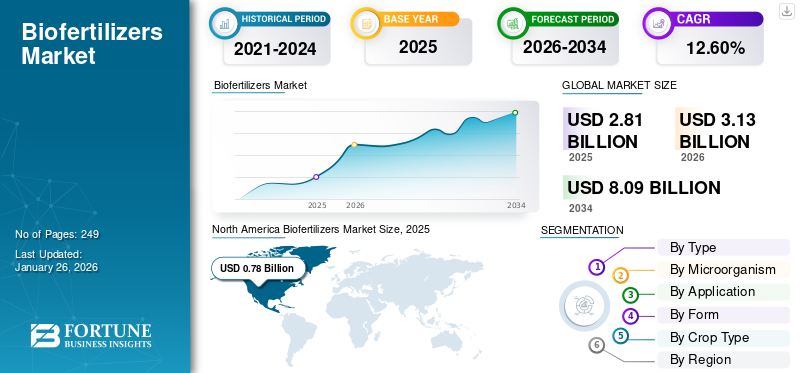
The global biofertilizers market size was valued at USD 2.81 billion in 2025 and is projected to grow from USD 3.13
billion in 2026 to USD 8.09 billion by 2034, exhibiting a CAGR of 12.60% during the forecast period. Asia Pacific dominated the biofertilizers market with a market share of 17.96% in 2025.
Biofertilizers, also known as bioinoculants, are defined as living microbes that amplify plant nutrition by colonizing the rhizosphere when applied via soil or seed. Microorganisms such as cyanobacteria, nitrogen-fixing soil bacteria, phosphate-solubilizing bacteria, and molds are majorly utilized in the production of biological fertilizers. These compounds hasten the microbial processes within the soil, intensifying the availability of nutrients in a form easily absorbed by plants. In addition, they enhance crop yield and soil fertility and preserve the plants against diseases and pests. The adoption of such sustainable practices is helpful in transforming the agricultural sectors across the world.
Furthermore, the market encompasses several major players which include Novozymes A/s, Lallemand Inc., and BioWorks Inc., among others. Innovative product launch, and geographic presence expansion have supported the growth of these companies in the global market. Several countries have introduced subsidies to make such products affordable for the farmers which further contribute to the biofertilizers market growth.
Download Free sample to learn more about this report.
Global Biofertilizers Industry Key Takeaways
 Market Size & Forecast
- 2025 Market Size: USD 2.81 billion
- 2026 Market Size: USD 3.13 billion
- 2034 Forecast Market Size: USD 8.09 billion
- CAGR: 12.60% from 2026–2034
 Market Share
- Asia Pacific dominated the biofertilizers market with a 17.96% share in 2025.
- The nitrogen-fixing segment is projected to lead with a 75.40% market share in 2026.
- The seed treatment application segment accounted for 59.42% of the market in 2026.
 Key Regional Highlights
North America
North America generated USD 0.78 billion in 2025, accounting for 27.58% of global revenue, driven by strong demand for organic farming inputs.
Europe
Europe reached USD 0.56 billion in 2025 and is expected to witness robust growth due to stricter regulations on chemical fertilizer usage.
Asia Pacific
Asia Pacific recorded USD 0.50 billion in 2025, supported by expanding agricultural activities and rising food demand across emerging economies.
U.S.
The market is projected to reach USD 0.65 billion by 2026, supported by innovation and product launches from leading agtech companies.
Japan
The biofertilizers market is forecast to reach USD 0.02 billion by 2026, driven by increasing adoption of sustainable agricultural practices.
Read More

MARKET DYNAMICS
MARKET DRIVERS
Expansion in Production of Horticulture Crops and Cereal Crops to Support Biological Products Growth
Biofertilizers can be used for the production of high-value crops such as horticulture crops. The use of intensive cultivation practices and the widespread use of chemical fertilizers have impacted soil fertility. Thus, creating an urgent need to adopt non-chemical alternatives, such as biofertilizers, for crop production. The use of these products helps to improve soil fertility and increase microbial content by replenishing the population of microorganisms in agricultural soils. Thus, using such products in combination with other products can improve crop yields and maintain soil health. Adoption of eco-friendly farming practices is another crucial factor which is supporting the increasing demand for biofertilizers.
- As per data provided by the Press Information Bureau of India, horticulture production in India grew from 342 million tons in 2021-23 to 352.23 million tons in 2023-24.
MARKET RESTRAINTS
Limited Shelf Life of Natural Fertilizers Impacts Efficacy of Such Products
One of the major manufacturing challenges faced by biofertilizer manufacturers is the storage and maintenance of microorganisms used in the final products. The survival rate of these microorganisms impacts the efficacy of biological fertilizers; hence, proper storage of such microorganisms is required. For instance, biological fertilizer packets should ideally be stored in a cool and dry place, away from heat and sunlight. Thus, strong technical knowledge and an advanced logistics system are required to improve and maintain the efficacy of such products.
MARKET OPPORTUNITIES
Increase in Area Under Organic Cultivation to Create Opportunity for Market Expansion
Organic food cultivation significantly over the past few years globally. The major factors contributing to the growth in areas under organic cultivation include an increase in demand for healthier and sustainable food products, growing consumer awareness about environmental sustainability, and risk association with the consumption of chemicals and pesticides. People prefer organic food products which support health benefits and environmental sustainability. Agricultural biologicals can be easily applied to crops and adopted in diverse farming practices. As agricultural biologicals such as biopesticides, bio stimulants, and biofertilizers support organic cultivation, the demand for such products is expected to increase. Increasing adoption of such agricultural practices is driving the demand for such products across different countries.
- As per data provided by the Economic Research Survey, the number of organic farms operating in the country increased by 90% in 2011 compared to 2021 which totaled at about 17,445 farms.
- Moreover, the organic trade association (OTA) stated that the sales of organic food products in the U.S. market was USD 65.0 billion in 2024.
BIOFERTILIZERS MARKET TRENDS
Government Push for Scientifically Validated Products Is One Of The Significant Market Trends
Farmers have significant doubts about the efficacy of biofertilizers. They have raised complaints with the government regarding the limited efficacy and low yield from using such products. Some of the products sold in developing economies, such as India, are mislabeled or unverified and have poor efficacy; hence, the government has adopted stringent measures and directed countries to publish scientific studies that prove the efficacy of such products.
- For instance, in July 2025, the Agriculture Minister of India stated that the companies must publish scientific evidence on their product’s efficacy before launching them in the market.
Download Free sample to learn more about this report.
Segmentation Analysis
By Type
Nitrogen Fixing Fertilizers to be Sought-after Owing to Ability to Generate Higher Yield
On the basis of type, the market is divided into phosphate solubilizers and nitrogen fixing.
To know how our report can help streamline your business, Speak to Analyst
The nitrogen-fixing segment is projected to dominate the market with a share of 75.40% in 2026 as it provides all the important nutrients which cannot be acquired from the air. Farmers have widely used nitrogen-fixing phosphate solubilizing biological fertilizers to produce high-demand crops such as wheat, rice, oilseeds, and others. Biological fertilizers containing nitrogen can correct the nitrogen level in the soil, aiding in the growth of the crop. Nitrogen bio-fertilizers are broadly classified into free-living, symbiotic, and associative symbiotic.
By Microorganism
Rhizobium Dominates Segment Owing to High Efficacy in Crop Production
In terms of microorganism, the market is divided into rhizobium, azotobacter, azospirillum, pseudomonas, bacillus, VAM, and others.
Rhizobium is the leading variant of microorganism used in agriculture due to its enormous importance in providing the major nitrogen source in soil. The Rhizobium segment is expected to account for 69.97% of the market share in 2026.
Apart from being an excellent nitrogen-fixing agent, rhizobium exerts plant growth-promoting traits and supports the insolubilization of inorganic phosphate. Furthermore, its rising demand is mainly due to its ability to ensure success in achieving crop productivity and reducing the need for synthetic fertilizers that are expensive and harmful to the environment.
The azotobacter segment is expected to grow at a CAGR of 11.90% over the forecast period.
By Application
Foliar Treatment Segment Holds Major Share Due to High Effectiveness
On the basis of application, the market is divided into seed treatment and soil treatment.
The seed treatment application segment dominated the global market with a market share of 59.42% in 2026 due to wide utilization in administering these fertilizers. Crop and plant seeds are subjected to biological fertilizer treatment to avoid viral or bacterial attacks, significantly reducing crop yield. Further, biological fertilizers applied to the seeds promote atmospheric nitrogen fixation and make them readily available for the crop. By application, the seed treatment segment held the share of 58.85% in 2024.
The segment of application is set to flourish with a growth rate of 12.70% growth across the forecast period. Soil fertilizers help to enhance soil fertility and boost the crop yields through supplying essential nutrients directly into the soil.
To know how our report can help streamline your business, Speak to Analyst
By Crop
Cereals Segment to Lead Owing to High Demand for Organic Cereals
In terms of crop type, the market is divided into cereals, pulses & oilseeds, fruits & vegetables, fiber crops, turf and ornamentals, and others.
At present, the application of organic fertilizers in the production of cereal grains is high compared to other crop types. The cereal segment is anticipated to retain its dominant position throughout the forecast period. Cereal grains are widely consumed across the world. The high demand for organic cereals in both developed as well as developing economies due to the potential health benefits offered is boosting the industry growth of organic cereals. In numerous experiments and field trials, the application of biological fertilizers on cereal crops has significantly increased their yields by nearly 60%-85%.
The cereals crop type segment dominated the global market with a market share of 1.4% in 2026.
In addition, cereals are projected to grow at a CAGR of 12.59% during the study period.
By Form
Dry Segment to Emerge as Dominant Due to High Efficacy
Based on form, the market is segmented into liquid, powder/dry, carrier based, and encapsulated/gel based.
The dry segment is expected to retain its dominance during the forecast period in the global market. This is attributed to the easier applicability and high effectiveness on the products. Such form of products represents the most widely used type cultivated globally. Furthermore, the segment is set to hold 53.98% share in 2025.
In addition, liquid form is projected to grow at a CAGR of 12.85% during the study period.
Biofertilizers Market Regional Outlook
By region, the market is categorized into Europe, North America, Asia Pacific, South America, and the Middle East & Africa.
North America
North America Biofertilizers Market Size, 2025 (USD Billion)
To get more information on the regional analysis of this market, Download Free sample
North America held the dominant share in 2023 valuing at USD 0.70 billion and also took the leading share in 2024 with USD 0.78 billion. The exceptional growth of the region’s market is a clear indication of the product’s popularity across the agri department and among stakeholders. Other major factors contributing to the biofertilizer’s market are the soaring demand and production of organic products. The U.S. market is projected to reach USD 0.65 billion by 2026. In 2025, North America generated USD 0.78 billion, contributing 27.58% to global market revenue, and is projected to grow to USD 0.86 billion in 2026.
- For instance, in March 2025, one of the leading agtech companies of the U.S., Pivot Bio, launched products named PROVEN and RETURN which ensures steady supply of nitrogen to the cotton plants.
Europe
Other regions such as Europe and Asia Pacific are anticipated to witness a notable growth in the coming years. Europe held the dominant share in 2023 valuing at USD 0.50 billion and also took the leading share in 2024 with USD 0.55 billion. Growing stringency on the use of chemical fertilizers, coupled with surging awareness related to harmful hazards associated with synthetic fertilizers, has led to the increased usage of biological fertilizers. The most common biological fertilizers utilized in the European market are Rhizosum PK, Rhizosum K, Cedomon, and Cerall. During the forecast period, the European region is projected to record a growth rate of 11.89%, which is the second highest amongst all the regions and touch the valuation of USD 0.62 billion in 2025. This is primarily due to the advancing research capabilities in these regions leading to high demand for these enzymes. The Europe market accounted for USD 0.56 billion in 2025, representing 19.70% of the global industry, and is expected to reach USD 0.62 billion in 2026.
The UK market is projected to reach USD 0.04 billion by 2026, while the Germany market is projected to reach USD 0.06 billion by 2026.
Backed by these factors, countries including Spain anticipate to record the valuation of USD 0.10 billion, Germany to record USD 0.06 billion, and Italy to record USD 0.08 billion in 2025.
Asia Pacific
After Europe, the market in Asia Pacific is estimated to reach USD 0.56 billion in 2025 and secure the position of third-largest region in the market. The region is a key market for agricultural products due to high population and strong demand for food products. In this region, India and China both are estimated to reach USD 0.12 billion and USD 0.29 billion each in 2025. The Japan market is projected to reach USD 0.02 billion by 2026, the China market is projected to reach USD 0.33 billion by 2026, and the India market is projected to reach USD 0.13 billion by 2026. Asia Pacific recorded a market size of USD 0.5 billion in 2025, capturing 17.96% of the global market share, and is projected to reach USD 0.56 billion in 2026.
South America
Over the forecast period, South America and Middle East & Africa regions would witness a moderate growth in this marketspace. The South America market in 2025 is set to record USD 0.53 billion as its valuation. However, poor logistics and a lack of farmer’s knowledge are key factors responsible for the slow growth of the region. In Middle East & Africa, South Africa is set to attain the value of USD 0.06 billion in 2025. Latin America accounted for USD 0.47 billion in 2025, representing 16.99% of the global market share, and is projected to reach USD 0.53 billion in 2026.
Middle East & Africa
The Middle East & Africa market generated USD 0.21 billion in 2025, representing 7.48% of the global market landscape, and is expected to reach USD 0.23 billion in 2026.
COMPETITIVE LANDSCAPE
Key Industry Players
Wide Range of Product Offerings and Strong Distribution Network of Key Companies Supported their Leading Position
Market players have realized the product's future growth potential. They are continuously trying to innovate and launch products in the market in order to meet the farmers' demand for solutions to increase crop resilience and nutrient use efficiency.
For instance, in November 2023, Yara International ASA, announced the launch of YaraAmplix, a new brand of products. The new portfolio contains natural ingredients, such as seaweed and plant extracts, which deliver targeted effects, such as improved nutrient use efficiency, crop yield, and enhanced tolerance to abiotic stress and quality.
Many other large and small market players are embarking on strategies, such as merger and acquisition, research & development, collaboration with the government, and others to establish their prominence in the market. Innovative companies are focusing on developing environmentally friendly agricultural inputs to help farmers produce high-quality organic products.
LIST OF KEY BIOFERTILIZERS COMPANIES PROFILED
- Bayer AG (Germany)
- Syngenta AG (Switzerland)
- UPL Limited (India)
- Gowan Group (U.S.)
- BASF SE (Germany)
- Marrone Bio Innovations (U.S.)
- SEIPASA S.A. (Spain)
- I. Industries (India)
- Novozymes A/S (Denmark)
- Koppert Biological Systems (Netherlands)
KEY INDUSTRY DEVELOPMENTS
- September 2025: ICL partnered with BioPrime in a long term partnership to commercialize biofertilizers solution in the Indian market. This partnership will help ICL use BioPrime’s BioNexus platform to launch microbial biofertilizers at large scale for the market.
- September 2024: Indian company Krishak Bharati Cooperative Limited (KRIBHCO) signed a partnership with Novonesis to develop agri-bio solutions for improving crop yield and enhancing soil quality.
- January 2024: Indian Biogas Association (IBA), a non-profit organization based in Haryana, announced a demand for incentives for “Biogas-Fertilizer Fund”, as a part of wishlist for Union Budget, 2024. The aim of the association is to promote the use of organically grown fertilizers and accelerate the bio compressed natural gas industry’s growth.
- December 2023: IPL Biologicals, a subsidiary based in Gurugram, Haryana, signed a memorandum of understanding (MoU) with the Gujarat Government for opening a new production facility of bio-pesticide and bio- fertilizers in the state. The MoU was signed for 4000 million and would focus on minimizing the usage of chemicals in the agri-industry.
- August 2023: Bionema Group Ltd., one of the leading biocontrol technology developers in the U.K., announced the launch of their latest addition of four new biofertilizers for use in forestry, agriculture, and sport turf. The newly launched product range, BioNFix and Rhizosafe, comprises of Azospirillum lipoferum BNL714, Paenibacillus azotofixans BNL1913, and others, are capable of restoring the soil’s nutrient cycle, which would promote plant’s growth.
REPORT COVERAGE
Request for Customization to gain extensive market insights.
Report Scope & Segmentation
|
ATTRIBUTE |
DETAILS |
|
Study Period |
2021–2034 |
|
Base Year |
2025 |
|
Estimated Year |
2026 |
|
Forecast Period |
2026-2034 |
|
Historical Period |
2021–2024 |
|
Growth Rate |
|
|
Unit |
Value (USD Billion) |
|
Segmentation |
By Type · Nitrogen Fixing · Phosphate Solubilizers · Others |
|
By Microorganism · Rhizobium · Azotobacter · Azospirillum · Pseudomonas · Bacillus · VAM · Others |
|
|
By Application · Seed Treatment · Soil Treatments · Others |
|
|
By Form · Liquid · Powder/Dry · Carrier Based · Encapsulated/Gel based |
|
|
By Crop Type Cereals · Pulses & Oilseeds o Pulses o Oilseeds · Fruits & Vegetables o Fruits o Vegetables · Fiber Crops · Turf & Ornamentals · Others |
|
|
By Region · North America (By Type, Microorganism, Application, Form, Crop Type, and Country) o U.S. (By Application) o Canada (By Application) o Mexico (By Application) · Europe (By Type, Microorganism, Application, Form, Crop Type, and Country/Sub-region) o Germany (By Application) o U.K. (By Application) o France (By Application) o Spain (By Application) o Italy (By Application) o Russia (By Application) o Rest of Europe (By Application) · Asia Pacific (By Type, Microorganism, Application, Form, Crop Type, and Country/Sub-region) o China (By Application) o Japan (By Application) o India (By Application) o Australia (By Application) o Rest of Asia Pacific (By Application) · South America (By Type, Microorganism, Application, Form, Crop Type, and Country/Sub-region) o Brazil (By Application) o Argentina (By Application) o Rest of Latin America (By Application) · Middle East & Africa (By Type, Microorganism, Application, Form, Crop Type, and Country/Sub-region) o Israel (By Application) o South Africa (By Application) · Rest of the Middle East & Africa (By Application) |
Frequently Asked Questions
Fortune Business Insights says that the global market value stood at USD 2.81 billion in 2025 and is projected to reach USD 8.09 billion by 2034.
In 2025, the market value stood at USD 2.81 billion.
The market is expected to exhibit a CAGR of 12.60% during the forecast period.
The nitrogen fixing segment is expected to be the leading segment based on type during the forecast period.
The expansion in the production of horticulture crops and cereal crops supports market growth.
Novozymes A/s, Lallemand Inc., and BioWorks Inc., among others are some of the prominent key players in the market.
North America dominated the market in 2025.
Proliferating demand for sustainable crop production inputs to support market growth is the current trend.



- 2021-2034
- 2025
- 2021-2024
- 249
-
(Offer valid till 15th Oct 2026)
Get 30-60 hrs Free Customization
Expand Regional and Country Coverage, Segments Analysis, Company Profiles, Competitive Benchmarking, and End-user Insights.














-
US +1 833 909 2966 ( Toll Free )
-
Get In Touch With Us