Colored Contact Lenses Market Size, Share & Industry Analysis, By Product Type (Enhancement Tinted Lenses, Opaque Colored Lenses, and Visibility Tinted Lenses), By Prescription Type (Corrective and Non-corrective / Cosmetic), By Material (Hydrogel, Silicone Hydrogel, and Others), By Disposability (Daily, Weekly / Bi-weekly, Monthly, and Annual), By Distribution Channel (Offline Channels {Optical Stores, Ophthalmology Clinics/Centers, and Retail Pharmacies} and Online Channels {E-commerce Platforms, Company-owned Websites, and Online Optical Retailers}), and Regional Forecast, 2026-2034
 Download Free Sample
Colored Contact Lenses Market Size and Future Outlook
 Listen to Audio Version
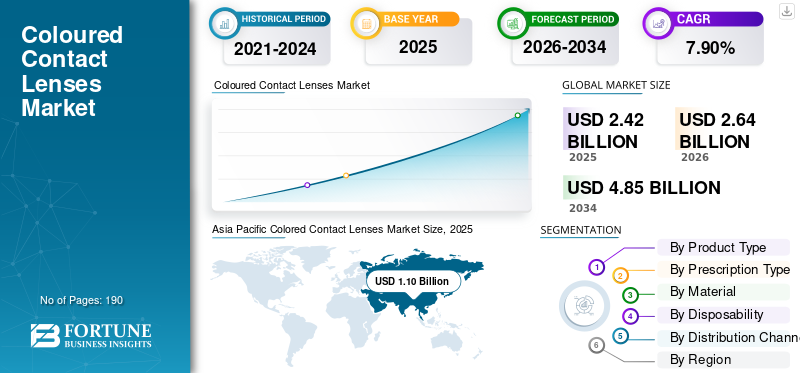
The global colored contact lenses market size was valued at USD 2.42 billion in 2025. The market is projected to grow from USD 2.64 billion in 2026 to USD 4.85 billion by 2034, exhibiting a CAGR of 7.90% during the forecast period. Asia Pacific dominated the colored contact lenses market with a market share of 45.45% in 2025.
The adoption of colored contact lenses is growing due to the increasing use of contact lenses for cosmetic eye enhancement, fashion styling, and vision correction. Rising beauty consciousness, social media influence, growing online product availability, and increasing demand for personalized appearance are supporting product adoption. Developments in lens materials, pigment-placement techniques, moisture retention, oxygen permeability, and natural-looking color patterns are improving safety, comfort, and appearance. These advancements are encouraging manufacturers to expand their product portfolios and address a broader range of corrective and non-corrective users.
- For instance, in May 2026, KSSEYE LENS introduced four next-generation colored contact lens technologies focused on improving eye safety, natural appearance, wearing comfort, and consistent visual performance. The development demonstrates the increasing focus of manufacturers on combining cosmetic differentiation with improved lens functionality and wearer experience.
Furthermore, key players such as Alcon Inc., Johnson & Johnson Vision Care, Inc., BAUSCH + LOMB CORPORATION, and Starvision Co., Ltd., are actively participating in new product launches, strategic collaborations, acquisitions, and investment initiatives to expand market presence.
Download Free sample to learn more about this report.
Colored Contact Lenses Market Key Takeaways
 Global Market Size & Forecast
- 2025 Market Size: USD 2.42 billion
- 2026 Market Size: USD 2.64 billion
- 2034 Forecast Market Size: USD 4.85 billion
- CAGR: 7.90% (2026–2034)
 Market Share
- Asia Pacific dominated the market with a 45.45% share in 2025.
- The Non-corrective/Cosmetic segment is projected to grow at an 8.78% CAGR.
- The Silicone Hydrogel segment is projected to grow at a 10.47% CAGR.
 Key Regional Highlights
Asia Pacific
Asia Pacific held the largest market share in 2025 and is estimated to reach USD 1.21 billion in 2026.
North America
North America ranked second in 2025, reaching USD 0.52 billion.
Europe
Europe is projected to reach USD 0.52 billion in 2026, growing at a 6.64% CAGR.
U.S.
U.S. market is estimated at approximately USD 0.51 billion in 2026, accounting for roughly 19.31% of the global market.
Japan
Japan market is estimated at around USD 0.26 billion in 2026, accounting for approximately 9.78% of the global market.
Read More

COLORED CONTACT LENSES MARKET TRENDS
Shift toward Silicone Hydrogel Colored Contact Lenses is a Prominent Market Trend
The market is witnessing a gradual shift toward silicone hydrogel lenses. These silicone hydrogel materials provide higher oxygen transmissibility, supporting ocular comfort and healthier-looking eyes during daily wear. This is crucial in colored lenses, as consumers increasingly expect cosmetic enhancement without compromising lens breathability and overall wearing experience. Manufacturers are therefore combining advanced lens materials with embedded pigment technologies, moisture-retention features, and natural-looking color patterns. The availability of silicone hydrogel colored lenses in both corrective and non-corrective options is expected to encourage broader adoption among fashion-conscious consumers and existing contact lens users.
- For instance, in December 2024, Alcon’s AIR OPTIX COLORS silicone hydrogel contact lenses were launched in Indonesia during the Jakarta X Beauty 2024 event. The lenses combine high oxygen transmissibility with embedded color technology and were introduced in multiple shades for cosmetic enhancement and vision correction, demonstrating the growing focus on combining aesthetics with advanced lens performance.
MARKET DYNAMICS
MARKET DRIVERS
Download Free sample to learn more about this report.
Expanding Addressable Contact-lens Population to Drive Market Growth
The growing population of contact-lens users is expanding the potential customer base for colored contact lenses. Increasing availability of lenses for myopia, hyperopia, astigmatism, and other refractive conditions allows consumers to combine vision correction with cosmetic eye enhancement in a single product. The development of daily disposable, toric, and broader prescription-range colored lenses is also enabling manufacturers to reach users who were previously limited to clear corrective lenses. As more consumers become familiar with contact-lens fitting, handling, and replacement practices, their willingness to experiment with colored alternatives is expected to increase. This combination of corrective and cosmetic demand is encouraging companies to expand their product portfolios and support colored contact lenses market growth.
- For instance, in February 2025, Menicon launched 1DAY Menicon Rei Toric, a daily disposable colored contact lens designed for people with astigmatism. The launch expanded the company’s colored-lens offering beyond standard prescriptions and enabled a wider group of corrective contact-lens users to access cosmetic color options.
|
Rank |
Market Driver |
Expected Impact on Market Growth |
CAGR Contribution (2026-2034) |
Impact: 2026-2028 |
Impact: 2029-2031 |
Impact: 2032-2034 |
|
1 |
Expanding addressable contact-lens population |
High |
3.00% |
High |
High |
High |
|
2 |
Beauty, fashion and self-expression adoption. |
High |
2.50% |
Medium |
High |
High |
|
3 |
High refractive-error and myopia burden |
High |
2.10% |
High |
High |
Medium |
|
4 |
Shift toward daily disposable convenience |
Medium-High |
1.70% |
Medium |
High |
High |
|
5 |
Material and comfort innovation |
Medium |
1.30% |
Medium |
Medium |
High |
|
6 |
Others |
Low |
0.80% |
Low |
Low |
Low |
|
Total Gross Growth Contribution |
11.40% |
MARKET RESTRAINTS
Safety Risks and Mandatory Prescription Requirements to Restrain Product Adoption
Safety concerns associated with colored contact lenses are expected to limit market growth, particularly among first-time and occasional cosmetic users. Improperly fitted lenses, poor hygiene, extended wear, low oxygen transmission, and products purchased from unregulated sellers can cause corneal abrasions, ulcers, infections, and, in severe cases, permanent vision loss. Moreover, regulatory restrictions on over-the-counter sales and growing publicity around counterfeit or unauthorized products can discourage consumers and restrict the expansion of informal and online distribution channels.
- For instance, in 2025, the American Academy of Ophthalmology published a clinical statement warning that cosmetic lenses purchased without professional supervision or a valid prescription had been associated with serious infections, vision loss, and other complications. The statement also highlighted that lenses sold through unauthorized stores or websites may be counterfeit or lack FDA approval, increasing the risk of permanent eye damage and reinforcing the need for stricter prescription-based sales.
|
Rank |
Market Restraint |
Expected Impact on Market Growth |
Negative CAGR Contribution (2026-2034) |
Impact: 2026-2028 |
Impact: 2029-2031 |
Impact: 2032-2034 |
|
1 |
Safety concerns and prescription requirements |
High |
1.40% |
High |
High |
Medium |
|
2 |
Replacement and care non-compliance |
Medium-High |
1.00% |
High |
Medium |
Medium |
|
3 |
Affordability and limited reimbursement |
Medium |
0.70% |
Medium |
Medium |
Low |
|
4 |
Others |
Low |
0.40% |
Low |
Low |
Low |
|
Total Market Reduction |
3.50% |
MARKET OPPORTUNITIES
Virtual Try-On And Personalized Recommendations To Create Premium Growth Opportunities
The integration of AR, AI, and image analysis technologies into colored contact lens platforms represents a significant market growth opportunity. Virtual try-on tools allow consumers to preview how different shades and patterns may look against their natural eye color and skin tone before purchasing or visiting an eye-care professional. Personalized recommendations can further narrow product choices according to preferred appearance, lens format, prescription requirements, and previous browsing behaviour. This reduces the uncertainty associated with online shade selection, improves consumer confidence, and may lower dependence on multiple physical trial lenses. Manufacturers can also use these tools to direct consumers from digital discovery toward professional fitting, free trials, and repeat purchases. Wider integration across brand websites, mobile applications, and online optical retailers could therefore improve conversion rates and strengthen direct-to-consumer engagement.
- For instance, in June 2025, Alcon highlighted its enhanced COLORS Virtual Try-On Tool, which incorporated more realistic shade-matching and side-by-side comparison capabilities. The tool enables users to preview multiple AIR OPTIX COLORS and DAILIES COLORS options, narrow their preferred shades, and proceed toward a professional consultation and free lens trial. The development highlighted improved patient engagement and connected online exploration with professional eye-care channels.
MARKET CHALLENGES
Balancing Cosmetic Appeal with Lens Comfort and Ocular Safety Remains a Significant Challenge to the Market Growth
The manufacturers face the challenge of delivering vivid, natural-looking color while maintaining adequate oxygen permeability, moisture retention, smooth lens surfaces, and safe pigment placement. Dense color patterns or poorly encapsulated pigments may reduce wearing comfort or create uneven surfaces that irritate the cornea. The challenge is greater for low-cost products sold through informal and online channels, where material quality, fitting accuracy, and regulatory compliance may be inconsistent. Dryness, redness, irritation, or concerns about infection can lead consumers to discontinue lens use and weaken confidence in cosmetic contact lenses.
- For instance, in September 2024, the American Academy of Ophthalmology issued a warning regarding some over-the-counter colored contact lenses that tested positive for chlorine, iron, and other potentially harmful substances. The article also highlighted that printed or pressed colorants may create raised lens surfaces capable of scratching the cornea and increasing the risk of infections and vision damage, demonstrating the difficulty of combining strong cosmetic effects with consistent product safety.
Segmentation Analysis
By Product Type
Opaque Colored Lenses Dominated Owing to Their Stronger and More Visible Eye Color Transformation
Based on the product type, the market is categorized into enhancement tinted lenses, opaque colored lenses, visibility tinted lenses, and others.
On the basis of product type, opaque colored lenses dominated the segment. They can completely change the natural eye color and provide a more noticeable cosmetic effect than enhancement or visibility-tinted lenses. Their dense pigmentation makes them suitable for consumers with both light and dark irises, thereby expanding the addressable consumer base. The stronger visual results, wider applicability, and frequent shade experimentation have supported higher product demand and segment dominance.
- For instance, in 2025, Bella expanded its colored contact lens portfolio with five cosmic-inspired shades, including Moon and Saturn. The lenses were developed with balanced opacity and multi-tonal patterns to provide a visible yet natural-looking transformation across different natural eye colors, highlighting the strong commercial focus on opaque colored designs.
The others segment is expected to grow at a CAGR of 9.46% over the forecast period.
To know how our report can help streamline your business, Speak to Analyst
By Prescription Type
Corrective Colored Lenses Led by Combining Vision Correction with Cosmetic Enhancement
Based on prescription type, the market is segmented into corrective and non-corrective / cosmetic.
In 2025, the corrective segment accounted for the dominant share as it addresses the large existing population of consumers who already require contact lenses for refractive correction. These products allow users to correct myopia, hyperopia, or astigmatism while simultaneously changing or enhancing their eye color, eliminating the need to choose between functional and cosmetic benefits. Corrective users generally purchase lenses repeatedly according to a defined replacement schedule, which creates more stable demand than occasional cosmetic use.
- For instance, in April 2025, PIA Co., Ltd. launched the Clainel daily colored contact lens brand with four shades and prescription powers ranging from plano to −10.00 D. The launch combined cosmetic eye-color enhancement with refractive correction, demonstrating how manufacturers are targeting the established population of vision-correction users to expand demand for corrective colored lenses.
The non-corrective/cosmetic segment is projected to grow at a CAGR of 8.78% during the forecast period.
By Material
Hydrogel Dominated Owing to Established Manufacturing, Softness, and Mass-market Affordability
Based on the material, the market is segmented into hydrogel, silicone hydrogel, and others.
Hydrogel dominated the material segment due to its long-established use in soft colored contact lens manufacturing, broad supplier availability, and comparatively economical production. The material’s water-containing structure provides a soft and flexible lens surface, which supports ease of handling and initial wearer comfort. Also, it is compatible with established color-printing and pigment-encapsulation processes, allowing manufacturers to introduce numerous shades and patterns without substantially increasing production complexity. Consequently, the material is extensively used across daily, monthly, and longer-replacement colored contact lens portfolios.
- For instance, in August 2024, KITS Eyecare launched KITS Daily Color Contacts manufactured using third-generation hydrogel material. The lenses were introduced in five colors and incorporated advanced surface technology for moisture retention and oxygen permeability, demonstrating the continued commercial importance of hydrogel in mass-market colored lens portfolios.
The silicone hydrogel segment is projected to grow at a CAGR of 10.47% during the forecast period.
By Disposability
Monthly Lenses Dominated Owing to Their Cost-Effectiveness
Based on the disposability, the market is segmented into daily, weekly / bi-weekly, monthly, and annual.
In 2025, monthly segment captured the largest share in the disposability segment. They provide a cost-effective option for consumers who wear colored lenses regularly. Compared with daily lenses, monthly products have a lower cost per wear, making them suitable for users who incorporate eye-color enhancement into their routine appearance. At the same time, their shorter replacement period provides greater convenience and hygiene than annual lenses, reducing prolonged exposure to deposits and lens deterioration. Monthly lenses are also widely available in prescription and non-corrective formats across extensive shade portfolios. This balance between affordability, reusable wear, product variety, and manageable replacement frequency supported their leading market position.
- For instance, in 2024, Amara expanded the Georgina Rodriguez colored contact lens collection with four new monthly shades—Biscuit, Almond, Choco, and Matcha. The expansion, alongside the launch of two daily options, demonstrated manufacturers’ continued emphasis on monthly lenses as a core format for consumers seeking reusable and varied cosmetic choices.
The daily segment is projected to grow at a CAGR of 10.15% over the forecast period.
By Distribution Channel
Offline Channels Dominated Owing to Professional Fitting and Greater Consumer Trust
Based on the distribution channel, the market is segmented into offline channels, optical stores, ophthalmology clinics & eye care centers, retail pharmacies, online channels, e-commerce platforms, company-owned websites, online optical retailers, and others.
Offline channels held the dominant share in the distribution channel segment as these contact lenses are medical devices that require appropriate selection, fitting, and usage guidance, even when purchased for cosmetic purposes. Consumers can additionally compare shades, obtain immediate assistance, and purchase lens-care products from the same location. The presence of established optical chains, pharmacies, and specialty retailers therefore supported higher sales through offline channels.
- For instance, in November 2025, Sweet Co. began launching three new SWEET 1 DAY colored contact lens products and supported the launch through an exclusive nationwide campaign across Don Quijote stores in Japan. The campaign included store-exclusive colors and in-store promotional benefits, demonstrating the importance of large physical retail networks in generating product visibility and consumer purchases.
The e-commerce platforms segment is projected to grow at a CAGR of 10.68% during forecast period.
Colored Contact Lenses Market Regional Outlook
By geography, the market is categorized into Europe, North America, Asia Pacific, Latin America, and the Middle East & Africa.
North America
Asia Pacific Colored Contact Lenses Market Size, 2025 (USD Billion)
To get more information on the regional analysis of this market, Download Free sample
North America was valued at USD 0.48 billion in 2024 and maintained its growth momentum by gaining the position of second largest in 2025 at USD 0.52 billion. The market is growing due to high contact-lens penetration, strong spending on cosmetic products, and widespread availability through optical retailers and online platforms. The demand in the region is also supported by product innovation in daily disposable and silicone hydrogel colored lenses.
U.S. Colored Contact Lenses Market
Given North America's substantial contribution and the U.S. dominance in the region, the U.S. market is estimated at around USD 0.51 billion in 2026, accounting for roughly 19.31% of the global market.
Europe
Europe is projected to grow at a CAGR of 6.64% over the coming years, with the third-highest growth among all regions, and reach a valuation of USD 0.52 billion by 2026. The regional growth is driven by rising interest in fashion-led eye enhancement and increasing use of prescription colored lenses. Strong regulatory oversight and established optical retail networks support consumer confidence in professionally fitted products.
U.K. Colored Contact Lenses Market
The U.K. market is estimated at USD 0.10 billion in 2026, accounting for roughly 3.61% of the global market.
Germany Colored Contact Lenses Market
Germany's market is projected to reach approximately USD 0.10 billion in 2026, equivalent to around 3.97% of the global market.
Asia Pacific
Asia Pacific accounted for the largest colored contact lenses market share in 2025 and is estimated to reach USD 1.21 billion in 2026. The Asia Pacific region is expanding rapidly due to a large young population, strong beauty and entertainment influences, and high acceptance of eye-enhancement products. Growing e-commerce penetration and extensive product launches across Japan, South Korea, China, and Southeast Asia further is further supporting the regional market demand.
Japan Colored Contact Lenses Market
The Japanese market in 2026 is estimated at around USD 0.26 billion, accounting for approximately 9.78% of the global market.
China's Colored Contact Lenses Market
China's market is projected to be among the largest worldwide, with 2026 revenues estimated at around USD 0.37 billion, accounting for approximately 14.13% of global sales.
India Colored Contact Lenses Market
The Indian market is estimated at around USD 0.16 billion in 2026, accounting for roughly 6.10% of global revenue.
Latin America and Middle East & Africa
The Latin America and Middle East & Africa regions are expected to witness moderate growth during the forecast period. Latin America is estimated to reach a valuation of USD 0.19 billion in 2026. Market growth is supported by increasing beauty consciousness, urbanization, and improving access to branded cosmetic lenses. In the Middle East & Africa, the GCC is set to reach USD 0.07 billion in 2026.
South Africa Colored Contact Lenses Market
The South African market is projected to reach approximately USD 0.03 billion by 2026, accounting for roughly 1.12% of global revenue.
COMPETITIVE LANDSCAPE
Key Industry Players
Omnichannel Availability And Product Innovation By Key Companies to Intensify Market Competition
The presence of multinational eye-care companies and specialized colored contact lens manufacturers characterizes the global market. They are strengthening their portfolios through new shades, daily and monthly replacement formats, wider prescription ranges, toric and multifocal options, and advanced hydrogel and silicone hydrogel materials. Established players benefit from strong regulatory capabilities, professional eye-care relationships, and international distribution networks. Based on current company portfolios, shade variety, material performance, prescription coverage, product safety, and omnichannel availability are becoming crucial competitive differentiators.
- For instance, in January 2025, PIA Co., Ltd. expanded its feliamo 1MONTH colored contact lens portfolio with three new shades—Oolong Tea, Tarte Tatin, and Tiramisu Ring. The company transferred popular designs from its daily disposable portfolio into the monthly replacement category and distributed the products through online retailers, contact lens specialty stores, and variety stores.
Major players such as Alcon Inc., Johnson & Johnson Vision Care, Inc., Bausch + Lomb Corporation, Starvision.Co.Ltd./OLENS compete through product innovation, brand partnerships, regulatory approvals, portfolio expansion, and geographic reach. Companies with strong eye-care brands, professional distribution relationships, and advanced material technologies are expected to maintain prominent positions. At the same time, specialized regional manufacturers are likely to increase competitive pressure through trend-focused designs, cost-effective products, and faster expansion across online channels.
LIST OF KEY COLORED CONTACT LENSES COMPANIES PROFILED
- Alcon Inc. (Switzerland)
- Johnson & Johnson Vision Care, Inc. (U.S.)
- Bausch + Lomb Corporation (U.S.)
- Starvision Co., Ltd. (South Korea)
- PEGAVISION Corporation (Taiwan)
- PIA Corporation (Japan)
- Lcode Co., Ltd. (Japan)
- Menicon Co., Ltd. (Japan)
- Neo Vision Co., Ltd. (South Korea)
- Interojo Co., Ltd. (South Korea)
- GEO Medical Co., Ltd. (South Korea)
- SEED Co., Ltd. (Japan)
- Dreamcon Co., Ltd. (South Korea)
- Maxvue Vision Sdn. Bhd. (Malaysia)
- Oculus Private Limited (Singapore)
KEY INDUSTRY DEVELOPMENTS
- February 2026: Johnson & Johnson launched two colored contact lenses in Singapore: ACUVUE OASYS MAX 1-Day MULTIFOCAL for ASTIGMATISM. The product is a daily disposable multifocal toric contact lens for people with both astigmatism and presbyopia, and ACUVUE OASYS MAX 1-Day for ASTIGMATISM.
- August 2025: Johnson & Johnson launched its Acuvue Oasys Max 1-Day Multifocal in the U.S. and Canada for Astigmatism and presbyopia.
- May 2025: PIA Co., Ltd. launched two new colors, Cream Rose and Mocha Ring, from its color contact lens brand TOPARDS 1MONTH. The product is produced by Rino Sashihara and is made available in online stores.
- August 2024: Kits Eyecare Ltd. launched KITS Daily Color Contacts. This innovative product line provides customers with high-quality daily contact lenses in a range of colors designed to enhance and define the look of the eyes.
- January 2024: Performance Vision Technologies Inc. launched ALTIUS Advanced Performance-Tinted Contact Lenses in the United States and select international markets. Given the diverse applications of ALTIUS Lenses (Medical/Sports Vision) in collaboration with Eyecare professionals and their staff, ALTIUS offers new options for enhanced patient eye care.
REPORT COVERAGE
The global colored contact lenses market report provides a detailed assessment of all market segments, highlighting the key drivers, trends, opportunities, restraints, and challenges influencing industry growth. It covers product developments in enhancement tinted lenses, opaque colored lenses, visibility tinted lenses, and special-effect or costume lenses, along with corrective and non-corrective cosmetic products. It also examines consumer preferences, contact-lens adoption, pricing patterns, safety concerns, prescription requirements, online purchasing behaviour, and the competitive strategies adopted by leading multinational and regional manufacturers. The report profiles major companies, evaluates their product portfolios, distribution networks, regulatory capabilities, geographic presence, and market positioning.
Request for Customization to gain extensive market insights.
Report Scope & Segmentation
| ATTRIBUTE | DETAILS |
| Study Period | 2021-2034 |
| Base Year | 2025 |
| Estimated Year | 2026 |
| Forecast Period | 2026-2034 |
| Historical Period | 2021-2024 |
| Growth Rate | CAGR of 7.90% from 2026 to 2034 |
| Unit | Value (USD Billion) |
| Segmentation | By Product Type, Prescription Type, Material, Disposability, Distribution Channel, and Region |
| By Product Type |
|
| By Prescription Type |
|
| By Material |
|
| By Disposability |
|
| By Distribution Channel |
|
| By Region |
|
Research Methodology
1. Bottom Up Approaches
Approach 1: Revenues and Market Share of Major Colored Contact Lens Players
- Collection of contact lens and colored contact lens revenues from annual reports, SEC filings, investor presentations, earnings releases, company websites, and product catalogues of key companies such as Alcon, Johnson & Johnson Vision Care, Bausch + Lomb, PEGAVISION, SEED, Menicon, Interojo, PIA Corporation, and OLENS.
- Estimation of colored contact lens revenue using product portfolio breadth, regional exposure, brand presence, product availability, and colored lens contribution to total contact lens sales.
- Mapping of company portfolios across enhancement tinted lenses, opaque colored lenses, visibility tinted lenses, and special-effect/costume lenses.
- Assessment of company presence by corrective and non-corrective lenses, hydrogel and silicone hydrogel materials, replacement schedules, and distribution channels.
- Adjustment of reported revenues to manufacturer-level sales by excluding retailer margins, distributor mark-ups, taxes, shipping charges, and eye-care service revenues.
Approach 2: Colored Contact Lens User and Consumption Analysis
- Estimation of the contact lens-wearing population across the United States, Canada, major European countries, Japan, China, India, Australia, Southeast Asia, Brazil, Mexico, GCC, South Africa, and other markets.
- Assessment of the percentage of contact lens users purchasing colored or tinted lenses for corrective, cosmetic, fashion, cosplay, and theatrical applications.
- Segmentation of consumers into corrective and non-corrective/cosmetic colored contact lens users.
- Estimation of annual lens consumption based on daily, weekly/bi-weekly, monthly, and annual replacement schedules.
- Application of country-specific adoption rates, wearing frequency, replacement compliance, pack sizes, and manufacturer-level average selling prices.
- Estimation of country-level market value by multiplying active colored contact lens users by annual consumption and manufacturer selling prices.
- Summation of country-level estimates to derive the regional and global market size.
Approach 3: Distribution Channel, Retail Audit and Product Availability Analysis
- Identification of colored contact lens products sold through optical stores, ophthalmology clinics and eye care centers, retail pharmacies, e-commerce platforms, company-owned websites, and online optical retailers.
- Collection of product-level information covering brands, shades, prescription availability, materials, pack sizes, replacement schedules, and listed prices.
- Assessment of product availability and sales presence across enhancement tinted, opaque colored, visibility tinted, and special-effect/costume lenses.
- Conversion of retail prices into manufacturer selling prices by removing retailer, distributor, marketplace, logistics, and tax components.
- Estimation of product sales using retailer presence, product rankings, review volumes, stock availability, brand visibility, promotional activity, and channel coverage.
- Evaluation of offline versus online sales contribution across individual countries and regions.
2. Top Down Approaches
Approach 1: Analysis of Parent Market
- Estimation of the global contact lens market using manufacturer revenues, contact lens user populations, annual lens consumption, and publicly available industry and regulatory data.
- Assessment of the proportion of total contact lens revenues attributable to colored contact lenses across major countries and regions.
- Allocation of the colored lens share using product registrations, company portfolio contribution, cosmetic lens adoption, online product availability, consumer preferences, and regional fashion trends.
- Application of regional and country-level colored contact lens penetration rates to estimate the total addressable market.
3. List of Key Sources
- Annual reports, SEC filings, investor presentations, earnings releases, and product catalogues
- Company websites and product registration databases
- S. FDA, European Commission, EUDAMED, PMDA, NMPA, CDSCO, TGA, and Health Canada
- Contact Lens Institute
- International Association of Contact Lens Educators
- British Contact Lens Association
- American Optometric Association
- National optometry and ophthalmology associations
- WHO, World Bank, OECD, Eurostat, and national statistics agencies
- Customs and international trade databases
- Product launches, regulatory approvals, recalls, manufacturing expansions, and distribution agreements
- Optical retailer, online optical retailer, pharmacy, and e-commerce product listings.
4. Primary Interviews
Supply Side Interviews: 60%
- Key respondents: Executives and professionals from colored contact lens manufacturers, OEM/ODM producers, brand owners, distributors, optical retailers, and e-commerce companies.
- Interviews should assess company revenues, manufacturing volumes, capacity utilization, product mix, manufacturer selling prices, regional sales, distribution margins, private-label activity, and market competition.
- Typical respondents include sales directors, marketing managers, product managers, regional heads, distributors, procurement managers, and manufacturing executives.
Demand Side Interviews: 40%
- Key Respondents: Optometrists, ophthalmologists, optical store owners, contact lens fitters, retail pharmacists, online optical retailers, and colored contact lens users.
- Interviews should evaluate consumer adoption, corrective versus cosmetic usage, purchase frequency, preferred replacement schedule, material preference, shade preference, channel selection, and average spending.
- Demand-side inputs should also validate country-level adoption rates, online purchasing trends, replacement compliance, safety awareness, and preference for branded versus unregulated products.
Frequently Asked Questions
According to Fortune Business Insights, the global market value stood at USD 2.42 billion in 2025 and is projected to reach USD 4.85 billion by 2034.
In 2025, the market value stood at USD 0.52 billion.
The market is expected to grow at a CAGR of 7.90% over the forecast period.
The opaque colored lenses segment is expected to lead the market.
Expanding addressable contact-lens population is driving market growth.
Alcon Inc., Johnson & Johnson Vision Care, Inc., BAUSCH + LOMB CORPORATION, and Starvision Co., Ltd. are among the major players in the global market.
Asia Pacific dominated the market in 2025.



- 2021-2034
- 2025
- 2021-2024
- 190
Get 30-60 hrs Free Customization
Expand Regional and Country Coverage, Segments Analysis, Company Profiles, Competitive Benchmarking, and End-user Insights.













.webp)






Related Reports
-
US +1 833 909 2966 ( Toll Free )
-
Get In Touch With Us