Shipping Container Market Size, Share & Industry Analysis, By Category (ISO and Non-ISO Container), By Container Type (Dry Freight, Refrigerated, Tank Containers, & Specials), By Size (20 ft., 40 ft., & 45 ft. & Above), By Material (Corten Steel & Aluminum), By Ownership/Purchase Type (Shipping Lines, Leasing Companies, & Shipper-Owned), By End-use Industry (Consumer Goods & Retail, Food & Beverages, Chemicals & Petrochemicals, Automotive & Industrial Machinery, Agriculture & Forestry Products), By Technology Integration (Standard Containers & Smart Containers) & Regional Forecast, 2026-2034
 Download Free Sample
(Offer valid till 30th Sep 2026)

KEY MARKET INSIGHTS
 Listen to Audio Version
The global shipping container market size was valued at USD 12.32 billion in 2025. The market is projected to grow from USD 12.7 billion in 2026 to USD 16.57 billion by 2034, exhibiting a CAGR of 3.37% during the forecast period. Asia Pacific dominated the shipping container market with a market share of 37.77% in 2025.
The global shipping container market comprises standardized containers used for transporting goods across sea, rail, and road networks, enabling efficient global trade logistics. Growth is driven by rising international trade volumes, the expansion of e-commerce, and the need for intermodal transport efficiency. Increasing demand for durable, corrosion-resistant containers made from Corten steel and lightweight aluminum is shaping material trends. Technological innovations such as smart containers with IoT sensors for tracking and temperature control enhance supply chain visibility. Additionally, the leasing model’s expansion, containerization of bulk cargo, and port infrastructure investments worldwide reinforce market growth, positioning shipping containers as the backbone of global freight movement.
Key players in the global shipping container market include China International Marine Containers (CIMC), Maersk Container Industry, Singamas Container Holdings, CXIC Group, and Dong Fang International Container. These companies emphasize lightweight, durable, and smart container solutions, incorporating IoT tracking and temperature control technologies. Strategic partnerships with shipping lines, leasing firms, and logistics providers, along with investments in automation and sustainable materials, enhance their competitiveness in global maritime logistics.
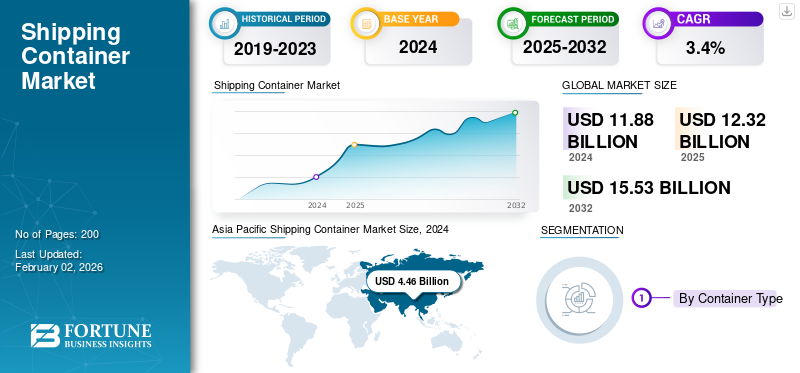
Download Free sample to learn more about this report.
Shipping Container Market Key Takeaways
 Global Market Size & Forecast
- 2025 Market Size: USD 12.32 billion
- 2026 Market Size: USD 12.70 billion
- 2034 Forecast Market Size: USD 16.57 billion
- CAGR: 3.37% from 2026–2034
 Market Share
- Asia Pacific dominated the shipping container market with a 37.77% share in 2025.
- The dry freight segment is expected to account for 88.09% of the market in 2026.
- The ISO containers segment is projected to hold 94.31% of the market in 2026.
 Key Regional Highlights
Asia Pacific
Asia Pacific generated USD 4.65 billion in 2025 and is projected to reach USD 4.83 billion in 2026, maintaining its market leadership.
North America
North America recorded a market size of USD 2.86 billion in 2025 and is expected to grow to USD 2.96 billion in 2026.
Europe
Europe accounted for USD 2.09 billion in 2025 and is projected to reach USD 2.14 billion in 2026.
U.S.
U.S. The country continues to drive North America's shipping container market through strong import-export activities and expanding logistics infrastructure.
Japan
Japan Growing international trade and advanced port operations continue to support steady demand for shipping containers.
Read More

MARKET DYNAMICS
MARKET DRIVERS
Expansion of Global Trade and Intermodal Logistics Drives Market Growth
Rising global trade volumes and the expansion of intermodal transport networks have accelerated demand for shipping containers. The seamless transfer of goods between maritime, rail, and road modes of transport enhances operational efficiency and reduces logistics costs. In December 2024, Adani Ports and Special Economic Zone Ltd reported an 8% year-on-year cargo volume increase, driven by higher container traffic and a 7% rise in liquid and gas shipments, strengthening port throughput efficiency. Strategic trade pacts such as RCEP and USMCA are improving port connectivity and container turnover. The global shift toward integrated transport ecosystems continues to drive container utilization and strengthen the overall shipping container market growth.
MARKET RESTRAINTS
Volatility in Raw Material Prices and Freight Costs Hamper Market Expansion
Fluctuations in steel prices and freight rates disrupt production economics, affecting profitability across the shipping container supply chain. According to Deccan Transport Group, steel represents nearly 60% of a container’s manufacturing cost, making the industry highly vulnerable to raw material swings. Rising fuel expenses and shipping surcharges further pressure operators. Persistent cost volatility hampers pricing stability, discouraging long-term production commitments and infrastructure investments, ultimately restraining manufacturing output and slowing container market expansion.
MARKET OPPORTUNITIES
Growth in Smart and Specialized Containers Boosts Production Adoption
Rising demand for advanced, technology-integrated containers is reshaping fleet modernization strategies. Smart reefers, tank containers, and IoT-enabled units cater to industries requiring cargo traceability, temperature regulation, and compliance with stringent safety standards. In March 2023, Hapag-Lloyd announced that 100,000 of its reefer shipping containers had been equipped with smart monitoring technology, enabling real-time temperature and location tracking and enhancing cargo transparency across global cold-chain operations. The integration of telematics and automation enhances efficiency, reduces spoilage, and enables predictive maintenance. As logistics networks adopt connected infrastructure, these innovations create lucrative opportunities and accelerate smart shipping container adoption globally.
Shipping Container Market Trends
Sustainability and Digital Transformation in Container Manufacturing is a Major Market Trend
Sustainability and digitalization are redefining container manufacturing and fleet management practices. Producers are developing lightweight, recyclable containers using low-emission materials to comply with environmental standards. In August 2025, Maersk welcomed the International Maritime Organization’s adoption of a global net-zero emissions framework, emphasizing its alignment with Maersk’s decarbonization goals and commitment to expanding low-emission shipping and green logistics solutions. IoT integration enables real-time tracking, predictive maintenance, and reduced energy consumption across transport chains. The convergence of sustainability and smart technology strengthens cost control, efficiency, and environmental compliance, collectively driving next-generation container innovation and boosting long-term adoption over the forecast period.
MARKET CHALLENGES
Uneven Trade Flows to Challenge Market Growth
Uneven trade flows and recurring congestion at major ports continue to challenge global container logistics. Import-heavy regions often accumulate excess containers, while exporters face severe shortages, inflating repositioning and demurrage costs. Investment in automation, predictive fleet management, and smarter port scheduling is essential to mitigate these disruptions and improve operational efficiency, supporting balanced container deployment worldwide.
Download Free sample to learn more about this report.
Segmentation Analysis
By Container Type
High Cargo Versatility and Operational Efficiency Anchor Dry Freight Container Dominance
By container type, the market is segmented into dry freight, refrigerated, tank containers, and specials.
Dry freight containers hold the largest shipping container market share due to their versatile applications in transporting goods, including non-perishable items such as consumer products, textiles, and industrial parts. Their cost-efficiency and high availability make them the preferred choice for most shipping routes. In June 2024, Maersk reported increased utilization of 20 and 40-foot dry goods containers on Asia-Europe and Trans-Pacific lanes, citing stable demand from retail and manufacturing sectors. This segment’s extensive deployment and global interoperability continue to drive consistent revenue generation and fleet expansion for manufacturers and lessors. The dry freight segment will account for 88.09% market share in 2026.
Tank containers are expanding rapidly owing to the growing transport of bulk liquids, chemicals, and food-grade products. In January 2025, ITCO reported that the global tank container fleet increased 3.96% YoY, highlighting accelerated adoption in liquid logistics.
To know how our report can help streamline your business, Speak to Analyst
By Category
Global Trade Standardization and Compatibility to Reinforce ISO Containers Segment Leadership
In terms of category, the market is bifurcated into ISO and non-ISO containers.
ISO containers continue to dominate the market as they are universally compatible with shipping lines, rail systems, and trucking networks, enabling smooth intermodal transfers. Their standardized dimensions ensure lower handling costs, easy stacking, and simplified maintenance. The ISO containers segment is expected to account for 94.31% of the market in 2026. Fleet owners and leasing companies favor ISO models for operational efficiency and faster asset turnover. In May 2025, the International Maritime Organization’s MSC 110 session discussed safety frameworks for autonomous and smart shipping systems under the I-ESKIMO 2025 initiative, focusing on regulatory harmonization, risk assessment, and integration of emerging maritime technologies. The broad adoption of these standards continues to drive sustained demand and operational scalability across international trade corridors. Non-ISO containers, such as open-top, flat-rack, and custom modular units, are growing fastest due to their adaptability for project cargo, offshore energy, and modular construction logistics, boosting demand for specialized container designs.
By Size
Optimal Capacity and Port Compatibility Strengthen the 40 ft. Segment Growth
Based on size, the market is categorized into 20 ft., 40 ft., and 45 ft. & above.
The 40 ft. container remains the global industry standard, holding largest market share, due to its optimal balance between volume capacity and transport efficiency. It is widely adopted for long-haul and intermodal freight, especially in high-volume trade routes between Asia, Europe, and North America. Fleet operators prefer 40 ft. containers for their cost-per-unit efficiency and compatibility with port infrastructure. In July 2024, Maersk confirmed that 40 ft. units comprised the majority of its active dry-cargo fleet serving Trans-Pacific and Asia-Europe corridors, reinforcing their dominance and driving steady fleet utilization and market growth. The 40 ft. segment is expected to account for 64.68% of the market in 2026.
Demand for 45 ft. and larger shipping containers is increasing with the expansion of e-commerce and high-volume retail logistics. Their higher payload capacity and improved cost efficiency are boosting adoption in long-distance containerized trading activities.
By Material
Structural Durability and Corrosion Resistance to Boost Corten Steel Segment Growth
On the basis of material, the market is categorized into corten steel and aluminum.
The corten steel segment dominates the global market owing to its superior corrosion resistance, structural durability, and long service life in marine environments. They withstand harsh weather and saltwater exposure, making them ideal for heavy-duty international shipping. Manufacturers favor Corten steel for its cost-effectiveness and recyclability. In December 2022, Tata Steel received an all-India license to manufacture Corten steel, aiming to curb dependence on Chinese shipping container imports and boost domestic production of corrosion-resistant container-grade steel. The corten steel segment will account for 97.54% market share in 2026.
The aluminum segment is gaining traction for lightweight, high-value cargo transport, particularly in air-sea combined logistics. Their reduced tare weight and fuel efficiency accelerate adoption in premium and sustainable shipping applications.
By Ownership/Purchase Type
Shipping Lines Segment Holds the Dominant Market Share due to its Fleet Scale
By ownership/purchase type, the market is segmented into shipping lines, leasing companies, and shipper-owned.
The shipping lines segment holds the largest ownership share of global container fleets due to their scale, network control, and operational integration. Major carriers such as Cosco Shipping, Maersk, MSC, and CMA CGM maintain vast in-house container inventories to ensure asset availability and optimize logistics scheduling. Ownership enables cost savings on leasing fees and a faster response to trade surges. In September 2024, MSC confirmed a fleet expansion exceeding 5 million TEU capacity, supported by extensive in-house container procurement, reinforcing shipping lines’ dominance and sustaining shipping container market demand across trade networks.
Shipper-owned shipping containers are expanding rapidly as exporters and logistics providers seek greater flexibility, lower leasing costs, and improved control over turnaround times, driving adoption in niche and time-sensitive freight operations.
By End-use Industry
Expanding E-Commerce and Retail Trade Concourse Consumer Goods & Retail Segment Growth
By end-use industry, the market is segregated into consumer goods & retail, food & beverage, chemicals & petrochemicals, automotive & industrial machinery, agriculture & forestry products, and others.
The consumer goods & retail segment dominates containerized trade due to sustained e-commerce growth and globalized product supply chains. The segment benefits from continuous demand for electronics, apparel, and household products transported through standardized dry containers. In January 2025, OSG Containers highlighted the vital role of shipping containers in supporting global e-commerce growth, emphasizing their contribution to efficient logistics, cost reduction, and seamless international goods movement across digital trade networks.
Food & beverage exports are rising sharply, supported by expanding cold-chain logistics and reefer container availability.
By Technology Integration
Standard Container Segment to Lead, Driven by its Cost Efficiency
By technology integration, the market is fragmented into standard containers and smart containers.
Standard containers continue to dominate the market as the backbone of global shipping fleets due to their simplicity, low cost, and proven compatibility across ports and intermodal systems. They handle the majority of non-perishable freight, requiring minimal monitoring or data integration. Fleet operators retain standard containers as the most scalable and economical option. Their universality and high reuse rates underpin market stability, ensuring steady replacement cycles and supporting sustained production and operational efficiency across trade routes.
Smart containers, equipped with IoT tracking, GPS, and real-time monitoring systems, are expanding swiftly. In October 2023, Hapag-Lloyd celebrated the installation of its 700,000th real-time tracking device, advancing its goal to digitize the entire container fleet and enhance transparency, safety, and global supply chain visibility.
Shipping Container Market Regional Outlook
By geography, the market is categorized into Europe, North America, Asia Pacific, and the Rest of the World.
Asia Pacific Shipping Container Market Size, 2025 (USD Billion) To get more information on the regional analysis of this market, Download Free sample
Asia Pacific
The Asia Pacific market generated USD 4.65 Billion in 2025, representing 37.77% of the global market landscape, and is expected to reach USD 4.83 Billion in 2026. Asia Pacific leads the global market, supported by massive manufacturing output, export-oriented economies, and advanced port infrastructure across China, Japan, South Korea, and India. Regional trade agreements and expanding shipbuilding capacity strengthen its leadership. In December 2024, China’s National Bureau of Statistics reported a 6.2% year-on-year increase in container throughput at major ports, reflecting robust trade activity and continued resilience in the country’s export-driven logistics sector. Increasing adoption of smart logistics and container digitalization in China and Southeast Asia continues to drive production growth and reinforce the region’s market dominance.
North America
North America recorded a market size of USD 2.86 Billion in 2025, capturing 23.23% of the global market share, and is projected to reach USD 2.96 Billion in 2026. North America remains the second-largest regional market, supported by a resilient trade network, importers and exporters, and strong import flows from Asia. High container leasing activity, infrastructure upgrades, and automation investments sustain regional performance. In June 2024, the U.S. Department of Transportation announced USD 450 million in funding under the Port Infrastructure Development Program to modernize port facilities, enhance cargo efficiency, and strengthen supply chain resilience across the U.S. Growing emphasis on sustainable and digital freight systems further supports container utilization and strengthens the region’s position in global maritime logistics.
U.S.
The U.S. dominates the North American container market due to extensive port capacity, strong consumer demand, and leading logistics infrastructure. Key hubs such as Los Angeles, Long Beach, and Savannah manage high import volumes of goods from Asia, ensuring consistent container movement. In October 2025, the Port of Los Angeles reported handling 812,772 TEUs in September 2025, marking a 10% year-on-year increase, driven by strong import demand and improved supply chain fluidity across U.S. gateways.
Europe
In 2025, Europe represented USD 2.09 Billion, accounting for 16.93% of the worldwide market, and is projected to grow to USD 2.14 Billion in 2026. The Europe market growth is driven by trade recovery, e-commerce, intermodal growth, port expansions, fleet renewal, decarbonization mandates, supply-chain resilience, leasing activity, digitalization, replacement cycles, nearshoring, and volatile freight rates. Major ports such as Rotterdam, Hamburg, and Antwerp anchor container traffic across Western Europe, which elevates the market growth in the region. In April 2025, Port Economics Europe reported that the Port of Antwerp-Bruges handled 3.46 million TEUs in Q1 2025, slightly surpassing Rotterdam’s 3.43 million TEUs, reflecting a temporary but notable lead driven by improved cargo flows and terminal efficiency.
Rest of the World
The market in Rest of the World reached USD 2.72 Billion in 2025, representing 22.07% of total market revenue, and is projected to reach USD 2.78 Billion in 2026. The Rest of the World acts as an emerging contributor, encompassing Latin America, the Middle East, and Africa, where growing port investments and trade diversification are driving container adoption. In October 2024, DP World and Mawani inaugurated a SAR 3 billion (USD 800 million) state-of-the-art logistics terminal at Jeddah Islamic Port, enhancing container handling capacity, automation, and regional trade connectivity within Saudi Arabia’s maritime network. Similar initiatives across Brazil and South Africa are enhancing maritime connectivity and logistics competitiveness, collectively elevating regional participation and expanding global shipping container distribution networks.
COMPETITIVE LANDSCAPE
Key Industry Players
Industry Participants Focus on Innovations to Boost their Market Presence
The global shipping container market is moderately consolidated, with leading manufacturers focusing on product innovation, material efficiency, and digital integration to strengthen their global presence. Key players include China International Marine Containers (CIMC), Maersk Container Industry, Singamas Container Holdings, CXIC Group, and Dong Fang International Container. Companies are investing in smart container technologies, sustainable materials, and automation to enhance fleet management and energy efficiency. In May 2025, Maersk announced a major upgrade to IoT connectivity across its global container fleet, enhancing real-time visibility, predictive maintenance, and cargo tracking to improve operational efficiency and customer experience.
LIST OF KEY SHIPPING CONTAINER COMPANIES PROFILED
- China International Marine Containers (CIMC) (China)
- Dong Fang International Container (DFIC) (China)
- CXIC Group Containers Co., Ltd. (China)
- Singamas Container Holdings Ltd. (Hong Kong)
- Maersk Container Industry (MCI) (Denmark)
- Yangzhou Tonglee Reefer Container Co., Ltd. (China)
- Nantong Tank Container Co., Ltd. (NTtank) (China)
- Welfit Oddy (Pty) Ltd. (South Africa)
- SEA BOX, Inc. (United States)
- BSL Containers (Hong Kong, China)
- Jindo Co., Ltd. (South Korea)
- Qingdao Pacific Container Co., Ltd. (China)
- Tianjin Xinhuachang International Containers Co., Ltd. (China)
- THIELMANN GmbH (Germany)
KEY INDUSTRY DEVELOPMENTS
- In September 2025, Hapag-Lloyd announced that over 85% of its dry container fleet had been equipped with IoT devices, enabling real-time tracking and operational diagnostics. The company also released a whitepaper outlining the benefits of smart containers in predictive maintenance, efficiency optimization, and safety management, further advancing digital transformation in container logistics.
- In July 2025, the International Organization for Standardization (ISO) approved the initiation of a new framework for smart container standards. The project aims to establish global guidelines for IoT-enabled containers, covering communication protocols, data privacy, and performance metrics, to accelerate interoperability and widespread adoption of intelligent container monitoring systems across international shipping networks.
- In June 2025, THIELMANN completed its integration under new ownership by IRESTAL Group, strengthening its position in stainless-steel industrial container solutions. The transition aims to expand THIELMANN’s production capabilities, drive innovation in pressure-vessel design, and accelerate its global presence across chemical, food, and pharmaceutical container markets.
- In February 2025, the Digital Container Shipping Association (DCSA) released its updated Booking 2.0 and electronic Bill of Lading (eBL 3.0) standards. These aim to unify data formats across carriers and digital platforms, reducing documentation delays and streamlining cross-border freight operations, advancing global efforts toward end-to-end container digitalization and paperless logistics ecosystems.
- In July 2024, the International Plant Protection Convention (IPPC) issued new recommendations to reduce pest contamination risks in sea containers. The guidelines, aligned with the CTU Code, emphasize cleaning protocols, inspection processes, and cooperation between shipping lines and ports, reinforcing global phytosanitary measures within containerized trade logistics and supply chain operations.
REPORT COVERAGE
Request for Customization to gain extensive market insights.
Report Scope & Segmentation
|
ATTRIBUTE |
DETAILS |
|
Study Period |
2019-2032 |
|
Base Year |
2024 |
|
Estimated Year |
2025 |
|
Forecast Period |
2025-2032 |
|
Historical Period |
2019-2023 |
|
Growth Rate |
CAGR of 3.4% from 2025-2032 |
|
Unit |
Value (USD Billion) |
|
Segmentation |
By Container Type, By Category, By Size, By Material, By Ownership/Purchase Type, By End-use Industry, By Technology Integration, By Region |
|
By Container Type |
|
|
By Category |
|
|
By Size |
|
|
By Material |
|
|
By Ownership/Purchase Type |
|
|
By End-use Industry |
|
|
By Technology Integration |
|
|
By Geography |
North America (By Container Type, By Category, By Size, By Material, By Ownership/Purchase Type, By End-use Industry, By Technology Integration, By Country)
Europe (By Container Type, By Category, By Size, By Material, By Ownership/Purchase Type, By End-use Industry, By Technology Integration, By Country)
Asia Pacific (By Container Type, By Category, By Size, By Material, By Ownership/Purchase Type, By End-use Industry, By Technology Integration, By Country)
Rest of the World (By Container Type, By Category, By Size, By Material, By Ownership/Purchase Type, By End-use Industry, By Technology Integration) |
Frequently Asked Questions
Fortune Business Insights says that the global market value stood at USD 12.32 billion in 2025 and is projected to reach USD 16.57 billion by 2034.
In 2025, the market value stood at USD 12.32 billion.
The market is expected to exhibit a CAGR of 3.37% during the forecast period (2026-2034).
The dry freight segment leads the market by container type.
Expansion of global trade and intermodal logistics are the key factors driving market growth.
Key players in the global shipping container market include China International Marine Containers (CIMC), Maersk Container Industry, Singamas Container Holdings, CXIC Group, and Dong Fang International Container.
Asia Pacific holds the largest share of the market.



- 2021-2034
- 2025
- 2021-2024
- 200
-
(Offer valid till 30th Sep 2026)
Get 30-60 hrs Free Customization
Expand Regional and Country Coverage, Segments Analysis, Company Profiles, Competitive Benchmarking, and End-user Insights.




















Related Reports
-
US +1 833 909 2966 ( Toll Free )
-
Get In Touch With Us