Conversational AI in Healthcare Market Size, Share & Industry Analysis, By Component (Software/Platform & Services), By Deployment (Cloud-Based, On-Premise & Hybrid), By Technology (Machine Learning & Deep Learning, NLP/Generative AI), By Interface (Chatbots Assistants, Voice Assistants, Omnichannel Assistants, Portal Assistants), By Application (Patient Engagement & Communication, Appointment Scheduling & Reminders, Symptom Checking & Triage), By End User (Healthcare Providers, Healthcare Payers, Pharma & Life Sciences Companies, Wellness Programs), and Regional Forecast, 2026-2034
 Download Free Sample
Conversational AI in Healthcare Market Size and Future Outlook
 Listen to Audio Version
The global conversational AI in healthcare market size was valued at USD 2.29 billion in 2025. The market is projected to grow from USD 2.98 billion in 2026 to USD 24.50 billion by 2034, exhibiting a CAGR of 30.11% during the forecast period. North America dominated the conversational AI in healthcare market with a market share of 44.10% in 2025.
The global conversational AI in healthcare market includes software platforms and services that use various technologies to support patient and provider interactions. The market is driven by rising healthcare call volumes, increasing clinician administrative burden, and growing demand for continuous digital patient access. The market is evolving from rule-based chatbots to generative AI assistants that can understand patient intent, summarize conversations, and guide users to the appropriate care pathway. Healthcare providers, payers, pharma companies, and employer-sponsored wellness programs are increasingly adopting these tools to improve communication, reduce manual workload, and support better care access.
Key players in the global market include Microsoft, Abridge Al, Inc., Ada Health GmbH, and Suki AI, Inc. These companies are focusing on product advancements and strategic initiatives to strengthen their market positions.
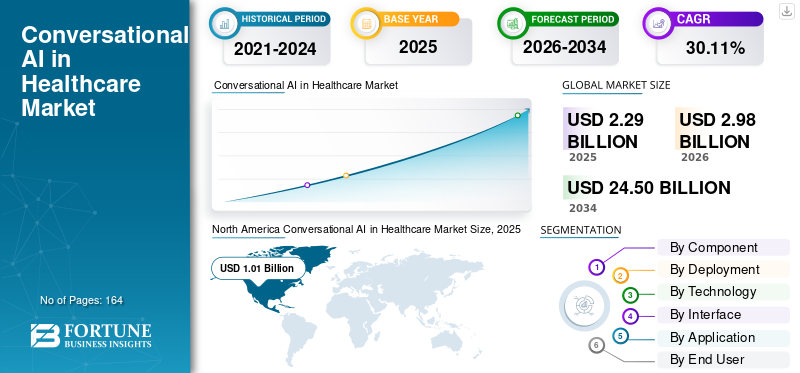
Download Free sample to learn more about this report.
Conversational AI in Healthcare Market KEY TAKEAWAYS
 Global Market Size & Forecast
- 2025 Market Size: USD 2.29 billion
- 2026 Market Size: USD 2.98 billion
- 2034 Forecast Market Size: USD 24.50 billion
- CAGR: 30.11% from 2026–2034
 Market Share
- North America dominated the conversational AI in healthcare market with a 44.10% share in 2025.
- The NLP/generative AI segment accounted for the largest market share in 2025.
- The cloud-based segment accounted for the largest market share in 2025.
 Key Regional Highlights
Asia Pacific
Asia Pacific reached USD 0.83 billion in 2026, driven by telehealth adoption and digital healthcare expansion.
North America
North America reached USD 1.01 billion in 2025, supported by AI-enabled patient engagement and EHR integration.
Europe
Europe is driven by multilingual patient engagement and virtual care solutions.
U.S.
U.S. reached USD 1.19 billion in 2026, fueled by digital health adoption and AI automation.
Japan
Japan reached USD 0.17 billion in 2026, driven by healthcare digitalization and AI-based access solutions.
Read More

CONVERSATIONAL AI in HEALTHCARE MARKET TRENDS
Growing Integration of AI-powered Automation into Healthcare Workflows is a Key Market Trend
The increasing incorporation of AI-driven automation into healthcare processes is emerging as a significant trend in the global conversational AI in healthcare market. Healthcare organizations are moving beyond isolated chatbots and increasingly integrating AI assistants directly into electronic health records, patient portals, call centers, and clinical documentation processes. These solutions help automate repetitive activities such as scheduling appointments, verifying patient identity, routing calls, conducting follow-up communication, supporting documentation, and navigating care. Consequently, hospitals and clinics can lessen administrative burdens, enhance response times, and enable clinical and support personnel to concentrate on more complicated patient requirements. The trend is being bolstered by the emergence of generative AI and voice-enabled assistants capable of comprehending natural language, summarizing discussions, and initiating workflow tasks within healthcare systems. This evolution is transforming conversational AI as an operational automation element rather than merely a tool for patient communication. These factors are contributing to the overall global conversational AI in healthcare market growth during the forecast period.
- For instance, in March 2025, Microsoft launched Dragon Copilot, a unified voice AI assistant for healthcare workflows that combines Dragon Medical One and DAX Copilot capabilities. The platform is designed to help clinicians streamline documentation, surface relevant clinical information, and automate administrative tasks within clinical workflows.
MARKET DYNAMICS
MARKET DRIVERS
Download Free sample to learn more about this report.
Rising Demand for Patient Engagement Technologies is Boosting Market Growth
Increased demand for patient engagement technologies is a major factor propelling the conversational AI market in healthcare market. Healthcare providers are encountering increased patient loads, extended call waiting periods, and rising demands for rapid digital communication. Consequently, hospitals, clinics, and healthcare organizations are implementing conversational AI solutions to aid appointment scheduling, reminders, frequently asked questions, follow-up communication, benefits navigation, and patient education. These tools assist healthcare providers in sustaining ongoing communication with patients without proportionally ramping up front-desk or contact-center staffing levels. They also enhance the patient experience by providing 24/7 access via chat, voice, mobile applications, and patient portals. This is strengthening the function of conversational AI as a fundamental patient engagement component across healthcare processes.
- For instance, in April 2025, KPJ Healthcare collaborated with IBM Malaysia and GlobeOSS to develop an AI-powered chatbot using IBM WatsonX technologies to enhance patient services, automate common interactions, and improve digital engagement across KPJ’s healthcare network.
MARKET RESTRAINTS
Concerns Associated with Data Privacy and Cybersecurity to Hamper Market Growth
Data privacy and cybersecurity concerns act as a major restraint on the global conversational AI in healthcare market. Conversational AI platforms often handle sensitive patient information such as symptoms, appointment details, insurance data, clinical notes, and care history. This increases concerns around unauthorized access, data misuse, third-party sharing, and compliance with regulations such as HIPAA and GDPR. Hospitals and payers may delay adoption when they are unsure whether AI vendors can provide strong encryption, access controls, audit trails, consent management, and secure EHR integration. Cybersecurity risks are also higher as conversational AI tools are connected to patient portals, contact centers, cloud platforms, and clinical workflows. As a result, data protection concerns can slow procurement cycles, increase vendor due diligence, and limit the deployment of AI assistants in sensitive patient-facing use cases.
- For example, in September 2025, a study titled “Can I Trust This Chatbot? Assessing User Privacy in AI-Healthcare Chatbot Applications” was published in the arXiv journal, which found significant privacy gaps among 12 widely downloaded AI healthcare chatbot apps. The study reported issues such as limited user control over personal data and weak disclosure of data protection practices.
MARKET OPPORTUNITIES
Growing Adoption of Digital Healthcare Solutions to Offer Market Growth Opportunities
The growing acceptance of digital healthcare solutions is generating a significant opportunity for the market. As hospitals, insurers, and digital health firms enhance telehealth, patient portals, remote monitoring, online booking, and mobile health platforms, they require smart tools that can assist patients across these digital interfaces. Conversational AI can address this need by assisting users in checking symptoms, scheduling appointments, comprehending benefits, completing digital intake forms, getting reminders, and exploring care options without relying entirely on human support teams. This presents a chance for vendors to incorporate AI assistants into larger digital health systems instead of providing them as independent chatbots. The potential is greater in markets where healthcare systems aim to minimize administrative hurdles, enhance digital access points, and provide more tailored patient assistance. With the rise of digital healthcare adoption, conversational AI could serve as a vital engagement link between patients, providers, payers, and care platforms.
- For instance, in July 2025, the U.S. Centers for Medicare & Medicaid Services announced a Health Tech Ecosystem initiative in collaboration with technology and healthcare leaders. The initiative aims to support patient-centric digital health tools, including conversational AI assistants for symptom checking, care navigation, appointment scheduling, and digital check-in.
MARKET CHALLENGES
Limitations Associated with AI Accuracy in Healthcare Interactions Pose a Prominent Challenge to Market Growth
Challenges related to the accuracy of AI in healthcare interactions continue to be a major issue for the global market. Healthcare discussions can be intricate, as patients might describe symptoms imprecisely, share partial information, or utilize non-medical terminology. In these scenarios, AI assistants might misinterpret intent, overlook warning signs, provide vague replies, or produce incorrect data that needs human evaluation. This restricts the application of conversational AI in high-risk scenarios such as triage, diagnostic assistance, medication direction, and clinical decision-making. As a result, providers require robust guidelines frameworks, clinician supervision, verified medical information, escalation routes, and ongoing model evaluation prior to widespread implementation of these tools. Consequently, worries about accuracy can hinder adoption, raise validation expenses, and confine conversational AI primarily to low-risk administrative and engagement tasks.
- For instance, in August 2025, a study reported by Medical Economics found that AI chatbots could repeat and expand on false medical information, including fabricated diseases, lab values, and clinical signs, in simulated clinical cases when safety measures were not applied.
Segmentation Analysis
By Component
Software/Platform Segment Dominated Due to Scalable Deployment Across Healthcare Workflows
In terms of component, the market is divided into software/platform and services.
The software/platform segment held the largest global market share in 2025, as conversational AI in healthcare is mainly delivered through AI-enabled chatbots, voice assistants, virtual agents, EHR-integrated assistants, and digital front-door platforms. Moreover, software platforms offer stronger scalability, as they can be deployed across multiple departments, locations, and patient touchpoints while maintaining consistent workflows. The segment is also supported by growing demand for cloud-based AI platforms, multilingual support, omnichannel engagement, and integration with EHRs, patient portals, and contact-center systems.
- For instance, in June 2025, MyndYou announced the completion of its deep Epic integration for Eleanor, its conversational AI platform, enabling health systems to embed AI across the patient care continuum and support enterprise-wide healthcare workflows.
The services segment is anticipated to rise with a CAGR of 23.86% over the forecast period.
To know how our report can help streamline your business, Speak to Analyst
By Deployment
Scalable Deployment and Easier Integration With Digital Front-Door and Patient Engagement Systems Boosted Cloud-Based Segment Growth
On the basis of deployment, the market is divided into cloud-based, on-premise, and hybrid.
The cloud-based segment accounted for the largest global conversational AI in healthcare market share in 2025. Cloud deployment allows healthcare organizations to scale AI assistants across multiple facilities, departments, and patient touchpoints without significant internal infrastructure investment. It also supports faster updates, continuous model improvement, centralized data management, multilingual capabilities, and easier integration with digital front-door and patient engagement systems. Furthermore, the segment is set to hold a 78.2% share in 2026.
- For instance, in May 2025, Omilia and SpinSci Technologies announced a strategic partnership to launch an AI-powered, EHR-integrated self-service solution. The solution combines Omilia’s enterprise conversational AI with SpinSci’s cloud-based patient engagement platform to improve patient access and communication.
The hybrid segment is growing at a CAGR of 24.73% over the forecast period.
By Technology
NLP/Generative AI Segment Dominated Due to Its Core Role in Conversational Healthcare Interactions
Based on technology, the market is classified into machine learning & deep learning, NLP/generative AI, and others.
The NLP/generative AI segment accounted for the dominant market share, as conversational AI platforms mainly depend on natural language understanding, speech recognition, intent detection, and response generation to manage patient and provider interactions. The segment is also supported by the rapid shift from scripted chatbots to healthcare-trained AI agents that can handle multi-turn conversations, retrieve contextual information, and escalate complex cases when required. Furthermore, the segment is set to hold a 55.3% share in 2026.
- For instance, in November 2025, Aetna, a CVS Health company, launched a generative AI-powered conversational experience across its digital channels to help members navigate benefits, care options, and health information in a more personalized manner.
The machine learning & deep learning segment is anticipated to rise with a CAGR of 27.71% over the forecast period.
By Interface
Chatbots/Text-based Assistants Segment Dominated Due to Easy Deployments Across Digital Channels
In terms of interface, the market is segmented into chatbots/text-based assistants, voice assistants, omnichannel assistants, embedded EHR/portal assistants, and others.
The chatbots/text-based assistants segment captured the highest share of the global market in 2025. This can be attributed to the fact that text-based AI tools are easier to deploy across websites, mobile apps, patient portals, SMS, and payer/member platforms. These assistants are widely used for appointment support, FAQs, benefits navigation, symptom guidance, medication reminders, digital intake, and post-care communication. The segment is also supported by growing patient preference for quick self-service communication without waiting for call-center support. Furthermore, the segment is set to hold a 39.8% share in 2026.
- For instance, in October 2024, Cigna Healthcare launched AI-powered digital tools, including a generative AI-powered virtual assistant. The virtual assistant provides conversational and personalized answers regarding benefits coverage, claims, and care options, while connecting users to a service advocate when needed.
The embedded EHR/portal assistants segment is anticipated to rise with a CAGR of 34.69% over the forecast period.
By Application
Patient Engagement & Communication Segment Dominated Due to Wider Use of Conversational AI Across Digital Front-door Workflows
On the basis of application, the market is divided into patient engagement & communication, appointment scheduling & reminders, symptom checking & triage, care navigation & coordination, contact center automation, and others.
The patient engagement & communication segment captured the highest share of the global market in 2025, as conversational AI is widely used to manage routine patient interactions across websites, mobile apps, SMS, chat, and voice channels. The segment is also supported by rising demand for digital front-door solutions that improve patient access while reducing pressure on front-desk and contact-center teams. Furthermore, the segment is set to hold a 23.9% share in 2026.
- For instance, in September 2025, Hello Patient raised USD 22.5 million in Series A funding to expand its conversational AI-powered patient engagement platform, which handles end-to-end communications across voice, text, and chat to reduce missed calls, lower no-shows, and improve patient access.
The care navigation & coordination segment is anticipated to rise with a CAGR of 31.27% over the forecast period.
By End User
Healthcare Providers Segment Dominated Due to Higher Volume of Patient Interactions
In terms of end user, the market is segmented into healthcare providers, healthcare payers, pharma & life sciences companies, employers’/wellness programs, and others.
In 2025, the hospitals & health systems segment held the leading position in the global market. The segment’s dominance can be attributed to the fact that these are the primary users of conversational AI for patient-facing and workflow automation needs. Additionally, providers have more direct and frequent patient interactions, which creates a larger need for scalable AI-based communication tools. The segment is also supported by rising pressure on front-desk teams, clinician burnout, and the need to improve access without adding proportional staffing costs. Furthermore, the segment is set to hold a 45.8% share in 2026.
- For instance, in September 2025, Primary Health Solutions deployed SoundHound’s AI Agent platform to improve patient experience, using multilingual voice AI agents to manage patient engagement and support high-volume patient interactions for a federally qualified health center.
The healthcare payers segment is projected to witness a growth rate of 31.90% during the forecast period.
Conversational AI in Healthcare Market Regional Outlook
By geography, the market is divided into North America, Latin America, Asia Pacific, Europe, and the Middle East & Africa.
North America
North America Conversational AI in Healthcare Market Size, 2025 (USD Billion)
To get more information on the regional analysis of this market, Download Free sample
The North American market reached USD 0.80 billion in 2024 and led the global market. In 2025, it maintained its leading position, with USD 1.01 billion. Strong adoption of digital health platforms, EHR-integrated AI tools, and patient access automation across hospitals and health systems supports the regional market growth.
U.S. Conversational AI in Healthcare Market
The U.S. market dominated the North American market. The market is expected to reach around USD 1.19 billion in 2026, accounting for roughly 40.0% of global sales.
Europe
Europe market is anticipated to grow at a CAGR of 28.80% during the forecast period. Europe is growing steadily due to rising demand for multilingual patient engagement, digital triage, virtual care navigation, and AI-enabled healthcare access tools. The region also has strong participation from companies such as Ada Health, Infermedica, Mediktor, and Nabla, which strengthens the local conversational AI ecosystem.
U.K. Conversational AI in Healthcare Market
The U.K. market is estimated to reach around USD 0.14 billion in 2026, representing roughly 4.7% of global revenues.
Germany Conversational AI in Healthcare Market
Germany’s market is projected to reach approximately USD 0.16 billion in 2026, equivalent to around 5.2% of global sales.
Asia Pacific
The Asia Pacific market is expected to reach a valuation of USD 0.83 billion in 2026. Asia Pacific is expected to witness the fastest growth due to large patient populations, increasing smartphone penetration, rapid telehealth adoption, and the rising need for scalable healthcare access solutions.
Japan Conversational AI in Healthcare Market
The Japanese market is estimated to reach around USD 0.17 billion in 2026, accounting for roughly 5.7% of global revenues.
China Conversational AI in Healthcare Market
China’s market is projected to reach around USD 0.26 billion in 2026, representing roughly 8.7% of global sales.
India Conversational AI in Healthcare Market
The Indian market is estimated at around USD 0.08 billion in 2026, accounting for roughly 2.6% of global revenues.
Latin America and Middle East & Africa
The Middle East & Africa and Latin America regions are likely to witness slower growth throughout the forecast period. The market in Latin America is projected to attain a valuation of USD 0.12 billion in 2026. Prominent factors such as growing investments in digital hospitals, smart healthcare infrastructure, and government-led healthcare transformation programs are boosting the market growth in these regions.
In the Middle East and Africa region, the GCC market is projected to reach approximately USD 0.03 billion in 2026, representing about 1.0% of worldwide revenues.
COMPETITIVE LANDSCAPE
Key Industry Players
Key Players Focus on Developing Conversational Platforms to Strengthen Their Market Position
The competitive landscape of the global conversational AI in healthcare market is defined by the presence of both established healthcare technology companies and specialized AI vendors. Key players in the market include Microsoft, Abridge Al, Inc., Ada Health GmbH, and Suki AI, Inc, whose market presence is supported by AI-enabled patient engagement, symptom checking, appointment scheduling, digital triage, care navigation, contact-center automation, and clinical documentation workflows.
Other key contributors include Kore.ai Inc., Nabla Technologies, Hyro, and Orbita, Inc. These companies are strengthening their market position through ambient AI, enterprise AI agents, and healthcare-specific conversational platforms that can support both patient-facing and provider-facing workflows.
- For instance, in September 2025, Hyro announced a collaboration with Sutter Health to deploy AI patient communication skills across calls and messages, supporting appointment management, scheduling, prescription management, billing inquiries, and other routine patient interactions.
LIST OF KEY CONVERSATIONAL AI in HEALTHCARE COMPANIES PROFILED
- Microsoft (U.S.)
- Abridge Al, Inc. (U.S.)
- Ada Health GmbH (Germany)
- Suki AI, Inc. (U.S.)
- ai Inc. (U.S.)
- Nabla Technologies (France)
- Hyro (U.S.)
- Orbita, Inc. (U.S.)
- Buoy Health, Inc. (U.S.)
- Teckel Medical (Spain)
KEY INDUSTRY DEVELOPMENTS
- March 2026: AWS announced the general availability of Amazon Connect Health, a purpose-built agentic AI solution for healthcare organizations. The platform includes AI agents for patient engagement, point-of-care workflows, patient access centers, EHR applications, and telehealth workflows.
- February 2026: Amazon One Medical introduced Health Insights, which works with Health AI, its conversational agent that allows members to ask real-time follow-up questions about biomarker results, medical terminology, and health trends.
- October 2025: Hackensack Meridian Health announced new AI agents built with Google Cloud technology to streamline administrative tasks, including patient follow-up and automated scheduling, while expanding clinical note summarization across 12 specialties.
- October 2025: Ada Health and Fullspan Health formed a strategic partnership to integrate Ada’s clinical AI into Fullspan’s digital health ecosystem, helping consumers understand symptoms, find trusted doctors, and navigate to appropriate care faster.
- July 2025: Nabla and Navina announced a strategic partnership to combine Nabla’s ambient clinical AI assistant with Navina’s clinical intelligence platform, supporting real-time clinician workflows, documentation, coding, and value-based care needs.
REPORT COVERAGE
The global conversational AI in healthcare market analysis encompasses an extensive examination of the market size and projections for all market segments featured in the report. It provides information on the market dynamics and trends that are anticipated to propel the market during the forecast period. It offers insights into crucial elements, such as innovations in products, the regulatory landscape, and the introduction of new products. Furthermore, it outlines collaborations, mergers & acquisitions, along with significant advancements in the industry within the market. The global market forecast report additionally offers a comprehensive competitive landscape with details on market share and profiles of major active participants.
Request for Customization to gain extensive market insights.
Report Scope & Segmentation
| ATTRIBUTE | DETAILS |
| Study Period | 2021-2034 |
| Base Year | 2025 |
| Estimated Year | 2026 |
| Forecast Period | 2026-2034 |
| Historical Period | 2021-2024 |
| Growth Rate | CAGR of 30.11% from 2026-2034 |
| Unit | Value (USD Billion) |
| Segmentation | By Component, Deployment, Technology, Interface, Application, End User, and Region |
| By Component |
|
| By Deployment |
|
| By Technology |
|
| By Interface |
|
| By Application |
|
| By End User |
|
| By Region |
|
Frequently Asked Questions
According to Fortune Business Insights, the global market value stood at USD 2.29 billion in 2025 and is projected to reach USD 24.50 billion by 2034.
In 2025, the market value stood at USD 1.01 billion.
The market is expected to exhibit a CAGR of 30.11% during the forecast period.
By component, the software/platform segment led the market.
Increasing adoption of digital healthcare solutions, rising demand for patient engagement technologies, and growing integration of AI-powered automation into healthcare workflows are the key factors driving market expansion.
Microsoft, Abridge Al, Inc., Ada Health GmbH, and Suki AI, Inc. are some of the prominent players in the global market.
North America dominated the market in 2025.



- 2021-2034
- 2025
- 2021-2024
- 164
Get 30-60 hrs Free Customization
Expand Regional and Country Coverage, Segments Analysis, Company Profiles, Competitive Benchmarking, and End-user Insights.













.webp)






Related Reports
-
US +1 833 909 2966 ( Toll Free )
-
Get In Touch With Us