Corporate Footwear Market Size, Share & Industry Analysis, By Material (Leather and Non-leather), By End-user (Men and Women), By Distribution Channel (Supermarket/Hypermarket, Specialty Store, Online, and Others), and Regional Forecast, 2026-2034
 Download Free Sample
(Offer valid till 31st Aug 2026)
KEY MARKET INSIGHTS
 Listen to Audio Version
The global corporate footwear market size was valued at USD 92.03 billion in 2025 and is projected to grow from USD 97.2 billion in 2026 to USD 156.04 billion by 2034, exhibiting a CAGR of 6.09% during the forecast period. Asia Pacific dominated the corporate footwear market with a market share of 41.16% in 2024.
Consumers’ increasing demand for athletic, stylish, and comfortable footwear reflects broader fashion trends. Furthermore, there has been a growing demand for eco-friendly products, including corporate shoes and sports shoes, made from sustainable materials, which boosts the market growth. Leading brands, such as Peter England, BlackBerry, and Red Tape, are investing in innovative designs and materials to offer superior comfort and performance to consumers, augmenting market growth in the long run.
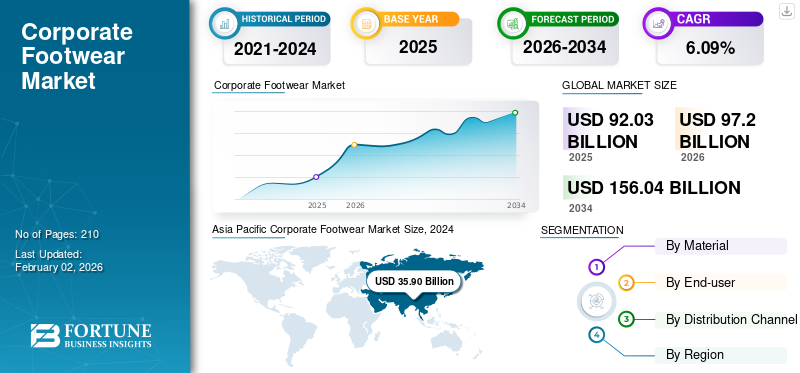
Download Free sample to learn more about this report.
CORPORATE FOOTWEAR MARKET KEY TAKEAWAYS
 Global Market Size & Forecast
- 2025 Market Size: USD 92.03 billion
- 2026 Market Size: USD 97.20 billion
- 2034 Forecast Market Size: USD 156.04 billion
- CAGR: 6.09% from 2026–2034
 Market Share
- Asia Pacific dominated the market with a 41.16% share in 2024.
- The Non-leather segment is expected to hold the largest market share in 2026.
- The Men segment is expected to dominate the market in 2026.
 Key Regional Highlights
Asia Pacific
The dominant region, driven by rising urbanization, increasing disposable incomes, and growing demand for premium and branded corporate footwear.
North America
The market is expected to witness the fastest growth, supported by high disposable incomes, strong demand for premium footwear, and expanding e-commerce.
Europe
The market is projected to grow steadily, driven by increasing demand for sustainable footwear, hybrid work culture, and strong fashion trends.
U.S.
The market is supported by strong consumer preference for innovative, comfortable, and sustainable corporate footwear, along with a well-developed retail network.
Japan
The market is projected to witness steady growth by 2026, driven by increasing demand for premium footwear, strong retail infrastructure, and evolving workplace fashion trends.
Read More

Market Dynamics
Market Drivers
Technological Advancements in Footwear Manufacturing to Drive Market Growth
Technological advancements in footwear manufacturing increase the demand for the product. AI-driven automation in shoe-making machines increases precision, reduces material waste, and streamlines production. Furthermore, real-time data monitoring and IoT integration allow manufacturers to address issues promptly, optimize inventory, and support the production of new footwear types, such as athletic shoes and flip-flops that could be worn in corporate spaces. These factors are expected to drive the global corporate footwear market share. For instance, in January 2023, Ajanta Shoes launched its first smart shoe category, ‘NAVIGATOR’, equipped with AI, which is powered by gyroscopic technology.
Market Restraints
Variations in Costs of Raw Materials to Restrict Market Growth
Fluctuations in the availability and price of raw materials directly affect the production costs of corporate shoes. Moreover, as material prices rise, manufacturers mainly pass these costs onto buyers, making corporate footwear less affordable to consumers. Furthermore, the global and regional nature of raw material sourcing introduces complexities, such as shipping delays, customs issues, and compliance with international trade laws. These factors restrict the market growth.
Market Opportunities
Fueling Online Retailing Platforms within the Fashion World to Drive Market Growth
E-retailing platforms allow corporate shoe brands to reach a global audience, including businesses and professionals in diverse regions. Additionally, online shopping provides unmatched convenience for corporate buyers who can browse and order footwear at any time. Moreover, e-retailers offer advanced search and filtering options, making it simpler for buyers to find the right footwear for their office needs. This expanded access leads to higher sales volumes and increased penetration in the market. For instance, in March 2025, Shoezone, a footwear retail company, launched a new online app to expand its omnichannel network across different regions.
Corporate Footwear Market Trends
Growing Demand for Sustainable Footwear to Boost Market Expansion
Many corporations are prioritizing sustainability in their procurement policies and corporate social responsibility initiatives. Therefore, brands can align with these goals by offering footwear made from recycled and bio-based products. Additionally, the demand for sustainable footwear is spurring innovation in materials and manufacturing processes, such as recycled plastics, organic cotton, and others. This allows brands to differentiate their corporate shoe offerings and cater to niche markets, augmenting corporate footwear market growth. For instance, in April 2025, RedTape launched its Corporate Social Responsibility (CSR) initiative, focused on addressing the social and environmental requirements of the company. The company aimed to minimize its carbon footprint by adopting sustainable practices.
Segmentation Analysis
By Material
Increasing Demand for Affordable Footwear to Boost Non-leather Segment Growth
Based on material, the market is divided into leather and non-leather.
The non-leather segment holds the major share of the market. Non-leather footwear, made from recycled plastics, organic cotton, and faux leather, attracts eco-friendly consumers. Additionally, these products are often more affordable and easier to mass-produce, making them accessible to a wide consumer base, further fostering segment growth.
The leather segment is growing at a fastest CAGR in the market. Leather footwear is widely regarded as a premium product, offering durability, which is highly valued in corporate and formal settings. These factors make footwear made from leather suitable for long hours in a professional environment, boosting segment growth.
By End-user
Popularity of Formal Attire among Men to Boost Men’s Segment Growth
Under the end-user, the market is bifurcated into men and women.
The men's segment holds the foremost share of the market. Corporate environments have traditionally mandated formal attire for men, including leather footwear. This requirement has made men’s formal shoes a part of their daily outfits in office spaces. These factors are expected to drive the growth of the men's segment.
The women's segment is growing at a fastest CAGR in the market. Recently, women have been seeking footwear that offers both comfort and professional style, leading to innovations in material and style. Furthermore, as women’s economic power grows, the demand for corporate footwear is also rising among women.
By Distribution Channel
Increasing Demand for Convenient Shopping Experience Fosters Supermarket/Hypermarket Segment Growth
In terms of distribution channels, the market is segmented into supermarket/hypermarket, specialty store, online, and others.
The supermarket/hypermarket segment seized a dominant share of the market. These markets provide consumers with convenient access to a wide range of footwear brands in a single store. This makes it easy for shoppers to compare and purchase products during routine visits, further fostering segment growth.
The online segment is growing at a fastest CAGR in the market. Online shopping allows consumers to browse and compare products before buying the footwear. In addition, brands leverage social media channels to engage directly with consumers and thus, drive sales through online channels.
Corporate Footwear Market Regional Outlook
The market is segmented based on region: Europe, North America, Asia Pacific, South America, and Middle East and Africa.
North America
Asia Pacific Corporate Footwear Market Size, 2024 (USD Billion)
To get more information on the regional analysis of this market, Download Free sample
North America is expected to be the fastest-growing region in the market. The region has a mature market with higher disposable incomes, supporting strong demand for premium and branded corporate footwear. Additionally, the prevalence of formal and business-casual dress codes in many North American workplaces sustains steady demand for corporate footwear, boosting the region’s growth.
In the U.S., consumers exhibit strong brand loyalty and preference for innovative, comfortable, and sustainable footwear products. Moreover, well-developed retail infrastructure and robust e-commerce growth ensure broad footwear availability and convenience among American consumers, contributing to the country’s growth.
Download Free sample to learn more about this report.
Europe
Europe is the second-fastest growing region in the market. The region is experiencing a shift toward more relaxed and hybrid work environments, increasing the demand for corporate footwear. Additionally, European consumers are increasingly prioritizing sustainably produced footwear, influencing corporate shoe choices and driving the market growth. Furthermore, Europe’s strong fashion culture also supports the demand for stylish and innovative corporate shoes within the region.
Asia Pacific
Asia Pacific dominated the market in 2024. The region has witnessed a significant increase in urban populations and disposable incomes, particularly in countries such as India, China, and Singapore. This led to heightened consumer preferences for both premium and branded corporate footwear. Growing middle-class population in the region is also driving the demand for high-quality and fashionable footwear, boosting the regional market growth.
South America and Middle East & Africa
South America and the Middle East & Africa are expected to pose a considerable share of the market. The adoption of Western fashion trends and celebrity-driven marketing is boosting demand for trendy and premium footwear products. Moreover, the geographical expansion of global corporate firms is also influencing consumers in those regions to invest in formal shoes, propelling the region’s growth.
Competitive Landscape
Key Market Players
Increased Investment in New Product and Material Innovation by Key Players to Bolster their Market Positions
In recent times, consumers increasingly expect shoes that offer superior comfort and contemporary style. Therefore, spurring investment by key players in product innovations such as 3D printing and AI-powered design allows companies to deliver tailored products, enhancing customer satisfaction. Moreover, there is a strong preference among consumers for eco-friendly footwear. Therefore, key players are responding by developing shoes from recycled or biodegradable materials to expand their product offerings, thus boosting the growth of the corporate footwear market.
List of Key Corporate Footwear Companies Profiled
- Peter England (India)
- BlackBerry (Canada)
- Red Tape (India)
- Skechers USA (U.S.)
- Ralph Lauren Corporation (U.S.)
- LVMH (France)
- Aditya Birla Fashion (India)
- Allen Edmonds LLC (U.S.)
- Johnston & Murphy (U.S.)
- Kiwi Enterprises (India)
Key Industry Developments
- May 2025: VKC Group announced the launch of its new sustainable footwear range, Go Planet-D, during an event in Malaysia.
- April 2024: RedTape announced a strategic partnership with Easyecom in order to manage their inventory, orders, and warehouse activities.
- September 2023: Gloryfootwear Company launched a new line of safety footwear, the ‘Zstep series’, which is suitable for professionals across various industries.
- September 2023: Campus Activewear launched a new range of technologically advanced footwear, ‘Air Turbo’, in the Indian footwear industry.
- December 2020: Red Chief Footwears launched its new range of formal footwear ‘RC-3042’, which is available in various retail channels.
REPORT COVERAGE
The market research report provides a comprehensive analysis, focusing on key elements such as major companies, regional and market segments, competitive dynamics, product type, categories, end-user, and distribution channel. Additionally, it offers insights into market dynamics and highlights significant developments within the industry. Beyond these aspects, it also examines various factors contributing to market growth in recent years.
Request for Customization to gain extensive market insights.
Report Scope & Segmentation
|
ATTRIBUTE |
DETAILS |
|
Study Period |
2021-2034 |
|
Base Year |
2025 |
|
Estimated Year |
2026 |
|
Forecast Period |
2026-2034 |
|
Historical Period |
2021-2024 |
|
Growth Rate |
CAGR of 6.09% from 2026 to 2034 |
|
Unit |
Value (USD Billion) |
|
Segmentation |
By Material
By End-user
By Distribution Channel
By Region
|
Frequently Asked Questions
Fortune Business Insights says that the global market size is worth USD 97.2 billion in 2026 and is anticipated to record a valuation of USD 156.04 billion by 2034.
Fortune Business Insights says that the global market value stood at USD 92.03 billion in 2025.
The global market will exhibit a CAGR of 6.09% during the forecast period.
By material, the non-leather segment is dominating the market.
Technological advancements in footwear manufacturing are a key factor driving the global market growth.
Peter England, BlackBerry, and Red Tape are some of the leading players globally.
Asia Pacific dominated the global market in 2024.



- 2021-2034
- 2025
- 2021-2024
- 210
-
(Offer valid till 31st Aug 2026)
Get 30-60 hrs Free Customization
Expand Regional and Country Coverage, Segments Analysis, Company Profiles, Competitive Benchmarking, and End-user Insights.



















Related Reports
-
US +1 833 909 2966 ( Toll Free )
-
Get In Touch With Us