Cryoablation Devices Market Size, Share & Industry Analysis, By Product (Tissue Contact Probe Ablators, Tissue Spray Probe Ablators), By Application, By End-use, By Region, and Regional Forecast, 2026-2034
 Download Free Sample
Cryoablation Devices Market Overview
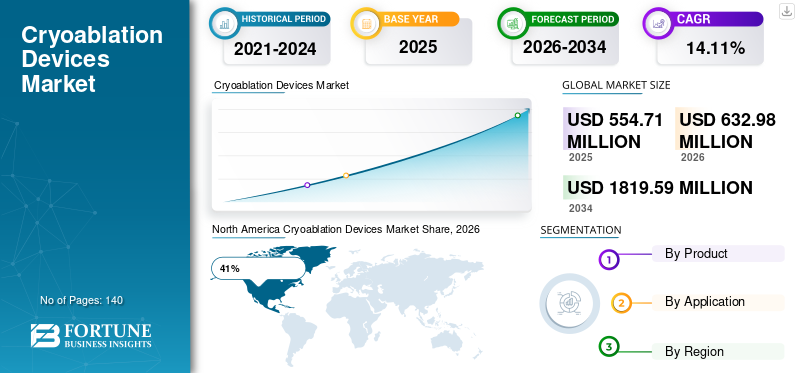
The cryoablation devices market size was valued at USD 554.71 million in 2025. The market is projected to grow from USD 632.98 million in 2026 to USD 1819.59 million by 2034, exhibiting a CAGR of 14.11% during the forecast period.

The cryoablation devices market is witnessing substantial expansion due to the increasing adoption of minimally invasive treatment technologies across oncology, cardiology, dermatology, and pain management applications. Cryoablation devices utilize extreme cold to destroy abnormal tissues while preserving surrounding healthy structures, making them an attractive alternative to conventional surgical interventions. The growing preference for outpatient procedures, reduced hospitalization periods, and lower post-operative complications continues to support market penetration across developed and emerging healthcare systems. The cryoablation devices market report indicates that technological innovations in probe design, imaging integration, and temperature monitoring systems are improving procedural precision and treatment outcomes. Increasing awareness among physicians and patients regarding minimally invasive therapies further strengthens market demand.
The United States represents the largest national market for cryoablation devices owing to advanced healthcare infrastructure, widespread adoption of image-guided interventions, and a high volume of oncology and cardiac procedures. Hospitals and specialty centers increasingly deploy cryoablation systems for prostate cancer, renal cancer, liver tumors, atrial fibrillation, and chronic pain management. Regulatory approvals for novel cryotherapy platforms and continued investments in electrophysiology programs support market expansion. The cryoablation devices industry analysis highlights strong clinical acceptance of cryoballoon and cryocatheter technologies for cardiac rhythm disorders. Additionally, favorable reimbursement frameworks and increasing physician training programs continue to enhance utilization across major healthcare facilities in the country.
Download Free sample to learn more about this report.
Cryoablation Devices Market Key Takeaways
 Global Market Size & Forecast
- 2025 Market Size: USD 554.71 Million
- 2026 Market Size: USD 632.98 Million
- 2034 Forecast Market Size: USD 1,819.59 Million
- CAGR: 14.11% from 2026-2034
 Market Share
- The market in North America dominated with a revenue share of 41% in 2025.
- Tissue Contact Probe Ablators dominated by product with a market share of approximately 68%.
- Oncology dominated by application with a market share of approximately 61%.
 Key Regional Highlights
North America
North America led the market with a 41% share, supported by advanced healthcare infrastructure and growing adoption of minimally invasive cryoablation procedures.
Europe
Europe accounted for 29% of the market, driven by established healthcare systems and increasing adoption of image-guided therapeutic technologies.
Asia-Pacific
Asia-Pacific held a 22% share, supported by expanding healthcare infrastructure and rising demand for minimally invasive cancer treatments.
U.S
The U.S. remains a key market, supported by advanced cancer treatment facilities and strong adoption of cryoablation technologies.
Japan
Japan accounted for approximately 27% of the Asia-Pacific market, supported by advanced healthcare infrastructure and growing adoption of minimally invasive treatment technologies.
Read More

Cryoablation Devices Market Latest Trends
The cryoablation devices market trends reveal growing demand for image-guided cryoablation procedures integrated with MRI, CT, and ultrasound technologies. Healthcare providers are increasingly adopting advanced visualization platforms that allow precise probe placement and real-time monitoring of the ablation zone. Such innovations improve procedural accuracy while minimizing damage to adjacent tissues. Manufacturers are focusing on developing next-generation cryoprobes with enhanced freezing efficiency, reduced procedure times, and greater flexibility for complex anatomical locations.
Download Free sample to learn more about this report.
Another significant trend in the cryoablation devices market analysis is the expanding use of cryoablation beyond traditional oncology applications. Cardiology remains a major growth area, particularly in atrial fibrillation treatment through cryoballoon technology. Furthermore, cryoablation is gaining traction in pain management, dermatology, and musculoskeletal disorders. Strategic collaborations between medical device manufacturers and healthcare institutions are accelerating product development and clinical adoption. Artificial intelligence-enabled treatment planning and robotic-assisted navigation systems are also emerging as influential technologies that may reshape the competitive landscape over the coming years.
Cryoablation Devices Market Dynamics
DRIVER
Rising Demand for Minimally Invasive Cancer and Cardiac Treatments
The primary growth driver in the cryoablation devices market is the increasing demand for minimally invasive therapeutic procedures. Rising incidences of cancer and cardiovascular disorders worldwide are creating substantial demand for effective treatment alternatives that reduce patient trauma and recovery time. Cryoablation offers several advantages, including precise tissue destruction, minimal blood loss, shorter hospital stays, and improved patient comfort.
Healthcare providers are increasingly incorporating cryoablation into treatment protocols for prostate cancer, renal tumors, liver lesions, lung nodules, and cardiac arrhythmias. Growing elderly populations further contribute to market expansion, as older patients often require less invasive treatment options due to higher surgical risks. Continuous improvements in cryogenic technology, catheter design, and procedural guidance systems are enhancing treatment effectiveness and expanding clinical indications. The cryoablation devices market research report identifies rising physician confidence and increasing patient preference for minimally invasive interventions as key factors supporting long-term industry growth.
RESTRAINT
High Equipment Costs and Specialized Infrastructure Requirements
Despite significant growth potential, the cryoablation devices market faces restraints related to high acquisition and operational costs. Advanced cryoablation systems require substantial capital investment, making adoption challenging for smaller hospitals and healthcare facilities in developing economies. Additional expenses associated with maintenance, cryogenic gas supply, imaging systems, and staff training further increase overall procedural costs.
Many healthcare institutions continue to evaluate the economic viability of cryoablation compared with alternative treatment modalities such as radiofrequency ablation and microwave ablation. Limited reimbursement in certain regions also affects market penetration. Furthermore, complex procedures often require multidisciplinary teams and sophisticated imaging infrastructure, restricting widespread implementation in resource-constrained environments. The need for specialized expertise and comprehensive physician training remains a significant barrier to rapid adoption, particularly in emerging markets where access to advanced medical technologies remains uneven.
OPPORTUNITY
Expansion into Emerging Healthcare Markets and New Clinical Applications
A major opportunity in the cryoablation devices market outlook lies in expanding healthcare infrastructure across Asia-Pacific, Latin America, and the Middle East. Governments and private healthcare providers are increasing investments in advanced medical technologies to address growing chronic disease burdens. This trend creates favorable conditions for cryoablation adoption.
Manufacturers are also exploring new clinical applications beyond oncology and cardiology. Pain management, neurology, orthopedic disorders, and pulmonary interventions represent promising growth areas. Increasing clinical evidence supporting cryoablation efficacy encourages broader physician acceptance. The integration of advanced imaging, artificial intelligence, and robotic guidance systems further enhances treatment precision and expands procedural possibilities. Strategic partnerships, product localization, and physician education initiatives are expected to accelerate market penetration in underserved regions. The cryoablation devices market opportunities remain substantial as healthcare systems prioritize minimally invasive treatment solutions with improved patient outcomes.
CHALLENGE
Competition from Alternative Ablation Technologies
The cryoablation devices industry faces significant challenges from competing technologies such as radiofrequency ablation, microwave ablation, laser ablation, and high-intensity focused ultrasound. These alternatives are widely established in many healthcare facilities and often benefit from extensive clinical experience among physicians.
Healthcare providers frequently compare procedural outcomes, treatment costs, and long-term efficacy before selecting a preferred technology. In certain applications, competing modalities may offer advantages related to procedure duration, equipment availability, or operational expenses. Regulatory approval processes and clinical validation requirements can also delay market entry for innovative cryoablation products. Manufacturers must continuously invest in research and development to demonstrate superior clinical performance and economic value. Maintaining differentiation through technological innovation, improved treatment precision, and expanded indications remains critical for sustaining competitive advantage within the global cryoablation devices market.
Cryoablation Devices Market Segmentation
By Product
Tissue Contact Probe Ablators represent the dominant segment within the cryoablation devices market, accounting for approximately 68% of global demand. These devices enable direct tissue contact, allowing precise delivery of cryogenic energy to targeted lesions. Their widespread adoption in oncology procedures such as prostate, kidney, liver, and lung tumor treatment significantly contributes to segment leadership.
Healthcare providers favor tissue contact probe systems due to their high procedural accuracy and ability to create predictable ablation zones. Technological advancements have improved probe flexibility, thermal control, and imaging compatibility, enhancing physician confidence during complex interventions. The segment also benefits from increasing use in cardiac applications and pain management procedures. As hospitals continue to prioritize minimally invasive treatments, tissue contact probe ablators are expected to maintain strong market presence throughout the forecast period.
Tissue Spray Probe Ablators account for an estimated 32% share of the cryoablation devices market. These systems utilize controlled cryogenic sprays to treat larger or irregular tissue surfaces, making them particularly valuable in dermatology, superficial lesions, and selected gastrointestinal procedures.
Growing adoption of spray-based cryotherapy techniques is driven by their ability to provide uniform treatment across broad tissue areas. Physicians increasingly utilize these devices for precancerous lesions, skin disorders, and targeted mucosal applications. Manufacturers are introducing improved spray delivery mechanisms that enhance temperature consistency and procedural safety. The segment continues to benefit from growing awareness regarding non-surgical treatment alternatives and increasing demand for outpatient procedures. As clinical applications expand, tissue spray probe ablators are expected to strengthen their position within the cryoablation devices market Forecast.
To know how our report can help streamline your business, Speak to Analyst
By Application
Oncology remains the largest application segment, representing approximately 61% of the cryoablation devices market share. The technology is extensively used in prostate cancer, renal cancer, liver tumors, lung lesions, and breast cancer management. Cryoablation offers a minimally invasive alternative for patients who may not be suitable candidates for conventional surgery.
Rising global cancer incidence and increasing physician acceptance of image-guided interventions support continued demand. The ability to preserve surrounding healthy tissue while achieving effective tumor destruction enhances clinical outcomes and patient satisfaction. Hospitals and cancer treatment centers continue to invest in advanced cryotherapy systems to expand treatment capabilities. The cryoablation devices market research report identifies oncology as the primary revenue-generating application due to strong clinical evidence and expanding procedural volumes.
By End-Use
Cardiology and other end-use applications collectively account for approximately 39% of the market. Cardiac cryoablation is widely utilized in the treatment of atrial fibrillation and other arrhythmias, particularly through cryoballoon catheter technologies. Growing prevalence of cardiac rhythm disorders and increasing demand for catheter-based interventions continue to drive segment growth.
Additional applications include pain management, dermatology, pulmonary medicine, and orthopedic treatments. Healthcare providers increasingly recognize the benefits of cryotherapy in reducing procedural trauma and improving recovery times. Advancements in catheter design and cryogenic delivery systems further support adoption across multiple specialties. The segment is expected to witness continued expansion as clinical research validates broader therapeutic applications for cryoablation technology.
Cryoablation Devices Market Regional Outlook
North America Cryoablation Devices Market Share, 2026 (%)
To get more information on the regional analysis of this market, Download Free sample
North America
North America remains the leading regional market with approximately 41% share. Strong adoption of minimally invasive procedures, advanced healthcare infrastructure, and significant investments in medical technology contribute to regional dominance. The United States accounts for the majority of regional demand due to high procedure volumes and broad physician acceptance of cryoablation technologies.
The region benefits from the presence of major manufacturers, established reimbursement systems, and ongoing clinical research programs. Hospitals and specialty clinics continue to expand electrophysiology and oncology services incorporating cryoablation solutions. Regulatory support and rapid commercialization of innovative products further strengthen market growth prospects across North America.
Europe
Europe accounts for approximately 29% of the global cryoablation devices market. The region benefits from widespread access to advanced healthcare services, strong clinical adoption of minimally invasive therapies, and increasing investments in oncology and cardiology infrastructure.
Countries across Western Europe continue to implement advanced treatment protocols that incorporate cryoablation for cancer and cardiac disorders. Academic research institutions actively participate in clinical trials evaluating new cryotherapy technologies. Growing awareness among healthcare professionals and favorable reimbursement policies support sustained market expansion. Continuous technological innovation and increasing demand for precision medicine are expected to strengthen Europe's position in the global market.
Germany cryoablation devices market
Germany represents approximately 24% of the European cryoablation devices market. The country possesses one of the region's most advanced healthcare systems, supported by extensive hospital networks and strong medical technology adoption. German healthcare providers increasingly utilize cryoablation for oncology, cardiology, and interventional radiology procedures.
The presence of specialized treatment centers and research institutions contributes to growing procedural volumes. Physicians demonstrate strong acceptance of minimally invasive treatment modalities, particularly for prostate cancer and cardiac arrhythmia management. Investments in medical innovation, coupled with robust healthcare expenditure, continue to drive demand. Ongoing clinical studies and collaboration between manufacturers and healthcare institutions further support market development within Germany.
United Kingdom cryoablation devices market
The United Kingdom accounts for approximately 18% of the European market. Adoption is driven by increasing focus on minimally invasive therapies within both public and private healthcare settings. Hospitals continue to expand access to advanced oncology and electrophysiology procedures utilizing cryoablation technologies.
Growing awareness regarding patient benefits, including reduced recovery times and lower complication rates, supports market expansion. The country's strong academic research environment facilitates clinical evaluation of emerging cryotherapy platforms. Increased investment in diagnostic imaging and interventional treatment infrastructure further strengthens demand for cryoablation devices across the United Kingdom.
Asia-Pacific
Asia-Pacific holds approximately 22% of the global cryoablation devices market and represents one of the fastest-developing regions. Rising healthcare expenditures, expanding hospital infrastructure, and increasing prevalence of chronic diseases contribute significantly to market growth.
Governments across the region are prioritizing access to advanced medical technologies while healthcare providers seek innovative treatment options. Growing awareness regarding minimally invasive procedures and improving physician training programs are accelerating adoption. Local manufacturing capabilities and strategic partnerships with international device companies further support market expansion throughout Asia-Pacific.
Japan cryoablation devices market
Japan accounts for approximately 27% of the Asia-Pacific market. The country's aging population and high incidence of chronic diseases create strong demand for minimally invasive treatment technologies. Healthcare institutions continue to invest in advanced oncology and cardiology capabilities, supporting cryoablation adoption.
Japanese physicians emphasize precision medicine and evidence-based treatment approaches, encouraging the use of sophisticated cryotherapy systems. Strong regulatory standards and ongoing technological innovation contribute to market development. Research collaborations between healthcare providers and device manufacturers continue to advance clinical applications and procedural effectiveness.
China cryoablation devices market
China represents approximately 34% of the Asia-Pacific market. Rapid healthcare modernization, expanding hospital networks, and increasing access to advanced medical technologies are driving demand. The country faces a growing burden of cancer and cardiovascular diseases, creating significant opportunities for cryoablation adoption.
Government initiatives aimed at improving healthcare quality and expanding specialty care services support market growth. Domestic and international manufacturers are actively investing in the Chinese market through partnerships, distribution agreements, and product launches. Increasing physician training and patient awareness continue to enhance acceptance of cryotherapy procedures.
Rest of World
The Rest of World region, including Latin America, the Middle East, and Africa, accounts for approximately 8% of the global market. Although adoption levels remain lower than those observed in developed regions, healthcare modernization initiatives are creating favorable growth opportunities.
Investments in specialty hospitals, cancer treatment centers, and cardiac care facilities are supporting market development. Governments and private healthcare organizations increasingly recognize the value of minimally invasive treatment technologies. Expanding physician education programs and improving access to advanced medical devices are expected to strengthen regional demand over the coming years.
List of Top Cryoablation Devices Companies
- Boston Scientific Corporation
- Micro Port Scientific Corporation
- Medtronic
- COOPERSURGICAL, INC.
- ATRICURE, INC.
- BVM Medical Limited
- CPSI Biotech
- Ice Cure Medical
- METRUM CRYOFLEX Sp. z o.
Top Two Companies by Estimated market share
- Medtronic – 24%
- Boston Scientific Corporation – 18%
Investment Analysis and Opportunities
Investment activity within the cryoablation devices market continues to increase as healthcare providers prioritize minimally invasive treatment technologies. Venture capital firms, private equity investors, and strategic healthcare investors are actively supporting companies developing next-generation cryoablation platforms. Significant investment is directed toward improving procedural precision, expanding clinical indications, and integrating advanced imaging capabilities.
Emerging markets present substantial investment opportunities due to expanding healthcare infrastructure and increasing disease prevalence. Companies focusing on localized manufacturing, physician training, and distribution network expansion are well positioned to capitalize on future demand. Strategic partnerships between device manufacturers and healthcare institutions are accelerating product commercialization and market penetration. The cryoablation devices market opportunities remain attractive for investors seeking exposure to innovative medical technologies with expanding clinical relevance.
New Product Development
Product innovation remains a central focus across the cryoablation devices industry. Manufacturers are introducing advanced cryoprobes with improved thermal efficiency, enhanced flexibility, and greater compatibility with imaging systems. Recent developments emphasize reduced procedure times, improved tissue targeting, and enhanced safety profiles.
New cryoballoon and cryocatheter technologies are expanding treatment options for cardiac arrhythmias. Companies are also integrating artificial intelligence and real-time monitoring capabilities into procedural workflows to improve treatment planning and outcome predictability. The introduction of larger-tip cryoprobes and enhanced cryogenic delivery systems reflects ongoing efforts to optimize procedural effectiveness. These innovations are expected to strengthen competitive positioning while expanding the range of treatable clinical conditions.
Five Recent Developments (2023–2025)
- AtriCure launched the cryoSPHERE MAX cryoablation probe featuring faster freezing performance in 2024.
- Medtronic expanded commercialization of advanced cryoablation catheter technologies for cardiac applications.
- Boston Scientific continued advancement of next-generation cryoablation catheter platforms with improved tissue contact design.
- Manufacturers increased integration of imaging-guided navigation systems into cryotherapy workflows.
- Multiple healthcare institutions expanded cryoablation programs for oncology and electrophysiology treatment services.
Report Coverage
The cryoablation devices market report provides comprehensive evaluation of industry structure, competitive landscape, technological developments, product innovation, and regional demand patterns. The study covers key product categories, major applications, end-user trends, and geographic performance across developed and emerging markets.
Request for Customization to gain extensive market insights.
The report examines market drivers, restraints, opportunities, and challenges influencing industry expansion. Competitive analysis includes major manufacturers, strategic initiatives, product launches, and innovation trends shaping market dynamics. Regional assessments evaluate healthcare infrastructure, regulatory environments, and adoption patterns influencing demand. The report further explores investment trends, technological advancements, and emerging applications expected to impact future market development. The cryoablation devices market research report serves as a valuable resource for manufacturers, healthcare providers, investors, distributors, and strategic decision-makers seeking actionable industry insights.
Frequently Asked Questions
Fortune Business Insights says that the global market value stood at USD 554.71 million in 2025 and is projected to reach USD 1,819.59 million by 2034.
The market is expected to exhibit a CAGR of 14.11% during the forecast period of 2026-2034.
Tissue Contact Probe Ablators led the product segment with approximately 68% of the market, supported by their precise delivery of cryogenic energy and widespread use in oncology procedures.
Key players include Medtronic, Boston Scientific Corporation, MicroPort Scientific Corporation, AtriCure, Inc., IceCure Medical, and CooperSurgical, Inc.
Major trends include increasing adoption of image-guided cryoablation with MRI, CT, and ultrasound and expansion into cardiology, pain management, and dermatology. North America dominated with a 41% market share.



- 2021-2034
- 2025
- 2021-2024
- 140
-

(Offer valid till 30th Sep 2026)
Get 30-60 hrs Free Customization
Expand Regional and Country Coverage, Segments Analysis, Company Profiles, Competitive Benchmarking, and End-user Insights.













.webp)






-
US +1 833 909 2966 ( Toll Free )
-
Get In Touch With Us