Dark Soy Sauce Market Size, Share & Industry Analysis, By Process (Brewed and Blended), By End-Use (Processed Foods, Prepared Foods, and Households), By Distribution Channel (Supermarkets, Hypermarkets, Convenience Stores, Online Retail, HoReCa, and QSR), and Regional Forecast, 2026-2034
 Download Free Sample
(Offer valid till 31st Oct 2026)

Dark Soy Sauce Market Size & Overview
 Listen to Audio Version
The global dark soy sauce market size was valued at USD 12.29 billion in 2025 and is projected to grow from USD 12.91 billion in 2026 to USD 21.17
billion by 2034, exhibiting a CAGR of 6.38% during the forecast period. Asia Pacific dominated the dark soy sauce market with a market share of 28.85% in 2025.
Some key players in the industry include Lee Kum Kee, Foshan Haitian Flavoring & Food Co., and YAMASA Corporation, among others.
Dark soy sauce, also called black sauce, is a darker, thicker type of sauce extracted from soybeans. This sauce is primarily used in Chinese cuisine and is mainly added at the end of cooking to improve flavor and color. Similarly, light sauce, dark sauce comprise wheat, salt, and numerous other ingredients, but they undergo a longer fermentation process. Compared to other sauces, this black sauce is sweeter, has a hint of malt flavor, and is less salty. Globally, this sauce is famous in Asian countries, specifically China, Japan, and South Korea, among others.
The surging popularity of traditional Chinese cuisines and increasing home cooking trend bolsters the global market growth.
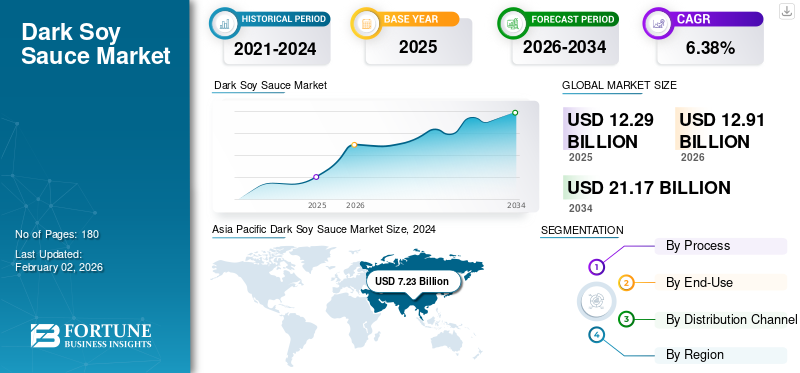
Download Free sample to learn more about this report.
Dark Soy Sauce Market Key Takeaways
 Global Market Size & Forecast
- 2025 Market Size: USD 12.29 billion
- 2026 Market Size: USD 12.91 billion
- 2034 Forecast Market Size: USD 21.17 billion
- CAGR: 6.38% from 2026–2034
 Market Share
- Asia Pacific dominated the dark soy sauce market with a 28.85% share in 2025.
- The Brewed segment held the largest market share.
- The Prepared Foods segment accounted for the largest market share.
 Key Regional Highlights
Asia Pacific
Asia Pacific reached USD 7.23 billion in 2025, accounting for 28.85% of the global market.
North America
North America recorded USD 2.55 billion in 2025 and is the fastest-growing regional market.
Europe
Europe generated USD 1.70 billion in 2025.
U.S
The market is expected to witness strong growth, driven by rising demand for Asian cuisine.
Japan
Demand is supported by the country's strong consumption of traditional soy sauce products.
Read More

MARKET DYNAMICS
Market Drivers
Rising Inclination toward Asian Cuisines Strengthens the Use of Sauce
The growing inclination toward Asian dishes is a pivotal driver in improving sauce usage. As most individuals experiment with Asian dishes, the need for sauce, especially soybean-sourced, a main ingredient, also soars. This trend is highly evident in Asian countries such as China, Vietnam, and Indonesia, where it is recognized as a staple ingredient. Along with this, its popularity is rising in North America and European regions as the majority of consumers are seeking Asian dishes offering diversified flavors. Predominantly, the umami flavor and versatility of the sauce are the key reasons behind the market expansion. Thus, this increasing demand for Asian dishes enables growth opportunities for the sauce market.
Market Restraints
Variations in Raw Material Prices and Intense Competition Affect Market Growth
One of the crucial obstacles sauce producers face is the surging fluctuations in raw material prices. Factors such as trade restrictions, supply chain disruptions, and variations in climatic conditions are the key components responsible for increased costs, ultimately affecting manufacturing costs. Moreover, natural disasters and geopolitical events can hamper the supply chain for numerous raw ingredients, leading to high prices of finished products. As a result, such factors impede the global market share.
Robust market competition is another hurdle that inhibits the dark soy sauce market growth. The sauce market faces stiff competition from both emerging and established players. This situation requires producers to differentiate their finished items and satisfy diverse consumer requirements.
Market Opportunities
Technological Advancements in Production of Sauces Unlock Growth Possibilities
Technological advancements in the soy sauce production process are known to provide lucrative growth opportunities. One main technology used for sauce is low-salt fermentation and high-temperature fermentation. This technique utilizes starter culture at a higher fermentation temperature (40-55°C), which boosts production and minimizes cost. Moreover, genetic engineering is becoming popular, and techniques such as mutagenesis and genome shuffling are being explored to optimize microbial strains for sauces. Additionally, bioreactor technology and the use of large-scale fermentation tanks can be used to produce high-quality products.
Dark Soy Sauce Market Trends
Surging Demand for Gluten-Free Sauces is the Current Trend
The global sauce market is witnessing a robust trend toward gluten-free sauces. These sauces are gaining huge traction in household and foodservice sectors as health-centric individuals seek allergen-free alternatives. Also, compared to conventional sauces, gluten-free sauce provides numerous health advantages and suits consumers following a healthy lifestyle. Similarly, traditional, gluten-free soy sauce has a refined flavor and can be purchased from retailers. Thus, this trend opens chances for food innovation, with producers launching a wide range of gluten-free variants.
SEGMENTATION ANALYSIS
By Process
Brewed Segment Led the Market Owing to its Health Advantages
On the basis of process, the market is bifurcated into brewed and blended.
Out of all, the brewed sector dominated the market and generated the largest share. Brewed soy sauce, also referred to as naturally brewed sauce, provide a unique and complex flavor profile owing to the long fermentation process. Moreover, this sauce offers numerous health advantages, such as boosting the immune system and enhancing digestive health.
Blended emerged as the fastest-growing segment and is anticipated to soar at a higher pace in the future. This sauce is economical in nature and can be produced at a faster pace, which adds value to the growth.
By End-Use
Prepared Foods Dominate the Market Owing to Increased Dining-Out Culture
Depending on end-use, the market is distributed into processed foods, prepared foods, and households.
Amongst all, the prepared foods sector leads in the global market, and is backed by convenience. Prepared food is a fully or partially prepared meal that requires minimal preparation before consumption. To enhance the flavor of culinary preparation, soy sauce can be used in stir-fried dishes, sushi, and barbecued meats.
The household sector is predicted to hold the highest CAGR during the forecast period. The trend of consuming home-cooked meals and the increasing availability of sauces via retailers will likely facilitate the industry’s growth.
By Distribution Channel
HoReCa Segment Leads Due to Increasing Popularity of Asian Cuisine
Based on distribution channel, the market is segmented into supermarkets, hypermarkets, convenience stores, online retail, HoReCa, and QSR.
The HoReCa category led the market and is projected to soar at the same pace in the near term. In this sector, this sauce is used as a dip, marinade, or as an ingredient in dressings and sauces. Restaurants can easily purchase this sauce in bulk quantities, which can be affordable compared to others. Moreover, the augmented demand for Asian cuisine and the growing socializing culture leads to rising utilization of sauce from culinary establishments.
The online retail channel is the fastest-growing segment and is expected to bolster at a higher pace in the future. The vast availability of sauces through local/international brands and easy return/exchange options collectively propels the segment’s growth.
Dark Soy Sauce Market Regional Outlook
Based on regions, the market is segmented into North America, Europe, Asia Pacific, South America, and the Middle East & Africa.
Asia Pacific
Asia Pacific Dark Soy Sauce Market Size, 2024 (USD Billion)
To get more information on the regional analysis of this market, Download Free sample
Asia Pacific led the global market and held a notable dark soy sauce market share in 2024. This region is considered a pivotal market for dark sauce and is driven by cultural significance and expansion of the foodservice industry. The majority of Asian individuals rely on Asian dishes such as noodles, ramen, and sushi, which use soy sauce in larger amounts. Moreover, the growing health consciousness influences food producers to introduce new sauce variants such as low-salt and gluten-free. Additionally, the increasing retailers of sauces and surging demand for premium sauces further bolster the regional growth. The Asia Pacific market accounted for USD 7.23 billion in 2025, representing 28.85% of the global industry, and is expected to reach USD 7.6 billion in 2026.
Amongst all Asian countries, China secured the foremost position, owing to surging demand for packaged ingredients and established production infrastructure.
Download Free sample to learn more about this report.
North America
North America is the fastest-growing region in the global market. In this region, the expanding presence of Chinese and Japanese food chains or restaurants supports the demand for sauces for takeaway and on-site use. Moreover, there is an augmented demand for easy-to-use packaged sauces that can be easily carried and used in several food items. Furthermore, the rising incidences of cardiovascular diseases and high blood pressure increase the need for sodium-free condiments. As a result, such factors improve the North American market expansion.North America maintained a strong presence in the global market, reaching USD 2.55 billion in 2025, accounting for 33.93% share, and is expected to reach USD 2.69 billion in 2026.
The U.S. dominated the global market and is expected to soar faster in the coming years. The growing consumers’ willingness to explore unique flavors and robust e-commerce channels drives the nation’s growth.
Europe
Europe is recognized as the third leading region, and this growth can be attributed to the surging inclination toward plant-based condiments and innovation in sauce variants. Compared to other regions, European countries are always seeking natural and plant-based sauces, free from synthetic ingredients. Moreover, the rising number of celiac patients in the region necessitates food producers to launch gluten-free sauces. Additionally, the growing demand for organic sauces further fuels the production and usage of dark soy sauce. In 2025, Europe generated USD 1.7 billion, contributing 30.99% to global market revenue, and is projected to grow to USD 1.78 billion in 2026.
Latin America
South America is still at its nascent stage and is expected to grow at a higher pace during the forecast period. The increasing soybean production and surging disposable income can improve the regional growing potential. Latin America contributed 33.57% to the global market in 2025, with a valuation of USD 0.44 billion, and is projected to reach USD 0.45 billion in 2026.
Middle East & Africa
The Middle East & Africa is at its developing stage and is predicted to maintain the same pace in the near term. The rising usage of sauces in culinary preparation and improved inclination toward halal soy sauces will likely strengthen the growth. In 2025, Middle East & Africa represented USD 0.37 billion, accounting for 35.18% of the worldwide market, and is projected to grow to USD 0.38 billion in 2026.
COMPETITIVE LANDSCAPE
KEY MARKET PLAYERS
Active Players are Focusing on Product Launches to Enhance Consumer Attention
The dominating players in the global industry are Lee Kum Kee, Kikkoman Corporation, Masan Group, Jiajia Food Group Co., Ltd., and others. All these players are aiming toward new product launches which aids in attracting new customers. Moreover, such launches strengthen brand awareness and help gain a competitive advantage globally.
List of Key Dark Soy Sauce Companies Profiled
- Lee Kum Kee (China)
- Kikkoman Corporation (Japan)
- Marunaka Shoyu (Japan)
- The Kraft Heinz Company (U.S.)
- Shoda Shoyu Co., Ltd. (Japan)
- Jiajia Food Group Co., Ltd. (China)
- Mc Cormick & Company Inc. (U.S.)
- Koon Chun Sauce Factory Hong Kong (China)
- Foshan Haitian Flavouring & Food Co. Ltd. (China)
- YAMASA Corporation (Japan)
KEY INDUSTRY DEVELOPMENTS
- March 2024: Kikkoman Corporation, a Japanese condiments manufacturer, released its first-ever range of dark soy sauce, especially for Indian consumers. This sauce offers flavor and color to dishes, specifically targeting Asian restaurants.
- January 2024: Thean Heong Sauce Industry Bhd, a Malaysian sauce brand, launched a range of premium ethnic sauces which comprises Superfood Dark, Superfood Chilli, Superfood Tomato Sauce, and others. These sauces are made of natural ingredients and are free from artificial preservatives.
- July 2023: Kikkoman Corporation, a renowned sauce producer in Japan, unveiled its new campaign, “Adding Kikkoman for Tastier Chinese Food,” which aims at promoting the use of sauce, including both dark and light soy sauce, in Chinese cuisine across India.
- July 2020: Surya Foods, a U.K.-based bulk and wholesale supplier of sauces, announced the launch of soy sauce through its brand, “Thai Dragon.” The sauces launched include dark and light soy sauce for consumers in the U.K.
REPORT COVERAGE
The global dark soy sauce market report includes quantitative and qualitative insights into the market. It also offers a detailed market analysis of the market size and growth rate for all possible market segments. Key insights presented in the report include an overview of related markets, a competitive landscape, recent industry developments such as mergers & acquisitions, the regulatory environment in critical countries, and current market trends.
Request for Customization to gain extensive market insights.
Report Scope & Segmentation
|
ATTRIBUTE |
DETAILS |
|
Study Period |
2021–2034 |
|
Base Year |
2025 |
|
Estimated Year |
2026 |
|
Forecast Period |
2026-2034 |
|
Historical Period |
2021–2024 |
|
Unit |
Value (USD Billion) |
|
Growth Rate |
CAGR of 6.38%% from 2026-2034 |
|
Segmentation |
By Process
|
|
By End-Use
|
|
|
By Distribution Channel
|
|
|
By Region
|
Frequently Asked Questions
Fortune Business Insights says that the global market size was valued at USD 12.29 billion in 2025.
The market is expected to grow at a CAGR of 6.38% during the forecast period.
By end use, the prepared foods segment led the market.
Rising inclination toward Asian cuisines strengthens the use of sauce, driving market growth.
Kikkoman Corporation, Lee Kum Kee, and Jiajia Food Group Co., Ltd. are a few of the key players in the market.
Asia Pacific held the highest share of the market.
Technological advancements in the production of sauces is a growth opportunity.



- 2021-2034
- 2025
- 2021-2024
- 180
-
(Offer valid till 31st Oct 2026)
Get 30-60 hrs Free Customization
Expand Regional and Country Coverage, Segments Analysis, Company Profiles, Competitive Benchmarking, and End-user Insights.




















Related Reports
-
US +1 833 909 2966 ( Toll Free )
-
Get In Touch With Us