Chillers Market Size, Share & Industry Analysis, By Type (Screw Chillers, Scroll Chillers, Centrifugal Chillers, and Others), By Application (Chemicals and Petrochemicals, Food and Beverages, Plastics, Rubber, Medical, and Others), and Regional Forecast, 2026-2034
 Download Free Sample
Chillers Market Analysis (2026-2034)
 Listen to Audio Version
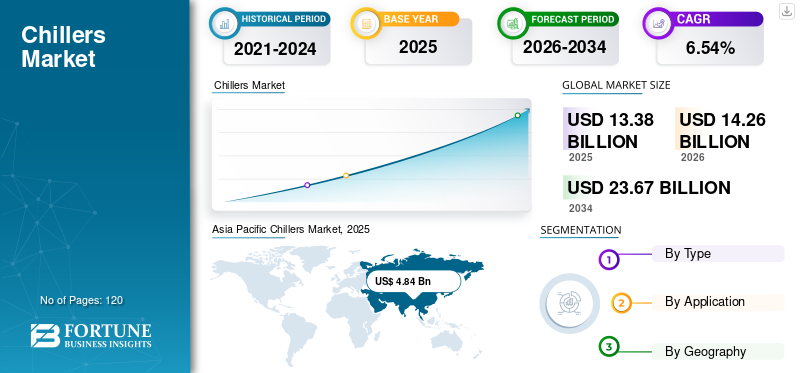
The global chillers market size was valued at USD 13.38 billion in 2025 and is projected to grow from USD 14.26 billion in 2026 to USD 23.67 billion by 2034, exhibiting a CAGR of 6.54% during the forecast period. Asia Pacific dominated the chillers market with a market share of 50.15% in 2025. Rising demand for frozen food is driving the global chillers market. The chillers faucets market in the U.S. is projected to grow significantly, reaching an estimated value of USD 2.19 billion by 2032, driven by the growing industrial development and popularity of smart chillers.
The global chillers market is undergoing steady transformation as industries prioritize energy efficiency, sustainable cooling technologies, and lifecycle cost optimization. Chillers play a critical role in removing heat from liquids used in air conditioning systems, industrial process cooling, and commercial refrigeration applications. Rising investments in commercial buildings, manufacturing facilities, healthcare infrastructure, and data centers continue supporting market expansion across both developed and emerging economies. Institutional buyers increasingly evaluate total cost of ownership, operational reliability, and regulatory compliance when selecting cooling solutions, shifting purchasing priorities beyond initial capital expenditure.
The transition toward environmentally responsible refrigerants and intelligent building management systems is reshaping product development strategies throughout the chiller industry. Manufacturers are expanding portfolios of water-cooled chillers and air-cooled chillers equipped with digital monitoring, predictive maintenance capabilities, and variable-speed compressors to improve operational performance. Integration with advanced controls enables facilities to optimize energy consumption while maintaining stable cooling capacity under varying load conditions.
Growing demand for industrial automation and high-performance process cooling is strengthening adoption across chemicals, pharmaceuticals, food processing, plastics, electronics manufacturing, and semiconductor production. In parallel, expanding urbanization and infrastructure development are increasing installations within hospitals, airports, hotels, educational institutions, and mixed-use commercial complexes. As climate conditions become more demanding, efficient systems capable of operating across varying ambient air temperatures are gaining greater commercial relevance.
Evolving government industrial policies are driving industrialization in developing economies such as India, China, and Thailand. In 2015, China launched “Made in China 2025,” a plan making innovation its top priority through various initiatives such as modernization and up-gradation of China’s manufacturing sector. China’s southern province of Hunan issued a three-year plan for the AI sector in 2019. The Chinese minister of industry and information technology in 2019 commented on government planning for the reduction of taxes and the betterment of intellectual property rights at the China Development Forum.
Water-cooled chillers remain dominant in large-scale installations due to their better thermal performance, although air-cooled systems are gaining favor in retrofit and space-constrained applications. Asia-Pacific remains the fastest-growing regional market due to industrial development and infrastructure investment. North America leads in retrofit and replacement projects, which are supported by evolving energy-efficiency requirements.
As global environmental initiatives gain pace, end users increasingly regard chillers as strategic long-term assets. The next wave of market expansion is likely to be driven by the integration of automation, predictive maintenance, and energy optimization techniques, with chillers serving as the foundation for modern energy-efficient infrastructure.
Download Free sample to learn more about this report.
Key Market Dynamics
Chillers Market Trends
The chillers market is undergoing a significant transformation as technology, policy, and sustainability come together. One of the most noticeable trends is the emphasis on energy efficiency and part-load optimisation, as most facilities operate below full capacity for extended periods of time.
Download Free sample to learn more about this report.
Manufacturers are increasingly using variable-speed drives and smart control systems to adjust energy consumption and improve seasonal efficiency. The global shift toward low-GWP refrigerants, prompted by environmental agreements and refrigerant phase-down programs, is changing both equipment design and service protocols.
Digital transformation is another defining trend. IoT-enabled monitoring, remote diagnostics, and predictive maintenance solutions help operators extend equipment life and reduce downtime. Hybrid and heat-recovery chillers, which reuse waste heat for other purposes, are also gaining popularity, particularly in areas that prioritize carbon neutrality and net-zero energy goals.
The upsurge in milk and beverage chillers is expected to drive this market demand in the near future. Ready-to-eat products are equally contributing to the popularity of chillers. Increasing demand for processed food is resulting in the growth of the chiller industry. The changing lifestyle patterns of consumers and convenience are the driving factors for the increasing processed food consumption. The various advantages of processed food, including easy preservation and storage; immediate consumption; time-efficiency; and ease of cooking, are expected to drive the processed food market. Furthermore, the increasing demand for refrigeration equipment in the soft-drink and alcoholic beverages industry to preserve products is expected to increase chiller demand.
Sustainability objectives are reshaping purchasing decisions throughout the chiller market as commercial and industrial operators seek cooling systems that reduce electricity consumption while complying with evolving environmental regulations. Energy efficiency has become a primary evaluation criterion, encouraging adoption of advanced compressor technologies, intelligent control systems, and refrigerants with lower global warming potential. Institutional buyers increasingly prioritize lifecycle performance over initial acquisition costs, particularly for large-scale installations serving commercial buildings and industrial facilities.
Digitalization is emerging as a defining market trend. Manufacturers are integrating Internet of Things (IoT)-enabled monitoring, predictive maintenance platforms, and cloud-based analytics into chiller systems to improve equipment reliability and reduce unplanned downtime. Continuous performance monitoring enables operators to optimize cooling loads, identify maintenance requirements early, and improve long-term operating efficiency. These capabilities are particularly valuable for mission-critical applications such as hospitals, pharmaceutical manufacturing, and data centers.
Chillers Market Growth Factors
Multiple structural forces are driving the global chiller market's growth. The growing demand for process cooling in industries such as chemicals, pharmaceuticals, plastics, and food and beverage remains a significant growth driver. These industries rely on chillers to ensure product quality, operational stability, and regulatory compliance.
The need to incorporate IoT in Chillers has led to the development of connected chillers. Unique features such as preventive maintenance are gaining popularity. The smart chillers offer reduced downtime, fewer disruptions, and longer equipment life. Thus, manufacturers are focusing on developing connected chillers. For instance, Johnson collaborated with Microsoft to develop connected services through the cloud to get insights into operations. Data analytics, remote monitoring, and diagnostics are expected to be the driving factors of the chiller industry. Smart chillers further prevent problems by quickly responding to emergencies and deteriorating conditions. Thus, the enhanced performance of chillers is resulting in the high demand for the smart chiller market.
The growth in infrastructure, including power, dam, and commercial projects, is fueling the chiller market growth. For instance, China’s Belt and Road Initiative is expected to open opportunities for renewable projects. In 2018, the Trump administration released an infrastructure development initiative to modernize the country’s infrastructure with investments of more than USD 200 billion. The commercial segment is also growing, driven by the increasing construction of office buildings, hospitals, and data centers, all of which rely on centralized cooling systems. Furthermore, stricter environmental and energy regulations are driving organizations to replace outdated equipment with high-efficiency, compliant chillers, accelerating market turnover.
Industrial expansion continues to create sustained demand for advanced cooling systems capable of supporting energy-intensive manufacturing processes. Industries including chemicals and petrochemicals, food and beverages, pharmaceuticals, plastics, and electronics rely on chillers to maintain consistent operating temperatures, protect production equipment, and improve process stability. As manufacturing facilities adopt greater automation and precision engineering, dependable process cooling infrastructure becomes increasingly important for maintaining operational efficiency and product quality.
Commercial construction activity represents another significant growth driver for the chillers market. Rising investment in office complexes, airports, shopping centers, hotels, hospitals, universities, and mixed-use developments is increasing demand for centralized air conditioning systems. Growing urban populations and infrastructure development across emerging economies are accelerating installation of high-capacity cooling equipment designed to serve large commercial buildings while minimizing long-term energy consumption.
Energy efficiency regulations are influencing replacement cycles across mature markets. Building owners are replacing aging equipment with modern water-cooled chillers and air-cooled chillers that incorporate variable-speed compressors, intelligent controls, and optimized heat exchange technologies. These systems reduce electricity consumption, improve operational flexibility, and support compliance with increasingly stringent environmental standards governing HVAC performance and refrigerant use.
Restraining Factors
Despite promising growth, several obstacles continue to impede large-scale chiller adoption. High initial capital costs are one of the most significant obstacles, particularly for small and medium-sized facilities. Large-capacity systems frequently necessitate infrastructure changes, control integration, and skilled installation teams, which increases project complexity.
The switch to new refrigerants increases uncertainty. End-users must pay more for retrofits, training, and compliance with new safety standards as global regulations change. Rising electricity prices and grid instability in certain regions also have an impact on operating costs, making high-efficiency equipment less appealing in the short term.
Maintenance and technical expertise are additional impediments. Many smaller operators lack the resources or skilled personnel required for effective operation and maintenance. Companies in such cases postpone upgrades or use modular approaches to reduce disruption and capital expenditure.
High capital investment requirements remain one of the principal constraints affecting the chiller market, particularly for large commercial and industrial installations. Advanced cooling systems require significant expenditure for equipment procurement, engineering design, installation, piping networks, electrical integration, and commissioning. These upfront costs can delay investment decisions among small and medium-sized enterprises, especially in regions where financing options for energy-efficient infrastructure remain limited.
Operating expenses also present ongoing challenges. Chillers consume considerable electrical power under continuous operating conditions, making lifecycle costs highly sensitive to fluctuations in energy prices. Facilities operating around the clock, including manufacturing plants, hospitals, and data centers, face increasing pressure to balance cooling performance with energy efficiency. Volatile utility costs can extend project payback periods and influence equipment replacement strategies.
Environmental regulations governing refrigerants introduce additional complexity for manufacturers and end users. Compliance with evolving standards related to refrigerant emissions, global warming potential, and energy performance requires continuous investment in product redesign, certification, and testing. Organizations replacing legacy systems often encounter compatibility issues with existing infrastructure, increasing retrofit costs and extending implementation timelines.
Maintenance requirements represent another operational consideration. Water-cooled chillers require regular inspection of cooling towers, water treatment systems, pumps, and heat exchangers to maintain efficiency and prevent corrosion or scaling. Although air-cooled chillers eliminate water management requirements, their performance can decline under elevated ambient air temperatures, particularly in regions experiencing prolonged heat waves. These application-specific limitations require careful equipment selection based on operating conditions.
Market Opportunities
Accelerating investment in sustainable infrastructure is creating substantial opportunities across the global chillers market. Governments and private developers are prioritizing energy-efficient HVAC systems for commercial buildings, healthcare facilities, airports, educational campuses, and mixed-use developments. As green building certifications become more influential in construction planning, demand for high-performance chillers capable of reducing operational energy consumption is expected to strengthen across both new installations and retrofit projects.
Data center expansion represents one of the fastest-growing application opportunities. Rapid growth in cloud computing, artificial intelligence, and digital services is increasing demand for reliable cooling infrastructure capable of maintaining stable operating temperatures under continuous workloads. Chiller manufacturers are responding by developing high-efficiency systems with intelligent controls, redundancy capabilities, and predictive maintenance functions that improve operational reliability while lowering lifecycle costs.
Industrial modernization is opening additional avenues for market growth. Manufacturers across chemicals and petrochemicals, pharmaceuticals, plastics, food and beverages, and semiconductor production are upgrading process cooling systems to improve production efficiency and product consistency. Facilities increasingly seek integrated solutions that combine advanced compressors, optimized expansion valve technologies, digital monitoring, and automated energy management to maximize asset utilization and minimize operating expenses.
Market Segmentation Analysis
By Type Outlook
“Screw Chillers Are Expected To Be The Fastest Growing Product In The Market”
Based on type, the chillers market is drilled down into Screw Chillers, Scroll Chillers, Centrifugal Chillers and Others.
Screw Chillers
Screw chillers are dominant in medium to large applications, providing excellent part-load performance and operational flexibility. They are ideal for industries that require continuous cooling, such as plastics, pharmaceuticals, and chemical manufacturing. Screw chillers account for a significant share of the global chiller market because they provide an effective balance between cooling capacity, operational efficiency, and installation flexibility. Their rotary screw compressors deliver reliable performance under varying load conditions, making them well suited for commercial buildings, manufacturing facilities, hospitals, educational campuses, and district cooling systems. Facilities operating continuously often prefer screw chillers because they maintain stable efficiency across partial-load operations while requiring comparatively lower maintenance than some alternative technologies.
Screw chillers are expected to exhibit the highest CAGR in the global market. The various features such as cost-effectiveness, low maintenance, and high efficiency are resulting in product popularity. Moreover, the increasing demand from industries such as oil & gas, pharmaceutical, chemical, food & beverages, and the automotive sector is expected to drive the market in the near future.
Scroll chillers maintain strong market demand in small and medium-capacity cooling applications where compact design, operational simplicity, and quiet performance are important purchasing considerations. Commercial offices, retail facilities, hotels, healthcare clinics, and educational institutions frequently adopt these systems because installation requirements remain relatively straightforward while maintenance demands are generally manageable.
Scroll chillers are compact and dependable and are commonly used for small- to medium-capacity cooling in commercial buildings and light industrial settings. Their low vibration, ease of maintenance, and modular design make them affordable and scalable solutions.
“Centrifugal Chillers Are Expected To Show Significant Growth In The Market”
Centrifugal Chillers are commonly used for large space cooling applications such as buildings, universities, government buildings, and airports. Thus, manufacturers are continuously innovating in centrifugal chillers. For example, in 2018, Daikin launched its advanced centrifugal oil-free water-cooled inverter chiller series with magnetic bearing technology. DZ chiller series comes with a 32% footprint reduction compared to the old series and a low-noise solution with a dedicated soundproof cabinet for the compressor. The application flexibility of the DZ chiller series, with various functionalities such as rapid restart with an automatic transfer switch to a backup generator, is suitable for data center applications. Furthermore, manufacturers are focusing on capacities less than 300TR. For instance, Danfoss Turbocor compressors range from 40 to 400 TR capacity.
Centrifugal chillers are in the high-capacity class, providing remarkable efficiency for huge infrastructure projects such as data centers, hospitals, and district cooling networks. Recent advances, such as magnetic-bearing compressors and oil-free systems, are lowering maintenance requirements and increasing energy efficiency.
The chiller type is chosen based on capacity requirements, efficiency goals, and lifespan cost considerations. As digital controls and variable-frequency motors become more commonplace, all chiller categories are shifting toward more intelligent, adaptive, and environmentally responsible solutions.
By Application Outlook
“Petrochemicals & Chemicals Segment Is Resulting In The Growth Of Chillers Market”
Based on the applications, the report scope is segmented into Chemicals & Petrochemicals, Food & Beverages, Plastics, Rubber, Medical & Others.
Chemicals and Petrochemicals
The petrochemical industry is expected to observe significant growth in the near future. The increasing demand from end-users for oil, gasoline, and petroleum products such as olefins, including propylene, ethylene, and aromatics, is resulting in the growth of the petrochemical industry. The demand for petrochemicals and their derivatives is increasing in various applications such as the pharmaceutical, tire, and paint sectors.
Temperature stability remains essential throughout chemical and petrochemical production, where precise cooling directly influences product quality, equipment reliability, and operational safety. Chillers remove heat generated during chemical reactions, separation processes, and continuous manufacturing operations while maintaining controlled process conditions. Increasing investment in refining capacity and specialty chemical production continues to support demand for high-capacity process cooling systems capable of operating under demanding industrial environments.
According to sources, the global petrochemical sector was valued at more than USD 530 billion in 2018 and is expected to grow around 8% in the near future. Chillers are playing a significant role in maintaining the equipment temperatures in the petrochemical sector. Cefic (European Chemical Industry Council), the world chemical sales in 2017 were valued at USD 3,879.48 billion, with a year-on-year growth of 4.6%. Thus, the increase in petrochemicals & chemical demand, in turn, is expected to result in chiller market growth.
“Plastic Industry Is Driving The Chillers Demand Around The Globe”
Chillers form a crucial part of the plastic industry for plastic extrusion and injection mold cooling. The increasing demand for plastic materials from daily-use products such as toys, food packaging, and consumer electronic products. Rising use of plastic in industrial applications such as building and construction materials is driving the plastic sector, which in turn is expected to drive the chiller market. Thus, manufacturers are especially focusing on industry-specific chiller features such as temperature control for temperature-sensitive processes in the plastic industry. For instance, Chase Cooling System introduced their QBE Series and CWE Series fluid chillers with an optional hot gas bypass valve for temperature-sensitive processes.
Food and Beverages
Food and beverage manufacturers rely extensively on chillers to maintain hygienic production conditions, preserve product quality, and comply with food safety standards. Cooling systems support beverage processing, dairy production, brewing, cold storage, packaging, and ingredient handling operations. Rising consumer demand for processed foods and expanding cold-chain infrastructure are encouraging manufacturers to invest in energy-efficient cooling equipment with enhanced operational reliability and lower lifecycle costs.
Plastics
Plastics manufacturing requires accurate temperature regulation during injection molding, extrusion, blow molding, and thermoforming operations. Chillers stabilize processing temperatures, reduce production defects, improve dimensional consistency, and increase manufacturing efficiency. Modern facilities increasingly adopt digitally monitored cooling systems capable of optimizing energy consumption while supporting continuous production schedules. Expansion of packaging, automotive, electronics, and consumer goods manufacturing continues strengthening demand across this application segment.
Rubber
Rubber processing facilities utilize chillers to regulate temperatures during mixing, molding, extrusion, and curing operations. Effective cooling improves material consistency, minimizes production variability, and protects manufacturing equipment from excessive thermal stress. Growing production of automotive tires, industrial seals, conveyor systems, and engineered rubber products is sustaining investment in reliable industrial cooling infrastructure. Manufacturers increasingly prioritize systems offering high efficiency, operational durability, and simplified maintenance.
Medical
Healthcare and life sciences represent an expanding application area for advanced chiller systems. Hospitals, diagnostic laboratories, pharmaceutical manufacturers, biotechnology facilities, and medical equipment producers require highly reliable cooling to protect sensitive processes and maintain stable operating environments. Precision temperature control supports medical imaging equipment, vaccine production, laboratory research, and pharmaceutical manufacturing. Increasing healthcare infrastructure investment worldwide continues driving demand for intelligent, energy-efficient cooling technologies with robust operational reliability.
To know how our report can help streamline your business, Speak to Analyst
Regional Insights
Geographically, the scope is segmented across five major regions, such as North America, Europe, Asia Pacific, Middle East & Africa, and Latin America, which is further categorized into countries.
Asia-Pacific Chillers Market Analysis
Asia Pacific dominated the market owing to the increasing demand from China. The cost-effectiveness and ease of installation have resulted in the popularity of Chillers in China’s industrial sector. Moreover, the increase in construction projects in Asia is expected to drive the chillers market over the forecast period.
Asia-Pacific is the fastest-growing region, driven by rapid industrialization, expanding manufacturing sectors, and large-scale infrastructural projects. Countries such as China, India, and Japan are making significant investments in sustainable cooling systems to satisfy rising energy and environmental needs.
The increasing demand from the rise in investments in data centers is expected to result in the growth of the chiller market. For instance, in 2019, Equinix, a Californian data center provider, formed a joint venture of USD 1 billion with Singapore-based GIC to operate and build hyperscale data centers in Europe. Furthermore, in 2019, the Australian-based property developer Lendlease entered into a partnership of USD 1 billion with an institutional investor to build data centers in Asia Pacific.
Asia-Pacific is expected to record the fastest growth in the chillers market owing to rapid industrialization, urbanization, and large-scale infrastructure development. Expanding manufacturing activities, commercial construction, and rising demand for air conditioning systems support widespread equipment deployment. Increasing investments in electronics, chemicals, pharmaceuticals, and food processing continue reinforcing regional market expansion and long-term investment potential.
Japan Chillers Market
Japan's chillers market is supported by technological innovation, advanced manufacturing capabilities, and widespread adoption of energy-efficient HVAC systems. Precision cooling requirements across semiconductor fabrication, electronics production, healthcare, and commercial facilities continue driving demand for high-performance equipment. Continuous research into intelligent controls and environmentally responsible refrigerants strengthens the country's competitive position within the regional market.
China Chillers Market
China remains the largest contributor to Asia-Pacific market growth because of extensive industrial production, rapid commercial construction, and expanding infrastructure investment. Rising demand for process cooling across chemicals, electronics, plastics, and manufacturing industries continues supporting equipment installations. Government initiatives promoting energy efficiency and sustainable industrial development further accelerate adoption of advanced chiller technologies nationwide.
Europe Chillers Market Analysis
Europe witnesses stable growth as a result of chiller replacement demand. The adoption of new technologies such as oil-free compressors is expected to increase demand of chillers demand. Europe's growth, aided by strong environmental legislation under the EU F-Gas Regulation. The region's concentration on low-GWP refrigerants and renewable integration fosters innovation in environmentally friendly chillers.
Europe's chiller market benefits from ambitious climate objectives, strict refrigerant regulations, and strong emphasis on energy-efficient HVAC technologies. Commercial building renovation projects and industrial modernization initiatives continue stimulating demand for advanced cooling systems. Growing adoption of low-global-warming-potential refrigerants and intelligent energy management solutions reinforces regional competitiveness while supporting sustainable market expansion across diverse end-use industries.
Germany Chillers Market
Germany maintains a leading position in the European chillers market through its advanced manufacturing sector, engineering expertise, and commitment to industrial energy efficiency. Strong demand from automotive production, chemicals, pharmaceuticals, and precision manufacturing supports consistent investment in high-performance process cooling equipment. Ongoing modernization of industrial facilities continues driving adoption of digitally connected, energy-efficient chiller technologies.
United Kingdom Chillers Market
The United Kingdom continues expanding its chillers market through investments in healthcare infrastructure, commercial developments, pharmaceutical manufacturing, and digital infrastructure. Increasing demand for sustainable cooling solutions encourages replacement of legacy equipment with modern high-efficiency systems. Building decarbonization initiatives and growing adoption of intelligent facility management technologies further strengthen long-term market opportunities across multiple application sectors.
North America Chillers Market Analysis
North America is expected to show significant growth in chiller demand owing to the increasing demand from various industries such as chemicals & petrochemicals, food & beverages, and medical sectors. Strong retrofit activity and stringent energy-efficiency rules are driving North America's growth. Continuous policy support for sustainability and refrigerant phase-down activities encourages the adoption of next-generation systems.
North America holds a significant share of the chillers market, supported by widespread replacement of aging HVAC infrastructure, stringent energy efficiency regulations, and expanding investments in commercial buildings and data centers. Growing demand for sustainable air conditioning systems and industrial process cooling encourages adoption of advanced water-cooled chillers and air-cooled chillers. Continued digitalization further strengthens regional market growth.
United States Chillers Market
The United States represents the largest market within North America due to substantial investments in healthcare facilities, commercial real estate, manufacturing, and hyperscale data centers. Equipment modernization programs emphasize predictive maintenance, intelligent building automation, and environmentally responsible refrigerants. Strong presence of major manufacturers and increasing infrastructure development continue supporting long-term expansion across commercial and industrial cooling applications.
Middle East & Africa is expected to observe lucrative growth owing to the increase in construction projects. For example, Saudi Arabia is undergoing the construction of three metro projects in Riyadh and Jeddah, which are expected to operate by 2020. Thus, increasing investments in transportation are driving the chiller demand in the near future. The Middle East market is booming as a result of large-scale district cooling projects that address severe temperatures and water scarcity issues. Meanwhile, Latin America and Africa are emerging markets where infrastructure modernization and climate adaptation activities are encouraging incremental adoption.
Chillers are increasingly considered critical enablers of energy-efficient and sustainable cooling solutions that are consistent with global decarbonization targets.
Latin America Chillers Market Analysis
Latin America's chillers market is steadily expanding through increasing industrial investment, commercial construction, and modernization of manufacturing infrastructure. Food processing, mining, healthcare, and beverage production remain important application sectors requiring dependable cooling systems. Rising awareness of operational energy efficiency and growing adoption of advanced HVAC technologies continue creating favorable long-term opportunities throughout the region.
Middle East & Africa Chillers Market Analysis
The Middle East & Africa chillers market benefits from extensive commercial construction, hospitality projects, healthcare expansion, and rising cooling requirements driven by extreme climatic conditions. Investment in sustainable infrastructure and high-efficiency HVAC systems continues to increase across major economies. Industrial diversification and urban development are expected to support stable long-term market growth.
Asia Pacific Chillers Market, 2025
To get more information on the regional analysis of this market, Download Free sample
Competitive Landscape
Competition within the chillers market is characterized by technological innovation, energy efficiency, product reliability, and lifecycle service capabilities rather than pricing alone. Manufacturers increasingly differentiate themselves through high-performance compressor technologies, intelligent building integration, refrigerant innovation, and global aftermarket service networks. As environmental regulations become more stringent and customers prioritize total cost of ownership, companies capable of delivering sustainable, digitally connected cooling solutions are strengthening their competitive positions across commercial and industrial markets.
Leading participants including Johnson Controls, Daikin Industries, Carrier Global Corporation, Trane Technologies, Mitsubishi Electric Corporation, LG Electronics, Panasonic Corporation, Smardt Chiller Group, GEA Group AG, and Bosch Thermotechnology collectively account for a substantial share of the global chillers market. These organizations leverage extensive engineering expertise, diversified product portfolios, and established distribution channels to address applications ranging from commercial buildings and district cooling systems to pharmaceuticals, food processing, chemicals, and data centers.
Technology remains the principal source of competitive differentiation. Manufacturers continue investing in variable-speed compressors, magnetic bearing centrifugal chillers, advanced heat exchanger designs, intelligent expansion valve systems, and low-global-warming-potential refrigerants to improve operating efficiency and environmental performance. Digital platforms incorporating predictive maintenance, remote diagnostics, cloud-based monitoring, and artificial intelligence-enabled optimization are increasingly becoming standard offerings for large commercial and industrial customers seeking greater operational visibility and reduced maintenance costs.
Strategic partnerships are also reshaping market competition. Equipment manufacturers collaborate with engineering, procurement, and construction contractors, building automation providers, energy service companies, and software developers to deliver integrated cooling solutions. Alliances with refrigerant technology suppliers and sustainability organizations further accelerate compliance with evolving environmental standards while supporting next-generation HVAC innovation. The manufacturers are focusing on advancements in technologies to provide customers with highly efficient chillers at low cost, with low maintenance, noise, and vibration. Johnson Controls is expected to be one of the leading players in the industry.
List of Top Chillers Market Companies:
- Daikin
- Johnson Controls
- Johnson Controls-Hitachi Air Conditioning
- Mitsubishi Heavy Industries, Ltd.
- Polaris Industries Australasia
- LG Electronics
- Midea
- Dunham-Bush Americas
- Chongqing General Industry Co., Ltd.
- Carrier Corporation
- The Danfoss Group
Recent Industry Developments
- March 2025: Johnson Controls expanded the availability of its YORK® YVAM air-cooled magnetic bearing chiller across Europe to address rapidly growing demand from hyperscale and colocation data centers. The strategic purpose was to improve energy efficiency, reduce water consumption, and strengthen thermal management for AI-driven digital infrastructure. Technologies and capabilities involved included magnetic-bearing compressors, oil-free operation, ultra-low-global-warming-potential refrigerants, and extended ambient temperature performance.
- August 2025: Carrier Global Corporation introduced the AquaSnap® 30MPQ Water-Source Heat Pump, expanding its modular chiller portfolio for commercial retrofit and new construction projects. The strategic purpose was to support building decarbonization while improving installation flexibility and energy performance. Technologies and capabilities involved included modular water-cooled scroll chiller architecture, SmartVu™ controls, R-32 refrigerant, and scalable multi-unit system configurations.
- February 2026: Johnson Controls launched Smart Ready YORK® Chillers with factory-installed connectivity to enable digital lifecycle management from commissioning onward. The strategic purpose was to reduce unplanned service events, improve operational reliability, and optimize asset performance throughout the equipment lifecycle. Technologies and capabilities involved included AI-enabled analytics, advanced fault detection and diagnostics, real-time performance monitoring, cloud connectivity, and predictive maintenance.
- February 2026: Trane Technologies launched the HSAG air-cooled magnetic bearing centrifugal chiller for the Asia-Pacific data center market. The strategic purpose was to support rapidly expanding AI and hyperscale computing infrastructure through higher cooling efficiency and improved environmental performance. Technologies and capabilities involved included oil-free magnetic bearing technology, low-global-warming-potential refrigerants, high-efficiency centrifugal compression, and advanced thermal management for mission-critical cooling environments
Report Coverage
Request for Customization to gain extensive market insights.
A growing trend is observed in the penetration of the chiller market position across the industries.
This market research report provides various key insights such as adoption trend analysis, recent industry developments including mergers & acquisitions, ecosystem analysis, macro and microeconomics factors, consolidated SWOT analysis, key industry trends, competitive landscape, and company profiles.
Report Scope and Segmentation
|
ATTRIBUTE |
DETAILS |
|
Study Period |
2021-2034 |
|
Base Year |
2025 |
|
Forecast Period |
2026-2034 |
|
Historical Period |
2021-2024 |
|
Unit |
Value (USD Billion) |
|
Segmentation |
By Type
|
|
By Application
|
|
|
By Geography
|
Frequently Asked Questions
The globalx chillers market size was valued at USD 13.38 billion in 2025.
The global chillers market size is projected to reach USD 23.67 billion by 2034.
The global chillers market exhibiting a CAGR of 6.54% during the forecast period.
By Type (Screw Chillers, Scroll Chillers, Centrifugal Chillers, and Others), By Application (Chemicals and Petrochemicals, Food and Beverages, Plastics, Rubber, Medical, and Others), and Regional Forecast, 2019-2032
- Increasing Infrastructure Development Is Resulting In Growth Of Chillers Market. - Industrial Development Is Fueling the Chillers Market Growth.
Daikin, Johnson Controls, Johnson Controls-Hitachi Air Conditioning, Mitsubishi Heavy Industries, Ltd., Polaris Industries Australasia, LG Electronics, Midea, Dunham-Bush Americas, Chongqing General Industry Co., Ltd., Carrier Corporation, The Danfoss Group
Asia Pacific dominated the Chillers market with a market share of 50.15% in 2025.
The petrochemical industry is expected to observe a significant growth in the near future.
Preventive Maintenance Is Resulting In Popularity Of Smart Chillers. Screw Chillers Is Expected To Be The Fastest Growing Product In The Market.



- 2021-2034
- 2025
- 2021-2024
- 120
Get 30-60 hrs Free Customization
Expand Regional and Country Coverage, Segments Analysis, Company Profiles, Competitive Benchmarking, and End-user Insights.















Related Reports
-
US +1 833 909 2966 ( Toll Free )
-
Get In Touch With Us