Diaper Rash Cream Market Size, Share & Industry Analysis, By Product Type (Antifungal Creams, Barrier Ointments, Preventive Daily-use Creams, Medicated Rash Creams, and Others), By Form (Synthetic and Natural/Organic), By End-user (Babies and Adults), By Distribution Channel (Specialty Stores/Medical Stores, Supermarkets & Hypermarkets, Online Stores, and Others), and Regional Forecast, 2026-2034
 Download Free Sample
(Offer valid till 31st Oct 2026)

Diaper Rash Cream Market Size and Future Outlook
 Listen to Audio Version
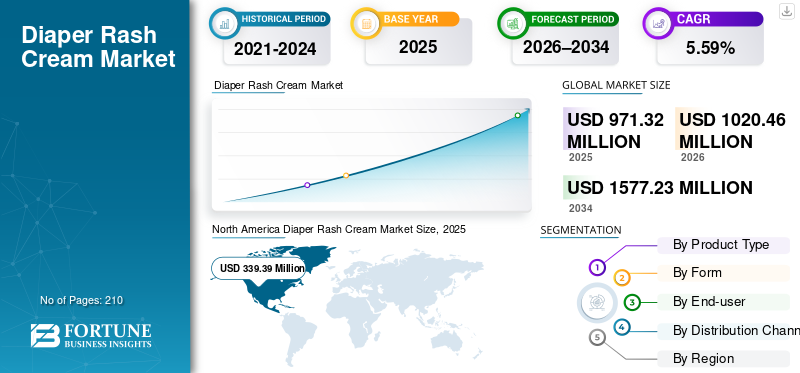
The global diaper rash cream market size was valued at USD 971.32 million in 2025. The market is projected to grow from USD 1,020.46 million in 2026 to USD 1,577.23 million by 2034, exhibiting a CAGR of 5.59% during the forecast period. North America dominated the diaper rash cream market with a market share of 34.94% in 2025.
A diaper rash cream is a topical skincare product formulated to prevent, soothe, and treat skin irritations and inflammation caused by prolonged exposure to moisture, friction, urine, and feces in the diaper area. Nowadays, parents are becoming increasingly informed about early-stage skin protection and preventive care. Pediatric advice, online parenting communities, and educational content from healthcare professionals have increased awareness of diaper rash prevention. This shift from reactive treatment to routine prevention is expanding overall product consumption and fostering global market share.
Leading companies, such as Johnson & Johnson, Beiersdorf AG, Netmeds, and Bayer AG, are continuously innovating by introducing multifunctional formulations, such as barrier creams with antifungal or soothing properties. Brands are also investing in lighter textures, breathable formulations, and fast-absorbing creams to improve user experience, thus propelling market growth.
Download Free sample to learn more about this report.
Diaper Rash Cream Market Key Takeaways
 Global Market Size & Forecast
- 2025 Market Size: USD 971.32 million
- 2026 Market Size: USD 1,020.46 million
- 2034 Forecast Market Size: USD 1,577.23 million
- CAGR: 5.59% from 2026–2034
 Market Share
- North America dominated the diaper rash cream market with a 34.94% share in 2025.
- The synthetic segment accounted for the largest market share at 69.53% in 2025.
- The babies segment led the market with a 65.35% share in 2025.
 Key Regional Highlights
North America
North America led the market in 2025 with a valuation of USD 339.39 million and reached USD 354.40 million in 2026.
Europe
Europe was valued at USD 286.66 million in 2025, making it the second-largest regional market.
Asia Pacific
Asia Pacific was valued at USD 243.40 million in 2025 and is projected to expand at a 7.02% CAGR through 2034.
U.S.
U.S. The market was valued at USD 281.32 million in 2025 and is projected to grow at a 4.83% CAGR during the forecast period.
Japan
Japan The market was valued at USD 20.62 million in 2025 and is expected to grow at a 6.28% CAGR during the forecast period.
Read More

Diaper Rash Cream Market Trends
Premiumization through Natural, Organic, and Clean-label Products to Support Market Expansion
In recent times, growing parental concern about ingredient safety is accelerating demand for diaper rash creams that are natural, organic, fragrance-free, and dermatologist-tested. Clean-label positioning, plant-based ingredients, and eco-friendly packaging allow brands to command premium pricing. This trend is particularly strong in North America, Europe, and urban Asia Pacific markets, driving value growth even in mature regions.
Download Free sample to learn more about this report.
Market Dynamics
Market Drivers
Rising Demand for Antifungal and Medicated Solutions to Foster Market Growth
Nowadays, the rising demand for antifungal and medicated solutions is playing a critical role in accelerating the diaper rash cream market growth, as diaper dermatitis is increasingly recognized as a medical condition rather than a purely cosmetic concern. Additionally, persistent and recurring rashes that do not respond to conventional barrier creams are increasingly diagnosed as yeast- or bacteria-related infections, particularly Candida-associated dermatitis. This shift in diagnosis has expanded the use of targeted antifungal and medicated formulations, directly increasing market growth.
Market Restraints
Availability of Alternative and Home-based Remedies to Limit Market Growth
Many consumers continue to use traditional remedies, including coconut oil, olive oil, cornstarch, or herbal pastes to manage mild diaper rashes. Cultural familiarity, perceived safety, and lower cost make these alternatives attractive, particularly for preventive use. The widespread acceptance of such substitutes reduces reliance on commercial diaper creams, limiting market growth.
Market Opportunities
Growth of E-commerce and Direct-to-consumer Channels to Propel Market Growth
The rapid growth of e-commerce platforms and direct-to-consumer (DTC) channels is emerging as a major catalyst for the market, fundamentally transforming how products are discovered, purchased, and consumed. Furthermore, online marketplaces and brand-owned websites allow caregivers in urban, semi-urban, and rural areas to access a broad range of diaper creams, including medicated, antifungal, and premium natural formulations, thereby fostering market growth.
Segmentation Analysis
By Product Type
Barrier Ointments Lead Market as They are Heavily Used by Pediatricians and Hospitals
Based on product type, the market is divided into antifungal creams, barrier ointments, preventive daily-use creams, medicated rash creams, and others.
The barrier ointments segment dominates the diaper rash cream market share. Barrier ointments are widely recommended by pediatricians, hospitals, and maternity care providers as a standard diapering solution. New parents are often introduced to barrier ointments immediately after childbirth, reinforcing habitual and long-term usage. This strong medical endorsement builds trust and ensures consistent repeat purchases, thus fostering segment growth.
The antifungal creams segment is expected to grow at the fastest CAGR during the forecast period.
To know how our report can help streamline your business, Speak to Analyst
By Form
Increasing Need for Quick, Reliable Moisture Protection Boosted Synthetic Segment Growth
Based on the form, the market is divided into synthetic and natural/organic.
The synthetic segment accounted for the majority of the market, with a 69.53% share in 2025. Widely used synthetic ingredients such as zinc oxide, petrolatum, dimethicone, and panthenol provide reliable moisture protection, skin repair, and inflammation control. These ingredients have been extensively studied and are considered gold standards for preventing and treating diaper dermatitis, thereby supporting the segment's growth.
The natural/organic segment is expected to grow at the fastest CAGR of 6.23% during the forecast period.
By End-user
Frequent Usage of Rash Creams among Babies Propelled Segment Growth
Based on end-user, the market is divided into adults and babies.
The babies segment led the market with a 65.35% share in 2025. Caregivers typically apply diaper cream during every diaper change or at least multiple times a day, especially in newborns. This high frequency of use translates into greater volume consumption than in adults, which is more situational and care-setting dependent.
The adult segment is expected to grow at the fastest CAGR of 7.07% during the forecast period.
By Distribution Channel
Specialty and Medical Stores Led Market Due to Availability of Different Diaper Creams
Based on the distribution channel, the market is divided into specialty stores/medical stores, supermarkets & hypermarkets, online stores, and others.
The specialty stores/medical stores segment led the global market, accounting for 37.50% in 2025. Specialty and medical stores stock a wide variety of diaper creams, including prescription-strength options, OTC medicated products, antifungal treatments, and dermatologist-tested brands. This breadth of offerings makes these stores a one-stop solution for both routine preventive care and targeted treatment needs, thereby fueling segment growth.
The online segment is expected to grow at a CAGR of 8.74% during the forecast period.
Diaper Rash Cream Market Regional Outlook
By region, the global market analysis is segmented into North America, Europe, Asia Pacific, South America, and the Middle East & Africa.
North America
North America Diaper Rash Cream Market Size, 2025 (USD Million)
To get more information on the regional analysis of this market, Download Free sample
North America led the market in 2025 with a valuation of USD 339.39 million and continued its dominance in 2026, reaching USD 354.40 million. Growing disposable incomes across the region are enabling consumers to spend more on premium and innovative products in coffee, skincare, and haircare, supporting consistent revenue expansion.
U.S. Diaper Rash Cream Market
Within the region, the U.S. market was valued at USD 281.32 million in 2025 and is expected to grow at a CAGR of 4.83% over the forecast period. Strong awareness of infant skin sensitivity, a well-established pediatric healthcare ecosystem, and preventive parenting habits fuel steady demand, with diaper creams widely used as part of everyday diapering routines.
Europe
Europe was valued at USD 286.66 million in 2025, securing its position as the second-largest regional market. Strong endorsements from pediatricians, dermatologists, and pharmacists continue to influence product adoption across the region.
U.K. Diaper Rash Cream Market
The U.K. market was valued at USD 45.92 million in 2025 and is set to rise at a CAGR of 6.62% during the forecast period. Market growth is fueled by increasing preference for hypoallergenic, dermatologist-approved solutions and the rising popularity of clean, natural, and organic formulations.
Germany Diaper Rash Cream Market
Germany was valued at USD 54.52 million in 2025 and is expected to grow at a CAGR of 6.24% during the forecast period. Germany’s demand is driven by high-quality standards, strong emphasis on dermatological safety, and preference for clinically proven formulations.
Asia Pacific
The Asia Pacific market is expected to grow at a 7.02% CAGR during the forecast period. It was valued at USD 243.40 million in 2025 and is expected to rank as the third-largest region.
China Diaper Rash Cream Market
China was valued at USD 83.02 million in 2025. Growing smartphone usage and online shopping platforms have enhanced access to niche coffee beauty brands, helping expand market reach even in tier-2 and tier-3 cities of this region.
India Diaper Rash Cream Market
India was valued at USD 73.95 million in 2025 and is expected to grow at a CAGR of 8.02% during the forecast period. India’s demand is rising due to high birth rates, increasing diaper penetration, and growing awareness of infant hygiene in urban and semi-urban areas.
Japan Diaper Rash Cream Market
Japan was valued at USD 20.62 million in 2025 and is expected to grow at a CAGR of 6.28% during the forecast period. Aging demographics also support demand for adult incontinence care, which is well developed in Japan. Preference for gentle, fragrance-free, and technologically advanced formulations reinforces market stability.
South America and Middle East & Africa
South America and the Middle East & Africa are also expected to grasp a considerable share of the market. South America in 2025 was valued at USD 63.14 million. The Middle East & Africa was valued at USD 38.74 million in 2025. Economic growth and urbanization in key Middle East & Africa markets such as the UAE, Saudi Arabia, and South Africa have raised disposable incomes, allowing more consumers to invest in premium coffee beauty products, thus fostering market growth.
UAE Diaper Rash Cream Market
The UAE was valued at USD 5.82 million in 2025 and is expected to grow at a CAGR of 1.52% during the forecast period. The UAE’s demand is supported by high disposable income, strong healthcare infrastructure, and a large expatriate population familiar with global baby-care brands.
Competitive Landscape
Key Industry Players
Continuous Product Innovation and Formulation Upgrades to Boost Market Growth
Nowadays, leading players are investing heavily in advanced formulations that go beyond basic protective barriers. Companies are introducing antifungal, medicated, and multi-action creams that combine barrier, soothing, and healing properties in a single product. Additionally, innovations such as breathable textures, fast-absorbing creams, and microbiome-friendly formulations are helping brands differentiate and address evolving consumer needs.
List of Key Diaper Rash Cream Companies Profiled
- Johnson & Johnson (U.S.)
- Beiersdorf AG (Germany)
- Netmeds (India)
- Sebapharma GmbH & Co. KG (Sebamed) (Germany)
- Mamaearth (Honasa Consumer Ltd.) (India)
- Bayer AG (Germany)
- Sanofi (France)
- Church & Dwight Co., Inc. (U.S.)
- Himalaya Wellness Company (India)
- Weleda AG (Switzerland)
Key Industry Developments
- September 2025: Bun Balm launched a diaper-area–specific treatment product designed to protect against irritation and redness.
- August 2025: Sonoma Pharmaceuticals launched a hypochlorous acid (HOCl)–based diaper rash solution, marking a shift toward antimicrobial, non-antibiotic skincare technologies.
- October 2024: Advantice Health launched The Multi-Purpose Rash Ointment to expand its use beyond infant diaper rash, positioning it for use on skin folds, friction areas, and mild rashes.
- June 2024: The Honest Company launched Honest Calm & Heal Diaper Rash Cream with a redesigned clean-label formulation.
- March 2024: Taro Pharmaceuticals introduced bébé Bottoms, a spray-formulated diaper rash solution, addressing hygiene and convenience concerns among modern caregivers.
- February 2023: Triple Paste launched Sheer Zinc Diaper Rash Ointment. The formulation focuses on zinc oxide protection while minimizing the thick, opaque residue associated with traditional barrier creams.
REPORT COVERAGE
The market report provides a comprehensive analysis, focusing on key elements such as major companies, regional and market segmentation, regional analysis, product launch, competition landscape, supply chain analysis, competitive dynamics, product type, form, end-user, and distribution channel. Additionally, it offers insights into market trends and highlights significant developments within the industry. Beyond these aspects, it also examines various factors that have contributed to market growth in recent years.
Request for Customization to gain extensive market insights.
Report Scope & Segmentation
|
ATTRIBUTE |
DETAILS |
|
Study Period |
2021-2034 |
|
Base Year |
2025 |
|
Estimated Year |
2026 |
|
Forecast Period |
2026-2034 |
|
Historical Period |
2021-2024 |
|
Growth Rate |
CAGR of 5.59% from 2026 to 2034 |
|
Unit |
Value (USD Million) |
|
Segmentation |
By Product Type
By Form
By End-user
By Distribution Channel
By Region North America (By Product Type, Form, End-user, Distribution Channel, and Country) · U.S. · Canada · Mexico Europe (By Product Type, Form, End-user, Distribution Channel, and Country) · Germany · U.K. · France · Italy · Spain · Rest of Europe Asia Pacific (By Product Type, Form, End-user, Distribution Channel, and Country) · China · India · Japan · Australia · Rest of Asia Pacific South America (By Product Type, Form, End-user, Distribution Channel, and Country) · Brazil · Argentina · Rest of South America Middle East & Africa (By Product Type, Form, End-user, Distribution Channel, and Country) · South Africa · UAE · Rest of Middle East & Africa |
Frequently Asked Questions
Fortune Business Insights says that the global market size stood at USD 971.32 million in 2025 and is anticipated to record a valuation of USD 1,577.23 million by 2034.
Fortune Business Insights says that the market value in North America stood at USD 339.39 million in 2025.
The global market will exhibit a CAGR of 5.59% during the forecast period of 2026-2034.
By product type, the barrier ointments segment dominates the market.
The rising demand for antifungal and medicated solutions is a key factor driving the global market.
Johnson & Johnson, Beiersdorf AG, Netmeds, and Bayer AG are some of the leading players globally.
North America dominated the global market in 2025.



- 2021-2034
- 2025
- 2021-2024
- 210
-
(Offer valid till 31st Oct 2026)
Get 30-60 hrs Free Customization
Expand Regional and Country Coverage, Segments Analysis, Company Profiles, Competitive Benchmarking, and End-user Insights.














Related Reports
-
US +1 833 909 2966 ( Toll Free )
-
Get In Touch With Us