Power Module for EV Charger Market Size, Share & Industry Analysis, By Module Type (AC-DC Power Module, DC-DC Power Module, and Bidirectional Power Module), By Charger Type (AC Charger and DC Fast Charger), By Power Rating (Below 20 kW, 20–50 kW, 51–150 kW, and Above 150 kW), By Cooling Type (Air Cooled and Liquid Cooled), By Application (Residential Charging and Commercial Charging), and Regional Forecast, 2026–2034
 Download Free Sample
(Offer valid till 30th Sep 2026)

Power Module for EV Charger Market Size and Future Outlook
 Listen to Audio Version
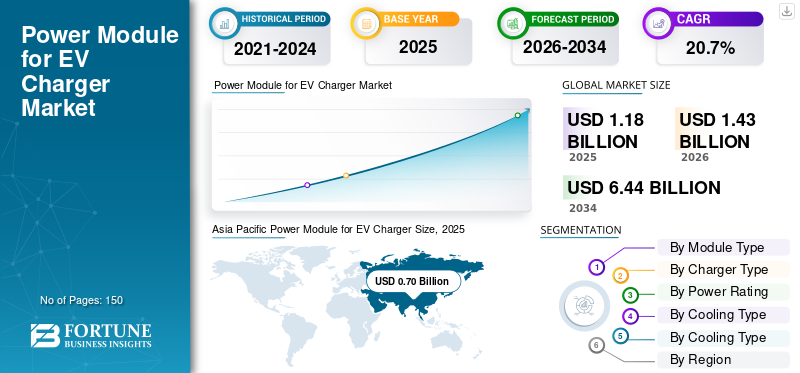
The global power module for EV charger market size was valued at USD 1.18 billion in 2025. The market is projected to grow from USD 1.43 billion in 2026 to USD 6.44 billion by 2034, exhibiting a CAGR of 20.7% during the forecast period. Asia Pacific dominated the power module for EV charger market with a market share of 59.32% in 2025.
A power module for the EV charger market refers to the industry focused on power conversion modules used in electric vehicle charging systems. These modules convert AC power from the grid into regulated DC power required to charge EV batteries efficiently and safely. They are used in AC chargers, DC fast chargers, and bidirectional chargers. The market growth is driven by rising EV adoption, fast-charging infrastructure expansion, and demand for compact, efficient charging solutions.
Key drivers of the global market include rising electric vehicle adoption, rapid expansion of public and private smart charging infrastructure, and increasing demand for high-power DC fast charging technology. Growing focus on efficient power conversion, compact charger design, and reduced charging time supports market growth. Advancements in silicon carbide and gallium nitride technologies, bidirectional charging, and renewable energy-integrated charging networks further drive demand.
Major players in the market include Infineon Technologies, Delta Electronics, STMicroelectronics, Wolfspeed, ABB, Siemens, Huawei Digital Power, Eaton, Bel Power Solutions, and Vicor Corporation. These companies are further competing through high-efficiency power conversion, compact module design, wide-bandgap semiconductor adoption, fast-charging compatibility, bidirectional charging capability, thermal management, and reliable charging infrastructure components solutions.
Download Free sample to learn more about this report.
POWER MODULE FOR EV CHARGER MARKET TRENDS
Adoption of Silicon Carbide-Based Modules to Improve Charging Efficiency
A major trend in the market is the increasing adoption of silicon carbide-based EV charger power modules. SiC devices allow higher switching frequencies, higher operating temperatures, reduced switching losses, and improved power density compared with conventional silicon-based components. This makes them especially suitable for DC fast chargers, ultra-fast charging systems, and compact modular charger designs. Suppliers are introducing SiC MOSFETs, diodes, and integrated modules to help charger manufacturers reduce cooling requirements, improve system efficiency, and increase charging reliability. Infineon notes that SiC semiconductors can improve charger efficiency by enabling higher temperatures and switching frequencies, while supporting higher power density in EV charging applications.
MARKET DYNAMICS
MARKET DRIVERS
Download Free sample to learn more about this report.
Rapid Expansion of EV Charging Infrastructure to Drive Power Module Demand
The main driver for the power module for EV charger market growth is the rapid expansion of EV charging infrastructure across residential, commercial, highway, and fleet charging locations. As EV adoption rises, charging networks require reliable AC-DC, DC-DC, and bidirectional power modules to convert grid electricity into battery-compatible power. DC fast chargers especially depend on modular power architecture to increase output, reduce downtime, and enable scalable station design. The IEA notes that large-scale EV adoption depends on accessible and affordable charging, while public charging could expand significantly by 2035. This supports strong demand for efficient, compact, and high-power charging solution modules capable of meeting diverse charging needs.
MARKET RESTRAINTS
High Initial Cost of Advanced Power Modules to Restrain Market Growth
A key restraint for the market is the high initial cost associated with advanced power electronics for EVs, particularly power modules using silicon carbide, gallium nitride, advanced thermal management, and high-frequency switching designs. Although these technologies improve efficiency, reduce power loss, and support compact charger architecture, they increase charger manufacturing costs. This can limit adoption among small-scale charging operators, cost-sensitive markets, and regions where EV infrastructure investment is still developing. In addition, power modules must meet strict reliability, safety, and grid-compliance standards, adding testing and certification expenses. As a result, buyers may delay upgrades or continue using lower-cost conventional modules, slowing near-term penetration of premium power module solutions.
MARKET OPPORTUNITIES
Bidirectional Charging and Vehicle-to-Grid Integration to Create New Opportunities
A major opportunity for the market lies in bidirectional charging and vehicle-to-grid integration. As EVs increasingly become distributed energy assets, chargers will need power modules that support two-way energy flow between the grid, buildings, renewable energy systems, and vehicle batteries. This creates opportunities for module suppliers to develop high-efficiency, bidirectional AC-DC and DC-DC solutions for residential, fleet, workplace, and public charging applications. These modules can help users manage peak demand, store renewable energy, and improve grid flexibility. Research from the U.S. Department of Energy highlights the importance of compact, lightweight, efficient, and reliable charger power electronics, supporting the shift toward more integrated charging architectures.
MARKET CHALLENGES
Thermal Management and Reliability Requirements to Challenge Module Suppliers
A key challenge for the market is maintaining thermal stability and long-term reliability under high-power charging conditions. DC fast chargers and ultra-fast chargers operate at high voltage and current levels, placing continuous stress on power semiconductors, capacitors, magnetic components, and cooling systems. Poor thermal design can reduce efficiency, shorten module lifespan, and increase charger downtime. This challenge becomes more significant as operators demand compact chargers with higher output power and lower maintenance needs. Module suppliers must balance heat dissipation, cost, size, and performance while meeting safety and reliability standards. As charging stations scale, consistent module performance under harsh outdoor conditions becomes critical for customer satisfaction and network uptime.
Segmentation Analysis
By Module Type
Grid-to-Battery Conversion Requirements to Propel AC-DC Power Module Segment Dominance
Based on module type, the market is categorized into AC-DC power module, DC-DC power module, and bidirectional power module.
The AC-DC power module segment dominates the market due to its critical role in converting grid-supplied alternating current into regulated direct current for EV battery charging. These modules are widely used across residential, commercial, and public charging systems, ensuring stable voltage conversion, high efficiency, and charger safety. Their broad compatibility with AC chargers and DC fast-charging architectures supports steady adoption. Growing EV penetration, expansion of charging stations, and demand for reliable power conversion solutions further strengthen the segment’s market leadership.
The DC-DC power module segment is expected to grow at a CAGR of 22.3% over the forecast period. Rising deployment of high-power DC fast chargers, modular charging systems, and voltage regulation needs in advanced EV charging infrastructure are accelerating demand for efficient DC-DC conversion solutions.
By Charger Type
Widespread Residential and Workplace Deployment to Propel AC Charger Segmental Dominance
Based on charger type, the market is categorized into AC charger and DC fast charger.
The AC charger segment dominates the market due to its widespread deployment across residential, workplace, fleet parking, and destination charging locations. AC chargers are cost-effective, easier to install, and suitable for overnight or long-duration charging needs. Their compatibility with home charging infrastructure and lower grid upgrade requirements support large-scale adoption. Rising EV ownership, government support for private charging points, and growing installation of Level 2 chargers further strengthen the segment’s leadership.
The DC fast charger segment is projected to grow at a CAGR of 23.6% over the forecast period. Increasing demand for rapid charging on highways, commercial hubs, and fleet depots is driving adoption of high-power modules that reduce charging time and improve charging network utilization.
By Power Rating
Balanced Fast-Charging Capacity to Propel 51–150 kW Segmental Dominance
Based on power rating, the market is categorized into below 20 kW, 20–50 kW, 51–150 kW, and above 150 kW.
The 51–150 kW segment dominates the market due to its strong suitability for public charging stations, commercial facilities, fleet depots, and urban fast-charging locations. Chargers in this range provide a practical balance between charging speed, installation cost, grid compatibility, and operational efficiency. They are widely adopted by charging network operators seeking faster turnaround than low-power chargers without the higher infrastructure costs linked to ultra-fast systems. Growing EV adoption, highway charging expansion, and demand for scalable modular charger designs further strengthen the segment’s leadership.
The above 150 kW segment is projected to grow at a CAGR of 23.8% over the forecast period. Rising demand for ultra-fast charging, long-distance EV travel, premium EV models, and high-utilization commercial charging corridors is accelerating adoption of high-power modules with advanced thermal management and efficiency.
To know how our report can help streamline your business, Speak to Analyst
By Cooling Type
Cost-Effective Thermal Design to Propel Air-Cooled Segment’s Dominance
Based on cooling type, the market is categorized into air cooled and liquid cooled.
The air-cooled segment dominates the market due to its lower system cost, simpler design, easier maintenance, and suitability for low- to mid-power charging applications. Air-cooled modules are widely used in residential chargers, workplace charging, and standard public charging systems where heat loads are manageable. Their reduced need for complex cooling infrastructure supports easier installation and lower operating expenses. Broad deployment of AC chargers and moderate-power DC chargers further strengthens adoption, as charging operators prioritize reliable and economical thermal management solutions for scalable infrastructure rollout.
The liquid-cooled segment is expected to grow at a CAGR of 21.2% over the forecast period. Rising deployment of high-power and ultra-fast chargers is increasing demand for liquid-cooled modules that offer superior heat dissipation, compact design, and stable performance under continuous heavy-load charging conditions.
By Application
High Utilization Across Public and Fleet Networks to Propel Commercial Charging Segment’s Dominance
Based on application, the market is categorized into residential charging and commercial charging.
The commercial charging segment dominates the market due to rapid deployment across public charging stations, workplaces, shopping centers, fleet depots, highways, and parking facilities. Commercial chargers require durable and efficient power modules capable of handling higher utilization, faster charging cycles, and continuous operation. Growing investment by charging network operators, retail chains, logistics fleets, and energy companies supports large-scale module demand. Increasing adoption of DC fast chargers and scalable modular charging systems further strengthens the segment’s leadership.
The residential charging segment is projected to grow at a CAGR of 19.2% over the forecast period. Rising home EV ownership, government incentives for private chargers, and demand for convenient overnight charging are driving adoption of compact, efficient power modules for residential EV charging systems.
Power Module for EV Charger Market Regional Outlook
By region, the market is categorized into Europe, North America, Asia Pacific, Latin America, and the Middle East & Africa.
Asia Pacific
Asia Pacific Power Module for EV Charger Size, 2025 (USD Billion)
To get more information on the regional analysis of this market, Download Free sample
Asia Pacific dominates the market due to strong EV production, large-scale charging infrastructure deployment, and government support for electrification. China, Japan, South Korea, and India are accelerating investments in public charging, fleet charging, and high-power DC charging networks. The region benefits from a strong electronics manufacturing base, cost-efficient component supply, and rapid adoption of compact, efficient power modules. Expanding urban EV penetration and commercial charging networks continue to strengthen Asia Pacific’s market leadership.
China Power Module for EV Charger Market
The China market in 2026 is estimated at around USD 0.66 billion, supported by the world’s largest EV fleet, extensive charging infrastructure, domestic manufacturing strength, and rapid DC fast-charger deployment.
Japan Power Module for EV Charger Market
The Japan market size in 2026 is estimated at around USD 0.05 billion, driven by EV adoption, compact charger demand, smart mobility initiatives, and growing deployment of reliable residential and commercial charging systems.
Europe
Europe holds the second-largest power module for EV charger market share and is expected to grow at a CAGR of 20.1% over the forecast period. Strict emission regulations, EV adoption targets, and strong public charging initiatives are driving demand for advanced charger power modules. Countries such as Germany, France, the U.K., Norway, and the Netherlands are expanding fast-charging corridors and residential charging installations. The region’s focus on renewable energy integration, bidirectional charging, and high-efficiency power electronics supports steady market expansion.
U.K. Power Module for EV Charger Market
The U.K. market in 2026 is estimated at around USD 0.03 billion, driven by expanding public charging networks, workplace installations, and rising demand for efficient AC-DC and DC fast-charging modules.
Germany Power Module for EV Charger Market
The Germany market in 2026 is estimated at around USD 0.06 billion, supported by strong EV production, highway fast-charging expansion, strict emission targets, and adoption of high-efficiency power electronics.
North America
North America represents the third-largest market, supported by rising EV adoption, expanding charging networks, and growing investments in highway fast-charging infrastructure. The U.S. leads regional demand, driven by federal and state-level funding, fleet electrification programs, and charging station expansion across urban and interstate routes. Demand for reliable AC-DC and DC-DC power modules is increasing as operators deploy scalable and high-power chargers. Canada also contributes through clean mobility policies and growing public charging infrastructure development.
U.S. Power Module for EV Charger Market
The U.S. market in 2026 is estimated at around USD 0.17 billion, driven by federal charging investments, fleet electrification, public fast-charging deployment, and demand for scalable modular charger systems.
Middle East & Africa
The Middle East & Africa market is gradually expanding as governments promote clean mobility, smart city development, and EV infrastructure projects. The UAE and Saudi Arabia are leading regional adoption through investments in public charging stations, luxury EV adoption, and sustainability initiatives. Demand for power modules is supported by commercial charging installations in urban centers, hospitality locations, and fleet applications. However, market growth remains at an early stage compared with developed regions due to limited EV penetration.
UAE Power Module for EV Charger Market
The UAE market in 2026 is estimated at around USD 0.01 billion, supported by smart city projects, luxury EV adoption, public charging investments, and sustainability-focused transport initiatives.
Latin America
Latin America is emerging as a developing market, supported by rising EV awareness, urban electrification initiatives, and gradual charging infrastructure deployment. Brazil, Mexico, and Chile are key markets investing in public charging, electric buses, and commercial fleet electrification. Demand is expected to increase as governments and utilities support cleaner transport solutions. Although infrastructure remains limited, growing private-sector participation and EV imports are creating opportunities for charger component suppliers across the region.
Brazil Power Module for EV Charger Market
The Brazil market in 2026 is estimated at around USD 0.02 billion, driven by gradual EV adoption, urban charging infrastructure development, electric bus deployment, and growing private-sector investment in clean mobility.
COMPETITIVE LANDSCAPE
Key Industry Players
Advanced Power Electronics and Strategic Partnerships Shape Market Competition
The power module for EV charger market is moderately competitive, with established semiconductor, power electronics, and charging infrastructure companies focusing on efficiency, compact design, reliability, and high-power charging compatibility. Key players compete through advanced AC-DC and DC-DC conversion technologies, silicon carbide and gallium nitride adoption, thermal management improvements, and modular product designs. Companies are also strengthening partnerships with charger manufacturers, EV OEMs, fleet operators, and energy providers to expand their market reach and support large-scale charging infrastructure deployment across residential, commercial, and public applications.
Competition is increasingly shaped by the shift toward DC fast charging, bidirectional charging, and ultra-fast charging networks. Market participants, such as Infineon Technologies, Delta Electronics, STMicroelectronics, Wolfspeed, ABB, and Siemens, are investing in high-density power modules that reduce energy losses, improve charging speed, and support scalable charger architectures. Product differentiation depends on conversion efficiency, safety compliance, durability, cost optimization, and performance under high-load conditions. As EV charging infrastructure expands globally, suppliers with strong manufacturing capacity, wide-bandgap semiconductor expertise, and integrated power electronics portfolios are expected to gain a competitive advantage.
LIST OF KEY POWER MODULE FOR EV CHARGER COMPANIES PROFILED
- Infineon Technologies AG (Germany)
- STMicroelectronics (Switzerland)
- ON Semiconductor Corporation (U.S.)
- Mitsubishi Electric Corporation (Japan)
- Fuji Electric Co., Ltd. (Japan)
- Semikron Danfoss (Germany)
- Vincotech GmbH (Germany)
- Wolfspeed, Inc. (U.S.)
- ROHM Co., Ltd. (Japan)
- Texas Instruments Incorporated (U.S.)
- Microchip Technology Inc. (U.S.)
- Toshiba Electronic Devices & Storage Corporation (Japan)
- Littelfuse, Inc. (U.S.)
- Hitachi Energy Ltd. (Switzerland)
- ABB Ltd. (Switzerland)
KEY INDUSTRY DEVELOPMENTS
- May 2026: Infineon Technologies introduced a 1300 V silicon carbide power module within its HybridPACK Drive family, enabling continuous operation up to 205°C, higher inverter power density, reduced cooling requirements, and improved EV power electronics efficiency.
- January 2026: ChargePoint and Eaton’s ultrafast charging architecture was scheduled to open orders for select customers, offering up to 600 kW for passenger EVs and megawatt-level charging support for heavy-duty vehicles.
- December 2025: Wolfspeed announced that its silicon carbide automotive MOSFETs would power Toyota onboard charger systems, strengthening its position in high-efficiency EV charging and power conversion applications.
- November 2025: Wolfspeed introduced 1200 V silicon carbide six-pack power modules using Gen 4 SiC MOSFET technology, targeting high-power inverters used in EV charging and powertrain systems.
- October 2025: Infineon Technologies launched EasyPACK C silicon carbide power modules for high-power industrial applications, including fast DC EV charging, megawatt charging systems, energy storage, and UPS equipment.
- October 2025: Siemens launched the SICHARGE FLEX distributed charging system, offering modular, scalable charging for depots, fleets, buses, trucks, and en-route charging applications with megawatt charging capability.
- August 2025: Eaton and ChargePoint announced an ultrafast DC charging architecture with end-to-end power infrastructure for public charging and fleet applications, supporting future V2X and high-power charging needs.
REPORT COVERAGE
The global power module for EV charger market analysis provides an in-depth study of market size and forecast by all the market segments included in the report. It includes details on the market dynamics and market trends expected to drive the market in the forecast period. It offers information on the technological advancements in the industry, new product launches, key industry developments, and details on partnerships, mergers & acquisitions. The market research report also encompasses a detailed competitive landscape, including market share and profiles of key operating players.
Request for Customization to gain extensive market insights.
Report Scope & Segmentation
| ATTRIBUTE | DETAILS |
| Study Period | 2021-2034 |
| Base Year | 2025 |
| Estimated Year | 2026 |
| Forecast Period | 2026-2034 |
| Historical Period | 2021-2024 |
| Growth Rate | CAGR of 20.7% from 2026-2034 |
| Unit | Value (USD Billion) |
| Segmentation | By Module Type, By Charger Type, By Power Rating, By Cooling Type, By Application, and By Region |
| By Module Type |
|
| By Charger Type |
|
| By Power Rating |
|
| By Cooling Type |
|
| By Application |
|
| By Region |
|
Frequently Asked Questions
Fortune Business Insights says that the global market value stood at USD 1.18 billion in 2025 and is projected to reach USD 6.44 billion by 2034.
In 2025, the market value stood at USD 0.70 billion.
The market is expected to exhibit a CAGR of 20.7% during the forecast period.
The air cooled segment led the market by propulsion type.
Rapid expansion of EV charging infrastructure to drive power module demand.
Asia Pacific dominated the market in 2025.



- 2021-2034
- 2025
- 2021-2024
- 150
-
(Offer valid till 30th Sep 2026)
Get 30-60 hrs Free Customization
Expand Regional and Country Coverage, Segments Analysis, Company Profiles, Competitive Benchmarking, and End-user Insights.




















Related Reports
-
US +1 833 909 2966 ( Toll Free )
-
Get In Touch With Us