Digital Biomarkers Market Size, Share & Industry Analysis, By Type (Wearable, Mobile-Based Applications), By Clinical Practice, By Therapeutic Area, By End-use (Healthcare Companies), and Regional Forecast, 2026-2034
 Download Free Sample
Digital Biomarkers Market Overview
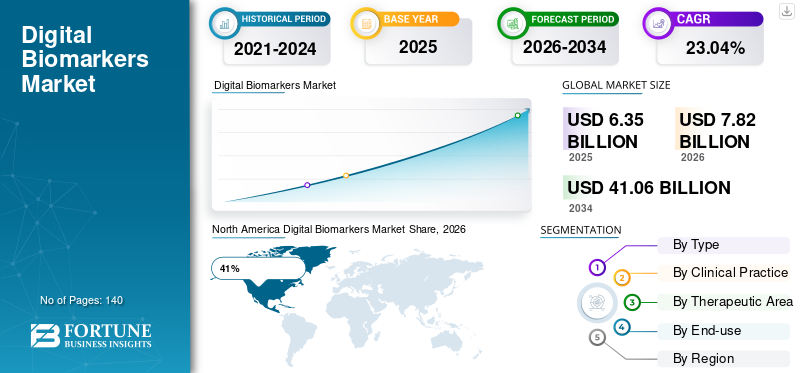
The global digital biomarkers market size was valued at USD 6.35 billion in 2025. The market is projected to grow from USD 7.82 billion in 2026 to USD 41.06 billion by 2034, exhibiting a CAGR of 23.04% during the forecast period. The market in North America dominated with a revenue share of 41% in 2025.

The global digital biomarkers market is expanding rapidly due to increasing adoption of connected healthcare technologies, wearable monitoring devices, and AI-driven patient analytics systems. Digital biomarkers are transforming healthcare delivery by enabling continuous real-time monitoring of physiological and behavioral data through smartphones, wearable sensors, and cloud-based platforms. The digital biomarkers market Report highlights growing demand from pharmaceutical companies, healthcare providers, and clinical research organizations seeking improved patient monitoring and personalized treatment strategies. Rising integration of telehealth services, remote patient monitoring, and predictive analytics technologies is strengthening market expansion. Increasing focus on preventive healthcare, chronic disease management, and digital therapeutics continues to drive long-term digital biomarkers market growth globally.
The United States digital biomarkers market is witnessing strong growth due to widespread adoption of wearable healthcare devices, advanced telemedicine infrastructure, and AI-enabled healthcare analytics platforms. Healthcare providers across the country are increasingly utilizing digital biomarkers for chronic disease monitoring, cardiovascular tracking, neurological assessments, and mental health management. The digital biomarkers industry Analysis indicates strong investment from pharmaceutical companies and biotechnology firms in decentralized clinical trials and remote patient monitoring technologies. Increasing consumer awareness regarding personalized healthcare and preventive medicine is accelerating market demand. Regulatory support for digital health innovation and expanding healthcare data integration capabilities continue to strengthen the long-term outlook of the USA digital biomarkers market.
Download Free sample to learn more about this report.
Digital Biomarkers Market Key Takeaways
 Global Market Size & Forecast
- 2025 Market Size: USD 6.35 Billion
- 2026 Market Size: USD 7.82 Billion
- 2034 Forecast Market Size: USD 41.06 Billion
- CAGR: 23.04% from 2026-2034
 Market Share
- North America dominated with a 41% market share.
- Wearable digital biomarkers accounted for approximately 61% of the market.
- Clinical practice applications held approximately 57% of the market.
 Key Regional Highlights
North America
Dominated with a 41% market share, supported by strong adoption of digital healthcare technologies.
Europe
Held a 27% market share, driven by increasing use of remote patient monitoring.
Asia-Pacific
Accounted for 24% of the market, supported by expanding digital health infrastructure.
U.S.
Market growth is supported by widespread adoption of wearable devices and remote healthcare solutions.
Japan
Accounted for 26% of the Asia-Pacific market, reflecting growing adoption of digital health technologies.
Read More

Digital Biomarkers Market Latest Trends
The digital biomarkers market is evolving rapidly with increasing integration of artificial intelligence, wearable technologies, and cloud-based healthcare analytics platforms. One of the most significant digital biomarkers market trends is the growing use of wearable devices capable of continuously tracking heart rate, sleep patterns, respiratory activity, glucose levels, and neurological functions in real time. Healthcare providers are increasingly relying on these digital signals to improve early disease detection and personalized treatment planning.
Download Free sample to learn more about this report.
AI-driven predictive analytics and machine learning algorithms are also transforming healthcare decision-making processes by identifying disease progression patterns through digital biomarker analysis. The digital biomarkers industry report further highlights increasing demand for digital therapeutics integrated with biomarker platforms for chronic disease management. Rising investment in mental health tracking applications, voice analysis tools, and cognitive monitoring systems continues to shape the future digital biomarkers market outlook across global healthcare ecosystems.
Digital Biomarkers Market Dynamics
DRIVER
Rising Adoption of Remote Patient Monitoring and Connected Healthcare Technologies.
The increasing adoption of remote patient monitoring systems and connected healthcare devices is a major factor driving digital biomarkers market growth worldwide. Healthcare providers are increasingly utilizing wearable sensors, mobile applications, and AI-powered analytics platforms to collect continuous patient health data outside traditional clinical environments. Digital biomarkers enable early disease detection, personalized treatment planning, and improved chronic disease management. The digital biomarkers market analysis highlights strong demand from cardiovascular, neurological, respiratory, and diabetes care sectors where continuous physiological monitoring is critical for treatment optimization. Pharmaceutical companies are also adopting digital biomarkers in clinical trials to improve patient engagement and real-world data collection efficiency. Growing consumer awareness regarding preventive healthcare and wellness tracking is accelerating adoption of wearable health technologies. Advancements in cloud computing, machine learning, and sensor miniaturization continue to improve digital biomarker accuracy and scalability.
RESTRAINT
Data Privacy Concerns and Regulatory Complexities.
Despite strong market expansion, the digital biomarkers market faces restraints associated with healthcare data privacy, cybersecurity risks, and regulatory compliance challenges. Digital biomarker platforms collect large volumes of sensitive patient information through wearable devices and cloud-connected applications, increasing concerns regarding unauthorized access and data misuse. The digital biomarkers market research Report highlights that inconsistent regulatory frameworks for digital health technologies across different countries may slow commercialization and large-scale adoption. Healthcare organizations often face difficulties integrating digital biomarker systems with existing electronic health record infrastructure. High implementation costs and technical interoperability challenges also create barriers for smaller healthcare providers. Patient concerns regarding continuous monitoring and data sharing may further limit adoption in certain demographic groups. In addition, variability in device accuracy, sensor calibration, and clinical validation standards can affect confidence among healthcare professionals.
OPPORTUNITY
Expansion of AI-Powered Precision Healthcare and Digital Therapeutics.
The growing demand for precision medicine and personalized healthcare creates substantial opportunities for the digital biomarkers market. AI-powered analytics systems capable of interpreting real-time physiological and behavioral data are enabling healthcare providers to deliver more accurate and individualized treatment strategies. Digital biomarkers are increasingly being integrated into digital therapeutics platforms for chronic disease management, mental health monitoring, and neurological disorder assessment. The digital biomarkers market forecast indicates strong future demand for smartphone-based diagnostics, voice analysis technologies, and cognitive performance tracking systems. Pharmaceutical companies are also investing heavily in digital biomarker solutions to improve decentralized clinical trial efficiency and real-world evidence generation. Expansion of telehealth services and home-based healthcare delivery models further enhances market opportunities. Wearable healthcare devices integrated with predictive analytics are becoming increasingly important in preventive medicine and elderly care management. Rising investments in AI-driven healthcare platforms and cloud-based patient monitoring technologies continue to create long-term growth potential within the global digital biomarkers market.
CHALLENGE
Standardization Limitations and Clinical Validation Requirements.
One of the key challenges in the digital biomarkers market is the lack of universal standards for data interpretation, clinical validation, and interoperability across healthcare systems. Different wearable devices and mobile health applications often generate inconsistent data formats, creating integration difficulties for healthcare providers and clinical researchers. The digital biomarkers industry Report identifies clinical validation as another major challenge because digital biomarker technologies must demonstrate long-term reliability and medical accuracy before gaining widespread healthcare adoption. Regulatory approval processes for AI-driven healthcare analytics platforms can also be time-consuming and expensive. Another challenge involves ensuring equal accessibility to digital healthcare technologies in rural and underserved populations. Limited digital literacy and inconsistent internet connectivity may restrict adoption in certain regions. Healthcare professionals also require additional training to effectively interpret and utilize digital biomarker data within clinical workflows. These factors continue to influence implementation complexity and commercialization timelines across the global digital biomarkers market.
Digital Biomarkers Market Segmentation
By Type
Wearable digital biomarkers account for approximately 61% of the global digital biomarkers market share and remain the dominant segment due to increasing adoption of smartwatches, fitness trackers, biosensors, and connected medical devices. These technologies continuously collect physiological and behavioral data including heart rate, oxygen saturation, sleep patterns, physical activity, and neurological indicators. The digital biomarkers market Report highlights rising demand for wearable monitoring systems in chronic disease management, elderly care, and preventive healthcare applications. Healthcare providers are increasingly integrating wearable devices into remote patient monitoring programs to improve treatment outcomes and reduce hospital readmissions. Pharmaceutical companies are also using wearable digital biomarkers in decentralized clinical trials to collect real-world patient data more efficiently.
Mobile-based applications represent nearly 39% of the global digital biomarkers market share and continue to gain popularity due to widespread smartphone adoption and expanding telehealth infrastructure. Mobile health applications enable continuous monitoring of cognitive performance, mental health indicators, medication adherence, respiratory conditions, and chronic disease symptoms through integrated digital platforms. The digital biomarkers industry Analysis identifies increasing demand for app-based diagnostics and AI-enabled healthcare monitoring tools across healthcare systems worldwide. Healthcare organizations are utilizing mobile-based digital biomarkers to improve patient engagement and enhance remote healthcare accessibility.
To know how our report can help streamline your business, Speak to Analyst
By Clinical Practice
Clinical practice applications account for approximately 57% of the global digital biomarkers market share due to increasing integration of digital monitoring technologies into hospitals, clinics, and telemedicine platforms. Healthcare providers are utilizing digital biomarkers for early disease detection, chronic condition management, rehabilitation monitoring, and personalized treatment planning. The digital biomarkers market Research Report highlights strong adoption of wearable monitoring systems for cardiovascular care, diabetes management, respiratory disease tracking, and neurological assessments. Remote patient monitoring programs are increasingly relying on digital biomarkers to improve healthcare efficiency and reduce hospital visits. AI-driven healthcare analytics platforms enable clinicians to interpret real-time patient data and identify potential health risks more effectively. Hospitals are integrating digital biomarker systems with electronic health records to enhance clinical decision-making processes.
By Therapeutic Area
Therapeutic area applications contribute nearly 43% market share within the digital biomarkers market and are expanding rapidly across neurology, cardiology, respiratory care, mental health, and metabolic disorder management. Digital biomarkers are increasingly used to monitor disease progression, treatment response, and patient adherence in specialized therapeutic programs. The digital biomarkers market forecast highlights rising use of cognitive monitoring systems, speech analysis tools, and wearable neurological trackers for Alzheimer’s disease, Parkinson’s disease, and mental health conditions. Cardiovascular and respiratory care sectors are also adopting digital biomarker platforms to improve patient monitoring and detect early signs of clinical deterioration. Pharmaceutical companies are utilizing therapeutic-specific digital biomarkers in clinical research and precision medicine development programs.
By End-use
Healthcare companies account for a major share of the digital biomarkers market because of the increasing adoption of connected healthcare technologies, AI-driven patient monitoring systems, and real-time health analytics platforms. Pharmaceutical companies, biotechnology firms, hospitals, diagnostic laboratories, and digital health providers are actively integrating digital biomarkers into clinical workflows, disease management programs, and research operations. The digital biomarkers market Analysis indicates that healthcare companies are using wearable devices, biosensors, and mobile-based applications to monitor chronic diseases, improve patient engagement, and optimize treatment outcomes. Rising demand for decentralized clinical trials and remote patient monitoring solutions is further strengthening the role of healthcare companies within the market.
Digital Biomarkers Market Regional Outlook
North America
North America Digital Biomarkers Market Share, 2026 (%)
To get more information on the regional analysis of this market, Download Free sample
North America dominates the digital biomarkers market with approximately 41% market share and remains the leading region for healthcare technology innovation, wearable device integration, and AI-powered medical analytics. The United States contributes the majority of demand due to advanced healthcare infrastructure, widespread telemedicine adoption, and strong investment in connected healthcare systems. Healthcare providers throughout the region are increasingly integrating digital biomarkers into chronic disease management, cardiovascular monitoring, neurological assessments, and preventive healthcare programs. The digital biomarkers market Report highlights growing use of wearable biosensors, smartphone healthcare applications, and cloud-based patient monitoring systems across hospitals and healthcare networks. Pharmaceutical companies are expanding the use of digital biomarkers in decentralized clinical trials to improve patient engagement and real-world evidence collection. Canada is also strengthening regional growth through healthcare digitization programs and increased adoption of remote monitoring technologies. AI-driven predictive analytics platforms are helping clinicians identify disease progression earlier and improve personalized treatment planning.
Europe
Europe accounts for nearly 27% of the global digital biomarkers market share and continues to witness strong growth supported by healthcare modernization, telemedicine expansion, and digital therapeutics adoption. Countries such as Germany, the United Kingdom, and France are rapidly integrating wearable healthcare technologies and AI-enabled patient monitoring systems into healthcare infrastructure. The digital biomarkers market Research Report highlights increasing demand for remote patient monitoring solutions in cardiovascular care, neurological disease management, respiratory tracking, and mental health applications. European healthcare providers are emphasizing interoperability between digital biomarker platforms and electronic health record systems to improve clinical efficiency and patient care quality. Pharmaceutical companies are utilizing digital biomarkers in decentralized clinical trials to improve operational flexibility and data collection accuracy. Research institutions are developing advanced voice biomarker technologies, cognitive monitoring systems, and predictive analytics tools for personalized healthcare applications. Government-supported healthcare digitization initiatives are encouraging greater adoption of connected healthcare ecosystems across hospitals and clinics.
Germany Digital Biomarkers Market
Germany holds approximately 32% share within the European digital biomarkers market and remains one of the region’s strongest healthcare technology and medical innovation centers. German healthcare providers are increasingly integrating wearable devices, AI-powered analytics platforms, and remote patient monitoring technologies into chronic disease management and preventive healthcare programs. The digital biomarkers market Analysis highlights rising investment in digital therapeutics, predictive healthcare systems, and decentralized clinical trial infrastructure throughout Germany. Pharmaceutical companies are collaborating with technology firms to enhance real-world evidence collection and improve personalized treatment strategies. Research institutions are focusing on advanced biosensors, neurological monitoring systems, and cloud-connected patient care platforms. Government support for healthcare digitization and telemedicine expansion is accelerating market development across hospitals and clinical networks. Increasing demand for connected healthcare devices and wellness monitoring applications continues to strengthen Germany’s digital biomarkers market growth trajectory.
United Kingdom Digital Biomarkers Market
The United Kingdom accounts for approximately 24% share of the European digital biomarkers market and continues to expand through rising adoption of connected healthcare technologies, wearable monitoring devices, and AI-driven patient analytics systems. Healthcare providers across the country are increasingly utilizing digital biomarkers for cardiovascular monitoring, respiratory care, neurological assessment, and mental health management. The digital biomarkers market forecast highlights strong investment in smartphone-based diagnostics, cloud healthcare infrastructure, and predictive analytics platforms throughout the United Kingdom. Pharmaceutical companies are integrating digital biomarkers into decentralized clinical trials to improve patient participation and operational efficiency. Hospitals and telemedicine providers are emphasizing remote patient monitoring systems to reduce healthcare costs and improve treatment outcomes. Research institutions are also advancing voice biomarker technologies and AI-based cognitive monitoring systems for neurological disorders. Rising awareness regarding preventive healthcare and personalized medicine continues to support strong demand for digital biomarker solutions across the UK healthcare ecosystem.
Asia-Pacific
Asia-Pacific represents approximately 24% of the global digital biomarkers market share and is emerging as one of the fastest-growing regions due to expanding smartphone penetration, increasing telemedicine adoption, and rising investment in connected healthcare technologies. Countries including China, Japan, India, and South Korea are rapidly integrating wearable healthcare devices and AI-powered analytics platforms into healthcare systems. The digital biomarkers market Report highlights strong demand for remote patient monitoring solutions across urban healthcare centers and underserved rural regions. Governments throughout Asia-Pacific are investing heavily in healthcare digitization and telehealth infrastructure to improve healthcare accessibility and efficiency. Smartphone-based healthcare applications are becoming increasingly important for chronic disease management, preventive healthcare, and mental health monitoring. Technology companies are collaborating with healthcare providers to develop cloud-connected patient monitoring systems capable of delivering real-time clinical insights. Pharmaceutical manufacturers are utilizing digital biomarkers in clinical research and decentralized trials to improve patient data collection. Expanding consumer awareness regarding wellness tracking devices and wearable biosensors continues to strengthen regional market growth.
Japan Digital Biomarkers Market
Japan accounts for approximately 26% share within the Asia-Pacific digital biomarkers market and remains a global leader in wearable healthcare technologies, robotics integration, and AI-powered medical systems. Japanese healthcare providers are increasingly utilizing digital biomarkers for elderly care monitoring, chronic disease management, neurological assessments, and preventive medicine applications. The digital biomarkers market Research Report highlights strong investment in biosensors, cognitive monitoring technologies, and smartphone-based healthcare diagnostics across Japan. Research institutions and healthcare companies are developing advanced predictive analytics systems for early disease detection and personalized treatment optimization. Pharmaceutical firms are also integrating digital biomarkers into clinical trial programs to improve treatment monitoring and patient engagement. Government support for telemedicine expansion and healthcare digitization continues to accelerate market development. High consumer adoption of wearable wellness devices and connected healthcare technologies further strengthens Japan’s digital biomarkers market outlook.
China digital biomarkers market
China holds approximately 38% share within the Asia-Pacific digital biomarkers market and continues to dominate regional growth due to strong healthcare digitization initiatives, expanding smartphone healthcare adoption, and increasing investment in artificial intelligence technologies. Healthcare providers across China are rapidly integrating wearable healthcare devices and AI-powered patient monitoring systems into cardiovascular care, diabetes management, respiratory monitoring, and preventive healthcare services. The digital biomarkers market outlook highlights substantial government investment in telemedicine infrastructure, cloud healthcare systems, and AI-enabled medical analytics platforms. Technology companies are developing smartphone-based diagnostic applications and connected biosensors designed for large-scale healthcare deployment. Pharmaceutical manufacturers are increasingly utilizing digital biomarkers in decentralized clinical trials and personalized medicine programs. China’s strong consumer electronics manufacturing ecosystem also supports large-scale production of wearable healthcare devices and connected biosensors.
Rest of World
The Rest of World region contributes approximately 8% of the global digital biomarkers market share and includes Latin America, the Middle East, and Africa. These regions are gradually increasing adoption of digital healthcare technologies due to expanding telemedicine infrastructure, growing smartphone penetration, and rising healthcare modernization efforts. Healthcare providers are increasingly utilizing digital biomarkers for chronic disease monitoring, preventive medicine, maternal healthcare, and remote patient management applications. The digital biomarkers market Report highlights growing demand for wearable healthcare devices and cloud-based patient monitoring systems in underserved and remote areas where traditional healthcare access remains limited. Governments and healthcare organizations are investing in telehealth platforms and AI-enabled healthcare analytics to improve healthcare accessibility and operational efficiency. Middle Eastern countries are focusing on smart healthcare infrastructure and connected medical technologies to strengthen healthcare delivery systems. Latin American healthcare providers are integrating wearable monitoring systems into diabetes and cardiovascular management programs.
List of Top Digital Biomarkers Companies
- ActiGraph LLC
- AliveCor Inc.
- Koneksa
- Altoida Inc.
- Amgen Inc.
- Biogen Inc.
- Empatica Inc.
- Vivo Sense
- IXICO plc
- Adherium Limited
- Neurotrack Technologies, Inc.
- Aural Analytic
- Huma
- Sonde Health, Inc.
- Clario
- Imagene AI
- Brainomix
- Kinsa Inc.
- Feel Therapeutics
Top Two Companies by Market Share
- AliveCor Inc. – Approximately 15% market share
- ActiGraph LLC – Approximately 12% market share
Investment Analysis and Opportunities
The digital biomarkers market is attracting significant investment from healthcare technology companies, pharmaceutical manufacturers, venture capital firms, and AI healthcare startups. Rising demand for connected healthcare systems, remote patient monitoring technologies, and personalized medicine platforms is encouraging strong capital inflow into the industry. Investors are particularly focusing on AI-driven analytics, wearable biosensors, cloud-based healthcare platforms, and decentralized clinical trial technologies.
North America remains the largest investment hub due to strong healthcare digitization and wearable technology adoption, while Asia-Pacific is emerging as a fast-growing market supported by smartphone healthcare expansion. Increasing collaborations between technology firms, pharmaceutical companies, and healthcare institutions continue to create substantial commercialization opportunities across the global digital biomarkers market.
New Product Development
New product development in the digital biomarkers market is centered around AI-powered healthcare analytics, wearable biosensors, smartphone-based diagnostics, and cloud-connected patient monitoring platforms. Companies are developing advanced wearable devices capable of continuously tracking cardiovascular activity, neurological functions, respiratory patterns, and metabolic indicators in real time.
Manufacturers are also introducing compact biosensors with improved battery efficiency, wireless connectivity, and predictive analytics integration. Pharmaceutical companies are collaborating with digital health firms to develop biomarker-driven decentralized clinical trial platforms. AI-enabled healthcare systems capable of identifying disease progression patterns through real-time patient data analysis are becoming increasingly important across healthcare ecosystems. Rising demand for preventive medicine and personalized digital therapeutics continues to accelerate innovation within the global digital biomarkers market.
Five Recent Developments (2023-2025)
- AliveCor Inc. expanded AI-powered cardiac monitoring capabilities in 2024 to improve remote cardiovascular diagnostics.
- Empatica Inc. introduced advanced wearable neurological monitoring solutions in 2023 for epilepsy and stress management applications.
- Huma strengthened digital health partnerships with healthcare providers in 2025 to enhance remote patient monitoring services.
- Clario expanded decentralized clinical trial technologies in 2024 through integration of advanced digital biomarker analytics platforms.
- Altoida Inc. increased investment in cognitive assessment technologies during 2025 for early Alzheimer’s disease detection and monitoring.
Report Coverage of digital biomarkers market
The digital biomarkers market Report provides comprehensive analysis of healthcare digitization trends, wearable technology advancements, AI-driven analytics systems, and remote patient monitoring innovations shaping the global digital healthcare ecosystem. The report evaluates major growth drivers influencing digital biomarkers market expansion, including increasing telemedicine adoption, chronic disease prevalence, personalized healthcare demand, and decentralized clinical trial development.
Request for Customization to gain extensive market insights.
Regional analysis spans North America, Europe, Asia-Pacific, and Rest of World markets with country-level insights focused on healthcare infrastructure, digital technology adoption, and regulatory support for connected healthcare systems. The digital biomarkers industry Report also evaluates competitive strategies adopted by leading digital health companies, including partnerships, product launches, AI integration, and wearable technology expansion initiatives. Emerging innovations such as predictive healthcare analytics, voice biomarkers, smartphone diagnostics, and cloud-connected therapeutics platforms are extensively analyzed to provide strategic insights for investors, healthcare providers, and technology developers.
Frequently Asked Questions
Fortune Business Insights says that the global market value stood at USD 6.35 billion in 2025 and is projected to reach USD 41.06 billion by 2034.
The market is expected to exhibit a CAGR of 23.04% during the forecast period of 2026-2034.
Wearable digital biomarkers was the leading type segment, accounting for approximately 61% of the market, driven by increasing adoption of smartwatches, fitness trackers, biosensors, and connected medical devices.
Key players include ActiGraph LLC, AliveCor Inc., Koneksa, Altoida Inc., Amgen Inc., and Biogen Inc.
Major trends include increasing integration of AI, wearable technologies, and cloud-based healthcare analytics, alongside growing use of real-time digital signals for early disease detection and personalized treatment. North America dominated with a 41% share in 2025.



- 2021-2034
- 2025
- 2021-2024
- 140
-

(Offer valid till 30th Sep 2026)
Get 30-60 hrs Free Customization
Expand Regional and Country Coverage, Segments Analysis, Company Profiles, Competitive Benchmarking, and End-user Insights.













.webp)






-
US +1 833 909 2966 ( Toll Free )
-
Get In Touch With Us