 Download Free Sample



Get a Quote
Receive a tailored pricing based on your needs.
- Choose license type
- Multiple user options
- Custom scope & coverage
- Fast turnaround
"Designing Growth Strategies is in our DNA"
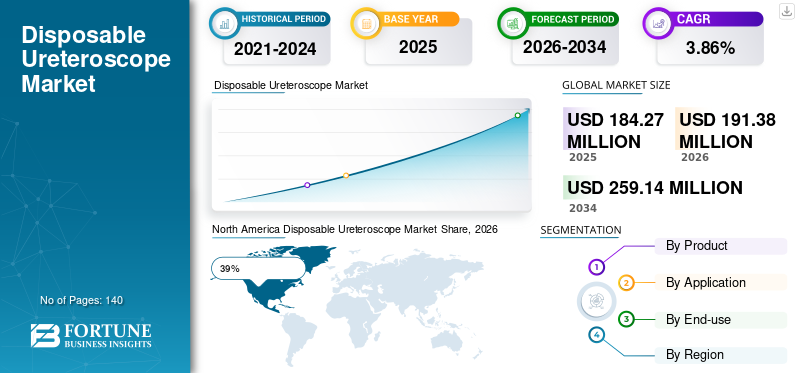
The global disposable ureteroscope market size was valued at USD 184.27 Million in 2025. The market is projected to grow from USD 191.38 Million in 2026 to USD 259.14 Million by 2034, exhibiting a CAGR of 3.86% during the forecast period.

The disposable ureteroscope market is experiencing significant expansion as healthcare providers increasingly prioritize infection prevention, procedural efficiency, and consistent clinical performance. Disposable ureteroscopes have emerged as an effective alternative to reusable devices, eliminating the need for sterilization, maintenance, and repair processes. Growing prevalence of kidney stones, urinary tract disorders, and other urological conditions has increased the number of ureteroscopy procedures performed globally, creating favorable conditions for market development. Hospitals and ambulatory surgical centers are adopting single-use technologies to reduce operational complexities and improve patient safety. Technological advancements including enhanced digital imaging, improved flexibility, and superior maneuverability continue to strengthen product adoption. The disposable ureteroscope market report highlights growing investments in minimally invasive surgical technologies, increasing awareness regarding cross-contamination risks, and expanding healthcare infrastructure as key factors supporting market expansion. Market participants are focusing on product innovation, strategic partnerships, and geographic expansion to strengthen their competitive positions within the global industry.
The United States represents the largest and most advanced market for disposable ureteroscopes. High incidence of kidney stone disease, advanced healthcare infrastructure, and widespread adoption of minimally invasive surgical procedures contribute significantly to market demand. U.S. healthcare facilities increasingly prefer disposable ureteroscopes due to their ability to eliminate reprocessing costs and reduce risks associated with contamination. Large hospital systems and ambulatory surgery centers are integrating single-use devices into routine urology practices to enhance workflow efficiency and procedural reliability. Continuous innovation by leading manufacturers, combined with favorable reimbursement environments and strong physician awareness, supports market growth. The Disposable Ureteroscope industry analysis indicates that healthcare providers across the United States are focusing on value-based care models, making disposable technologies attractive due to their predictable performance and reduced maintenance requirements. Growing investments in urology departments and advanced endoscopic systems further support market expansion across the country.
Download Free sample to learn more about this report.
 Global Market Size & Forecast
 Market Share
 Key Regional Highlights
North America
North America led the market with a 39% share, supported by advanced urology care infrastructure and increasing adoption of minimally invasive procedures.
Europe
Europe accounted for 29% of the market, driven by growing demand for advanced endourology technologies and minimally invasive treatments.
Asia-Pacific
Asia-Pacific held a 24% share, supported by rising kidney stone prevalence and expanding healthcare infrastructure.
U.S
The U.S. remains a key market, supported by advanced urological care and strong adoption of minimally invasive kidney stone treatments.
Japan
Japan accounted for approximately 16% of the Asia-Pacific market, supported by advanced healthcare infrastructure and growing adoption of endourology technologies.
Read More

The disposable ureteroscope market trends indicate increasing adoption of advanced digital visualization systems that enhance procedural accuracy and clinical outcomes. Manufacturers are introducing high-definition imaging platforms capable of providing superior visualization of urinary tract anatomy, enabling more precise diagnosis and treatment. Enhanced tip deflection technology, improved irrigation systems, and lightweight device designs are becoming important differentiators in the competitive landscape. Healthcare providers are increasingly evaluating procedural efficiency and infection prevention benefits when selecting ureteroscope technologies, driving demand for single-use alternatives.
Download Free sample to learn more about this report.
Another important trend shaping the disposable ureteroscope market outlook is the rapid expansion of outpatient urological procedures. Ambulatory surgery centers are emerging as significant end users because disposable devices simplify workflow management and eliminate sterilization requirements. Artificial intelligence-assisted imaging, integrated procedure documentation capabilities, and cloud-based data management solutions are beginning to influence product development strategies. Manufacturers are also focusing on sustainability initiatives, including recyclable packaging materials and environmentally responsible manufacturing processes. Strategic collaborations between medical device companies and healthcare providers are accelerating adoption rates while improving physician training and product awareness. These trends collectively contribute to a dynamic and highly competitive market environment.
Rising Prevalence of Kidney Stone Disease and Increasing Demand for Infection-Control Solutions
The primary driver of disposable ureteroscope market Growth is the increasing incidence of kidney stones and related urological disorders worldwide. Growing patient populations requiring minimally invasive interventions are creating substantial demand for advanced ureteroscopy technologies. Disposable ureteroscopes eliminate the risk of contamination associated with reusable devices, making them particularly attractive in healthcare environments focused on patient safety and infection prevention. Hospitals benefit from reduced sterilization requirements, lower maintenance expenses, and consistent device performance across procedures. Increasing awareness of healthcare-associated infections has accelerated the transition toward single-use technologies, particularly in developed healthcare systems. Furthermore, advancements in imaging quality, device flexibility, and ergonomic design are enhancing clinical effectiveness and physician acceptance. Healthcare providers are increasingly recognizing the operational advantages of disposable ureteroscopes, including improved workflow efficiency and reduced downtime associated with equipment repairs. These factors collectively support strong demand across hospitals, specialty clinics, and ambulatory surgical centers.
Higher Acquisition Costs Compared with Reusable Ureteroscope Systems
One of the primary restraints affecting the disposable ureteroscope market is the higher per-procedure acquisition cost associated with single-use devices. While disposable ureteroscopes eliminate expenses related to reprocessing, sterilization, and repair, some healthcare facilities continue to focus on initial purchasing costs when evaluating procurement decisions. Budget limitations in smaller hospitals and healthcare centers may restrict adoption, particularly in developing regions where healthcare resources are constrained. Existing investments in reusable ureteroscope infrastructure can also slow the transition toward disposable alternatives. Environmental concerns regarding medical waste generation have emerged as another challenge influencing purchasing decisions among healthcare administrators. In addition, reimbursement limitations in certain healthcare systems may affect adoption rates. Although total ownership cost analyses often demonstrate long-term advantages for disposable technologies, resistance to changing established clinical practices remains a factor influencing market penetration.
Expansion of Ambulatory Surgical Centers and Emerging Healthcare Markets
Significant opportunities exist within the disposable ureteroscope market due to the rapid expansion of ambulatory surgical centers and emerging healthcare systems. Outpatient facilities prioritize efficiency, rapid patient turnover, and simplified operational workflows, making disposable ureteroscopes highly attractive. These devices eliminate sterilization requirements and reduce equipment management complexities, supporting efficient procedure scheduling and resource utilization. Emerging economies are investing heavily in healthcare modernization, creating favorable conditions for advanced medical device adoption. Increasing physician training programs and greater awareness of minimally invasive treatment options are expanding procedural volumes in these regions. Manufacturers are introducing cost-effective product portfolios tailored to diverse healthcare settings, further supporting market penetration. Strategic distribution partnerships, localized manufacturing capabilities, and healthcare infrastructure investments are creating new growth opportunities across Asia-Pacific, Latin America, the Middle East, and Africa. These developments are expected to enhance the long-term growth potential of the disposable ureteroscope market forecast.
Environmental Sustainability and Medical Waste Management Concerns
A major challenge facing the Disposable Ureteroscope Industry Report is the growing emphasis on environmental sustainability within healthcare systems. Disposable medical devices contribute to increased medical waste volumes, prompting concerns among healthcare administrators, policymakers, and environmental organizations. Manufacturers must balance infection-control benefits with sustainability objectives while maintaining product quality and performance. Developing recyclable components, environmentally friendly packaging materials, and waste reduction initiatives requires significant investment in research and development. Regulatory pressures related to environmental compliance are also increasing in several regions. Healthcare facilities are evaluating the environmental impact of procurement decisions, influencing purchasing strategies and supplier selection processes. Additionally, establishing effective recycling and waste management programs for disposable medical devices remains complex. Addressing these challenges will require ongoing innovation and collaboration between manufacturers, healthcare providers, and regulatory authorities.
Flexible ureteroscopes account for approximately 67% of the disposable ureteroscope market due to their superior maneuverability, enhanced accessibility to the upper urinary tract, and growing utilization in minimally invasive kidney stone treatment procedures. disposable ureteroscope market analysis indicates that flexible disposable ureteroscopes are extensively utilized in laser lithotripsy, stone extraction, and diagnostic ureteroscopy because they provide improved navigation within complex renal anatomies. Healthcare facilities increasingly prefer flexible single-use devices because they eliminate sterilization requirements and minimize contamination risks associated with reusable scopes. Rising demand for outpatient kidney stone management procedures and increasing physician preference for minimally invasive treatment options continue to strengthen market expansion within this segment. Manufacturers are investing heavily in advanced imaging systems, ergonomic device structures, and improved deflection capabilities designed to enhance procedural precision and visualization quality.
Rigid ureteroscopes represent approximately 33% of the disposable ureteroscope market and remain important for lower urinary tract procedures and straightforward ureteroscopic interventions requiring stable instrumentation and high optical clarity. disposable ureteroscope market Insights indicate that rigid disposable ureteroscopes are commonly utilized for diagnostic evaluations, ureteral stone treatment, and specific interventional procedures where flexibility requirements are limited. These devices offer durability, simplified handling characteristics, and reliable imaging performance, making them suitable for selected clinical applications within urology departments and specialty clinics. Manufacturers are increasingly introducing compact rigid disposable ureteroscope systems featuring improved optical resolution and enhanced patient comfort during procedures.
To know how our report can help streamline your business, Speak to Analyst
Stone Management accounts for approximately 72% of the disposable ureteroscope market due to the increasing global prevalence of kidney stone disorders and growing adoption of minimally invasive lithotripsy procedures. disposable ureteroscope market analysis indicates that disposable ureteroscopes are extensively utilized for laser lithotripsy, ureteral stone extraction, and complex renal stone management because they provide superior maneuverability, improved visualization, and reliable procedural performance. Hospitals and ambulatory surgical centers increasingly prefer single-use ureteroscopes for stone management procedures because they eliminate cross-contamination risks, reduce maintenance expenses, and improve operational efficiency. Rising patient demand for minimally invasive treatments and shorter recovery periods continues to strengthen market expansion. disposable ureteroscope market trends reveal growing integration of high-definition digital imaging systems and enhanced laser compatibility designed to improve treatment precision and stone visualization. Increasing investments in outpatient kidney stone treatment infrastructure and advanced endourology technologies are expected to support continued growth within this application segment globally.
Hospitals account for approximately 61% of the disposable ureteroscope market due to the large volume of endourological procedures performed within hospital-based surgical and urology departments. disposable ureteroscope market analysis indicates that hospitals increasingly adopt single-use ureteroscopes to improve infection prevention, optimize workflow efficiency, and reduce costs associated with reprocessing and equipment repairs. Growing incidence of kidney stones, urinary tract disorders, and minimally invasive surgical interventions continues to support strong procedural demand within healthcare institutions. Hospitals are investing heavily in advanced digital imaging technologies, laser lithotripsy systems, and integrated urology operating suites to improve patient outcomes and procedural precision. disposable ureteroscope market trends reveal increasing preference for disposable flexible ureteroscopes capable of delivering high-definition imaging and enhanced maneuverability during complex procedures. Expansion of same-day discharge protocols and increasing focus on patient safety standards continue to strengthen commercial opportunities within the hospital segment globally.
North America Disposable Ureteroscope Market Share, 2026 (%)
To get more information on the regional analysis of this market, Download Free sample
North America accounted for approximately 39% of the global disposable ureteroscope market share due to strong healthcare infrastructure, advanced surgical technologies, and increasing demand for minimally invasive urology procedures. The region continues to witness rising prevalence of kidney stone disease and urinary tract disorders, which significantly increases the number of ureteroscopy procedures performed annually. Hospitals and ambulatory surgical centers across the United States and Canada are increasingly adopting disposable ureteroscopes because they reduce risks associated with cross-contamination and eliminate the need for sterilization and maintenance. Healthcare providers are emphasizing operational efficiency, patient safety, and reduced procedural downtime, which supports the transition toward single-use devices. Continuous innovation in digital imaging systems, flexible endoscopic designs, and enhanced maneuverability features is further improving physician preference for disposable ureteroscopes. Leading manufacturers are heavily investing in research and development activities while expanding physician training programs across the region. Favorable reimbursement systems, high healthcare expenditure, and strong adoption of technologically advanced medical devices continue to strengthen market growth.
Europe held nearly 29% of the disposable ureteroscope market share, supported by advanced healthcare systems, rising awareness regarding infection prevention, and increasing use of minimally invasive surgical technologies. Countries such as Germany, the United Kingdom, France, and Italy are witnessing strong adoption of disposable ureteroscopes due to growing concerns regarding contamination risks associated with reusable endoscopic devices. Hospitals and specialty urology centers are increasingly focusing on patient safety, procedural efficiency, and cost optimization, encouraging the use of single-use technologies. The region benefits from strong regulatory standards, continuous healthcare modernization programs, and increasing investments in advanced medical equipment. Physicians are increasingly preferring disposable ureteroscopes because these devices provide consistent imaging quality, improved procedural reliability, and reduced maintenance requirements. Manufacturers operating in Europe are introducing technologically advanced products featuring enhanced flexibility, high-definition imaging, and ergonomic designs to strengthen competitive positioning. Rising demand for outpatient procedures and increasing expansion of ambulatory surgical centers are also supporting market growth.
Germany represented around 28% of the European disposable ureteroscope market and maintained its position as the leading country within the regional industry. The country benefits from advanced healthcare infrastructure, strong medical technology expertise, and high adoption of innovative urology solutions. Hospitals and specialty clinics across Germany are increasingly integrating disposable ureteroscopes into clinical practice to improve infection prevention and reduce operational burdens related to sterilization and maintenance. Rising incidence of kidney stone disease and increasing preference for minimally invasive procedures continue to support market demand. Healthcare providers are emphasizing high-quality patient care and procedural efficiency, encouraging adoption of technologically advanced endoscopic systems. Physicians strongly prefer devices that provide superior imaging quality, enhanced maneuverability, and reliable clinical performance during complex procedures. Germany also benefits from substantial healthcare expenditure and continuous investments in digital healthcare technologies. Medical device manufacturers are expanding their presence through product launches, research collaborations, and physician education initiatives.
The United Kingdom accounted for nearly 21% of the European disposable ureteroscope market due to increasing adoption of minimally invasive urological procedures and rising focus on infection-control solutions. Hospitals and ambulatory surgical centers across the country are gradually transitioning toward disposable endoscopic technologies to improve workflow efficiency and reduce maintenance-related challenges. Growing prevalence of kidney stone disease and urinary tract disorders is increasing the number of ureteroscopy procedures performed annually, supporting demand for advanced disposable ureteroscopes. Healthcare providers are increasingly prioritizing patient safety and procedural reliability, which encourages the use of single-use devices. The market is also benefiting from modernization initiatives within the healthcare system and increasing investments in advanced medical technologies. Physicians are recognizing the advantages of disposable ureteroscopes in terms of consistent imaging performance, reduced contamination risks, and operational convenience. Manufacturers are strengthening distribution networks and introducing technologically advanced products tailored to the requirements of healthcare institutions.
Asia-Pacific captured approximately 24% of the global disposable ureteroscope market share and remains one of the fastest-growing regional markets due to rapid healthcare infrastructure development and increasing demand for advanced urology technologies. Countries including China, Japan, India, South Korea, and Australia are experiencing rising prevalence of kidney stone disease and urinary tract disorders, creating substantial demand for minimally invasive procedures. Governments and private healthcare organizations are investing heavily in hospital modernization, digital healthcare systems, and advanced medical equipment. Healthcare providers across the region are increasingly adopting disposable ureteroscopes to improve infection prevention and simplify operational workflows. Growing physician awareness regarding the benefits of single-use devices is also contributing to market expansion. Manufacturers are actively strengthening regional presence through strategic partnerships, localized manufacturing initiatives, and product customization strategies. Technological advancements such as high-definition imaging systems, lightweight designs, and improved flexibility are supporting physician adoption. Expanding ambulatory surgical centers and increasing outpatient procedure volumes are further driving demand. Asia-Pacific continues to attract significant investment from global medical device manufacturers due to its large patient population and rapidly evolving healthcare landscape.
Japan contributed nearly 16% of the Asia-Pacific disposable ureteroscope market due to its advanced healthcare infrastructure and strong adoption of innovative medical technologies. The country’s healthcare system emphasizes precision, efficiency, and patient safety, which creates strong demand for advanced minimally invasive treatment solutions. Rising prevalence of urological disorders among the aging population is increasing demand for ureteroscopy procedures across hospitals and specialty clinics. Healthcare providers are increasingly integrating disposable ureteroscopes into clinical practice because these devices reduce contamination risks and eliminate sterilization requirements. Physicians strongly prefer technologically advanced devices featuring superior imaging quality, enhanced maneuverability, and ergonomic designs that improve procedural outcomes. Continuous investments in healthcare modernization and digital medical technologies are further supporting market growth. Manufacturers are focusing on introducing next-generation disposable ureteroscope systems equipped with advanced visualization capabilities and improved procedural performance. The Japanese market also benefits from strong physician training programs and widespread awareness regarding infection prevention standards.
China accounted for approximately 14% of the Asia-Pacific disposable ureteroscope market and represented the largest national market within the region. Rapid healthcare infrastructure expansion, increasing healthcare expenditure, and rising prevalence of kidney stone disease are significantly contributing to market demand. Hospitals across major metropolitan regions are investing heavily in advanced endoscopic technologies to improve procedural outcomes and support growing patient volumes. Healthcare providers are increasingly adopting disposable ureteroscopes because these devices reduce sterilization challenges and enhance infection prevention during surgical procedures. Government initiatives promoting healthcare modernization and advanced medical technology adoption are creating favorable market conditions. Domestic and international manufacturers are actively strengthening market presence through localized production capabilities, strategic partnerships, and expanded distribution networks.
The Rest of World region represented nearly 8% of the global disposable ureteroscope market share and includes Latin America, the Middle East, and Africa. Although adoption rates remain lower compared with developed regions, improving healthcare infrastructure and increasing awareness regarding advanced urological treatment technologies are creating new opportunities for market participants. Hospitals and private healthcare providers are gradually incorporating minimally invasive surgical procedures to improve patient outcomes and operational efficiency. Disposable ureteroscopes are gaining attention because they eliminate sterilization requirements and reduce contamination risks associated with reusable devices. Governments and healthcare organizations across emerging economies are investing in hospital modernization programs and advanced medical equipment procurement. Growing physician training initiatives and increasing access to specialized healthcare services are supporting adoption of disposable endoscopic technologies. Manufacturers are focusing on expanding regional distribution networks and introducing cost-effective products tailored to local healthcare requirements. Rising prevalence of urinary tract disorders and increasing outpatient treatment capabilities are also contributing to market growth.
The disposable ureteroscope market Opportunities landscape is attracting increasing investment from medical device manufacturers, healthcare technology investors, and strategic stakeholders seeking exposure to high-growth minimally invasive treatment segments. Capital investment is focused on product innovation, advanced imaging technologies, manufacturing expansion, and geographic market penetration. Companies are allocating substantial resources toward research and development activities aimed at improving visualization quality, device flexibility, and overall procedural efficiency.
Emerging healthcare markets offer particularly attractive investment opportunities due to ongoing infrastructure development and increasing demand for advanced urological procedures. Expansion of ambulatory surgical centers and outpatient treatment facilities further supports investment potential. Strategic acquisitions, technology partnerships, and distribution network expansion initiatives are expected to remain important investment themes throughout the industry. Sustainability-focused product development also represents a growing area of interest among investors and healthcare providers.
Innovation remains a central component of the disposable ureteroscope market outlook. Manufacturers are introducing next-generation devices featuring high-definition digital imaging, improved irrigation performance, enhanced maneuverability, and optimized ergonomic designs. These advancements are intended to improve physician experience and procedural outcomes while maintaining operational efficiency.
Recent product development efforts have focused on integrating advanced visualization technologies and improving compatibility with laser lithotripsy systems. Several manufacturers are exploring artificial intelligence-supported imaging capabilities that assist physicians during procedures. Lightweight construction materials, enhanced tip deflection systems, and durable single-use designs continue to drive competitive differentiation. Environmental sustainability considerations are also influencing development strategies, resulting in greater emphasis on recyclable materials and reduced packaging waste.
The disposable ureteroscope market research report provides a comprehensive assessment of industry structure, market trends, competitive dynamics, technological developments, and growth opportunities. The report evaluates product categories, application segments, regional performance, and strategic initiatives undertaken by leading manufacturers. It also examines the impact of healthcare infrastructure development, infection-control requirements, and evolving procedural practices on market demand.
Request for Customization to gain extensive market insights.
The Disposable Ureteroscope Industry Report includes detailed segmentation analysis covering flexible and rigid ureteroscopes, hospitals, ambulatory surgical centers, and specialty clinics. Regional evaluation encompasses North America, Europe, Asia-Pacific, and Rest of World markets, along with country-level insights for key national markets. Competitive benchmarking, investment analysis, innovation assessment, and emerging opportunity identification provide valuable insights for manufacturers, investors, distributors, and healthcare decision-makers seeking to understand the evolving market landscape.
Fortune Business Insights says that the global market value stood at USD 184.27 million in 2025 and is projected to reach USD 259.14 million by 2034.
The market is expected to exhibit a CAGR of 3.86% during the forecast period of 2026-2034.
Flexible ureteroscopes led the product segment with approximately 67% market share, driven by their superior maneuverability and accessibility to the upper urinary tract.
Key players include Boston Scientific Corporation, Richard Wolf GmbH, Olympus Corporation, FUJIFILM Holdings Corporation, Karl Storz GmbH, and Smith & Nephew Inc.
Key trends include increasing adoption of advanced digital visualization systems and enhanced tip-deflection technologies, alongside growing use of disposable ureteroscopes in outpatient urological procedures. North America led the market with a 39% share.


(Offer valid till 15th Nov 2026)
Get 30-60 hrs Free Customization
Expand Regional and Country Coverage, Segments Analysis, Company Profiles, Competitive Benchmarking, and End-user Insights.













.webp)






Get In Touch With Us
US +1 833 909 2966 ( Toll Free )
Receive a tailored pricing based on your needs.
Discuss your questions with our industry experts.
Have questions? Get quick answers before you purchase.

