 Download Free Sample
 The pharmaceutical companies segment is expected to lead the market by end user, contributing 58.60% globally in 2026. Large pharmaceutical companies display dedicated DCS lines for patented biological products and lyophilised products to maintain control over critical filling processes. Its acquisition strategy is focused on validated solutions, long-term service contracts and perfect integration with existing business quality systems.
Dual Chamber Syringe (DCS) Filling Machine Market Size, Share & Industry Analysis, By Type (Fully Automatic, Semi-Automatic, and Manual), By End User (Pharmaceutical Companies, Biotechnology Companies, CMOs & CDMOs, and Others), and Regional Forecast, 2026-2034
KEY MARKET INSIGHTS
 Listen to Audio Version
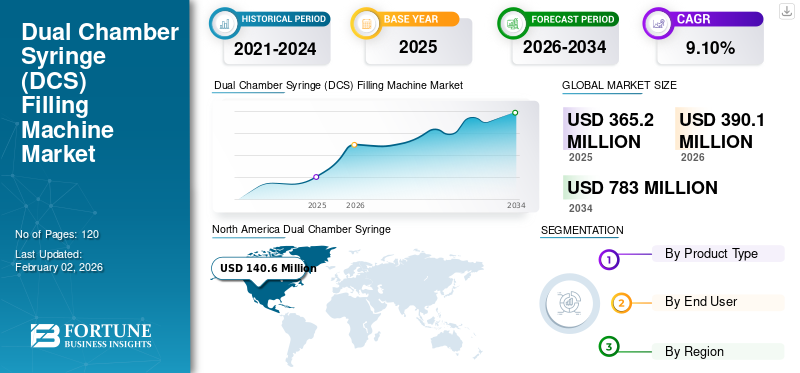
The global dual chamber syringe (DCS) filling machine market size was valued at USD 365.2 million in 2025 and is projected to grow from USD 390.1 million in 2026 to USD 783.0 million by 2034, exhibiting a CAGR of 9.10% during the forecast period. North America dominated the dual chamber syringe (DCS) filling machine market with a market share of 38.50% in 2025.
The market is emerging as an important part of the pharmaceutical manufacturing panorama, inspired by the need for safe, accurate, and sterile filled solutions. These machines allow efficient management of complex formulations, including organic and lyophilized drugs, ensuring an accurate dose and stability of extended drugs.
The market is growing rapidly due to the growing role of biological products and vaccine production and increasing role of contract manufacturing organizations. In addition, advancements in automation and robotics are increasing production efficiency, while strict regulatory requirements and safety continue to drive demand.
A few prominent players operating in the market are Syntegon Technologies, Prosys Servo Filling Systems, Dara Pharmaceutical Packaging, TurboFil Packaging Machines, and Optima Machinery Corporation.
Download Free sample to learn more about this report.
MARKET DYNAMICS
Market Drivers
Growth in Biologics and Lyophilized Injectables Drives the Market Development
The growth in biologics and lyophilized injectables is driving the global dual chamber syringe (DCS) filling machine market growth. The market is experiencing a significant growth, driven by a convergence of factors that are reforming the pharmaceutical and biotechnological sectors. As the biopharmaceutical industry grows, there is a greater need for specialized delivery systems that can guarantee the proper stability and administration of complex drug formulations.
For example, Nipro Corporation has invested USD 14 million in its German and Japanese plants to expand the production capacity of preferred syringes. The company is also developing preferred double camera syringes to treat patients with prostate and breast cancer. This highlights the industry approach in developing advanced medication management systems for complex and sensitive medicine formulations.
Market Restraints
High Capital Cost and Stringent Validation Requirements Hampers the Market Growth
One of the key hampering factors for the market of the filling machine of the dual chamber syringe is the high cost of capital and the strict validation requirements associated with these systems. Early investment is sufficient to get advanced DC filling machines, which present a challenge to small and medium-sized pharmaceutical companies. In addition, complex verification and compliance processes ordered by regulatory officers require significant time, experience, and financial resources, for further adoption.
Market Opportunities
Outsourcing to CMOs & CDMOs (fill–finish capacity expansion) Offers Lucrative Growth Opportunities
The subcontracting of filling operations and contract-manufacturing organizations (CMO) and the development of contract-manufacturing organizations (CDM) present a significant opportunity for the double chamber syringe DCS filling machine market. This trend is driven by the high cost of new technological systems, such as insulators and restricted access barrier (RAB) systems, which can cost between USD 4 million and USD 8 million, making them five times more expensive than traditional systems. Many pharmaceutical companies choose to outsource their CDMO filling operations that have already invested in this latest generation and specialized experience.
This strategy allows companies to avoid the significant capital investment required for these complex and highly regulated machines, which allows them to focus on their basic competencies, such as the discovery of drugs and clinical development. This outsourcing trend is an important growth driver, since CDMOs and CMOs are expanding their filling ability to meet the growing demand for therapies that save lives, including the development of new medications and vaccines.
This double demand requires that filling suppliers for filling purposes maintain flexible operations and invest continuously both in capacity and in technological advancements. The success of the product market, such as GLP-1 agonists, used to treat diabetes and type 2 obesity, has also fed the need for large volume filling, further accelerating the outsourcing trend.
DUAL CHAMBER SYRINGE (DCS) FILLING MACHINE MARKET TRENDS
Modular, Isolator-Integrated Automated Lines with Digital Validation Has Emerged as a Prominent Market Trend
The dual chamber syringe filling machines market (DCS) is experiencing a rapid and deep transformation, driven by a global impulse for greater sterility, automation and operational efficiency in pharmaceutical manufacturing. The latest industrial developments highlight a strong focus on modular automated lines integrated in the insulator with digital validation. This is a significant industrial development promoted by the imperative of sterility and regulatory compliance. The integration of the insulator and the restricted access barrier (RAB) system creates a strong, sterile construction environment, which effectively separates the process of filling from human operators. This not only reduces the risk of drug pollution but also contributes to a 50% decline in filling errors, which is important for the guarantee of quality and patient safety.
A major benefit of these integrated systems is the simplification of procedures and a significant drawback in the required space on the technical floor, which allows better allocation of resources. The market is also seeing a change towards a room concept in the room for stable climatic conditions, which eliminates external influences and increases security. The use of robotics is a key part of this automation, with the trend clearly moving towards automated robot systems to avoid operator intervention and increase safety both for the process and for the operator.
Download Free sample to learn more about this report.
SEGMENTATION ANALYSIS
By Type
Growth of Fully Automatic Systems Dominates the Market
Based on the type, the market is segmented into fully automatic, semi-automatic, and manual.
The fully automatic segment is projected to dominate the dual chamber syringe (DCS) filling machine market, accounting for 74.08% of the global market share in 2026. These machines are the backbone of commercial production for continuous sterile filling. Large-scale manufacturers favor them due to their ability to support insulators, robotic transfer, and full-line automation, and they also meet the strict pollution and productivity control requirements.
On the contrary, the semi-automatic segment has a highest annual compound growth rate (CAGR) of 9.3%. This growth is driven by manufacturers and contract-manufacturing organizations (CMOs) that require flexible automation at a lower cost for smaller lot sizes and multiple executions. These systems allow faster changes and faster rating time, which makes them ideal for companies with diverse product portfolios.
To know how our report can help streamline your business, Speak to Analyst
By End User
Pharmaceutical Companies are Dominating the market due to Advanced Infrastructure
The market is divided into pharmaceutical companies, biotechnology companies, CMOs & CDMOs, and others.
Meanwhile, biotechnology companies are expanding rapidly, recording the highest CAGR of 8.8%. This growth is driven by the maturation of their pipelines and the demand for scalable solutions. They prefer modular and flexible equipment that enables smooth transfer of R&D technologies into commercial production, as they typically handle a wider range of emerging and specialized products in ready-to-use and reconstitution formats.
DUAL CHAMBER SYRINGE (DCS) FILLING MACHINE MARKET REGIONAL OUTLOOK
Geographically the market is segmented into North America, Europe, Asia Pacific, South America and Middle East & Africa.
North America
North America Dual Chamber Syringe (DCS) Filling Machine Market Size, 2025 (USD Million) To get more information on the regional analysis of this market, Download Free sample
North America recorded a market size of USD 140.6 million in 2025, capturing 38.50% of the global market share, and is projected to reach USD 150.1 million in 2026. The region is experiencing strong growth as a leading biopharmaceutical hub, driven by a high concentration of major pharmaceutical companies and is fueled by significant R&D investment. U.S., in particular, is the home of several biotech and pharma firms that are at the forefront of the development of complex biological and lyophilised drugs, ideally suited for dual-centric syringes. The U.S. market is projected to reach USD 129.5 million by 2026.
The market is also powered by stringent regulatory standards from bodies such as the FDA, which makes upgraded rotting stuffing technologies, which have fully automated, highly accurate machines with high adoption rates, which facilitates isolators and robot handling to reduce contamination. Additionally, increased attention to patient-focused drug distribution systems, including self-administration, is enhancing the demand for facilitated and easily used pre-filled syringes, pushing machinery manufacturers to further innovation.
Europe
In 2025, Europe represented USD 103.4 million, accounting for 28.30% of the worldwide market, and is projected to grow to USD 109.3 million in 2026. It is inspired by a strong presence of drug hubs in countries such as Germany, the UK and Italy. Market growth is attributed to focus on quality and safety standards of the European Union, such as European Medicines Agency (EMA) regulations, which promote the use of advanced sterile filling technologies. The UK market is projected to reach USD 8.8 million by 2026 and the Germany market is estimated to reach USD 23.5 million by 2026.
Asia Pacific
The Asia Pacific market generated USD 96.5 million in 2025, representing 26.40% of the global market landscape, and is expected to reach USD 104.8 million in 2026. This growth is driven by the rapid development of the healthcare and pharmaceutical industries in the sector, especially in China and India. China holds an important part with USD 31.6 million, and India with USD 18.3 million. The market here is growing due to many factors, including a large and aging population, increasing per capita health care expenses, and increasing prevalence of chronic diseases that require an advanced pharmaceutical distribution system. Additionally, governments in these countries are actively promoting domestic drug manufacturing to reduce dependence on imports and improve health care access. The Japan market is projected to reach USD 27.5 million by 2026, the China market is estimated to reach USD 34.5 million by 2026, and the India market is estimated to reach USD 20.0 million by 2026.
South America and Middle East & Africa
The markets of South America and the Middle East & Africa are expected to emerge in 2025 with revenues of USD 15.8 million and USD 9.0 million, respectively. These regions are experiencing development due to rapid urbanization, healthcare infrastructure, and expansion of local pharmaceutical production. Middle East & Africa accounted for USD 9 million in 2025, representing 2.50% of the global market share, and is projected to reach USD 9.4 million in 2026. This growth is supported by large-scale economic investments and an emphasis on diversifying their economies beyond oil, with a particular focus on strengthening healthcare and life sciences as priority sectors. In 2025, Latin America held 4.30% of the global market, reaching a valuation of USD 15.8 million, and is projected to grow to USD 16.6 million in 2026.
COMPETITIVE LANDSCAPE
Key Industry Players
Key Players Strengthen Market Leadership Through Innovation and Strategic Initiatives
The global Dual Chamber Syringe (DCS) filling machine market is highly competitive and fragmented, with several market players operating across regions. Companies such as Syntegon Technologies, Prosys Servo Filling Systems, Dara Pharmaceutical Packaging, TurboFil Packaging Machines, Optima Machinery Corporation, DEC Group, Comecer, and Groninger Group are actively contributing to the industry’s growth. These players focus on strategies such as product innovations, technological upgrades, mergers and acquisitions, and increased investments in automation to enhance efficiency and reliability. By pursuing these initiatives, they strengthen their market positions and remain competitive in the evolving pharmaceutical manufacturing landscape.
LIST OF KEY DUAL CHAMBER SYRINGE (DCS) FILLING MACHINE COMPANIES PROFILED:
- Syntegon Technologies (Germany)
- Prosys Servo Filling Systems (U.S.)
- Dara Pharmaceutical Packaging (Spain)
- TurboFil Packaging Machines (U.S.)
- Optima Machinery Corporation (Germany)
- DEC Group (Germany)
- Comecer (Italy)
- Groninger Group (Germany)
- Marya Pharmaceutical (China)
- Vetter Pharma (Germany)
- Romaco (Germany)
- IMA Group (Italy)
- Marchesini Group (Italy)
KEY INDUSTRY DEVELOPMENTS
- September 2025- Apiject Systems, a medical technology company, announced an important milestone when presenting its innovative prefilled plastic syringe of a unique dose for the regulatory approval of the FDA. It highlights an important tendency towards more scalable and affordable preclusive syringe formats that are easier to produce and distribute.
- September 2025- Syntegon Technology, a world leader in pharmaceutical processing and packaging, continues to innovate in the aseptic filling space. The company is actively developing advanced filling and closing systems for pre-sterilized nested syringes. A key approach is the integration of control systems in process (CPI) that perform checking measurements in real time and location of the cap.
- August 2025- Harikrushna Technopride launched the HTE-DCS-50 ISD, an automatic fill of double-camera and plug syringes. This launch is an excellent example of end-to-end specialized solutions. The machine has a vacuum-assisted fluid filling to avoid air bubbles, 100% weighing in the weighing process and SCADA software for regulatory compliance.
- July 2025- Dara Pharmaceutical Packaging has released "Combi" Ready-To-Use (RTU) lines. These flexible pharmaceutical packaging systems can treat vials, syringes, and cartridges separately in addition to handling nest and tray setups.
- June 2025- Groninger, a full packaging systems specialist, is promoting its innovation with "transfer without touch" (NTT) systems. These modular and compact systems are designed to handle ready to use (RTU) syringes, rods, and cartridges. The company's patented technology to handle bathtubs and nests with UV decontamination reduces the generation of particles and minimizes human contact with the sterile environment.
Request for Customization to gain extensive market insights.
Report Scope & Segmentation
|
ATTRIBUTE |
DETAILS |
|
Study Period |
2021-2034 |
|
Base Year |
2025 |
|
Estimated Year |
2026 |
|
Forecast Period |
2026-2034 |
|
Growth Rate |
CAGR of 9.10% from 2026-2034 |
|
Historical Period |
2021-2024 |
|
Unit |
Value (USD Million) |
|
Segmentation |
By Type · Fully Automatic · Semi-Automatic · Manual |
|
By End User · Pharmaceutical Companies · Biotechnology Companies · CMOs & CDMOs · Others |
|
|
By Region · North America (By Type, End User, and Country/Sub-region) o U.S. (By Type) o Canada (By Type) o Mexico (By Type) Europe (By Type, End User, and Country/Sub-region) o U.K. (By Type) o Germany (By Type) o France (By Type) o Italy (By Type) o Rest of Europe · Asia Pacific (By Type, End User, and Country/Sub-region) o China (By Type) o Japan (By Type) o India (By Type) o South Korea (By Type) o Rest of Asia Pacific · South America (By Type, End User, and Country/Sub-region) o Argentina (By Type) o Brazil (By Type) o Rest of South America · Middle East & Africa (By Type, End User, and Country/Sub-region) o GCC (By Type) o South Africa (By Type) o Rest of the Middle East & Africa |
Frequently Asked Questions
The global dual chamber syringe (DCS) filling machine market size is projected to grow from USD 390.1 million in 2026 to USD 783.0 million by 2034, exhibiting a CAGR of 9.10% during the forecast period.
The market is expected to exhibit steady growth at a CAGR of 9.10% during the forecast period.
Growth in biologics and lyophilized injectables drives the market growth.
Syntegon Technologies, Prosys Servo Filling Systems, Dara Pharmaceutical Packaging, and TurboFil Packaging Machines are some of the top players in the market.
North America region held the largest market share.
Seeking Comprehensive Intelligence on Different Markets?Get in Touch with Our Experts
Speak to an Expert


- 2021-2034
- 2025
- 2021-2024
- 120
Download Free Sample
Jump to Content
Get 30-60 hrs Free Customization
Expand Regional and Country Coverage, Segments Analysis, Company Profiles, Competitive Benchmarking, and End-user Insights.
Machinery & Equipment
Clients




-
US +1 833 909 2966 ( Toll Free )
-
Get In Touch With Us