Dura Substitutes Market Size, Share & Industry Analysis, By Type (Biological Dura Substitutes, Synthetic Dura Substitutes), and Regional Forecast, 2026-2034
 Download Free Sample
Dura Substitutes Market Overview
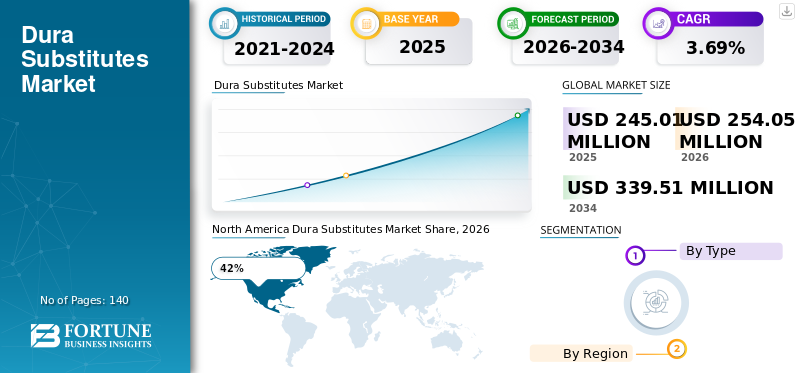
The global dura substitutes market size was valued at USD 245.01 billion in 2025. The market is projected to grow from USD 254.05 billion in 2026 to USD 339.51 billion by 2034, exhibiting a CAGR of 3.69% during the forecast period.

The dura substitutes market is an important segment of the neurosurgical biomaterials industry, driven by the increasing volume of cranial and spinal surgeries worldwide. Dura substitutes are utilized to repair or replace damaged dura mater during neurosurgical procedures, helping prevent cerebrospinal fluid leakage and supporting tissue regeneration. The market is witnessing growing adoption of advanced biological and synthetic materials that offer improved biocompatibility, handling characteristics, and durability. Hospitals and specialized neurosurgical centers remain major end users due to the increasing prevalence of traumatic brain injuries, brain tumors, hydrocephalus, and spinal disorders. Continuous product innovation and expanding surgical capabilities are strengthening dura substitutes market growth and dura substitutes market opportunities.
The United States represents the largest contributor to the North American dura substitutes market due to its advanced healthcare infrastructure and high neurosurgical procedure volume. More than 1,000 specialized neurosurgery centers operate across the country, supporting strong demand for biological and synthetic dura repair products. Brain tumor surgeries, spinal decompression procedures, and trauma-related interventions continue to create consistent product utilization. The country benefits from extensive clinical research activities and rapid adoption of innovative biomaterials. Healthcare providers increasingly prefer durable, infection-resistant, and easy-to-handle products that enhance surgical outcomes. The USA remains a key hub for dura substitutes market research report development, product commercialization, and clinical innovation.
Download Free sample to learn more about this report.
Dura Substitutes Market Key Takeaways
 Global Market Size & Forecast
- 2025 Market Size: USD 245.01 Billion
- 2026 Market Size: USD 254.05 Billion
- 2034 Forecast Market Size: USD 339.51 Billion
- CAGR: 3.69% from 2026-2034
 Market Share
- The market in North America dominated with a revenue share of 42% in 2025.
- Biological dura substitutes dominated by type with a market share of approximately 62%.
- Synthetic dura substitutes accounted for a market share of approximately 38%.
 Key Regional Highlights
North America
North America led the market with a 42% share, supported by advanced neurosurgical infrastructure and increasing demand for dura substitutes.
Europe
Europe accounted for 28% of the market, driven by established healthcare systems and growing adoption of advanced neurosurgical procedures.
Asia-Pacific
Asia-Pacific held a 22% share, supported by expanding healthcare infrastructure and rising access to neurosurgical treatments.
U.S
The U.S. remains a key market, supported by advanced neurosurgical capabilities and strong demand for tissue repair solutions.
Japan
Japan accounted for approximately 24% of the Asia-Pacific market, supported by advanced healthcare infrastructure and growing adoption of innovative neurosurgical products.
Read More

Dura Substitutes Market Latest Trends
The dura substitutes market is experiencing significant technological advancements as manufacturers focus on improving biocompatibility, tissue integration, and surgical efficiency. One major trend involves the development of collagen-based and extracellular matrix-derived biological substitutes that closely mimic native tissue properties. These products are gaining acceptance among neurosurgeons due to their ability to support healing and reduce complications. Another important trend is the growing use of synthetic polymers engineered for enhanced strength and controlled degradation. Manufacturers are introducing products that offer improved watertight closure, which is critical during complex cranial procedures. Integration of advanced sterilization technologies is also becoming common, helping improve product safety and storage stability.
Download Free sample to learn more about this report.
Minimally invasive neurosurgical techniques are influencing product design, encouraging the development of thinner and more flexible dura substitutes. Customizable implants and ready-to-use grafts are increasingly preferred because they reduce operating room preparation time. Strategic collaborations between biomaterial developers and healthcare institutions are accelerating innovation. dura substitutes market trends also indicate growing interest in regenerative medicine approaches that combine scaffold technology with biologically active components. These developments continue to strengthen dura substitutes market outlook and support long-term clinical adoption across healthcare systems worldwide.
Dura Substitutes Market Dynamics
DRIVER
Increasing Volume of Neurosurgical Procedures Worldwide
The growing number of neurosurgical procedures is a major factor supporting dura substitutes market growth. Rising incidences of traumatic brain injuries, spinal cord disorders, brain tumors, hydrocephalus, and neurovascular diseases are increasing the need for effective dura repair solutions. Neurosurgeons increasingly rely on advanced substitutes to achieve secure closure and reduce postoperative complications. The expansion of specialized neurological treatment centers and improvements in diagnostic imaging technologies are further contributing to procedure growth. Aging populations in developed countries are also increasing demand for surgical interventions involving the central nervous system. As healthcare systems continue to improve access to specialized neurosurgical care, demand for high-performance dura substitute products is expected to remain strong across hospitals and surgical facilities.
RESTRAINT
High Cost of Advanced Biological Materials
The relatively high cost associated with premium biological dura substitutes remains a significant market restraint. Products derived from collagen matrices and other biological materials often require sophisticated processing and sterilization methods, increasing manufacturing expenses. Budget limitations in healthcare facilities can restrict widespread adoption, particularly in developing regions. Some healthcare providers continue to rely on traditional grafting techniques when reimbursement policies do not adequately support advanced biomaterials. Additionally, procurement departments frequently evaluate cost-effectiveness before approving new products. Price sensitivity within public healthcare systems can limit market penetration for premium offerings. These factors may affect purchasing decisions and slow adoption rates despite the clinical advantages associated with advanced dura substitute technologies.
OPPORTUNITY
Expansion of Regenerative Biomaterial Technologies
Regenerative biomaterials present substantial opportunities within the dura substitutes market. Manufacturers are investing in advanced scaffold technologies that encourage tissue regeneration and improve healing outcomes. Research efforts are focusing on biologically active materials capable of promoting cellular integration while maintaining structural support. Increasing collaboration between biomaterial scientists and neurosurgeons is accelerating the development of next-generation products. Emerging healthcare markets are also creating opportunities for broader commercialization. As regulatory pathways become clearer and clinical evidence expands, innovative regenerative products may achieve wider acceptance. The growing emphasis on patient outcomes and reduced complication rates positions regenerative dura substitutes as an attractive area for future investment and product differentiation.
CHALLENGE
Regulatory And Clinical Validation Requirements
One of the primary challenges facing manufacturers is the extensive regulatory and clinical validation process required for market approval. Dura substitutes are used in highly sensitive neurological procedures, requiring comprehensive evidence regarding safety, efficacy, sterility, and long-term performance. Clinical studies often require substantial financial resources and extended timelines. Regulatory agencies maintain stringent standards for biomaterials intended for implantation, creating barriers for smaller companies. Variations in approval requirements across different countries further increase complexity for global manufacturers. Post-market surveillance obligations and quality assurance requirements also add operational burdens. These challenges can delay product launches and increase development costs, affecting overall market expansion strategies.
Dura Substitutes Market Segmentation
By Type
Biological Dura Substitutes hold approximately 62% of the global dura substitutes market share due to their excellent biocompatibility and ability to support tissue healing. These products are commonly derived from collagen, extracellular matrices, and processed biological tissues designed to replicate natural dura characteristics. Neurosurgeons frequently prefer biological options because they integrate effectively with surrounding tissues and reduce the likelihood of inflammatory responses. Continuous improvements in purification and sterilization technologies have enhanced product safety and performance. Hospitals performing complex cranial surgeries increasingly utilize biological substitutes for patients requiring long-term tissue regeneration.
Synthetic Dura Substitutes account for approximately 38% of the dura substitutes market share. These products are manufactured using advanced polymer technologies designed to provide consistent performance and structural stability. Synthetic materials offer advantages including controlled manufacturing specifications, predictable durability, and reduced dependence on biological sourcing. They are widely utilized in procedures where surgeons require reliable mechanical strength and watertight closure. Manufacturers continue to introduce innovative polymer formulations with enhanced flexibility and handling characteristics. Synthetic substitutes are gaining attention in healthcare systems seeking standardized products with long shelf lives and efficient storage requirements.
To know how our report can help streamline your business, Speak to Analyst
Dura Substitutes Market Regional Outlook
North America Dura Substitutes Market Share, 2026 (%)
To get more information on the regional analysis of this market, Download Free sample
North America
North America holds 42% of the global dura substitutes market share and remains the leading regional market due to its highly advanced healthcare infrastructure and extensive neurosurgical capabilities. The region performs a large number of cranial and spinal surgeries annually, creating consistent demand for dura repair materials. Hospitals and specialized neuroscience centers increasingly utilize biological and synthetic substitutes to improve surgical outcomes and reduce cerebrospinal fluid leakage. The United States contributes the majority of regional demand, supported by strong adoption of innovative biomaterials and active clinical research programs. Canada also demonstrates steady market growth through investments in neurological care. Favorable reimbursement systems, surgeon awareness, and access to advanced technologies continue to strengthen regional market expansion. Continuous innovation in biomaterials further supports North America's leadership position.
Europe
Europe accounts for 28% of the global dura substitutes market share and represents a mature market characterized by advanced healthcare systems and growing neurosurgical procedure volumes. Countries across the region are investing in specialized neurological treatment centers and modern surgical technologies. Demand is supported by increasing prevalence of neurological disorders, brain tumors, and spinal conditions requiring surgical intervention. Biological dura substitutes remain widely used because of their tissue compatibility and healing properties. Research collaborations between hospitals, universities, and medical device manufacturers continue to drive innovation. Regulatory frameworks support product quality and patient safety, encouraging adoption of advanced solutions. Growing focus on improving clinical outcomes and reducing postoperative complications contributes to sustained demand throughout the European market.
Germany Dura Substitutes Market
Germany accounts for approximately 26% of the European dura substitutes market and serves as one of the region's most important healthcare markets. The country benefits from a large network of hospitals, specialized neurosurgical centers, and advanced medical research institutions. Demand for dura substitutes is supported by increasing surgical procedures involving brain tumors, trauma cases, and spinal disorders. Healthcare providers prioritize high-quality biomaterials that offer durability and effective tissue integration. Germany's strong medical device manufacturing sector contributes to ongoing product innovation and technology development. Government support for healthcare modernization and research activities further strengthens market growth. The country's emphasis on patient safety and clinical excellence continues to support widespread adoption of advanced dura repair products.
United Kingdom Dura Substitutes Market
The United Kingdom represents approximately 18% of the European dura substitutes market and continues to demonstrate steady growth in neurosurgical biomaterial adoption. Demand is driven by increasing awareness of advanced dura repair solutions and expanding treatment volumes for neurological disorders. Healthcare institutions focus on improving surgical outcomes through the use of innovative biological and synthetic substitutes. Major hospitals and academic medical centers actively participate in clinical evaluations and product assessments. Ongoing investments in healthcare infrastructure and specialized surgical facilities support market expansion. The country's emphasis on evidence-based medicine encourages adoption of clinically validated products. Strong collaboration between healthcare providers and medical technology companies continues to create opportunities for market development and product innovation.
Asia-Pacific
Asia-Pacific holds 22% of the global dura substitutes market share and is emerging as a major growth region for neurosurgical biomaterials. Rapid healthcare infrastructure development and increasing healthcare expenditure are supporting adoption of advanced surgical products. Large patient populations and growing incidences of neurological disorders contribute to rising demand for dura substitutes. Countries throughout the region are expanding access to specialized neurosurgical services and investing in modern medical technologies. Biological substitutes are gaining popularity among leading hospitals, while synthetic products remain important due to affordability considerations. Local manufacturers are increasing production capacity and improving product accessibility. Government initiatives aimed at strengthening healthcare systems further encourage adoption of advanced dura repair solutions, supporting long-term regional market expansion.
Japan Dura Substitutes Market
Japan accounts for approximately 24% of the Asia-Pacific dura substitutes market and remains a key market for advanced neurosurgical products. The country's aging population contributes to increasing rates of neurological disorders requiring surgical treatment. Healthcare providers emphasize product quality, safety, and clinical performance when selecting dura repair materials. Advanced hospital infrastructure and strong medical technology capabilities support widespread use of innovative biological and synthetic substitutes. Research institutions and manufacturers collaborate extensively on biomaterial development and clinical evaluation. Japanese surgeons often adopt technologically advanced products designed to improve tissue healing and surgical efficiency. Continuous innovation and high standards of patient care contribute to sustained demand for premium dura substitute solutions across the country.
China Dura Substitutes Market
China represents approximately 32% of the Asia-Pacific dura substitutes market and is the largest country-level market in the region. Rapid healthcare modernization and increasing hospital construction projects have expanded access to specialized neurosurgical care. Rising numbers of brain and spinal surgeries continue to drive demand for advanced dura repair products. Domestic manufacturers are improving production capabilities and introducing cost-effective solutions to meet growing demand. Government healthcare initiatives support adoption of innovative medical technologies and encourage investment in healthcare infrastructure. Large patient populations and increasing awareness of advanced treatment options further strengthen market growth. China continues to attract significant industry attention due to its expanding healthcare sector and long-term growth potential.
Rest of World
The Rest of World region accounts for 8% of the global dura substitutes market share and includes Latin America, the Middle East, and Africa. Market growth is supported by gradual improvements in healthcare infrastructure and increasing availability of specialized surgical services. Demand remains concentrated in major urban hospitals where advanced neurosurgical procedures are routinely performed. Healthcare providers are becoming more aware of the clinical benefits associated with modern dura repair materials. International manufacturers are expanding distribution networks to improve product accessibility across developing markets. Government investments in healthcare modernization and surgeon training programs continue to strengthen adoption. As neurological treatment capabilities expand and healthcare access improves, the region is expected to generate additional opportunities for dura substitute manufacturers.
List of Top Dura Substitutes Companies
- Medtronic
- B. Braun SE
- Stryker
- DePuy Synthes (Johnson & Johnson)
- W. L. Gore & Associates, Inc.
- Acera Surgical Inc.
- Severn Healthcare Technologies Limited.
- INTEGRA LIFESCIENCES
- GUNZE LIMITED
Top two companies with the highest market share
- INTEGRA LIFESCIENCES — 18%
- Stryker — 15%
Investment Analysis and Opportunities
Investment activity in the dura substitutes market is increasingly concentrated in advanced collagen matrices, absorbable synthetics, and sealant-adjacent technologies that improve closure reliability in cranial and spinal surgery. Capital is flowing toward products that reduce cerebrospinal fluid leakage, shorten operating-room time, and improve handling in complex anatomy. Integra’s public disclosures continue to highlight dural access and repair as a meaningful growth area, while Stryker and B. Braun maintain visible portfolios in suturable and onlay dural substitutes. That combination supports a steady acquisition, licensing, and partnership environment around biomaterials, distribution, and surgical workflow enhancement.
The most attractive opportunities sit in markets where neurosurgical volume is rising and premium biomaterials can gain reimbursement support. Japan and China are especially important because recent approvals and commercialization updates show that regional expansion remains achievable for manufacturers with strong regulatory execution. Investors are also watching next-generation regenerative materials, electrospun scaffolds, and sutureless closure systems that may differentiate on tissue integration and surgeon convenience. Companies that combine durable product performance with sterilization stability, broader indications, and hospital-friendly packaging are better placed to win procurement contracts and improve dura substitutes market share.
New Product Development
New product development in the dura substitutes market is centered on better conformability, stronger suture retention, controlled resorption, and easier implantation in complex anatomy. Stryker’s DuraMatrix line demonstrates this direction through variants such as DuraMatrix Suturable, DuraMatrix-Onlay, and DuraMatrix-Onlay Conform, each designed for different closure preferences and structural requirements. The DuraMatrix family emphasizes collagen-based restoration, with documented features such as suture pullout strength, conformability, and sutureless placement options.
B. Braun’s Neuro-Patch and Lyoplant family show continued demand for both synthetic and biological substitution formats, while GUNZE’s SEAMDURA and DURAWAVE emphasize absorbable design and reduced foreign-body burden. Integra’s dural repair portfolio remains commercially important after the Durepair acquisition, and its DuraSeal hydrogel platform adds value by addressing postoperative leakage control in a related closure segment. Product innovation is increasingly shaped by the need to combine durability, biocompatibility, and faster surgical workflow in one device.
Five Recent Developments (2023-2025)
- In October 2024, Integra LifeSciences acquired Durepair dura regeneration matrix from Medtronic, expanding its dural repair portfolio.
- In November 2024, Integra reported that an economic evaluation of DuraSeal found average cost savings across five European countries when compared with fibrin glue in posterior fossa surgery.
- In Q1 2024, Integra reported mid-single-digit growth in dural access and repair, driven by DuraGen.
- Stryker’s DuraMatrix-Onlay Conform material was positioned in 2024 as a collagen-based graft with direct placement and sutureless closure capability.
- GUNZE continued to highlight absorbable dural substitute technology through SEAMDURA and DURAWAVE, both designed to support dural defect repair with absorbable or tissue-replacement behavior.
Report Coverage
This dura substitutes market report covers product type, application, regional demand, competitive landscape, investment activity, innovation trends, and recent manufacturer developments. The scope includes biological and synthetic dural substitutes, with attention to how each product class performs in cranial and spinal surgery. The report also evaluates regional market performance across North America, Europe, Asia-Pacific, and Rest of World, with country-level focus on the United States, Germany, the United Kingdom, Japan, and China. Competitive coverage includes major manufacturers such as Integra LifeSciences, Stryker, B. Braun, Medtronic, GUNZE, and other important participants in the dural repair ecosystem.
Request for Customization to gain extensive market insights.
The coverage further reflects current market dynamics tied to neurosurgical procedure growth, biomaterial innovation, hospital procurement behavior, and regulatory execution. It is designed for B2B readers seeking dura substitutes market analysis, dura substitutes industry report, dura substitutes market outlook, dura substitutes market insights, and dura substitutes market opportunities.
Frequently Asked Questions
Fortune Business Insights says that the global market value stood at USD 245.01 billion in 2025 and is projected to reach USD 339.51 billion by 2034.
The market is expected to exhibit a CAGR of 3.69% during the forecast period of 2026-2034.
Biological Dura Substitutes led the type segment with approximately 62% market share, supported by their excellent biocompatibility and ability to promote tissue healing.
Key players include INTEGRA LIFESCIENCES, Stryker, B. Braun SE, Medtronic, DePuy Synthes (Johnson & Johnson), and W. L. Gore & Associates, Inc.
Major trends include growing adoption of collagen-based and extracellular matrix-derived biological substitutes and advanced synthetic polymers. North America led the market with a 42% share.



- 2021-2034
- 2025
- 2021-2024
- 140
-

(Offer valid till 15th Oct 2026)
Get 30-60 hrs Free Customization
Expand Regional and Country Coverage, Segments Analysis, Company Profiles, Competitive Benchmarking, and End-user Insights.













.webp)






-
US +1 833 909 2966 ( Toll Free )
-
Get In Touch With Us