Durable Medical Equipment Market Size, Share & Industry Analysis By Product Type (Personal Mobility Devices [Wheelchairs & Scooters, Walkers, Crutches & Canes, and Others], Bathroom Safety Devices [Commodes, Toilet Rails/Frames, and Others], Medical Furniture [Medical Beds, Stretchers, Lift Chairs, and Others], and Monitoring and Therapeutic Devices [Blood Glucose Monitor, Oxygen Concentrators, Infusion Pumps, Vital Sign Monitors, and Others]), By End User (Hospitals, Clinics, Homecare Settings, and Others), and Regional Forecast, 2026-2034
 Download Free Sample
Durable Medical Equipment Market Size and Future Outlook
 Listen to Audio Version
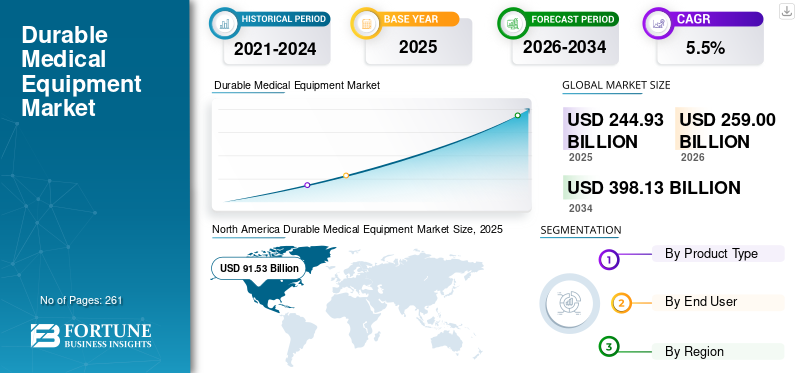
The global durable medical equipment market size was valued at USD 244.93 billion in 2025 and is projected to grow from USD 259.00 billion in 2026 to USD 398.13 billion by 2034, exhibiting a CAGR of 5.5% during the forecast period. North America dominated the durable medical equipment market with a market share of 37.36% in 2025.
Durable medical equipment is a reusable medical device prescribed by a physician for long-term home use to aid with chronic illnesses or injuries. The increasing prevalence of chronic disorders, expansion of healthcare infrastructure, and growing demand for home healthcare solutions are resulting in a growing adoption rate of these devices. The surging geriatric population is further resulting in an escalating number of patients, thereby augmenting the adoption rate of the equipment.
- For instance, about 590 million people are living with diabetes globally, according to data published by the International Diabetes Federation (IDF) in
In addition, the soaring integration of technological advancements in these products by pivotal players, such as Medtronic and GE Healthcare, among others, is further escalating their demand.
Download Free sample to learn more about this report.
Durable Medical Equipment Market KEY TAKEAWAYS
 Market Size & Forecast
- 2025 Market Size: USD 244.93 Billion
- 2026 Market Size: USD 259.00 Billion
- 2034 Forecast Market Size: USD 398.13 Billion
- CAGR: 5.5% from 2026–2034
 Market Share
- North America dominated the durable medical equipment market with a 37.36% share in 2025.
- The monitoring and therapeutic devices segment accounted for a leading share in the market in 2025.
- The others segment is projected to account for 55.7% of the market in 2026.
 Key Regional Highlights
North America
North America led the market, driven by advanced healthcare infrastructure and medical equipment adoption.
Europe
Europe is projected to reach USD 69.82 billion in 2026, driven by an aging population and medical device innovations.
Asia Pacific
Asia Pacific is projected to reach USD 69.53 billion in 2026, driven by healthcare expansion and hospital growth.
U.S.
The durable medical equipment market is projected to reach USD 84.83 billion in 2026.
Japan
The durable medical equipment market is projected to reach USD 13.61 billion in 2026.
Read More

Durable Medical Equipment Market Trends
Shift toward Home-Use and Community-Based Equipment to Fuel the Demand
There is a preferential shift from institutional-based usage toward home care facilities. This trend is being driven by the growing aging population and demand for assistive devices, the rising prevalence of chronic conditions, and the increasing awareness about treatment, monitoring, and recovery in non-hospital settings. Healthcare facilities are focusing on supporting long-term disease management efficiently, resulting in growing demand for easy-to-operate, portable, and caregiver-friendly devices, including wheelchairs, oxygen concentrators, home-use beds, walkers, blood glucose monitors, and other monitoring and therapeutic devices.
Moreover, companies are increasingly emphasizing devices specifically for home facilities, further resulting in a growing demand for simpler interfaces, improved safety features, easier transportability, and connected functionality.
- According to statistics published by the World Health Organization (WHO) in 2022, it was reported that there are more than 2.5 billion people who would benefit from one or more assistive products.
Market Dynamics
Market Drivers
Download Free sample to learn more about this report.
Increasing Prevalence of Chronic Conditions to Fuel Market Growth
The growing prevalence of chronic diseases, including cardiovascular disorders, diabetes, musculoskeletal impairments, kidney disorders, and others, is resulting in an increasing demand for durable medical equipment, including oxygen concentrators, walkers, wheelchairs, and others.
- For instance, according to 2024 statistics published by the Centers for Disease Control & Prevention (CDC), approximately 1 in 20 adults has coronary artery disease in the U.S.
This, along with a growing aging population and demand for home healthcare and remote patient monitoring devices, is further fueling the adoption rate of these devices. Therefore, the factors above, coupled with the growing innovation in these devices, are expected to boost the adoption rate, thereby contributing to the global durable medical equipment market growth.
Market Restraints
High Cost Associated with Advanced Equipment to Hamper the Market Growth
There is a growing demand for medical equipment such as wheelchairs, walkers, and others. However, the high upfront cost associated with advanced durable medical devices is limiting the adoption rate of the devices, including oxygen therapy systems, powered wheelchairs, advanced home-care beds, patient lifts, infusion pumps, and connected monitoring devices.
Moreover, the high cost of these devices and limited reimbursement are resulting in the postponement of decisions and shift toward lower-cost alternatives, among others. These aspects are further hampering the adoption of these devices among patients, caregivers, and smaller healthcare providers in price-sensitive and underinsured markets.
- For instance, according to 2025 statistics published by Extreme Motus, the cost of advanced power wheelchair models ranges from USD 10,000 to USD 15,000.
Regulatory compliance and approval delays are additional prominent factors that are likely to hamper the market growth.
Market Opportunities
Expansion of Healthcare Infrastructure to Create New Avenues for Growth
There is a rapid expansion of healthcare systems in emerging nations, including China, Mexico, and others. The expansion of healthcare infrastructure, the growing number of long-term care facilities, outpatient networks, and home-healthcare delivery systems are consequently boosting the adoption of durable medical equipment in the healthcare facilities. This is contributing to the escalating demand for devices such as wheelchairs, medical beds, patient lifts, walkers, oxygen concentrators, infusion pumps, and home-use monitoring devices, further creating strong growth opportunities in the market.
- According to 2026 data published by the American Hospital Association, there are about 6,100 hospitals in the U.S.
Market Challenges
Limited Access to Healthcare in Emerging Nations to Hamper Market Expansion
There is an escalating demand for innovative medical devices among the patient population. However, the shortage of technologically advanced devices, limited healthcare spending, inadequate reimbursement framework, particularly in developing countries, are leading to restricted access to healthcare facilities.
Furthermore, a limited number of clinical facilities and limited healthcare providers, among others, are some of the significant factors, resulting in the limited adoption of medical devices, especially in emerging nations, such as India, China, among others.
- For instance, as per The World Bank Group (WBG) in 2023, around 4.5 billion individuals at the global level lack full access to essential health services.
SEGMENTATION ANALYSIS
By Product Type
Increasing Prevalence of Chronic Diseases Pushed the Dominance of Monitoring and Therapeutic Devices Segment
On the basis of product type, the market is subdivided into personal mobility devices, bathroom safety devices, medical furniture, and monitoring and therapeutic devices. Personal mobility devices are further divided into wheelchairs & scooters, walkers, crutches & canes, and others. Bathroom safety devices are also divided into commodes, toilet rails/frames, and others. Medical furniture is divided into medical beds, stretchers, lift chairs, and others. Monitoring and therapeutic devices are categorized into blood glucose monitor, oxygen concentrators, infusion pumps, vital sign monitors, and others.
To know how our report can help streamline your business, Speak to Analyst
The monitoring and therapeutic devices segment accounted for a leading share in the market in 2025. The expansion is driven by the rising prevalence of chronic conditions among patients, resulting in a rising adoption of medical equipment globally. In addition, the growing focus of major companies on launching novel durable devices, is further poised to contribute to the global market growth.
- For instance, according to 2023 data published by the American Lung Association (ALA), approximately 11.1 million people are living with COPD in the U.S.
The personal mobility devices segment is expected to grow at a CAGR of 5.6% over the forecast period.
By End-user
Rising Number of Ambulatory Surgical Centers led to the Others Segment Dominance
On the basis of end user, the market is divided into hospitals, clinics, homecare settings, and others.
The others segment dominated the global durable medical equipment market share in 2025. The mounting chronic disease prevalence, surging number of patient admissions in these settings, and the rising number of ambulatory surgical centers, nursing homes, among others, are some key factors driving the expansion of the segment. This segment is anticipated to hold a share of 55.7% in 2026.
- For instance, according to Definitive Healthcare, as per data published in 2026, it was reported that there are over 6,500 ambulatory surgical centers in the U.S.
In addition, the clinics segment is projected to expand at a CAGR of 5.5% during the analysis period.
Durable Medical Equipment Market Regional Outlook
Based on region, the market has been studied across North America, Europe, Asia Pacific, Latin America, and the Middle East & Africa.
North America
North America Durable Medical Equipment Market Size, 2025 (USD Billion)
To get more information on the regional analysis of this market, Download Free sample
The North America market held the dominant share in 2024, valued at USD 86.52 billion, and also accounted for the leading share in 2025 with a value of USD 91.53 billion. The increasing prevalence of chronic diseases such as diabetes and inflammatory bowel disease, advanced healthcare infrastructure, and the introduction of equipment, among others, are some of the factors contributing to the growth of this regional market.
- For instance, according to 2024 data published by the Centers for Disease Control & Prevention (CDC), the prevalence of inflammatory bowel disease (IBD) is estimated between 2.4 and 3.1 million among patients in the U.S.
U.S. Durable Medical Equipment Market
Based on North America’s strong contribution and the U.S. dominance within the region, the U.S. market can be analytically approximated at around USD 84.83 billion in 2026, accounting for roughly 32.8% of global sales.
Europe
Europe is projected to record a growth rate of 4.8% over the analysis period, which is the second highest among all regions, and reach a valuation of USD 69.82 billion by 2026. The increasing aging population and technological advancements in devices are likely to support the market growth.
U.K. Durable Medical Equipment Market
The U.K. market is estimated to touch around USD 9.93 billion in 2026, representing roughly 3.8% of global revenues.
Germany Durable Medical Equipment Market
The Germany market is projected to reach approximately USD 13.93 billion in 2026, equivalent to around 5.4% of global sales.
Asia Pacific
Asia Pacific is estimated to reach USD 69.53 billion in 2026 and secure the position of the third-largest region in the market. The expanding healthcare access and rising number of hospitals are likely to support the growth of the market. In the region, India and China are both estimated to reach USD 5.36 billion and USD 22.58 billion, respectively, in 2026.
Japan Durable Medical Equipment Market
The Japan market is estimated to touch around USD 13.61 billion in 2026, accounting for roughly 5.3% of global revenues. Japan has historically reported a relatively high prevalence of chronic conditions, with an increasing number of major companies operating in the market.
China Durable Medical Equipment Market
The China market is projected to be one of the largest worldwide, with 2026 revenues estimated at around USD 22.58 billion, representing roughly 8.7% of global sales.
India Durable Medical Equipment Market
The India market size is estimated to touch around USD 5.36 billion in 2026, accounting for roughly 2.1% of global revenues.
Latin America and the Middle East & Africa
The Latin America and Middle East & Africa regions are expected to witness moderate growth in this market during the forecast period. The Latin America market is set to reach a valuation of USD 13.06 billion in 2026. The growth is due to the gradual growth tied to public healthcare investment and medical tourism hubs in the regions. The Middle East & Africa market is also expected to grow due to the rising number of healthcare facilities in the region. In the Middle East & Africa, the GCC is set to reach a value of USD 4.00 billion in 2026.
South Africa Durable Medical Equipment Market
The South Africa market is projected to reach around USD 4.00 billion in 2026, representing roughly 1.5% of global revenues.
Competitive Landscape
Key Industry Players
Increasing Number of Equipment Launches to Support their Dominance
A strong focus on inorganic growth strategies at the global level and a robust device portfolio are the prominent aspects driving the dominance of key industry participants. Medtronic and GE Healthcare were prominent companies in this market in 2025. Furthermore, the rising focus of key companies on acquisitions and collaborations among other companies is likely to consolidate their presence, further contributing to their global market share.
- For instance, in July 2025, Medtronic collaborated with Koninklijke Philips N.V., with an aim to advance patient monitoring to improve patient care.
Other notable players, including Stryker and others, are also expanding in the market. This is primarily on account of their escalating emphasis on takeovers and collaborating with other participants for strengthening their market presence.
List of Key Durable Medical Equipment Companies Profiled
- Medtronic (Ireland)
- GE Healthcare (U.S.)
- Koninklijke Philips N.V. (Netherlands)
- Siemens Healthineers AG (Germany)
- Baxter (U.S.)
- Invacare Corporation (U.S.)
- Fresenius Medical Care AG (Germany)
- ResMed (U.S.)
- Permobil (Sweden)
- Sunrise Medical (Germany)
KEY INDUSTRY DEVELOPMENTS
- September 2025: Baxter, a global medtech company, launched the Welch Allyn Connex 360 Vital Signs Monitor, its next generation patient monitoring device.
- May 2025: Sunrise Medical launched Meet Empluse M90, the revolutionary wheel add-on to use with manual wheelchairs, with an aim to strengthen its product portfolio.
- May 2025: Sunrise Medical launched outdoor mobility powerchairs, the XT2 and XT4to provide stability, and range, opening up new possibilities for work, leisure, and exploration.
- November 2024: Permobil established its innovation center in Sweden. This helped the company strengthen its position and expand its geographical presence.
- October 2023: Permobil launched a TiLite CR1, the lightest ever TiLite wheelchair, to strengthen its product portfolio.
- August 2022: Dozee collaborated with Midmark Corporation with an aim to launch a connected bed platform for non-ICU settings.
- January 2022: Invacare Corporation launched the Invacare AVIVA STORM RX Narrow Base Power Wheelchair with an aim to increase its product offerings.
REPORT COVERAGE
The durable medical equipment market report provides a detailed global market analysis and focuses on key aspects such as leading companies and market segmentation, including product type and end user. Besides this, the global report offers insights into the market growth trends and highlights key industry developments. In addition to the aforementioned factors, the report encompasses several factors that have contributed to the growth and advancement of the market over recent years.
Request for Customization to gain extensive market insights.
Report Scope & Segmentation
| ATTRIBUTE | DETAILS |
| Study Period | 2021-2034 |
| Base Year | 2025 |
| Estimated Year | 2026 |
| Forecast Period | 2026-2034 |
| Historical Period | 2021-2024 |
| Growth Rate | CAGR of 5.5% over 2026-2034 |
| Unit | Value (USD Billion) |
| Segmentation | By Product Type, End User, and Region |
| By Product Type |
|
| By End User |
|
| By Region |
|
Frequently Asked Questions
Fortune Business Insights says that the global market size was USD 244.93 billion in 2025 and is projected to reach USD 398.13 billion by 2034.
In 2025, the North America market value stood at USD 91.53 billion.
The market will grow at a CAGR of 5.5% over the forecast period (2026-2034).
By product type, the monitoring and therapeutic devices segment led the market in 2025.
The introduction of novel durable medical equipment is one of the major factors driving the market's growth.
Medtronic and GE Healthcare are the major players in the global market.
North America dominated the market share in 2025.
The growing prevalence of chronic diseases and the growing adoption of durable medical equipment are key factors anticipated to boost the adoption of these products.



- 2021-2034
- 2025
- 2021-2024
- 261
Get 30-60 hrs Free Customization
Expand Regional and Country Coverage, Segments Analysis, Company Profiles, Competitive Benchmarking, and End-user Insights.













.webp)






Related Reports
-
US +1 833 909 2966 ( Toll Free )
-
Get In Touch With Us