E-Commerce Logistics Market Size, Share, & Industry Analysis, By Operational Area (Domestic and International), By Type (Forward Logistics and Backward Logistics), By Service Type (Warehousing, Transporting, and Others), and Regional Forecast, 2026-2034
 Download Free Sample
(Offer valid till 30th Sep 2026)

KEY MARKET INSIGHTS
 Listen to Audio Version
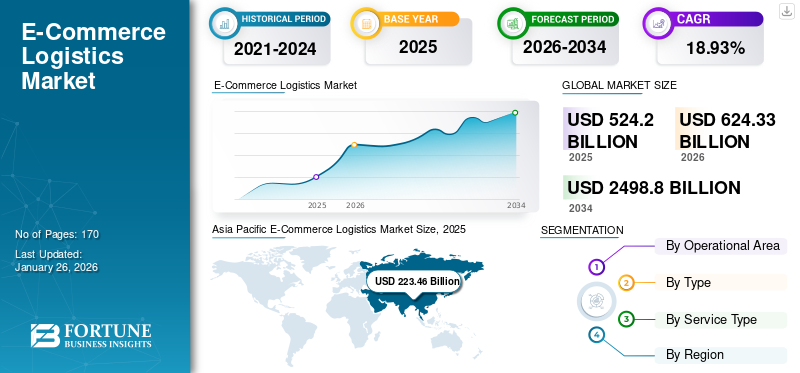
The global e-commerce logistics market size was valued at USD 524.2 billion in 2025. The market is projected to grow from USD 624.33 billion in 2026 to USD 2498.8 billion by 2034, exhibiting a CAGR of 18.93% over the forecast period. Asia Pacific dominated the e-commerce logistics market with a market share of 42.63% in 2025.
E-commerce logistics covers a wide array of services such as warehousing, transportation, and packaging solutions, facilitating management, movement, storage, and easy flow of goods in the online retail sector. The e-commerce logistics industry has undergone significant transformation over the past decade, driven by the rapid growth of online shopping platforms. One of the key drivers is increasing consumer demand for fast and reliable delivery services. Companies are continually innovating to meet expectations, leveraging technology such as automated warehouses, real-time tracking systems, and data analytics to optimize supply chain efficiency. Additionally, the emergence of omnichannel retailing, where consumers expect seamless integration between online and offline experiences, has further complicated logistics operations.
Logistics management is a critical component of success for brands operating in the retail industry. The technology and processes that are revolutionizing logistics and supply chain operations are assisting brands to keep up with the pace of digital commerce. As the popularity of online shopping grows amongst consumers, businesses are implementing efficient logistics practices to satisfy customers, cut costs, and maintain a competitive edge, fueling market expansion. Furthermore, there has been a significant volume of cross-border e-commerce owing to the large and growing middle-class hunger for foreign products, augmenting market growth.
The COVID-19 pandemic had a significant impact on the e-commerce logistics market, influencing various aspects such as increased online shopping, a shift to contactless delivery, and adaptation to safety protocols, warehouse automation, and sustainability focus. The pandemic accelerated the transformation of e-commerce logistics, pushing companies to innovate and adapt to the changing landscapes.
Download Free sample to learn more about this report.
E-Commerce Logistics Market Key Takeaways
 Global Market Size & Forecast
- 2025 Market Size: USD 524.2 billion
- 2026 Market Size: USD 624.33 billion
- 2034 Forecast Market Size: USD 2498.8 billion
- CAGR: 18.93% from 2026-2034
 Market Share
- Asia Pacific dominated the e-commerce logistics market with a 42.63% share in 2025.
- The domestic segment accounted for the largest market share of 65.36% in 2026.
- The forward logistics type segment held a 63.71% share in 2026.
 Key Regional Highlights
North America
North America accounted for USD 132.49 billion in 2025 and is projected to reach USD 155.94 billion in 2026.
Asia Pacific
Asia Pacific recorded USD 223.46 billion in 2025 and is expected to reach USD 269.31 billion in 2026.
Europe
Europe reached USD 122.14 billion in 2025 and is projected to grow to USD 145.47 billion in 2026.
U.S.
The market is valued at USD 130.28 billion in 2026.
Japan
The market is valued at USD 27.67 billion in 2026.
Read More

E-Commerce Logistics Market Trends
Rapid Order Delivery, Use of Alternative Delivery Tools, and Sustainability in Logistics Trending Amongst Consumers
The latest trend in the e-commerce logistics market highlights the industry's ongoing evolution to meet the increasing demand of online shoppers and the complexities of global supply chains. Same-day or next-day delivery is one of the major trends amongst consumers as they expect faster delivery times, pushing companies to offer speedy shipping options. To shorten delivery times, retailers are establishing smaller, localized warehouses in urban areas. These micro-fulfillment centers enable faster order processing and delivery, catering to the demand for quick turnaround times. Retail giants such as Amazon and Walmart have set high standards, promoting others to enhance their logistic capabilities in this regard.
Besides, the use of alternative delivery methods, such as autonomous vehicles and drones, reduces labor and fuel costs. These technologies are becoming more viable and cost-efficient, particularly for last-mile deliveries. There is a growing emphasis on sustainability in logistics. Companies are heavily investing in electric delivery vehicles, optimizing routes to reduce emissions, and using eco-friendly packaging materials. Sustainability initiatives are becoming a competitive differentiator. Efficient returns management processes, streamlining reverse logistics, and improved customer experience help reduce the cost associated with handling returned goods.
- Asia Pacific witnessed e-commerce logistics market growth from USD 223.46 billion in 2025 and USD 269.31 billion in 2026.
Download Free sample to learn more about this report.
E-Commerce Logistics Market Growth Factors
Reduced Cost of Shipping Through Logistics Service Providers Propels Market Development
Reduced shipping costs are a significant factor driving the e-commerce logistics market growth. As e-commerce continues to grow, logistics service providers can achieve economies of scale. Higher shipping volumes allow companies to negotiate better rates with carriers and optimize their operations to handle large quantities of goods more efficiently. The adoption of advanced technologies, such as machine learning, AI, and big data analytics helps logistics companies optimize routes, predict demand, and manage inventory more effectively. This leads to reduced fuel consumption, minimized delays, and lower labor costs. Additionally, companies are increasingly using consolidation centers and hub-and-spoke distribution models. By centralizing sorting and distribution, companies are reducing transportation costs while improving delivery times, which uplifts market growth.
Implementation of Automation, Robotics, and Augmented Reality in Warehouses Optimizes Logistics Operations
Automation in warehouses, such as the use of Automated Guided Vehicles (AGVs) and robotic arms, curbs labor costs, enhances the operational efficiency of companies and drives the growth of the market. Sophisticated sorting systems and conveyor belts speed up the processing of orders, leading to quicker and affordable shipping. Moreover, robotics equipped with IoT connectivity and sensors provide real-time data and analytics, helping in predictive maintenance, demand forecasting, and process optimization. Also, the data gathered by robotics can be scrutinized to make informed decisions, improving goods transition and customer services, which fuels market growth.
Furthermore, the establishment of localized warehouses and micro-fulfillment centers closer to customers reduces the distance goods need to travel, leading to negligible or no shipping costs and faster delivery times, further amplifying market development. In addition, worker safety and product safety improved by integration of automation reduces the chances of workplace injuries or product damage during the logistics process, contributing to increased productivity.
RESTRAINING FACTORS
Poor Infrastructure, Cost Pressures, and High Rate of Returns Hampers Market Progression
Emerging economies such as India, China, and Brazil face high logistics costs compared to developed countries such as the U.S., Japan, and other European countries. Together with infrastructural inefficiencies, the cost of deliveries is shooting up by factors including a high share of cash of deliveries and a high return rate. This is driving e-commerce retail logistics firms to switch to surface transit for deliveries, restraining market growth. Lack of proper infrastructure for both air and surface transit leads to inefficiency, higher logistics costs, longer transit times, and higher returns, which significantly have a negative impact on market development.
E-Commerce Logistics Market Segmentation Analysis
By Operational Area Analysis
Affordability and Convenience Associated with International Leading Segment Growth
By operational area, the market is divided into domestic and international. The domestic segment led the market accounting for 65.36% market share in 2026 and is projected to maintain its leading position during the forecast period. Domestic operational area is expanding in response to increased online shopping frequency coupled with the rising spending power of consumers and discounts offered by e-commerce platforms, triggering individuals to make frequent purchases of items irrespective of need. In recent years, domestic e-commerce logistics have boomed owing to the rising need for instant delivery of home goods, including groceries and medicine prescriptions, among other items. In this regard, together with the domestic e-commerce logistic industry, small and mid-sized retailers are also under pressure to stay afloat in the competitive landscape.
The international e-commerce logistics segment is estimated to grow at the fastest CAGR between the projected period of 2024-2032. The easy availability of foreign brands through big e-commerce providers such as Amazon and Alibaba and a significant increase in the volume of cross-border shipments have been substantial drivers of the segment's growth.
To know how our report can help streamline your business, Speak to Analyst
By Type Analysis
Backward Logistics to Witness Fastest Growth Due to its Critical Role in Product Handling, Swaps, and Product Recalls
By type, the market is bifurcated into forward logistics and backward logistics.
The backward logistics type is poised to flourish at the highest growth rate during the forecast period. Backward logistics manages the movement of things upstream or from consumers to suppliers when they are not satisfied with the product. These goods are then added back to the inventory or given back to the vendors. The increasing rate of returns, product exchange, and growing importance of a strong reverse logistics or returns management process are likely to supplement the growth of the segment. This segment is likely to grow with a considerable CAGR of 20.95% during the forecast period (2024-2032).
The forward logistics type segment is projected to dominate the market with a share of 63.71% in 2026. The high share of the segment is attributable to its fundamental function in ensuring effective and efficient order fulfillment, enabling seamless delivery of items from suppliers to customers at the downstream end of the e-commerce supply chain.
By Service Type Analysis
Increased Cross-Border Shipments Supplements Growth of Transportation Services
Based on the service type, the market is segmented into transporting, warehousing, and others.
The transportation service type segment is expected to lead the market, contributing 48.89% globally in 2026 due to its critical role in the supply chain. The modes of e-commerce logistics transportation include airways, roadways, railways, and waterways. Road transportation plays a crucial role in facilitating last-mile deliveries. Unlike other transportation modes, such as airways and railways, which have limitations on reaching individual households, roads offer direct access to various locations, including commercial and residential areas. However, the efficiency and speed of air transportation and increasing foreign purchases by consumers make it the optimal choice to meet the demands of customers who seek speedy deliveries, which contributes to market growth. The segment is set to hold 49% of the market share in 2025.
The warehousing service is projected to grow exponentially with the fastest CAGR over the analysis period. Technological advancements such as robotics and automation implemented in warehouses help them run operations efficiently and effectively, which increases profits. Some businesses are establishing fulfillment centers or local warehouses nearer to dense customer areas for more flexible inventory management and speedy delivery times, which is likely to add to the segment's growth in the near future. This segment is foreseen to record a significant CAGR of 20.81% during the forecast period (2024-2032).
REGIONAL INSIGHTS
Geographically, the market is divided into North America, South America, Europe, Asia Pacific, and the Middle East & Africa.
Asia Pacific
Asia Pacific E-Commerce Logistics Market Size, 2025 (USD Billion)
To get more information on the regional analysis of this market, Download Free sample
Asia Pacific recorded a market size of USD 223.46 billion in 2025, capturing 42.63% of the global market share, and is expected to reach USD 269.31 billion in 2026, driven by the rising penetration of internet, growing spending power of consumers, and the increasing number of options for e-commerce services. Additionally, the rise of e-commerce companies has reflected a positive market outlook. India's e-commerce logistic sector is expanding quickly owing to the increasing consumer demand for home delivery over in-store purchasing. The Chinese market is expected to be worth USD 62.51 billion in 2025. Moreover, several Chinese investments toward improving infrastructure, including railways, highways, and airports, are largely supplementing China’s logistics services growth. Besides, the integration of cutting-edge technologies by SMEs, substantial transformation toward digitization, and continuing modernization of are notably driving market progression. The Japan market is valued at USD 27.67 billion by 2026, the China market is valued at USD 75.12 billion by 2026, and the India market is valued at USD 66.29 billion by 2026.
To know how our report can help streamline your business, Speak to Analyst
North America
In 2025, North America generated USD 132.49 billion, contributing 25.27% to global market revenue, and is expected to reach USD 155.94 billion in 2026. North America holds the second position in the market, and its substantial share is attributed to the presence of leading e-commerce companies, including eBay, Walmart, and Amazon. Amazon held a market cap of around USD 1.899 trillion in July 2024 and remains the leading e-commerce organization. The company has a significant impact on the American economy, accounting for nearly 38% of all e-commerce providers. In 2020, the company's strategic investment to cater to the soaring demand has pushed it to open more than 300 delivery centers and 100 fulfillment centers to counter last-mile dispatches. The The U.S. market is valued at USD 130.28 billion by 2026.
Europe
The Europe market accounted for USD 122.14 billion in 2025, representing 23.30% of the global industry, and is expected to reach USD 145.47 billion in 2026. As online shopping continues to enlarge across Europe, consumers expect greater flexibility and shorter delivery times in receiving their orders. This demand has encouraged logistics companies to invest in more advanced logistics solutions. Fulfilling these evolving consumer expectations is critical for driving market growth and staying afloat in the dynamic e-commerce logistics landscape of the region. Moreover, an increased focus on expanding distribution network centers and warehouse strategically to optimize inventory management and lower transit times leads the market development across nations in Europe. The UK market is valued at USD 19.54 billion by 2026, while the Germany market is valued at USD 26.38 billion by 2026. while France is expected to hold USD 12.40 billion in the 2025.
South America
The market in South America reached USD 0.39 billion in 2025, representing 4.35% of total market revenue, and is expected to reach USD 0.42 billion in 2026. The e-commerce logistics market in South America and the Middle East & Africa is growing quickly, driven by online retail expansion and mobile adoption. South America focuses on last-mile delivery, pickup points, and cross-border solutions to offset infrastructure challenges, while MEA combines advanced, fast delivery in Gulf states with cost-efficient, mobile-first logistics in African markets. Across both regions, partnerships, digital platforms, and sustainability initiatives are shaping competitiveness. The UAE market is anticipated to be worth USD 1.67 billion in 2025.
Middle East & Africa
The Middle East & Africa market generated USD 16.51 billion in 2025, representing 3.15% of the global market landscape, and is expected to reach USD 19.17 billion in 2026.
KEY INDUSTRY PLAYERS
Setting Up Warehouses and Micro Fulfillment Centers to Meet Escalating Consumer Demand
The global e-commerce logistics market is characterized by fierce competition due to the presence of numerous well-established players, such as DHL International GmbH, FedEx Corporation, Aramex International, and Gati Limited. These companies are adopting several organic and inorganic growth strategies, including acquisition, mergers, expansions, and partnerships, to have a strong foothold in the market. The players are setting up warehouses in multiple countries to enhance delivery operations. For instance, CEVA Logistics increased its presence in Southeast Asia by setting up a new warehouse in Vietnam in February 2021. With this expansion, the company intends to strengthen distribution and consumer storage needs across industries. The company also announced its expansion in Thailand with its new head office in Bangkok to support customers.
List of Top E-commerce Logistics Companies:
- DHL International GmbH (Germany)
- FedEx Corporation (U.S.)
- Aramex International (UAE)
- XPO Logistics Plc. (U.S.)
- United Parcel Service, Inc. (U.S.)
- Gati Limited (India)
- Kenco Group, Inc. (U.S.)
- Clipper Logistics Plc. (U.K.)
- Agility Public Warehousing Company K.S.C.P. (Kuwait)
- CEVA Logistics (U.K.)
Key Industry Developments:
- February 2024: Indian government declared the strategies to allocate funds towards strengthening the UPI infrastructure and promoting digital payments. This initiative is expected to further accelerate digital payment adoption across the country, which is likely to benefit the e-commerce logistics industry by encouraging more online shopping.
- January 2024: UPS, one of the largest and most trusted global shipping and logistics companies, launched micro-hubs in major U.S. cities to facilitate same-day deliveries. This development of micro-fulfillment centers in urban areas assist in managing high order volume and reducing delivery turnaround times in densely populated cities.
- November 2022: CEVA Logistics signed a multi-year contract extension with ASOS. This contract aims to manage warehousing, e-commerce fulfillment, and inbound and outbound services for ASOS.
- October 2022: Aramex PJSC announced the acquisition of USA Shipping, LLC. This acquisition is focused on strengthening Aramex's cross-border express business, which is likely to provide strong revenue growth.
- September 2022: DHL acquired a major stake in a Dutch e-commerce specialist, Monta, aiming to serve mid-sized and small webshops in online sales and e-fulfillment. This partnership consolidated DHL's core logistics business.
REPORT COVERAGE
The market research report provides a detailed analysis of the market and focuses on key aspects such as the competitive landscape, services, and leading service types. Besides this, it offers market insights and highlights key industry developments. In addition to the aforementioned factors, it encompasses several factors that have contributed to the growth of the market in recent years.
Request for Customization to gain extensive market insights.
Report Scope & Segmentation
|
ATTRIBUTE |
DETAILS |
|
Study Period |
2021-2034 |
|
Base Year |
2025 |
|
Estimated Year |
2026 |
|
Forecast Period |
2026-2034 |
|
Historical Period |
2021-2024 |
|
Growth Rate |
CAGR of 18.93% from 2026 to 2034 |
|
Unit |
Value (USD Billion) |
|
Segmentation
|
By Operational Area
|
|
By Type
|
|
|
By Service Type
|
|
|
By Region
|
Frequently Asked Questions
According to Fortune Business Insights, the global market size was USD 624.33 billion in 2026 and is anticipated to record a valuation of USD 2498.8 billion by 2034.
In 2025, the Asia Pacific market stood at USD 223.46 billion.
Growing at a CAGR of 18.93% the market will exhibit a steady growth rate during the forecast period of 2026-2034.
By operational area, the domestic segment dominated the market.
Increasing penetration of smartphones, higher usage of e-commerce platforms, and growing reliability of logistics services fuels market growth.
FedEx Corporation, DHL International GmbH, Aramex International, XPO Logistics Plc., and United Parcel Service, Inc. are a few significant players in the global market.
Asia Pacific held the highest market share in 2026.
The rising trend of same-day or next-day delivery, the use of alternative delivery methods, and improved efficient returns management processes are likely to drive the adoption of e-commerce logistics services.



- 2021-2034
- 2025
- 2021-2024
- 170
-
(Offer valid till 30th Sep 2026)
Get 30-60 hrs Free Customization
Expand Regional and Country Coverage, Segments Analysis, Company Profiles, Competitive Benchmarking, and End-user Insights.




















Related Reports
-
US +1 833 909 2966 ( Toll Free )
-
Get In Touch With Us