E Commerce Market Size, Share & Industry Analysis, By Product (Automotive, Beauty & Personal Care, Books & Stationery, Consumer Electronics, Home Appliances, Clothing & Footwear, Healthcare), By Model (Business-to-Business), and Regional Forecast, 2026-2034
 Download Free Sample
 E Commerce Market Overview
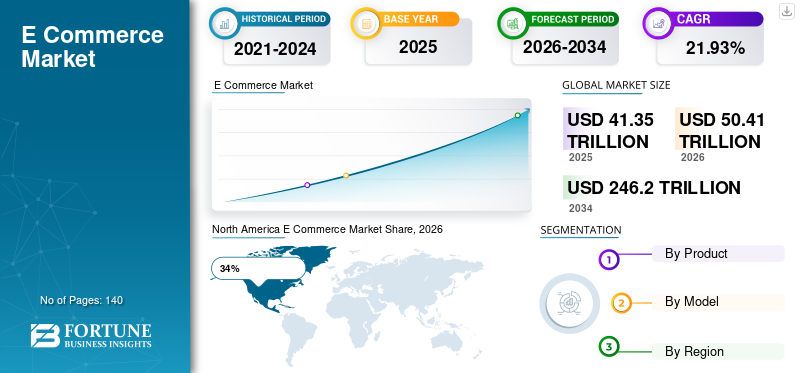
The global E commerce market size was valued at USD 41.34 billion in 2025. The market is projected to grow from USD 50.41 billion in 2026 to USD 246.20 billion by 2034, exhibiting a CAGR of 21.93% during the forecast period.

The E commerce market continues to transform global retail and wholesale trade through rapid digitalization, mobile commerce expansion, and advanced payment integration. Businesses across consumer electronics, apparel, healthcare, and home appliances are adopting omnichannel sales strategies to improve customer engagement and operational efficiency. E commerce market Growth is strongly influenced by rising smartphone penetration, internet accessibility, AI-driven recommendation systems, and cross-border online trade. Logistics automation and same-day delivery infrastructure are further supporting E commerce market Share expansion. The E Commerce Industry Report highlights increasing adoption of cloud-based marketplaces and digital wallets, while personalized shopping experiences and social commerce integration continue shaping E commerce market Trends worldwide.
The USA E commerce market represents one of the most mature digital commerce ecosystems globally, supported by over 310 million internet users and widespread online payment adoption. Mobile commerce contributes more than 46% of online retail transactions across the country. Consumer demand for rapid delivery, subscription-based purchasing, and AI-enabled product recommendations continues strengthening E commerce market Opportunities in the United States. Business-to-business procurement platforms are expanding rapidly among manufacturing, healthcare, and retail sectors. Online grocery sales, consumer electronics purchases, and apparel transactions remain dominant categories. Advanced warehouse robotics, real-time inventory tracking, and integrated fulfillment systems are improving operational productivity throughout the USA E Commerce Industry Analysis landscape.
Download Free sample to learn more about this report.
Key Takeaways
Market Size & Growth
- Global market size 2025: USD 50.41 billion
- Global market size 2034: USD 246.20 billion
- CAGR (2025–2034): 21.93%
Market Share – Regional
- North America: 34%
- Europe: 26%
- Asia-Pacific: 31%
- Rest of World: 9%
Country-Level Shares
- Germany: 28% of Europe’s market
- United Kingdom: 24% of Europe’s market
- Japan: 18% of Asia-Pacific market
- China: 30% of Asia-Pacific market
E Commerce Market Latest Trends
The E commerce market is witnessing substantial transformation through technological innovation, evolving consumer preferences, and increased digital retail penetration. Artificial intelligence and machine learning technologies are enabling advanced recommendation engines, customer behavior analytics, and automated customer support solutions. Retailers are investing heavily in conversational commerce, voice-enabled shopping assistants, and predictive personalization to improve online engagement rates. Social commerce integration through live streaming and influencer-driven retail promotions has become a major E commerce market Trend among younger consumers.
Download Free sample to learn more about this report.
Mobile commerce continues dominating online transactions, with smartphone-based purchases accounting for a major portion of digital retail activity. Contactless payment systems, digital wallets, and buy-now-pay-later services are expanding rapidly across developed and emerging economies. Cross-border online trade is increasing as international logistics networks improve delivery timelines and customs processing efficiency. Sustainable packaging and eco-friendly delivery solutions are also gaining importance in the E commerce market Research Report due to rising environmental awareness among businesses and consumers.
E Commerce Market Dynamics
DRIVER
Rising Smartphone Penetration and Internet Accessibility.
The expansion of affordable smartphones and high-speed internet connectivity is significantly accelerating E commerce market Growth worldwide. More than 5.4 billion smartphone users actively engage with digital shopping platforms, increasing online transaction volumes across consumer categories. Improved broadband infrastructure in developing economies has strengthened digital inclusion and online retail accessibility. Businesses are leveraging mobile applications, digital payment systems, and AI-powered marketing tools to reach larger customer bases. Online grocery ordering, fashion retailing, and healthcare product sales are expanding rapidly due to enhanced digital convenience. Social media platforms are further supporting customer acquisition through integrated shopping features. The E Commerce Industry Analysis also highlights increased adoption of cloud computing and data analytics for operational scalability and customer retention strategies.
RESTRAINT
Rising Cybersecurity Risks and Online Payment Fraud.
Cybersecurity threats remain a significant restraint within the E commerce market Forecast due to increasing incidents of data breaches, payment fraud, and identity theft. Businesses operating large-scale digital commerce platforms face substantial challenges in securing customer information and transaction systems. Phishing attacks, fake product listings, and fraudulent sellers negatively impact consumer trust in online retail ecosystems. Compliance with evolving data protection regulations increases operational complexity for multinational E Commerce companies. Small and medium enterprises often lack sufficient cybersecurity investment capabilities, making them vulnerable to cyberattacks. Cross-border transactions also create complications regarding taxation, regulatory compliance, and consumer protection policies. These factors collectively create operational risks that may limit long-term E commerce market Share expansion across certain regions.
OPPORTUNITY
Expansion of Cross-border Digital Commerce Platforms.
Cross-border digital retailing is creating major opportunities for businesses seeking international market expansion. Consumers increasingly purchase products from overseas sellers due to broader product availability, competitive pricing, and improved international shipping services. Global logistics providers are investing in fulfillment hubs, customs optimization systems, and AI-powered route planning to reduce delivery times. The E commerce market Opportunities segment is also benefiting from multilingual platforms and localized payment integration, enabling smoother international transactions. Emerging markets in Asia-Pacific, Latin America, and the Middle East are witnessing rising demand for imported electronics, fashion products, and health supplements. Business-to-business procurement platforms are also expanding cross-border supplier networks, helping manufacturers and distributors optimize sourcing efficiency while increasing international trade participation.
CHALLENGE
Increasing Logistics and Last-mile Delivery Costs.
The rapid expansion of online shopping has intensified pressure on logistics networks and delivery infrastructure. Last-mile delivery expenses continue increasing due to fuel price volatility, labor shortages, and rising customer expectations for same-day shipping. Urban congestion and high return rates create operational inefficiencies for E Commerce service providers. Warehousing costs are also increasing as retailers invest in automation systems and regional fulfillment centers to reduce delivery timelines. Reverse logistics management remains a major challenge, especially within fashion and electronics categories where return volumes are high. Environmental regulations regarding packaging waste and delivery emissions are adding compliance costs for logistics operators. The E commerce market Research Report indicates that balancing operational efficiency with customer satisfaction remains a critical challenge for industry participants globally.
E Commerce Market Segmentation
By Product
The automotive segment accounts for approximately 11% of the global E commerce market Share due to increasing online sales of spare parts, tires, accessories, and maintenance products. Digital automotive platforms provide consumers with detailed product comparisons, compatibility checks, and installation guidance. Online procurement systems are helping vehicle manufacturers and service centers streamline supply chain operations. Rising demand for electric vehicle components and smart automotive accessories is further strengthening digital sales activity. Mobile commerce applications are improving customer convenience through real-time inventory visibility and delivery tracking.
Beauty and personal care products contribute nearly 14% of the E commerce market Size globally. Consumers increasingly prefer online platforms for skincare, cosmetics, fragrances, and grooming products due to convenience and access to wider product selections. Influencer marketing and social commerce campaigns significantly impact digital beauty product purchasing behavior. Subscription-based skincare kits and personalized beauty recommendations are supporting recurring online sales growth. AI-powered skin analysis tools and virtual try-on technologies are improving customer engagement rates.
The books and stationery segment holds approximately 8% market share within the E commerce market Outlook. Educational materials, office supplies, notebooks, and digital learning products continue experiencing strong online demand. E-learning expansion and remote work adoption have increased purchases of printers, writing tools, and organizational products through digital commerce platforms. Personalized stationery and print-on-demand publishing services are further driving segment expansion. Online bookstores offer broader inventory availability and faster delivery options compared to traditional retail stores.
Consumer electronics represent nearly 24% of the global E commerce market Share, making it one of the largest product categories. Smartphones, laptops, gaming devices, wearable technology, and smart home products dominate online electronics sales. Customers prefer digital platforms due to competitive pricing, product comparison tools, and customer review accessibility. Flash sales and seasonal promotional campaigns significantly influence purchasing volumes. AI-enabled chat support and virtual product demonstrations are improving conversion rates across online electronics platforms.
Home appliances account for approximately 13% of the E commerce market Growth landscape. Smart refrigerators, air purifiers, washing machines, and kitchen appliances are increasingly purchased through online platforms due to broader product availability and financing options. Consumers value doorstep installation services, extended warranties, and digital product demonstrations offered by online retailers. IoT-enabled home appliances with smartphone integration are driving product innovation within the segment. Large appliance retailers are investing in AI-powered inventory systems and regional fulfillment centers to improve delivery efficiency.
Clothing and footwear contribute nearly 22% of global E commerce market Share. Fashion retailers are heavily investing in augmented reality fitting tools, AI-based size recommendations, and influencer marketing campaigns to improve customer acquisition. Fast-fashion platforms and direct-to-consumer apparel brands continue expanding digital sales channels globally. Seasonal promotions, flexible return policies, and subscription-based styling services are strengthening online fashion engagement. Sustainable fashion and recycled textile products are gaining popularity among environmentally conscious consumers.
Healthcare products represent approximately 8% of the E commerce market Size, supported by rising online purchases of supplements, wellness products, personal care equipment, and medical supplies. Telemedicine integration and digital prescription services are expanding healthcare-related online commerce activity. Consumers increasingly prefer online healthcare platforms for convenience, subscription medicine delivery, and price transparency. Wearable health monitoring devices and home diagnostic kits are driving product diversification.
To know how our report can help streamline your business, Speak to Analyst
By Model
The business-to-business application segment accounts for nearly 63% of the total E commerce market Share globally. Manufacturing companies, wholesalers, distributors, and institutional buyers increasingly rely on digital procurement platforms for operational efficiency and supply chain optimization. Automated purchasing systems, real-time inventory visibility, and integrated payment processing improve transaction transparency across industrial sectors. Bulk procurement of office supplies, industrial machinery, healthcare equipment, and electronics continues driving B2B E commerce market Growth.
E Commerce Market Regional Outlook
North America
North America E Commerce Market Share, 2026 (%)
To get more information on the regional analysis of this market, Download Free sample
North America dominates the E commerce market with 34% market share because of strong internet penetration, advanced warehouse automation, and widespread use of online payment technologies. Consumer demand for same-day delivery services, subscription-based shopping, and personalized digital experiences continues increasing across the region. Businesses are investing heavily in AI-powered recommendation systems, robotic fulfillment centers, and cloud-based inventory management tools to improve operational productivity. Consumer electronics, healthcare products, fashion retail, and online grocery services remain major contributors to regional digital commerce activity. The United States leads regional expansion due to high mobile commerce adoption and strong customer preference for online shopping convenience. Canada is witnessing rising online demand for home appliances and healthcare products, while Mexico is strengthening cross-border retail participation through improving digital payment systems.
Europe
Europe accounts for 26% of the global E commerce market Share due to high broadband accessibility and strong adoption of mobile payment systems. Consumers across the region actively engage in cross-border online shopping, especially for fashion products, electronics, beauty items, and household appliances. Businesses are increasingly implementing AI-driven customer service systems and automated inventory management technologies to improve operational efficiency. Digital wallets and installment payment solutions continue gaining popularity among online shoppers throughout the region. Western European countries remain key contributors to E commerce market Growth because of strong transportation infrastructure and advanced logistics capabilities. Sustainability regulations regarding packaging materials and carbon-neutral delivery systems are influencing operational strategies among digital retailers. Online grocery services and healthcare product purchases are also expanding steadily due to rising consumer preference for convenience-based shopping.
Germany E Commerce Market
Germany represents 28% of the European E commerce market Share because of strong industrial infrastructure and widespread online purchasing activity. Consumer electronics, automotive accessories, and home appliances remain major online retail categories throughout the country. Businesses are investing in AI-powered logistics systems and automated distribution centers to strengthen delivery efficiency and reduce operational delays. Mobile commerce adoption is increasing steadily among younger consumers, while subscription-based retail services continue gaining popularity across healthcare and grocery categories. Cross-border trade activity with neighboring European countries is supporting further expansion of Germany’s digital retail ecosystem. Manufacturing companies and industrial suppliers are increasingly adopting business-to-business procurement platforms for operational optimization.
United Kingdom E Commerce Market
The United Kingdom contributes 24% of the European E commerce market Share due to strong digital payment adoption and extensive online retail participation. Fashion products, consumer electronics, and beauty items remain dominant digital commerce categories within the country. Same-day delivery services and flexible payment models continue strengthening customer engagement across online marketplaces. Businesses are increasingly integrating AI-driven recommendation engines and personalized advertising systems to improve customer acquisition and retention. Online grocery delivery services and subscription commerce platforms are expanding rapidly throughout metropolitan areas. Retail companies are investing in automated fulfillment centers and sustainable transportation technologies to improve operational efficiency. The E commerce market Research Report highlights increasing demand for omnichannel shopping infrastructure and cloud-based digital procurement systems throughout the United Kingdom retail sector.
Asia-Pacific
Asia-Pacific holds 31% of the global E commerce market Share because of rapid urbanization, smartphone penetration, and mobile commerce expansion. China, Japan, India, and Southeast Asian economies continue driving regional growth through increasing digital retail participation and strong online consumer engagement. Mobile payment systems and social commerce applications significantly influence purchasing behavior across electronics, apparel, grocery, and healthcare product categories. Businesses throughout the region are investing heavily in AI-powered analytics systems, automated warehousing technologies, and live-stream commerce platforms to improve transaction efficiency. Social media marketing and influencer-driven shopping campaigns are accelerating customer acquisition rates across digital marketplaces. Cross-border trade within Asia-Pacific is increasing due to stronger logistics infrastructure and faster customs processing systems. The E commerce market Outlook highlights rising adoption of subscription-based shopping models and cloud-based procurement platforms throughout the region.
Japan E Commerce Market
Japan accounts for 18% of the Asia-Pacific E commerce market Share because of advanced digital infrastructure and strong demand for premium consumer products. Electronics, healthcare items, and household appliances remain major online retail categories across the country. Consumers increasingly prefer mobile commerce platforms due to convenience, secure payment systems, and rapid delivery services. Businesses are investing in robotic warehousing systems and AI-powered customer support technologies to improve operational productivity. Subscription commerce services and personalized shopping experiences continue gaining popularity among Japanese consumers. Cross-border trade with neighboring Asian economies is strengthening Japan’s digital retail ecosystem. The E commerce market Analysis highlights rising investments in smart logistics infrastructure, automated inventory systems, and sustainable packaging technologies throughout Japan.
China E Commerce Market
China represents 30% of the Asia-Pacific E commerce market Share, making it the largest digital commerce economy in the region. Mobile commerce dominates online transactions due to widespread use of integrated payment ecosystems and social shopping applications. Consumer electronics, fashion products, and home appliances remain the leading online retail categories throughout the country. Live-stream commerce and influencer-driven marketing campaigns continue shaping digital purchasing behavior across urban and rural markets. Businesses are investing heavily in automated fulfillment centers, drone delivery programs, and AI-powered recommendation engines to strengthen operational efficiency. Cross-border online exports are expanding rapidly because of increasing international demand for manufactured consumer products. The E commerce market Insights landscape highlights growing rural internet accessibility and expanding smartphone usage as key contributors to continued online retail development throughout China.
Rest of World
The Rest of World region accounts for 9% of the global E commerce market Share due to increasing internet penetration and growing adoption of digital payment systems across Latin America, the Middle East, and Africa. Online purchases of electronics, fashion products, and healthcare supplies are expanding steadily because of improving logistics networks and rising smartphone accessibility. Brazil, the United Arab Emirates, Saudi Arabia, and South Africa remain important emerging digital commerce markets. Regional businesses are investing in multilingual retail platforms, AI-based customer analytics systems, and localized payment integration to improve online shopping accessibility. Social commerce and influencer-driven advertising strategies are becoming increasingly important for customer acquisition. Cross-border trade activity is also increasing because of expanding fulfillment infrastructure and improved shipping efficiency. The E commerce market Outlook highlights rising adoption of cloud-based inventory management systems and automated logistics technologies throughout emerging economies.
List of Top E Commerce Companies
- Alibaba.com
- Amazon.com, Inc.
- ASOS
- Costco Wholesale Corporation
- Dangdang
- eBay Inc.
- Flipkart.com
- JD.com
- Lazada
- MercadoLibre S.R.L.
- Shopee
- Shopify
- Walmart
- Wayfair LLC
- Zalando
Top Two Companies with Highest Market Share
- Amazon.com, Inc. – 18% market share
- Alibaba.com – 15% market share
Investment Analysis and Opportunities
The E commerce market is attracting substantial investments across logistics infrastructure, AI-powered analytics, cloud computing, and digital payment technologies. Venture capital firms and institutional investors are increasingly funding mobile commerce startups, social commerce platforms, and cross-border retail solutions. Warehouse automation and robotic fulfillment systems are becoming major investment areas due to rising demand for rapid delivery services. Businesses are also allocating capital toward sustainable packaging technologies and electric delivery vehicle fleets to improve environmental compliance.
Emerging economies present strong E commerce market Opportunities due to expanding internet penetration and increasing smartphone accessibility. Business-to-business procurement platforms are gaining investor attention because of growing digital transformation within manufacturing and wholesale distribution sectors. Subscription commerce, personalized shopping algorithms, and AI-based customer engagement tools continue attracting investment activity globally. Digital payment integration and financial technology partnerships are improving transaction efficiency and customer retention.
New Product Development
Innovation within the E commerce market is increasingly focused on artificial intelligence, immersive shopping technologies, and automation-driven operational efficiency. Retail platforms are introducing AI-powered virtual assistants capable of delivering personalized product recommendations and multilingual customer support. Augmented reality fitting applications are improving online apparel and beauty product purchasing experiences by enabling virtual product visualization before purchase. Smart recommendation systems based on customer browsing patterns are also enhancing transaction conversion rates.
Logistics providers are developing autonomous delivery technologies, robotic warehousing systems, and AI-powered route optimization tools to improve supply chain productivity. Subscription-based shopping models and predictive replenishment services are becoming common across healthcare, grocery, and personal care categories. Businesses are launching integrated digital wallet systems and buy-now-pay-later financing options to improve purchasing flexibility. The E commerce market Research Report highlights growing development of voice-commerce applications and social commerce integration tools that support live-stream product promotions and influencer-driven sales campaigns.
Five Recent Developments (2023-2025)
- In 2023, Amazon expanded automated fulfillment center operations using advanced robotics and AI-driven inventory systems.
- In 2023, Alibaba introduced upgraded AI recommendation algorithms to improve cross-border digital commerce efficiency.
- In 2024, Shopify launched enhanced business-to-business procurement tools for enterprise-level digital commerce management.
- In 2024, JD.com expanded autonomous delivery vehicle testing programs across major urban logistics networks.
- In 2025, Walmart strengthened same-day delivery infrastructure through regional warehouse expansion and predictive analytics integration.
Report Coverage of E Commerce Market
The E commerce market Report provides comprehensive analysis of global digital commerce trends, operational developments, competitive landscapes, and technological advancements across multiple product categories. The report evaluates consumer purchasing behavior, mobile commerce adoption, AI-powered retail solutions, and logistics infrastructure developments influencing market expansion. Detailed segmentation analysis covers automotive, beauty products, consumer electronics, healthcare, home appliances, and fashion categories, along with business-to-business procurement applications.
Request for Customization to gain extensive market insights.
Regional analysis within the E commerce market Research Report examines North America, Europe, Asia-Pacific, and Rest of World markets, highlighting regional market share distribution, digital payment adoption, logistics capabilities, and online retail participation trends. The report also analyzes competitive positioning strategies adopted by major E Commerce companies, including warehouse automation, cloud-based commerce systems, personalized recommendation engines, and cross-border retail expansion initiatives.



- 2021-2034
- 2025
- 2021-2024
- 140
Get 30-60 hrs Free Customization
Expand Regional and Country Coverage, Segments Analysis, Company Profiles, Competitive Benchmarking, and End-user Insights.




















-
US +1 833 909 2966 ( Toll Free )
-
Get In Touch With Us