ECG Patch Holter Monitor Market Size, Share & Industry Analysis, By Product (ECG Patch, Holter Monitors), By Application, By End Use, and Regional Forecast, 2026-2034
 Download Free Sample
ECG Patch Holter Monitor Market Overview
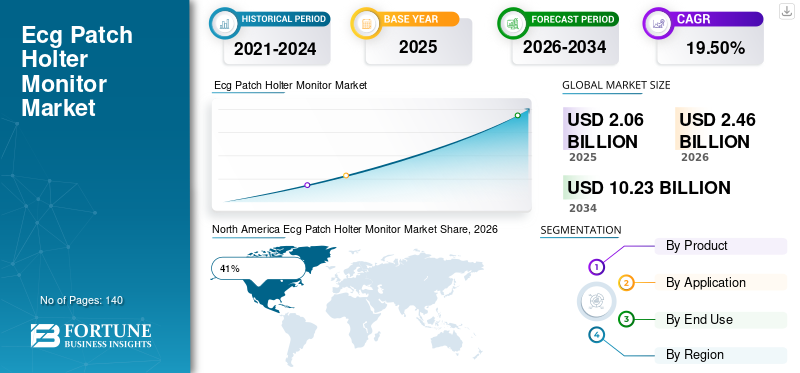
The global ECG patch holter monitor market size was valued at USD 2.06 billion in 2025. The market is projected to grow from USD 2.46 billion in 2026 to USD 10.23 billion by 2034, exhibiting a CAGR of 19.50% during the forecast period.

The ECG patch holter monitor market is experiencing strong expansion due to the growing burden of cardiovascular disorders, increasing prevalence of atrial fibrillation, and rising demand for long-term ambulatory cardiac monitoring solutions. Healthcare providers are increasingly adopting lightweight, wearable ECG patch systems as alternatives to traditional monitoring devices because of improved patient comfort and continuous data collection capabilities. The market is witnessing rapid technological advancement through wireless connectivity, cloud-based analytics, and artificial intelligence-assisted interpretation. Hospitals, diagnostic centers, and outpatient facilities are incorporating advanced monitoring solutions to improve arrhythmia detection rates. The ECG patch holter monitor market Report highlights increasing adoption across preventive cardiology and remote patient monitoring applications.
The United States represents the largest market for ECG patch and Holter monitoring technologies due to a high incidence of cardiovascular diseases and strong adoption of digital healthcare solutions. More than 800,000 cardiac-related hospitalizations occur annually, creating significant demand for continuous monitoring systems. Healthcare systems are increasingly utilizing wearable cardiac monitoring devices for early diagnosis and outpatient management. Remote patient monitoring programs have expanded substantially across major healthcare networks, accelerating demand for patch-based ECG solutions. The USA ECG patch holter monitor market Analysis indicates widespread acceptance of wireless cardiac monitoring, particularly among aging populations and patients requiring extended rhythm assessment beyond traditional 24-hour monitoring periods.
Download Free sample to learn more about this report.
Ecg Patch Holter Monitor Market Key Takeaways
 Global Market Size & Forecast
- 2025 Market Size: USD 2.06 Billion
- 2026 Market Size: USD 2.46 Billion
- 2034 Forecast Market Size: USD 10.23 Billion
- CAGR: 19.50% from 2026-2034
 Market Share
- The market in North America dominated with a revenue share of 41% in 2025.
- ECG Patch devices dominated with approximately 58% market share.
- Diagnostic monitoring dominated with approximately 64% market share.
 Key Regional Highlights
North America
North America dominated the market with a 41% share in 2025, supported by advanced cardiac monitoring infrastructure.
Europe
Europe accounted for 28% of the market, driven by growing adoption of ambulatory cardiac monitoring.
Asia-Pacific
Asia-Pacific held a 23% market share, supported by expanding healthcare infrastructure and rising cardiovascular disease burden.
U.S.
The U.S. market is supported by increasing adoption of wearable ECG monitoring and advanced cardiac care technologies.
Japan
Japan accounted for 35% of the Asia-Pacific market, supported by advanced healthcare infrastructure and growing demand for cardiac monitoring solutions.
Read More

ECG Patch Holter Monitor Market Latest Trends
The ECG patch holter monitor market Trends reveal a substantial shift from conventional wired monitoring devices toward disposable and wearable ECG patch technologies. Healthcare providers are increasingly preferring single-use adhesive patch systems capable of monitoring patients for up to 14 days or longer. These devices improve compliance and generate larger volumes of cardiac rhythm data compared with traditional monitors. Artificial intelligence integration is becoming a major trend across the ECG patch holter monitor industry report. Advanced algorithms can automatically detect arrhythmias, atrial fibrillation episodes, and abnormal cardiac events, reducing clinician workload and improving diagnostic accuracy. Cloud-enabled platforms are allowing physicians to review patient data remotely, supporting telehealth initiatives.
Download Free sample to learn more about this report.
Miniaturization of electronics has enabled manufacturers to develop lightweight, water-resistant, and patient-friendly monitoring devices. The market is also witnessing growing adoption of smartphone-connected ECG systems that facilitate real-time data transmission. Healthcare organizations are increasingly implementing remote cardiac monitoring programs to reduce hospital visits and improve chronic disease management. Another notable trend includes expansion into preventive healthcare. Physicians are recommending long-duration ECG monitoring for high-risk populations, including elderly patients and individuals with hypertension, diabetes, and previous cardiac events. These developments continue to strengthen the ECG patch holter monitor market Outlook and create new opportunities across ambulatory care settings.
ECG Patch Holter Monitor Market Dynamics
DRIVER
Rising Prevalence of Cardiac Arrhythmias and Cardiovascular Disorders
The primary driver in the ECG patch holter monitor market Growth is the increasing incidence of cardiovascular diseases worldwide. Cardiac arrhythmias, including atrial fibrillation, are becoming more common among aging populations. Healthcare providers require accurate diagnostic tools capable of detecting intermittent cardiac abnormalities that may not appear during standard ECG examinations. ECG patch monitors provide extended monitoring durations, enabling physicians to capture infrequent cardiac events more effectively. Growing awareness regarding early diagnosis, preventive cardiology initiatives, and remote patient monitoring programs further supports market expansion. The ECG patch holter monitor market Research Report indicates that healthcare systems are increasingly prioritizing ambulatory monitoring technologies to improve patient outcomes while reducing hospitalization rates. Continuous advancements in wearable technology and data analytics are also strengthening adoption among healthcare professionals and patients.
RESTRAINT
High Device Costs and Reimbursement Limitations
One of the major restraints affecting the ECG patch holter monitor market is the relatively high cost associated with advanced wearable monitoring solutions. Although ECG patches provide enhanced diagnostic capabilities, their adoption can be limited in cost-sensitive healthcare environments. Many healthcare facilities continue using conventional Holter monitors due to established workflows and lower acquisition expenses. Reimbursement variations across different healthcare systems also create challenges for widespread adoption. Smaller clinics and diagnostic centers may hesitate to invest in advanced monitoring platforms without clear financial returns. In some developing regions, limited awareness and inadequate healthcare infrastructure further restrict utilization. These factors can slow market penetration despite growing clinical benefits and technological improvements.
OPPORTUNITY
Expansion of Remote Patient Monitoring Programs
Remote patient monitoring represents one of the most significant opportunities within the ECG patch holter monitor market Opportunities landscape. Healthcare providers are increasingly adopting home-based monitoring programs to reduce hospital congestion and improve patient convenience. ECG patch devices are ideally suited for remote monitoring because they can collect continuous cardiac data without restricting patient mobility. Telemedicine expansion is creating favorable conditions for wearable cardiac monitoring technologies. Healthcare organizations are investing in digital health ecosystems that integrate monitoring devices with electronic medical records and cloud platforms. Emerging economies are also expanding digital healthcare infrastructure, creating new avenues for market penetration. These developments are expected to increase demand for connected ECG monitoring systems across multiple healthcare settings.
CHALLENGE
Data Management and Cybersecurity Concerns
The growing volume of cardiac monitoring data presents a major challenge for market participants. Long-duration ECG monitoring generates extensive datasets requiring secure storage, analysis, and interpretation. Healthcare providers must manage increasing amounts of patient information while complying with strict data privacy regulations. Cybersecurity threats targeting connected medical devices have become a concern among healthcare organizations. Integration challenges between monitoring platforms and hospital information systems can also complicate implementation. Additionally, clinicians face increasing workloads related to reviewing large quantities of monitoring data. Manufacturers must continue investing in advanced analytics, secure communication protocols, and streamlined workflows to address these challenges and support sustainable market growth.
ECG Patch Holter Monitor Market Segmentation
By Product
ECG Patch devices account for approximately 58% of the ECG patch holter monitor market Share. These devices have gained popularity because they offer enhanced patient comfort, reduced interference with daily activities, and extended monitoring periods. Unlike conventional monitoring systems, ECG patches are lightweight, discreet, and often waterproof, enabling continuous monitoring during routine activities. Physicians increasingly prefer patch-based solutions for detecting intermittent arrhythmias and asymptomatic cardiac events. Integration with wireless communication technologies further improves clinical workflow efficiency.
Holter Monitors represent approximately 42% of the ECG patch holter monitor market Share. These devices remain widely used due to their long clinical history and proven effectiveness in cardiac rhythm assessment. Traditional Holter systems are commonly utilized for 24-hour and 48-hour monitoring applications within hospitals and diagnostic centers. Healthcare providers continue relying on these systems for comprehensive cardiac evaluations and diagnostic investigations. Technological advancements have improved data storage, battery performance, and analysis capabilities, enhancing the value of modern Holter monitoring solutions.
To know how our report can help streamline your business, Speak to Analyst
By Application
Diagnostic monitoring accounts for approximately 64% of the ECG patch holter monitor market Share. This application segment is driven by increasing demand for arrhythmia detection, atrial fibrillation screening, and post-treatment cardiac assessment. Physicians rely on continuous ECG monitoring to identify intermittent abnormalities that may remain undetected during routine examinations. Extended monitoring durations improve diagnostic accuracy and support informed treatment decisions. Healthcare providers increasingly utilize ECG patch systems for early detection of cardiovascular conditions, contributing to improved patient outcomes. The segment benefits from growing awareness regarding preventive cardiac care and expanding use of ambulatory monitoring technologies.
By End Use
The end-use segment represents approximately 36% of the ECG patch holter monitor market Share and includes hospitals, specialty cardiac centers, ambulatory surgical centers, and diagnostic facilities. Hospitals remain the largest users due to high patient volumes and comprehensive cardiac care services. Specialty clinics increasingly adopt wearable monitoring technologies to support outpatient diagnosis and follow-up care. Ambulatory facilities are expanding utilization as healthcare systems emphasize cost-effective treatment models. Growing demand for remote patient monitoring and home healthcare services is further contributing to adoption across diverse end-user settings within the ECG patch holter monitor market.
ECG Patch Holter Monitor Market Regional Outlook
North America ECG Patch Holter Monitor Market Share, 2025 (%)
To get more information on the regional analysis of this market, Download Free sample
North America
North America holds approximately 41% of the ECG patch holter monitor market Share, making it the leading regional market. The region benefits from advanced healthcare infrastructure, high adoption of wearable medical technologies, and strong awareness regarding cardiovascular health. Rising cases of atrial fibrillation and cardiac arrhythmias continue to drive demand for long-term monitoring solutions. Hospitals and cardiology centers are increasingly utilizing ECG patch devices for continuous patient assessment. The growing adoption of remote patient monitoring programs supports wider deployment of wireless cardiac monitoring systems. Artificial intelligence-based diagnostic tools are also gaining traction across healthcare networks. Favorable reimbursement policies encourage healthcare providers to adopt advanced monitoring technologies. Increasing investment in digital health platforms further strengthens market expansion. Continuous innovation and strong clinical acceptance support North America's leadership position.
Europe
Europe accounts for approximately 28% of the ECG patch holter monitor market Share and remains a significant contributor to global demand. The region is characterized by strong healthcare systems and increasing focus on preventive cardiac care. Growing incidence of cardiovascular diseases is encouraging healthcare providers to implement advanced monitoring solutions. ECG patch devices are increasingly preferred because of their convenience and extended monitoring capabilities. Healthcare organizations continue investing in outpatient monitoring services to reduce hospital workloads. Telemedicine adoption has expanded substantially across several European countries. Medical technology advancements are improving diagnostic accuracy and patient compliance. Government initiatives promoting digital healthcare transformation are supporting market growth. Demand remains strong across both public and private healthcare sectors. Continuous innovation is expected to sustain long-term market development.
Germany ECG Patch Holter Monitor Market
Germany represents approximately 30% of the global ECG patch holter monitor market Share and remains one of Europe's largest healthcare technology markets. The country benefits from a well-established healthcare infrastructure and high healthcare expenditure. Cardiology departments increasingly adopt wearable monitoring systems for early diagnosis of cardiac disorders. ECG patch technologies are gaining popularity due to improved patient comfort and monitoring efficiency. The growing elderly population contributes to higher demand for long-term cardiac assessment solutions. Hospitals and specialty clinics continue investing in digital health technologies. Remote monitoring applications are becoming more common in outpatient care settings. Strong emphasis on preventive healthcare supports widespread adoption of advanced diagnostic tools. Research and innovation activities continue to strengthen market competitiveness. Germany remains a key hub for cardiac monitoring technology advancement.
United Kingdom ECG Patch Holter Monitor Market
The United Kingdom holds approximately 11% of the global ECG patch holter monitor market Share. Increasing prevalence of heart rhythm disorders is driving demand for advanced cardiac monitoring solutions. Healthcare providers are emphasizing earlier diagnosis and continuous patient monitoring to improve treatment outcomes. ECG patch systems are increasingly adopted due to their ability to provide extended monitoring periods. Expansion of telehealth services has accelerated demand for connected healthcare devices. Hospitals are integrating wearable monitoring technologies into routine cardiology workflows. Growing investments in healthcare digitization support adoption of cloud-connected monitoring platforms. Outpatient cardiac monitoring services are becoming increasingly important across the country. Improved patient compliance and convenience further contribute to market growth. The United Kingdom continues to be an important market for innovative cardiac diagnostic technologies.
Asia-Pacific
Asia-Pacific accounts for approximately 23% of the ECG patch holter monitor market Share and is one of the fastest-growing regional markets. Rising cardiovascular disease prevalence and expanding healthcare infrastructure are major growth factors. Increasing healthcare awareness is encouraging patients to seek early diagnosis and treatment. Governments across the region are investing heavily in healthcare modernization initiatives. Growing urban populations and aging demographics contribute to higher demand for cardiac monitoring solutions. ECG patch devices are becoming increasingly popular due to their convenience and portability. Telemedicine expansion is supporting remote patient monitoring adoption. Domestic manufacturers are introducing affordable solutions to improve accessibility. Healthcare providers are increasingly implementing wearable technologies for chronic disease management. The region offers substantial opportunities due to its large patient population and ongoing healthcare transformation.
Japan ECG Patch Holter Monitor Market
Japan contributes approximately 35% of the global ECG patch holter monitor market Share. The country has one of the world's largest elderly populations, creating strong demand for cardiac monitoring technologies. Healthcare providers increasingly utilize advanced ECG patch systems for arrhythmia detection and chronic disease management. High healthcare standards support rapid adoption of innovative medical technologies. Hospitals and specialty cardiac centers continue investing in digital healthcare solutions. Wearable monitoring devices are gaining popularity because they improve patient comfort and diagnostic efficiency. Continuous technological innovation remains a defining characteristic of the Japanese healthcare sector. Preventive healthcare initiatives are encouraging broader utilization of monitoring technologies. Integration of artificial intelligence enhances diagnostic capabilities. Japan remains an important contributor to advancements in cardiac monitoring systems.
China ECG Patch Holter Monitor Market
China represents approximately 24% of the global ECG patch holter monitor market Share and is a major growth engine within Asia-Pacific. Rapid healthcare infrastructure development is supporting wider adoption of advanced monitoring technologies. Rising prevalence of cardiovascular disorders is increasing demand for long-term cardiac monitoring solutions. Healthcare providers are expanding remote monitoring programs to improve patient access and care efficiency. Large patient populations create significant opportunities for ECG patch manufacturers. Government support for healthcare modernization continues to strengthen market development. Domestic production capabilities are improving product availability and affordability. Hospitals increasingly utilize digital health technologies for cardiac diagnostics. Growing awareness of preventive healthcare is encouraging earlier disease detection. China continues to strengthen its position within the global cardiac monitoring industry.
Rest of World
The Rest of World region accounts for approximately 8% of the ECG patch holter monitor market Share. Countries across Latin America, the Middle East, and Africa are gradually increasing adoption of advanced cardiac monitoring technologies. Growing healthcare investments are improving access to diagnostic services and modern medical equipment. Healthcare providers are recognizing the benefits of long-duration ECG monitoring for early disease detection. Urban hospitals are increasingly implementing wearable monitoring systems to enhance patient care. Telemedicine expansion is supporting broader use of remote cardiac monitoring technologies. Rising awareness of cardiovascular diseases is contributing to increased demand. Government healthcare improvement programs are encouraging technology adoption. Market participants are exploring new opportunities in underserved regions. Continued healthcare modernization is expected to support sustained growth across these emerging markets.
List of Top Ecg Patch Holter Monitor Companies
- Nissha Medical Technologies (NMT)
- Medtronic plc
- Hill-Rom
- iRhythm Technologies, Inc.
- Nihon Kohden Corporation
- Koninklijke Philips N.V.
- GE Healthcare
- Fukuda Denshi Co., Ltd.
- Spacelabs Healthcare
- AliveCor, Inc.
- Cardiac Insight Inc.
- VitalConnect
- LifeSignals, Inc.
- Bardy Diagnostics, Inc.
- Nasiff Associates, Inc.
- Midmark Corporation
- Lief Therapeutics, Inc.
- Schiller AG
Top Two Companies with Highest Market Share
- iRhythm Technologies, Inc. – 18%
- Koninklijke Philips N.V. – 14%
Investment Analysis and Opportunities
The ECG patch holter monitor market is attracting increasing investment due to growing demand for wearable healthcare technologies and remote patient monitoring solutions. Investors are focusing on companies developing artificial intelligence-enabled diagnostic platforms capable of improving arrhythmia detection accuracy. Venture capital activity remains strong in digital health and connected medical device sectors. Healthcare providers are investing in cloud-based monitoring infrastructure that supports continuous patient observation outside traditional hospital environments. Strategic partnerships between medical device manufacturers and healthcare technology companies are expanding market opportunities. Investment activity is particularly strong in wireless communication technologies, data analytics, and software platforms supporting cardiac monitoring ecosystems.
Emerging markets offer substantial opportunities due to expanding healthcare infrastructure and increasing cardiovascular disease prevalence. Companies introducing cost-effective monitoring solutions are positioned to benefit from growing demand across developing regions. The ECG patch holter monitor market Outlook remains favorable as healthcare systems continue prioritizing preventive care, chronic disease management, and remote healthcare delivery models. Increased focus on home-based monitoring and digital health transformation is expected to create additional investment opportunities throughout the forecast period.
New Product Development
Product innovation remains a critical competitive factor within the ECG patch holter monitor market. Manufacturers are developing smaller, lighter, and more comfortable monitoring devices that improve patient adherence and enable longer monitoring durations. Wireless communication capabilities and smartphone integration have become standard features in many new product launches. Artificial intelligence is increasingly incorporated into cardiac monitoring platforms to automate arrhythmia detection and reduce clinician workload. Advanced algorithms can analyze large datasets and identify clinically significant cardiac events with greater efficiency. Manufacturers are also focusing on extended battery life and improved data storage capabilities.
Recent innovations include disposable ECG patches designed for continuous monitoring over multiple weeks, cloud-connected diagnostic systems, and real-time reporting platforms. Water-resistant designs and flexible materials enhance patient comfort and usability. Companies are introducing integrated ecosystems combining wearable sensors, analytics software, and physician portals to streamline cardiac care workflows. Research and development efforts are increasingly focused on predictive analytics, allowing healthcare providers to identify high-risk patients before serious cardiac events occur. These innovations continue to strengthen the ECG patch holter monitor market Growth potential and support broader adoption across healthcare environments.
Five Recent Developments (2023-2025)
- iRhythm Technologies expanded deployment of advanced Zio patch monitoring solutions with enhanced analytics capabilities during 2025.
- Philips strengthened its connected cardiac monitoring portfolio through upgrades to remote patient monitoring platforms in 2024.
- Medtronic introduced expanded digital cardiac monitoring functionalities supporting improved ambulatory patient management in 2024.
- VitalConnect advanced wearable biosensor technology with enhanced continuous cardiac monitoring features during 2023.
- GE Healthcare expanded integration of cloud-based cardiac diagnostic workflows supporting remote ECG monitoring applications in 2025.
Report Coverage of ECG Patch Holter Monitor Market
The ECG patch holter monitor market Report provides comprehensive analysis of industry developments, technological advancements, competitive landscape, and emerging growth opportunities. The report examines market dynamics, including drivers, restraints, opportunities, and challenges influencing industry performance. It evaluates adoption patterns across hospitals, diagnostic centers, specialty clinics, and remote patient monitoring programs. The study includes detailed segmentation analysis by type and application, highlighting market share distribution and key demand trends. Regional analysis covers North America, Europe, Asia-Pacific, and Rest of World markets, providing insights into healthcare infrastructure development, regulatory environments, and adoption patterns.
Request for Customization to gain extensive market insights.
The report also assesses competitive positioning among leading manufacturers and examines product innovation strategies shaping the industry. Special attention is given to artificial intelligence integration, cloud connectivity, wearable technology advancements, and remote patient monitoring trends. Investment opportunities, new product development activities, and recent industry developments are analyzed to provide stakeholders with actionable business intelligence. The ECG patch holter monitor industry report serves as a valuable resource for manufacturers, investors, healthcare providers, distributors, and strategic decision-makers seeking detailed market insights.
Frequently Asked Questions
Fortune Business Insights says that the global ECG Patch Holter Monitor Market value stood at USD 2.06 billion in 2025 and is projected to reach USD 10.23 billion by 2034.
The market is expected to exhibit a CAGR of 19.50% during the forecast period of 2026-2034.
ECG Patch devices dominated the product segment with approximately 58% market share, driven by enhanced patient comfort, extended monitoring periods, and wireless connectivity.
Key players include Nissha Medical Technologies (NMT), Medtronic plc, Hill-Rom, iRhythm Technologies, Inc., Nihon Kohden Corporation, and Koninklijke Philips N.V.
Major trends include the shift toward wearable and disposable ECG patches and increasing integration of artificial intelligence and cloud-based analytics. North America led the market with a 41% share.



- 2021-2034
- 2025
- 2021-2024
- 140
-

(Offer valid till 30th Sep 2026)
Get 30-60 hrs Free Customization
Expand Regional and Country Coverage, Segments Analysis, Company Profiles, Competitive Benchmarking, and End-user Insights.













.webp)






-
US +1 833 909 2966 ( Toll Free )
-
Get In Touch With Us