Electric Vehicle Battery Swapping Market Size, Share & Industry Analysis, By Service Type (Subscription Model, Pay-Per-Use Model), By Vehicle Type (Two-Wheeler, Three-Wheeler, Others), and Regional Forecast, 2026-2034
 Download Free Sample
(Offer valid till 30th Sep 2026)

Electric vehicle battery swapping Market Size and Industry Overview
 Listen to Audio Version
The global electric vehicle battery swapping market size was valued at USD 1.94 billion in 2025. The market is projected to grow from USD 2.57 billion in 2026 to USD 24.54 billion by 2034, exhibiting a CAGR of 32.60% during the forecast period. Asia Pacific dominated the electric vehicle battery swapping market, accounting for 69.96% market share in 2025. The Industry growth is driven by rapid EV adoption, fleet electrification demand, reduced charging downtime, infrastructure standardization initiatives, and urban mobility transformation policies.
The electric vehicle battery swapping market is emerging as a strategic enabler of scalable electric mobility infrastructure. As electric vehicle adoption accelerates across urban and commercial segments, the need to minimize charging downtime and optimize asset utilization becomes increasingly critical. Battery swapping models address range anxiety, grid constraints, and operational inefficiencies associated with conventional charging systems.
The electric vehicle battery swapping market size expansion is supported by the rapid electrification of two-wheelers and three-wheelers, particularly in high-density urban markets. Fleet operators, ride-hailing services, and last-mile logistics providers prioritize uptime and predictable energy costs. Swapping networks allows vehicles to exchange depleted batteries for fully charged units within minutes, improving operational continuity.
Electric vehicle battery swapping market share remains regionally concentrated in Asia-Pacific, where regulatory incentives and standardized battery formats are accelerating deployment. Strategic alliances between vehicle manufacturers and energy infrastructure providers are reshaping competitive dynamics. Integrated ecosystem models that combine vehicle sales, battery ownership separation, and subscription services are gaining traction.
Electric vehicle battery swapping market trends highlight modular battery architecture, digital energy management platforms, and interoperability standardization efforts. Operators increasingly leverage data analytics to optimize battery lifecycle performance and station placement.
Electric vehicle battery swapping market growth is expected to remain robust throughout the forecast period, driven by urban electrification mandates and commercial fleet expansion. While adoption patterns vary by region, battery swapping is positioned as a complementary solution to fast-charging infrastructure within the broader electric mobility ecosystem.
Download Free sample to learn more about this report.
Electric vehicle battery swapping can be defined as the process of swapping discharged or depleted batteries for charged ones, with the operation only requiring as much time as refueling a conventional vehicle. Thus, battery swapping eliminates concerns related to electric vehicle (EV) adoption, such as long charging times, range anxiety, and high battery replacement costs. Furthermore, by separating the battery and the vehicle, the battery swapping model reduces the EV purchase cost and enhances the competitiveness of the electric vehicle market. These factors will influence the electric vehicle battery swapping market growth.
Strong Policy Support to Counter the COVID-19 Pandemic Will Positively Influence Growth
The majority of the companies involved in the market are startups. They are expected to face difficulties concerning fundraising during the short term. However, startups, such as Numocity, are vital for developing the electric vehicle sector in high-volume emerging economies. Hence, fundraising/merger & acquisition activities are expected to be picked up in the medium and long term.
Furthermore, continuous decrease in battery costs, upgrades in performance, and model choice offered by OEMs and fleet operators transitioning to eco-friendly vehicles also contributed to the continued electric vehicle uptake. Thus, the consistent increase in demand for electric cars and heavily incentivized support for public transportation companies, accelerating fleet transition, will create positive demand for battery swapping systems in the long term.
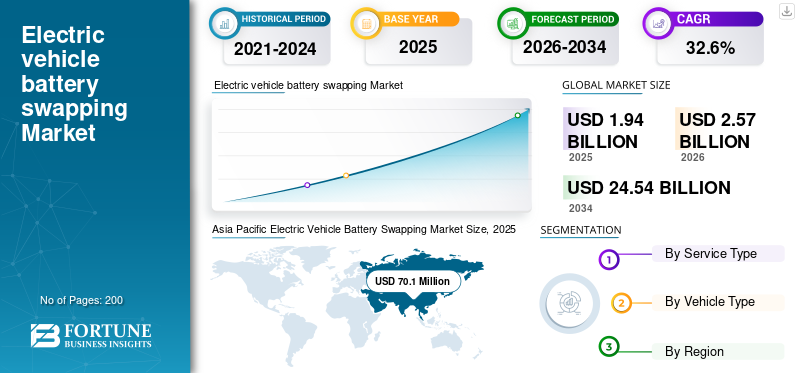
Download Free sample to learn more about this report.
Electric Vehicle Battery Swapping Market KEY TAKEAWAYS
 Market Size & Forecast
- 2025 Market Size: USD 1.94 billion
- 2026 Market Size: USD 2.57 billion
- 2034 Forecast Market Size: USD 24.54 billion
- CAGR: 32.60% from 2026–2034
 Market Share
- Asia Pacific dominated the electric vehicle battery swapping market with a 69.96% share in 2025.
- The subscription model segment accounted for the largest market share.
- The pay-per-use (PPU) model segment is projected to witness the fastest growth during the forecast period.
 Key Regional Highlights
Asia Pacific
Asia Pacific led the global market, supported by strong EV adoption and battery manufacturing partnerships.
Europe
Europe is expected to witness steady growth due to expanding battery swapping initiatives for urban mobility.
North America
North America is projected to grow with rising fleet electrification and battery swapping deployments.
U.S.
U.S. Commercial fleet pilots and supportive state-level initiatives are driving market expansion.
Japan
Japan Urban two-wheeler electrification and government-backed pilot programs are supporting market growth.
Read More

Key Market Dynamics
electric vehicle battery swapping market Trends
Battery as a Service Model Will Positively Influence Growth
The battery as a service (Baas) model eliminates the risk associated with owning batteries and significantly reduces the total vehicle cost for owners. For instance, in August 2020, NIO launched its Baas Model, which offers a USD 10,000 deduction of the original purchase price and only a USD 142 subscription fee for charging and swapping batteries. Furthermore, in China, as part of the NEV 2020 policy, EVs that cost more than USD 43,000 are eligible for subsidies only if they support battery swapping. Hence, the Baas model will positively influence the growth of the market.
Battery standardization initiatives represent a defining electric vehicle battery swapping market trend. Industry collaborations aim to harmonize battery pack dimensions and connectors. Standardization enhances interoperability and reduces fragmentation. Subscription-based energy models are expanding. Consumers increasingly adopt battery-as-a-service frameworks that separate battery ownership from vehicle purchase. This approach lowers upfront cost and creates recurring revenue streams.
Digital platform integration strengthens operational efficiency. Advanced battery management systems track usage, health status, and charging cycles. Data-driven optimization improves asset utilization. Fleet-focused deployment strategies dominate infrastructure expansion. Operators prioritize high-traffic urban corridors and logistics hubs. This targeted approach maximizes station throughput and economic viability.
Modular battery design is gaining prominence. Swappable battery packs are engineered for lightweight handling and safety compliance. Design innovation enhances usability and reduces mechanical complexity. Renewable energy integration is emerging within centralized charging facilities. Swapping stations increasingly incorporate solar or grid-balancing strategies to reduce carbon intensity.
Market Drivers
Power System Benefits to Augment Market Growth
With the increasing demand for larger battery capacity, there is a rising need for fast chargers. To satisfy daily energy requirements and keep up with the expanding battery capacities, users will also need to upgrade their charging equipment. In this aspect, battery swapping is superior to a conventional charging setup, as upgrades will only be required at the battery swapping stations (BSS). In the traditional infrastructure, upgrades would be needed at the household level and the charging station.
Furthermore, as the BSS site is a collection of batteries, it can smooth the daily demand curve by resupplying power to the grid. This feature also creates additional benefits such as load following, frequency regulation, and voluntary reserve provisions. Hence, these factors will propel the demand for electric vehicle battery swapping.
Easier Management for Energy Producers and Transmission System Operators (TSO) to Propel Demand for Electric Vehicle Battery Swapping
Batteries are centrally charged in the BSS model, where the centralized charging stations' power is enormous. However, the power can be controlled centrally, which is helpful for the distinct formation of power grid lines. An individual connection to a network of widely distributed cable-charging stations is more complex than a BSS site using systematic, standardized solutions for connecting to the grid. Therefore, for TSOs, negotiating becomes more accessible due to fewer market key players. Hence, these factors will fuel the adoption of electric vehicle battery swapping.
Rapid electrification of urban mobility systems is the primary driver of the electric vehicle battery swapping market. Two-wheeler and three-wheeler adoption in densely populated cities increases demand for fast energy replenishment solutions. Battery swapping minimizes vehicle downtime compared to conventional charging. Fleet electrification accelerates market expansion. Logistics operators and ride-hailing platforms prioritize operational efficiency. Swapping networks ensures continuous vehicle utilization and predictable energy costs. This model improves fleet productivity and reduces charging-related bottlenecks.
Grid capacity limitations further support adoption. High concentration of fast-charging stations can strain distribution networks. Battery swapping centralizes charging operations, allowing optimized load management and off-peak charging strategies. Cost optimization also drives demand. Separation of battery ownership from vehicle purchase reduces upfront acquisition cost. Subscription-based energy access models enhance affordability for individual users and fleet operators.
Market Restraints
High Total Cost of Investment to Restrain Growth
According to NIO, the battery swapping station, which includes site leasing, batteries, labor, and other equipment, costs about 5 million yuan (USD 772,800). The cost is significantly higher than the construction cost of a charging station (around 2 million yuan or USD 309,112). The annual depreciation cost of a battery swapping station is approximately 500,000 yuan or USD 77,280. A first-generation, second-generation, and third-generation NIO station keeps around 6, 13, and 28 batteries in storage. This translates to a considerable amount of capital tied up and a high increase in the total investment cost. The value of the old batteries belonging to operators will depreciate substantially when a new generation of batteries is launched in the market. Hence, these factors will restrain the growth of the market.
High initial infrastructure investment constrains the electric vehicle battery swapping market. Establishing swapping stations requires capital-intensive equipment, battery inventory, and digital management systems. Financial viability depends on achieving sufficient utilization rates. Standardization challenges present another barrier. Lack of uniform battery formats across manufacturers complicates interoperability. Proprietary systems limit cross-brand compatibility and slow ecosystem scalability.
Battery degradation risk also affects profitability. Swapping operators must manage performance consistency across shared battery pools. Lifecycle variability can increase operational complexity and maintenance costs. Consumer acceptance varies by region. Private vehicle owners may prefer home charging convenience. Swapping models are more attractive to commercial fleets than to individual users in certain markets.
Regulatory uncertainty influences investment decisions. Inconsistent policy frameworks regarding battery ownership, safety compliance, and recycling obligations create risk for infrastructure providers. Logistical complexity further constrains expansion. Inventory management, transportation of batteries, and site selection require coordinated planning. Inefficient deployment can reduce return on investment.
Market Opportunities
Commercial fleet electrification presents a substantial opportunity within the electric vehicle battery swapping market. Urban delivery services and shared mobility operators require rapid energy replenishment. Dedicated swapping networks enhance route efficiency and vehicle availability. Emerging economies offer high-growth potential. Urban congestion and cost-sensitive consumers support the adoption of battery-as-a-service models. Infrastructure development can scale alongside vehicle penetration.
Standardized battery alliances create expansion pathways. Collaborative industry initiatives enable cross-brand interoperability, increasing the addressable market size. Ecosystem integration strengthens competitive positioning. Expansion into four-wheeler segments represents a long-term opportunity. Although currently concentrated in two- and three-wheelers, battery swapping may extend to passenger and light commercial vehicles where downtime reduction is critical.
Energy storage integration provides incremental revenue streams. Swapping stations can function as distributed energy storage hubs, supporting grid stabilization services. This dual-use model enhances financial viability. Technological advancement in battery chemistry improves lifecycle economics. Higher energy density and durability enhance return on infrastructure investment.
SEGMENTATION ANALYSIS
By Service Type Analysis
Subscription Model Segment Accounted for the Largest Market Share in 2020 due to Affordability.
Based on service type, this market is segmented into subscription and pay-per-use models.
Subscription Model
The subscription model segment is expected to lead the market during the forecast period. Factors such as affordability, low cost per swap, and battery leasing solutions are credited for the high share of subscription models. The subscription model represents a dominant revenue structure within the electric vehicle battery swapping market. Under this framework, users pay recurring fees to access battery swapping services without owning the battery. Separation of battery ownership reduces upfront vehicle acquisition cost and improves affordability, particularly for commercial operators and cost-sensitive commuters.
Fleet operators favor subscription structures due to predictable operating expenditure. Energy costs become standardized and manageable, supporting financial planning and route optimization. Subscription models also enable centralized battery health management, ensuring performance consistency across shared fleets.
From an operator perspective, subscription services create stable, recurring revenue streams. Infrastructure utilization improves as contracted fleets guarantee minimum swap volumes. Data analytics integration enhances lifecycle monitoring and inventory forecasting, optimizing capital deployment.
Pay-Per-Use Model
The pay-per-use (PPU) model segment is anticipated to exhibit a higher CAGR during the forecasted period. This can be attributed to the increased PPU model adoption among private customers who use their vehicles infrequently and avoid upfront capital expenditures. The pay-per-use model offers flexibility for individual users and low-frequency commercial operators. Customers pay per swap transaction rather than committing to recurring contracts. This model supports broader consumer adoption in early-stage markets where fleet penetration remains limited.
Pay-per-use pricing aligns with irregular travel patterns. It reduces long-term commitment barriers and supports gradual ecosystem development. Operators benefit from diversified customer bases but face demand variability and revenue unpredictability. To manage volatility, operators often deploy dynamic pricing structures. Peak-hour pricing and location-based tariffs optimize station throughput. Digital platforms track transaction frequency and enable demand forecasting.
While pay-per-use models provide flexibility, margins may be thinner compared to subscription contracts. Infrastructure investment risk remains higher without guaranteed volume commitments. Nevertheless, this model supports early electric vehicle battery swapping market growth in developing markets and complements subscription frameworks in mixed-use urban environments.
By Vehicle Type Analysis
To know how our report can help streamline your business, Speak to Analyst
The Wheeler Segment Held the Largest Market Share, Attributed to the Low Cost
The market for electric vehicle battery swapping is segmented by vehicle type into two-wheeler, three-wheeler, and others.
Two-Wheeler
The two-wheeler segment accounted for a 67.1% share of the market in 2020. Factors such as increasing government support for the electrification of transport and the excellent compatibility of two-wheelers with the modular design approach will propel the growth of this segment.
Two-wheelers represent the largest segment within the electric vehicle battery swapping market. Urban commuters and delivery riders rely heavily on motorcycles and scooters for daily mobility. High daily usage frequency increases demand for rapid energy replenishment. Battery swapping addresses charging downtime constraints common in dense cities. Riders often lack private charging access, making centralized swapping stations attractive. Subscription models are particularly effective in this segment, as fleet operators seek operational continuity.
Lower battery capacity requirements reduce infrastructure complexity compared to larger vehicles. Standardized modular battery packs enable efficient handling and quick exchange. As a result, two-wheelers account for the majority of installed swapping stations and contribute significantly to the electric vehicle battery swapping market size. Government policies in major Asian markets further reinforce two-wheeler electrification. Subsidies and emission regulations accelerate adoption. Consequently, this segment remains the primary engine of the electric vehicle battery swapping market growth.
Three-Wheeler
The three-wheeler segment is expected to register a superior CAGR during the forecast period. There were around 1.5 million electric three-wheelers in India in 2019. Sales of electric three-wheelers have continued to increase in China and India with new domestic brands. Battery swapping offers greater mobility and considerably reduces the total cost of ownership for rickshaw drivers. These factors are attributed to the growth of this segment.
Three-wheelers, including electric auto-rickshaws and cargo vehicles, represent a high-impact commercial segment. These vehicles serve passenger transport and last-mile logistics markets. Operational uptime is critical, making battery swapping economically attractive. Three-wheeler batteries are larger than two-wheeler units, requiring more robust station infrastructure. However, consistent daily route patterns support predictable swap volumes. Fleet-based subscription models dominate this category.
Commercial operators prioritize total cost of ownership. Battery-as-a-service models reduce capital expenditure and shift risk to infrastructure providers. Swapping enhances revenue generation potential by minimizing idle time. As urban logistics and micro-mobility services expand, three-wheelers contribute meaningfully to the electric vehicle battery swapping market share. Growth is particularly strong in emerging economies where three-wheelers are integral to urban transportation networks.
Four-wheeler battery swapping faces greater standardization challenges due to battery size variation and safety requirements. Infrastructure investment is significantly higher compared to two- and three-wheelers. Nevertheless, commercial fleets seeking rapid turnaround times may adopt swapping in controlled environments.
Across vehicle types, segmentation trends indicate strong dominance of two- and three-wheelers in the near term, with gradual exploration of larger vehicle applications. Operators capable of optimizing asset utilization, standardizing battery formats, and integrating digital management platforms are positioned to capture sustained electric vehicle battery swapping market growth.
Regional ANALYSIS
Asia Pacific Electric Vehicle Battery Swapping Market Size, 2025 (USD Million)
To get more information on the regional analysis of this market, Download Free sample
In terms of geography, the market studied across North America, Europe, the Asia Pacific, and the rest of the world.
Asia-Pacific Electric Vehicle Battery Swapping Market Analysis:
Asia Pacific accounted for the largest electric vehicle battery swapping market share in 2025 at USD 70.1 million. Large Japanese automakers are developing economically feasible and practical solutions focusing on emerging economies in the Asia Pacific. Hence, they collaborate with domestic battery manufacturers to jointly develop and commercialize batteries and vehicles in an integrated modular design.
In China, the adoption of the battery swapping model has increased exponentially as it has emerged as a viable complementary solution to cable charging. Domestic companies, such as BAIC, have redesigned vehicles to implement a swapping solution focusing on the commercial sector. Hence, these factors are attributed to the increased uptake of battery swapping in this region. The electric vehicle battery swapping market in the U.S. is projected to grow significantly, reaching an estimated value of USD 168.7 million by 2028.
Asia-Pacific dominates the electric vehicle battery swapping market, supported by high two-wheeler penetration and dense urban populations. Regulatory incentives and battery standardization initiatives accelerate infrastructure expansion. Strong fleet adoption in logistics and ride-hailing segments sustains the leading electric vehicle battery swapping market share globally.
Japan Electric Vehicle Battery Swapping Market:
Japan’s electric vehicle battery swapping market focuses on urban two-wheeler electrification and structured pilot programs. Advanced battery management systems and technology integration strengthen reliability. Government support for emission reduction supports the gradual growth of the electric vehicle battery swapping market.
China Electric Vehicle Battery Swapping Market:
China leads in the electric vehicle battery swapping market size through aggressive infrastructure deployment and policy alignment. Standardized battery frameworks and commercial fleet adoption accelerate scaling. Strategic integration with urban mobility ecosystems sustains robust electric vehicle battery swapping market growth.
Europe Electric Vehicle Battery Swapping Market Analysis:
Europe is expected to show good growth in the market due to the increasing development of battery swapping for compact city-oriented vehicles in Germany and Sweden. Europe’s electric vehicle battery swapping market remains nascent but strategically relevant. Urban electrification policies and decarbonization mandates support exploration of alternative charging models. Two-wheeler adoption in Southern Europe provides a niche opportunity. Regulatory emphasis on standardization may accelerate long-term development, sustaining measured electric vehicle battery swapping market growth.
Germany Electric Vehicle Battery Swapping Market:
Germany’s electric vehicle battery swapping market focuses on pilot initiatives and industrial fleet trials. Strong automotive engineering capability supports technical experimentation. However, widespread fast-charging infrastructure limits consumer switching incentives. Growth remains gradual, tied primarily to commercial mobility programs and urban delivery electrification strategies.
United Kingdom Electric Vehicle Battery Swapping Market:
The United Kingdom electric vehicle battery swapping market is driven by fleet electrification in logistics and shared mobility. Policy support for zero-emission transport encourages infrastructure pilots. Adoption remains limited compared to charging networks, but controlled fleet environments provide viable early-stage growth opportunities.
North America Electric Vehicle Battery Swapping Market Analysis:
In North America, increasing stringency of emission regulations in the U.S. and implementation of the battery swapping model in key states, such as California (where Ample supports Uber EVs with five swapping stations), will support the growth of the market during the forecast period.
North America represents an emerging electric vehicle battery swapping market with selective deployment focused on fleet applications. Infrastructure investment prioritizes commercial logistics and pilot urban mobility programs. Regulatory support for electrification encourages experimentation, but fast-charging dominance limits widespread swapping adoption. Growth remains moderate, supported by innovation partnerships and urban fleet electrification initiatives.
United States Electric Vehicle Battery Swapping Market:
The United States electric vehicle battery swapping market is characterized by pilot-scale deployment and commercial fleet experimentation. Swapping adoption is concentrated in delivery and shared mobility fleets seeking reduced downtime. Infrastructure economics remain under evaluation. While fast charging dominates consumer segments, targeted fleet programs support incremental electric vehicle battery swapping market growth.
Latin America Electric Vehicle Battery Swapping Market Analysis:
Latin America demonstrates early-stage electric vehicle battery swapping market development. Urban congestion and two-wheeler adoption create opportunities, but infrastructure investment remains limited. Gradual fleet electrification supports incremental growth.
Middle East & Africa Electric Vehicle Battery Swapping Market Analysis:
The Middle East and Africa electric vehicle battery swapping market is in exploratory stages. Urban electrification initiatives and commercial fleet trials support limited adoption. Infrastructure expansion depends on regulatory clarity and investment availability.
Electric Vehicle Battery Swapping Industry Competitive Landscape:
High Capital Investment by NIO to Strengthen its Position as a Leading Player in the Market
NIO has adopted the swapping solution to differentiate its product and gain a competitive advantage among private customers. By 2020, the company had installed 178 battery-swap stations in 64 different cities across China. Furthermore, NIO completed more than 700,000 swaps by the end of June 2020. As part of its NIO Power 2025 plan, the company aims to install 700 stations by the end of 2021. Hence, the full-fledged adoption of battery swapping, specifically in China, has enabled NIO to capture a larger market share.
The electric vehicle battery swapping industry's competitive landscape is defined by infrastructure operators, battery technology providers, and electric vehicle manufacturers forming integrated ecosystem partnerships. Market positioning depends on standardization capability, battery management expertise, and network density. Leading operators in Asia-Pacific hold substantial electric vehicle battery swapping market share through vertically integrated models combining vehicle manufacturing and energy services. These companies leverage subscription frameworks and standardized battery packs to scale rapidly.
Emerging players focus on modular battery design and digital platform integration. Technology-driven differentiation centers on real-time battery diagnostics, predictive maintenance analytics, and dynamic energy pricing models. Strategic partnerships are critical to expansion. Infrastructure providers collaborate with fleet operators, ride-hailing companies, and logistics firms to secure consistent demand. Government-backed alliances support urban infrastructure rollout.
Competition increasingly emphasizes interoperability and ecosystem control. Operators that establish proprietary battery formats gain user lock-in but may face scalability constraints. Conversely, open-standard approaches enable broader adoption but require collaborative governance. Long-term competitiveness depends on asset utilization efficiency, lifecycle cost management, and regulatory alignment. Firms capable of integrating digital energy platforms with scalable infrastructure are positioned to capture sustained electric vehicle battery swapping market growth across expanding electric mobility ecosystems.
LIST OF KEY COMPANIES PROFILED:
- ChargeMYGaadi (New Delhi, India)
- NIO, Inc. (Shanghai, China)
- Numocity (Karnataka, India)
- BAIC (Beijing, China)
- KYMCO (Kaohsiung City, Taiwan)
- Gogoro, Inc. (Taoyuan, Taiwan)
- Amplify Mobility (Telangana, India)
- Lithion Power Private Limited (New Delhi, India)
- Sun Mobility (Karnataka, India)
- Ample (California, US)
- Aulton New Energy Automotive Technology (Shanghai, China)
- ECHARGEUP (New Delhi, India)
- Amara Raja Group (Andhra Pradesh, India)
- Others
Latest Electric Vehicle Battery Swapping Industry Developments:
- January 2024: NIO expanded its battery swapping station network to strengthen urban electric mobility infrastructure, integrating advanced battery health monitoring and automated swap technology.
- April 2024: Gogoro partnered with a regional two-wheeler manufacturer to expand battery swapping interoperability, enhancing modular battery compatibility and subscription-based service integration.
- August 2024: SUN Mobility launched upgraded high-capacity swapping stations targeting three-wheeler fleets, improving battery lifecycle analytics and load management capabilities.
- February 2025: CATL introduced a standardized swappable battery platform designed for multi-brand compatibility, aiming to accelerate infrastructure scalability and reduce ecosystem fragmentation.
- June 2025: Ample deployed modular battery swapping stations in a commercial fleet pilot program, integrating cloud-based energy optimization and automated exchange systems to enhance operational efficiency.
REPORT COVERAGE
The electric vehicle battery swapping market research report covers a detailed analysis of the industry and focuses on key aspects, such as leading companies, product types, and leading applications of the product. Besides this, it offers insights into the market trends and highlights key industry developments. In addition to the aforementioned factors, the report delivers an in-depth market analysis of several factors that have contributed to growth over recent years.
Request for Customization to gain extensive market insights.
Report Scope & Segmentation
|
ATTRIBUTE |
DETAILS |
|
Study Period |
2021-2034 |
|
Base Year |
2025 |
|
Estimated Year |
2026 |
|
Forecast Period |
2026-2034 |
|
Historical Period |
2021-2024 |
|
Unit |
Value (USD Million) |
|
Segmentation |
By Service Type
|
|
By Vehicle Type
|
|
|
By Geography
|
Frequently Asked Questions
Fortune Business Insights says that the global market size was USD 1.94 billion in 2025 and is projected to reach USD 24.54 billion by 2034.
In 2025, the Asia Pacific market value stood at USD 70.1 million.
Registering a CAGR of 32.6%, the market will exhibit excellent growth during the forecast period (2026-2034).
The subscription model segment is expected to lead this market during the forecast period.
Electric vehicle battery swapping enables easier management for energy producers and transmission system operators (TSOs) to drive the market's growth.
NIO, BAIC, and Aulton are the major players in the global market.
Asia Pacific held the largest share in the market in 2025.
The elimination of upgraded costs for users compared to cable charging and exponential vehicle-to-grid benefits and increasing adoption of shared e-mobility trends, such as ride-hailing and rentals, are expected to drive the adoption of electric vehicle battery swapping during the forecast period.



- 2021-2034
- 2025
- 2021-2024
- 200
-
(Offer valid till 30th Sep 2026)
Get 30-60 hrs Free Customization
Expand Regional and Country Coverage, Segments Analysis, Company Profiles, Competitive Benchmarking, and End-user Insights.




















-
US +1 833 909 2966 ( Toll Free )
-
Get In Touch With Us