Electrotherapy Devices Market Size, Share & Industry Analysis, By Offering (Instrument {Transcutaneous Electrical Nerve Stimulation (TENS), Electrical Muscle Stimulation (EMS), Interferential Current Therapy (IFC), Microcurrent Therapy, and Others} and Accessories & Consumables), By Indication (Pain Management, Neurological Rehabilitation, Tissue Repair & Wound Healing, and Others), By End-user (Hospitals, Physiotherapy & Rehabilitation Clinics, Homecare Settings, and Others), and Regional Forecast, 2026-2034
 Download Free Sample
Electrotherapy Devices Market Size and Future Outlook
 Listen to Audio Version
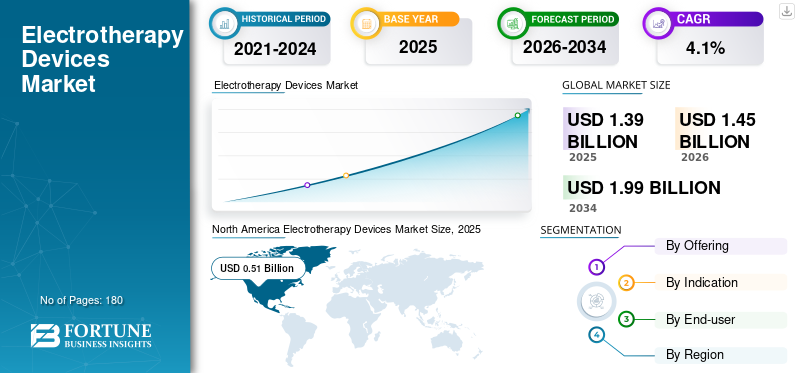
The global electrotherapy devices market size was valued at USD 1.39 billion in 2025. The market is projected to grow from USD 1.45 billion in 2026 to USD 1.99 billion by 2034, exhibiting a CAGR of 4.1% during the forecast period. North America dominated the electrotherapy devices market with a market share of 36.69% in 2025.
Electrotherapy devices are tools or equipment that use electrical energy to stimulate nerves and muscles for therapeutic purposes, including pain relief, neuromuscular rehabilitation, tissue repair, and functional recovery. The market growth is attributed to increasing cases of musculoskeletal disorders, sports injuries, and neurological conditions, as well as the growing geriatric population, which is driving the demand for such devices.
Furthermore, Zynex Inc., Enovis, BTL Group of Companies, and OMRON Healthcare, Inc. held the majority of the market share due to their extensive product portfolios and strong investments.
Download Free sample to learn more about this report.
Electrotherapy Devices Market Key Takeaways
 Global Market Size & Forecast
- 2025 Market Size: USD 1.39 billion
- 2026 Market Size: USD 1.45 billion
- 2034 Forecast Market Size: USD 1.99 billion
- CAGR: 4.1% from 2026–2034
 Market Share
- North America dominated the electrotherapy devices market with a 36.69% share in 2025.
- The pain management segment is estimated to hold a 47.7% share in 2026.
- The physiotherapy & rehabilitation clinics segment is projected to account for a 42.6% share in 2026.
 Key Regional Highlights
North America
North America remained the leading regional market, valued at USD 0.51 billion in 2025.
Europe
Europe is projected to reach USD 0.39 billion by 2026, growing at a 3.5% CAGR during the forecast period.
Asia Pacific
Asia Pacific is expected to reach USD 0.39 billion by 2026, making it the third-largest regional market.
U.S.
U.S. The market is projected to reach USD 0.42 billion by 2026, accounting for approximately 28.9% of the global market.
Japan
Japan The market is forecasted to reach USD 0.11 billion by 2026, representing approximately 7.7% of the global market.
Read More

ELECTROTHERAPY DEVICES MARKET TRENDS
Technological Integration and Smart Neuromodulation to Emerge as a Key Trend
Currently, smart electrotherapy systems with wireless connectivity, programmable settings, and AI-enabled therapy optimization are emerging as key trends. Implantable spinal cord stimulators from key players now feature MRI compatibility and advanced waveform modulation.
Additionally, the wearable neuromuscular stimulators with app-based controls are improving therapy adherence. Such innovations are transforming electrotherapy from a basic physiotherapy tool into an advanced neuromodulation solution across multiple clinical indications.
MARKET DYNAMICS
MARKET DRIVERS
Download Free sample to learn more about this report.
Rising Demand for Non-Opioid Pain Management to Drive Market Expansion
Over the past few years, there has been an increasing shift toward non-opioid pain management due to the rising incidence of chronic conditions such as arthritis, osteoporosis, and other conditions. Also, this shift is attributed to increasing regulatory scrutiny and opioid-related addiction crises, which have accelerated demand for drug-free alternatives. In such a scenario, electrotherapy provides safe, non-invasive, and cost-effective pain relief, which is influencing key players to expand their product offerings, contributing to global electrotherapy devices market growth.
- For instance, according to the data published by the International Association for the Study of Pain in July 2023, chronic pain affects roughly 20.0% of adults in Western countries, posing a significant public health challenge.
MARKET RESTRAINTS
Limited Reimbursement and Clinical Variability to Restrict Market Growth
Despite growing adoption, limited reimbursement, and mixed clinical evidence for certain indications, are anticipated to constrain market expansion. Coverage for portable TENS and home-use devices varies significantly across regions, particularly in emerging markets. Also, smaller physiotherapy clinics may also face budget constraints for advanced electrotherapy instruments due to higher costs. Additionally, regulatory approval pathways for neuromodulation systems are complex, limiting the entry of new players and delaying product commercialization in some regions.
- For instance, in February 2026, Hospital Store stated that TENS machines are priced between USD 22.0 and USD 1,653.
MARKET OPPORTUNITIES
Expansion of Remote Patient Monitoring Programs to Offer Significant Opportunities
In recent years, there has been a growing shift toward home healthcare, thereby driving demand for portable and wearable electrotherapy systems that allow patients to manage chronic pain and participate in rehabilitation independently. Moreover, integration with mobile applications for therapy monitoring and personalization is expected to enhance patient engagement further, offering substantial opportunities for key players to increase product innovation.
- For instance, according to a blog post published by Lucent Health Group in February 2024, families are increasingly opting for home healthcare to deliver high-quality medical and personal care in the comfort of their homes.
MARKET CHALLENGES
Competition from Alternative Therapies to Challenge Market Expansion
Currently, the electrotherapy devices face competition from alternative pain management and rehabilitation solutions such as ultrasound therapy, radiofrequency ablation, laser therapy, and biologics. Additionally, patient compliance issues in home-based electrotherapy are expected to affect treatment outcomes. Furthermore, ensuring clinician training and standardized therapy protocols is essential to improving efficacy perception and long-term market sustainability, thereby challenging market expansion.
Segmentation Analysis
By Offering
Increasing Investment by Hospitals to Boost Instrument Segment’s Growth
Based on offering, the market is segmented into instrument and accessories & consumables. The instrument segment is further sub-segmented into Transcutaneous Electrical Nerve Stimulation (TENS), Electrical Muscle Stimulation (EMS), Interferential Current Therapy (IFC), microcurrent therapy, and others.
The instrument segment accounted for the largest global electrotherapy devices market share in 2025. Hospitals and rehabilitation centers are investing heavily in multifunctional electrotherapy platforms to expand their treatment capabilities, which is anticipated to drive the segment’s growth in the coming years.
Moreover, the accessories and consumables segment is projected to achieve a 4.0% CAGR during the forecast period.
To know how our report can help streamline your business, Speak to Analyst
By Indication
Increasing Incidence of Chronic Pain Conditions to Drive Pain Management Segment’s Growth
By indication, the market is segmented into pain management, neurological rehabilitation, tissue repair & wound healing, and others.
The pain management segment accounted for the largest market share in 2025. The segment's growth is attributed to the high global incidence of chronic pain conditions such as lower back pain, neuropathic pain, osteoarthritis, and post-surgical pain, which is expected to fuel the demand for electrotherapy devices. Moreover, the segment is estimated to hold a 47.7% share in 2026.
- For instance, according to the data from the World Health Organization (WHO) in June 2023, low back pain (LBP) was projected to increase to 843.0 million cases by 2050.
Additionally, the neurological rehabilitation segment is expected to expand at a CAGR of 4.2% during the forecast period.
By End-user
Availability of Advanced Devices in Physiotherapy & Rehabilitation Clinics to Drive Segment’s Growth
On the basis of end-user, the market is segmented into hospitals, physiotherapy & rehabilitation clinics, homecare settings, and others.
In 2025, physiotherapy & rehabilitation clinics dominated the market as end users. The segment’s growth is attributed to higher patient visits to these settings, driven by the availability of specialty electrotherapy devices. Moreover, an increase in the number of such clinics is anticipated to drive the segment’s expansion. Furthermore, the segment is set to hold a 42.6% share in 2026.
In addition, the hospitals segment is projected to grow at a 4.0% CAGR over the forecast period.
Electrotherapy Devices Market Regional Outlook
Based on region, the market is classified into North America, Europe, Asia Pacific, Latin America, and the Middle East & Africa.
North America
North America Electrotherapy Devices Market Size, 2025 (USD Billion)
To get more information on the regional analysis of this market, Download Free sample
North America accounted for the largest share of revenues in 2024, valued at USD 0.50 billion, and was later valued at USD 0.51 billion in 2025. The growth is attributed to advanced healthcare infrastructure and the strong presence of leading players, which favor the adoption of such devices in the region.
U.S. Electrotherapy Devices Market
By 2026, the U.S. is expected to reach USD 0.42 billion, representing about 28.9% of the global market.
Europe
Europe is projected to record a 3.5% growth rate during the projection period, the second-highest globally, reaching USD 0.39 billion by 2026. The region’s growth is attributed to an aging population, rising musculoskeletal disorders, and strong adoption of electrotherapy in countries such as Germany, U.K., and France.
- For instance, according to the data from the Center for Ageing Better 2023-24, England's population aged 50 and over has grown by nearly 7.0 million over the past 40 years, with four in ten people now in that age group.
U.K. Electrotherapy Devices Market
The U.K. market is projected to reach USD 0.07 billion by 2026, contributing approximately 5.1% to the global revenue.
Germany Electrotherapy Devices Market
Germany's market is projected to reach USD 0.08 billion by 2026, accounting for approximately 5.2% of global revenue.
Asia Pacific
By 2026, the Asia Pacific market is projected to reach USD 0.39 billion, making it the third-largest market worldwide. The region’s market growth is driven by expanding healthcare infrastructure and growing awareness of non-invasive pain management in China, Japan, and India.
Japan Electrotherapy Devices Market
Japan is forecasted to reach USD 0.11 billion in revenue by 2026, representing about 7.7% of the global market.
China Electrotherapy Devices Market
China’s market is expected to reach nearly USD 0.12 billion by 2026, accounting for 8.0% of global revenues.
India Electrotherapy Devices Market
India’s market is projected to reach USD 0.06 billion by 2026, accounting for around 4.1% of global market revenue.
Latin America and Middle East & Africa
Latin America and the Middle East & Africa are anticipated to experience moderate growth, with the Latin American market projected to reach USD 0.10 billion by 2026. In these regions, there has been an increase in healthcare modernization initiatives and rising specialty hospital infrastructure, contributing to product demand.
GCC Electrotherapy Devices Market
By 2026, the market in the GCC is projected to reach approximately USD 0.03 billion, representing around 1.8% of the overall global market revenue.
COMPETITIVE LANDSCAPE
Key Industry Players
Continuous Product Innovations and Broader Portfolios to Increase Market Share of Key Players
In 2025, Zynex Inc., Enovis, BTL Group of Companies, and OMRON Healthcare, Inc. held the largest global market share. The share is mainly due to their focus on continuous technological innovation and broad portfolios.
Moreover, other prominent players are focusing on direct-to-consumer distribution, intensifying price competition, strategic expansion through new product launches, and geographic expansion to improve their market share.
LIST OF KEY ELECTROTHERAPY DEVICES COMPANIES PROFILED
- Zynex Inc. (U.S.)
- BTL Group of Companies (Czech Republic)
- OMRON Healthcare, Inc. (Japan)
- Enovis (U.S.)
- Eme srl (Italy)
- GymnaUniphy (Belgium)
- Mettler Electronics Corp. (U.S.)
- Beurer GmbH (Germany)
- iReliev (U.S.)
- TENSCare Ltd (U.K.)
KEY INDUSTRY DEVELOPMENTS
- February 2026: Zynex Inc. announced it has entered a provider agreement with Humana Inc., making its electrotherapy products, such as the NexWave device, available in-network to Humana members.
- June 2025: MellingMedical announced a strategic partnership with Zynex Medical to expand access to non-invasive electrotherapy and orthotic solutions for pain management across U.S. federal healthcare, including VA and DoD facilities.
- September 2024: Zynex Inc. received FDA clearance for its new TensWave device. This prescription-only, portable TENS unit provides drug-free pain relief for chronic and acute conditions, complementing its electrotherapy portfolio.
- February 2024: Zynex Inc. received FDA 510(k) clearance for its next-generation M-Wave NMES device, succeeding the long-standing E-Wave for muscle stimulation therapies.
- February 2024: Zynex Inc. ranked 9th in The Healthcare Technology Report's Top 25 Medical Device Companies for 2024, strengthening its brand reputation.
- November 2023: Zynex Inc. submitted a 510(k) application to the FDA for its next-generation M-Wave Neuromuscular Electrical Stimulation (NMES) device, to succeed the E-Wave.
- May 2021: ITO CO., LTD. received FDA 510(k) clearance for its "D function" Electrical Muscle Stimulator, designed to treat temporomandibular joint (TMJ) dysfunction and associated pain using comfortable waveforms.
REPORT COVERAGE
The report presents a comprehensive evaluation of all market segments, outlining the key drivers, trends, opportunities, restraints, and challenges shaping industry growth. It further delivers insights into technological innovations, major industry developments, the number of healthcare facilities, market share analysis, and detailed profiles of prominent market players.
Request for Customization to gain extensive market insights.
Report Scope & Segmentation
| ATTRIBUTE | DETAILS |
| Study Period | 2021-2034 |
| Base Year | 2025 |
| Estimated Year | 2026 |
| Forecast Period | 2026-2034 |
| Historical Period | 2021-2024 |
| Growth Rate | CAGR of 4.1% from 2026-2034 |
| Unit | Value (USD Billion) |
| Segmentation | By Offering, Indication, End-user, and Region |
| By Offering |
|
| By Indication |
|
| By End-user |
|
| By Region |
|
Frequently Asked Questions
Fortune Business Insights says that the global market value stood at USD 1.39 billion in 2025 and is projected to reach USD 1.99 billion by 2034.
In 2025, the market value stood at USD 0.51 billion.
The market is expected to grow at a CAGR of 4.1% over the forecast period.
The instruments segment led the market by offering.
The key factor driving the market is the rising demand for non-opioid pain management.
Zynex Inc., Enovis, BTL Group of Companies, and OMRON Healthcare, Inc. are among the prominent players in the market.
North America dominated the market in 2025.



- 2021-2034
- 2025
- 2021-2024
- 180
Get 30-60 hrs Free Customization
Expand Regional and Country Coverage, Segments Analysis, Company Profiles, Competitive Benchmarking, and End-user Insights.













.webp)






-
US +1 833 909 2966 ( Toll Free )
-
Get In Touch With Us