Endoluminal Suturing Devices Market Size, Share & Industry Analysis, By Application (Bariatric Surgery, Gastrointestinal Surgery), By End-use (Hospitals), and Regional Forecast, 2026-2034
 Download Free Sample
Endoluminal Suturing Devices Market Overview
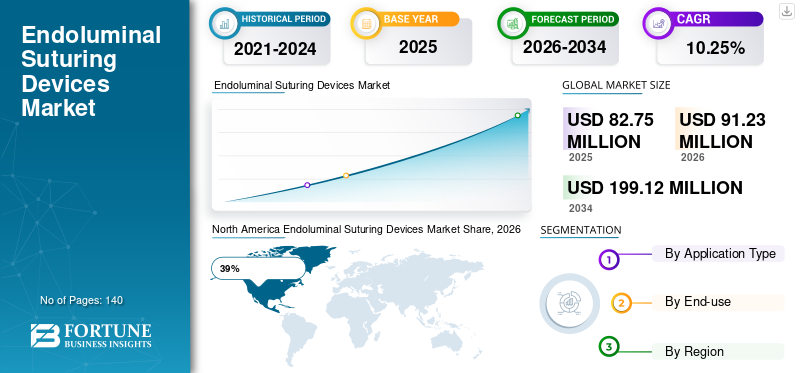
The endoluminal suturing devices market size was valued at USD 82.75 Million in 2025. The market is projected to grow from USD 91.23 Million in 2026 to USD 199.12 Million by 2034, exhibiting a CAGR of 10.25% during the forecast period.

The endoluminal suturing devices market is gaining strong attention across the global medical technology sector due to the increasing adoption of minimally invasive gastrointestinal and bariatric procedures. endoluminal suturing devices are used to close tissue defects, secure stents, manage perforations, and support endoscopic sleeve gastroplasty procedures. Healthcare providers are increasingly integrating advanced suturing systems into therapeutic endoscopy workflows to improve procedural efficiency and patient outcomes. The endoluminal suturing devices market report highlights growing demand from hospitals, specialty gastrointestinal centers, and ambulatory surgical facilities seeking advanced closure technologies that reduce surgical trauma and shorten recovery periods. Continuous innovation in endoscopic visualization, robotic assistance, and precision suturing platforms is further strengthening market expansion.
The United States remains the most influential contributor to the endoluminal suturing devices market due to widespread adoption of advanced endoscopy procedures and a highly developed healthcare infrastructure. Large academic medical centers and gastrointestinal specialty networks are increasingly performing endoscopic bariatric therapies and complex gastrointestinal repairs using endoluminal suturing systems. The availability of skilled gastroenterologists, favorable procedural awareness, and strong clinical evidence supporting minimally invasive treatment methods continue to drive demand. The endoluminal suturing devices industry analysis indicates that the country benefits from extensive device commercialization, physician training programs, and rapid integration of innovative therapeutic endoscopy technologies across healthcare institutions.
Download Free sample to learn more about this report.
Endoluminal Suturing Devices Market Key Takeaways
 Global Market Size & Forecast
- 2025 Market Size: USD 82.75 Million
- 2026 Market Size: USD 91.23 Million
- 2034 Forecast Market Size: USD 199.12 Million
- CAGR: 10.25% from 2026-2034
 Market Share
- The market in North America dominated with a revenue share of 39% in 2025.
- Bariatric surgery applications dominated with approximately 58% market share.
- Hospitals dominated with approximately 72% market share.
 Key Regional Highlights
North America
North America dominated the market with a 39% share in 2025, supported by advanced therapeutic endoscopy infrastructure.
Europe
Europe accounted for 28% of the market, driven by growing adoption of minimally invasive procedures.
Asia-Pacific
Asia-Pacific held a 24% market share, supported by expanding healthcare infrastructure and increasing demand for endoscopic treatments.
U.S.
The U.S. market is supported by high adoption of advanced endoscopic procedures and minimally invasive surgical technologies.
Japan
Japan accounted for 22% of the Asia-Pacific market, supported by advanced healthcare facilities and growing adoption of therapeutic endoscopy.
Read More

endoluminal suturing devices market Latest Trends
The endoluminal suturing devices market trends indicate a rapid shift toward advanced endoscopic interventions that reduce the need for conventional open surgeries. Healthcare providers are increasingly utilizing suturing platforms for endoscopic sleeve gastroplasty, fistula closure, gastrointestinal defect management, and post-resection tissue approximation. Growing acceptance of minimally invasive obesity management techniques has significantly increased procedural volumes involving endoluminal suturing technologies.
Download Free sample to learn more about this report.
Another important trend shaping the endoluminal suturing devices market analysis is the integration of enhanced visualization systems, AI-assisted procedural planning, and ergonomic suturing platforms. Manufacturers are focusing on improving device maneuverability, precision control, and compatibility with modern endoscopes. Disposable and hybrid suturing systems are also gaining traction due to infection-control priorities in healthcare settings. In addition, physician training initiatives and expanded clinical indications are encouraging broader adoption across emerging healthcare markets. These developments continue to support favorable endoluminal suturing devices market outlook and strengthen long-term industry competitiveness.
endoluminal suturing devices market Dynamics
DRIVER
Rising Demand for Minimally Invasive Gastrointestinal and Bariatric Procedures
The primary growth driver in the endoluminal suturing devices market is the increasing preference for minimally invasive therapeutic procedures. Healthcare providers are seeking alternatives to conventional surgeries that can reduce hospitalization duration, minimize procedural complications, and improve patient recovery experiences. endoluminal suturing devices enable physicians to perform tissue closure, defect repair, and bariatric interventions through natural orifices without extensive incisions.
The rising prevalence of obesity, gastrointestinal disorders, and gastrointestinal cancers has increased the need for advanced endoscopic procedures. Hospitals are investing in therapeutic endoscopy departments equipped with sophisticated suturing systems capable of addressing complex clinical cases. Furthermore, growing patient awareness regarding scar-free procedures and reduced postoperative discomfort has accelerated demand. As healthcare systems continue to prioritize cost-effective treatment pathways, the endoluminal suturing devices market growth trajectory remains strongly supported by minimally invasive surgical innovation.
RESTRAINT
High Procedural Costs and Specialized Training Requirements
One of the major restraints affecting the endoluminal suturing devices market is the substantial cost associated with advanced suturing platforms and related procedural infrastructure. Many healthcare facilities, particularly in developing regions, face budget limitations that restrict procurement of sophisticated endoscopic systems. Device acquisition expenses, maintenance requirements, and accessory costs can create adoption barriers.
The market also faces challenges related to physician training. Effective utilization of endoluminal suturing technology requires specialized endoscopic expertise and extensive hands-on experience. Learning curves associated with complex suturing techniques may discourage adoption among smaller healthcare institutions lacking advanced training programs. Limited reimbursement support in certain healthcare systems further affects purchasing decisions. These factors collectively create barriers that may slow market penetration despite growing clinical demand.
OPPORTUNITY
Expansion of Endoscopic Bariatric Therapies and Outpatient Procedures
A significant opportunity within the endoluminal suturing devices market lies in the rapid expansion of endoscopic bariatric therapies. Rising obesity rates globally have encouraged healthcare providers to explore less invasive weight management solutions. Endoscopic sleeve gastroplasty procedures increasingly rely on sophisticated suturing devices to reshape stomach anatomy without traditional surgery.
The growing shift toward outpatient treatment environments also creates substantial opportunities. Ambulatory surgical centers and specialty gastrointestinal clinics are adopting advanced endoscopic technologies to manage increasing patient volumes efficiently. Manufacturers are introducing user-friendly systems with improved procedural reliability and reduced setup times. Emerging economies are simultaneously investing in healthcare modernization programs that support advanced endoscopy adoption. These developments create favorable conditions for endoluminal suturing devices market opportunities across multiple geographic regions.
CHALLENGE
Regulatory Complexity and Competitive Technological Landscape
Regulatory compliance remains a major challenge within the endoluminal suturing devices market. Medical device manufacturers must satisfy stringent clinical validation, quality assurance, and safety requirements before introducing new products. Approval timelines can delay commercialization and increase development expenditures.
The competitive landscape presents additional challenges. Companies continuously invest in research and development to differentiate their products through enhanced precision, ease of use, and clinical versatility. Rapid technological advancement requires sustained innovation investment, while healthcare providers demand strong clinical evidence before adopting new systems. Market participants must balance product affordability with technological sophistication. These pressures create a complex environment where maintaining competitive positioning requires continuous strategic investment and innovation.
endoluminal suturing devices market Segmentation
By Application Type
Bariatric surgery applications account for approximately 58% of the endoluminal suturing devices market share. Endoscopic sleeve gastroplasty has emerged as one of the most significant procedure categories utilizing advanced suturing systems. Rising obesity prevalence and increasing demand for less invasive weight management interventions have supported substantial procedural growth. Healthcare providers increasingly recommend endoscopic bariatric procedures for patients seeking alternatives to conventional surgical approaches.
The endoluminal suturing devices market research report indicates that bariatric applications benefit from favorable patient acceptance, reduced recovery periods, and lower procedural risk profiles. Manufacturers continue developing specialized suturing platforms designed to improve tissue capture, suture durability, and procedural efficiency. Advanced device ergonomics and enhanced endoscope compatibility are further supporting adoption across obesity treatment centers. Growing physician confidence in long-term clinical outcomes continues strengthening this segment's market position.
Gastrointestinal surgery applications represent nearly 42% of the endoluminal suturing devices market Size. These devices play a critical role in defect closure, perforation repair, fistula management, and post-resection tissue approximation procedures. Increasing prevalence of gastrointestinal disorders and expanding therapeutic endoscopy indications have contributed significantly to demand.
Healthcare facilities are increasingly integrating advanced suturing systems into gastrointestinal treatment pathways due to their ability to improve procedural outcomes and reduce the need for invasive surgery. Clinical evidence supporting endoscopic defect closure techniques continues to expand, encouraging broader utilization among gastroenterologists and surgeons. The endoluminal suturing devices industry report identifies gastrointestinal surgery as a strategically important segment due to its diverse procedural applications and growing clinical acceptance.
To know how our report can help streamline your business, Speak to Analyst
By End-use
Hospitals account for approximately 72% of the endoluminal suturing devices market share. Large healthcare institutions possess the infrastructure, specialist expertise, and procedural volumes necessary to support advanced endoluminal interventions. Academic medical centers and tertiary care hospitals are among the largest adopters due to their focus on innovative therapeutic procedures and clinical research activities.
The endoluminal suturing devices market forecast indicates continued hospital dominance as institutions expand minimally invasive surgery programs and therapeutic endoscopy departments. Hospitals also serve as major training centers for gastroenterologists and surgeons learning advanced suturing techniques. Their ability to manage complex cases requiring multidisciplinary expertise strengthens their role within the market ecosystem. Ongoing investment in digital endoscopy platforms and integrated procedural suites further supports growth across this segment.
endoluminal suturing devices market Regional Outlook
North America
North America Endoluminal Suturing Devices Market Share, 2025 (%)
To get more information on the regional analysis of this market, Download Free sample
North America holds approximately 39% of the global endoluminal suturing devices market share. The region benefits from advanced healthcare infrastructure, extensive physician expertise, and strong adoption of minimally invasive gastrointestinal procedures. The United States serves as the primary demand center due to widespread utilization of therapeutic endoscopy technologies and ongoing clinical innovation. Hospitals and specialty centers actively invest in advanced suturing systems to support bariatric interventions and gastrointestinal defect management.
The endoluminal suturing devices market Insights for North America also highlight the presence of major device manufacturers, robust physician training networks, and strong awareness regarding minimally invasive treatment alternatives. Continuous expansion of endoscopic bariatric programs and increasing procedural complexity are creating sustained demand for technologically advanced suturing platforms.
Europe
Europe accounts for approximately 28% of the endoluminal suturing devices market share. Regional growth is supported by well-established healthcare systems, rising gastrointestinal disease prevalence, and increasing emphasis on minimally invasive treatment methodologies. Countries across Western Europe continue investing in advanced endoscopy infrastructure and physician training initiatives.
The endoluminal suturing devices market analysis indicates strong adoption among university hospitals and specialty gastrointestinal centers. Demand is further supported by aging populations, increasing obesity management requirements, and broader access to therapeutic endoscopy services. Manufacturers continue strengthening distribution networks and clinical education programs throughout the region.
Germany Endoluminal Suturing Devices Market
Germany represents approximately 26% of the European endoluminal suturing devices market. The country maintains a strong position due to its advanced medical technology sector, sophisticated healthcare infrastructure, and extensive utilization of minimally invasive procedures. Hospitals across Germany increasingly adopt endoluminal suturing systems for gastrointestinal closure procedures and bariatric interventions.
The German market benefits from strong collaboration between healthcare institutions, clinical researchers, and medical device manufacturers. High procedural standards and continuous investment in endoscopy modernization programs support sustained demand. Growing interest in outpatient therapeutic interventions and advanced obesity management solutions is further contributing to market development throughout the country.
United Kingdom Endoluminal Suturing Devices Market
The United Kingdom accounts for approximately 19% of the European endoluminal suturing devices market. Demand is driven by increasing adoption of therapeutic endoscopy, rising obesity treatment initiatives, and expanding utilization of minimally invasive gastrointestinal procedures. Major healthcare institutions continue investing in advanced endoscopic technologies to improve procedural outcomes and operational efficiency.
The endoluminal suturing devices market outlook for the United Kingdom remains favorable due to ongoing healthcare modernization efforts and increasing awareness regarding endoscopic bariatric therapies. Clinical training initiatives and technology adoption programs are encouraging broader use of suturing devices across both public and private healthcare sectors.
Asia-Pacific
Asia-Pacific holds approximately 24% of the global endoluminal suturing devices market share. The region is characterized by rapid healthcare infrastructure development, increasing procedural volumes, and expanding access to advanced medical technologies. Rising prevalence of obesity and gastrointestinal disorders has significantly increased demand for minimally invasive treatment solutions.
Healthcare providers across Asia-Pacific are actively upgrading endoscopy facilities and expanding therapeutic capabilities. Growing medical tourism activities, improving physician expertise, and increasing investment in healthcare modernization programs continue strengthening regional market opportunities. The endoluminal suturing devices industry analysis identifies Asia-Pacific as one of the most dynamic regions for future expansion.
Japan Endoluminal Suturing Devices Market
Japan contributes approximately 22% of the Asia-Pacific endoluminal suturing devices market. The country's advanced healthcare system and strong technological capabilities support substantial adoption of innovative endoscopic devices. Japanese healthcare providers are recognized for early integration of minimally invasive treatment approaches and precision medical technologies.
The market benefits from a growing elderly population requiring gastrointestinal interventions and advanced therapeutic endoscopy services. Research-focused hospitals and specialized treatment centers continue evaluating next-generation suturing technologies designed to enhance procedural accuracy and patient outcomes. These factors support ongoing market expansion throughout Japan.
China Endoluminal Suturing Devices Market
China represents approximately 34% of the Asia-Pacific endoluminal suturing devices market. Rapid healthcare infrastructure development, expanding hospital networks, and increasing awareness regarding minimally invasive treatments are driving substantial demand. Large urban healthcare institutions continue investing in advanced endoscopy systems capable of supporting complex therapeutic procedures.
Government healthcare modernization initiatives and rising healthcare expenditure are accelerating adoption of innovative medical devices across the country. Growing obesity prevalence and increasing gastrointestinal disease burden have further expanded procedural demand. Manufacturers are strengthening local partnerships and distribution capabilities to capitalize on emerging opportunities within the Chinese market.
Rest of World
The Rest of World region accounts for approximately 9% of the global endoluminal suturing devices market share. Growth is supported by increasing healthcare investments across Latin America, the Middle East, and Africa. Hospitals in these regions are gradually adopting advanced endoscopic technologies to improve treatment capabilities and reduce reliance on invasive surgical procedures.
market expansion is further encouraged by improving physician training programs, growing awareness regarding minimally invasive interventions, and expanding healthcare infrastructure development projects. International manufacturers continue targeting underserved markets through strategic partnerships and educational initiatives aimed at increasing adoption of therapeutic endoscopy technologies.
List of Top endoluminal suturing devices Companies
- Medtronic Plc
- Ethicon Endo Surgery (J&J)
- Apollo Endosurgery Inc.
- Richard Wolf GmbH
- Karl Storz GmbH
- Olympus Corporation
- Teleflex Corporation
- Braun Melsungen
- Terumo Corporation
- Boston Scientific
Top Two Companies by Market Share
- Apollo Endosurgery Inc. – 30%
- Ethicon Endo Surgery (J&J) – 18%
Investment Analysis and Opportunities
Investment activity within the endoluminal suturing devices market continues to increase as healthcare providers prioritize minimally invasive treatment technologies. Venture capital firms, strategic investors, and medical technology companies are funding innovations focused on advanced tissue closure systems, robotic-assisted endoscopy, and enhanced suturing precision. Market participants are also investing heavily in physician education programs to expand procedural adoption.
Significant opportunities exist in emerging economies where healthcare modernization initiatives are accelerating procurement of advanced endoscopic equipment. Manufacturers are pursuing acquisitions, partnerships, and distribution agreements to strengthen geographic presence and expand product portfolios. The endoluminal suturing devices market opportunities remain particularly attractive in bariatric therapy, outpatient gastrointestinal procedures, and next-generation endoscopic platform development.
New Product Development
Manufacturers are actively developing next-generation endoluminal suturing devices designed to improve procedural flexibility, tissue capture efficiency, and user control. New systems feature enhanced articulation mechanisms, improved needle deployment technologies, and compatibility with a broader range of endoscopes. These innovations support greater procedural precision while reducing operator complexity.
The endoluminal suturing devices market trends also indicate increasing focus on disposable components, infection prevention technologies, and AI-enabled procedural guidance. Companies are exploring robotic-assisted endoscopic suturing platforms capable of supporting highly complex interventions. Enhanced visualization integration and advanced material engineering continue contributing to improved device performance, helping healthcare providers achieve more consistent clinical outcomes.
Five Recent Developments (2023-2025)
- Boston Scientific strengthened integration of Apollo Endosurgery technologies into its gastrointestinal device portfolio.
- Multiple manufacturers expanded physician training programs focused on endoscopic sleeve gastroplasty and therapeutic suturing procedures.
- Advanced suturing platforms with improved maneuverability and precision control entered clinical evaluation stages.
- Healthcare institutions increased adoption of minimally invasive obesity management procedures utilizing endoluminal suturing systems.
- Several companies expanded regional distribution agreements across Asia-Pacific and Middle Eastern healthcare markets.
Report Coverage of endoluminal suturing devices market
The endoluminal suturing devices market report provides comprehensive analysis of market structure, competitive dynamics, technological developments, and emerging growth opportunities. Coverage includes detailed evaluation of product innovation, procedural adoption patterns, regulatory influences, and healthcare infrastructure developments affecting demand across major geographic regions.
Request for Customization to gain extensive market insights.
The report further examines segmentation by application, end-use sector, and regional performance while assessing strategic initiatives implemented by leading manufacturers. Detailed endoluminal suturing devices market research report insights support decision-making for investors, healthcare providers, distributors, and medical technology companies seeking to understand evolving industry trends. Market intelligence also includes competitive benchmarking, innovation assessment, and future opportunity evaluation across both established and emerging healthcare markets.
Frequently Asked Questions
Fortune Business Insights says that the global Endoluminal Suturing Devices Market value stood at USD 82.75 million in 2025 and is projected to reach USD 199.12 million by 2034.
The market is expected to exhibit a CAGR of 10.25% during the forecast period of 2026-2034.
The bariatric surgery segment dominated with approximately 58% market share, driven by the growing adoption of endoscopic sleeve gastroplasty and minimally invasive weight management procedures.
Key players include Medtronic Plc, Ethicon Endo Surgery (J&J), Apollo Endosurgery Inc., Richard Wolf GmbH, Karl Storz GmbH, and Olympus Corporation.
Major trends include the shift toward minimally invasive endoscopic procedures and increasing integration of AI-assisted planning, enhanced visualization, and ergonomic suturing platforms. North America led the market with a 39% share.



- 2021-2034
- 2025
- 2021-2024
- 140
-

(Offer valid till 30th Sep 2026)
Get 30-60 hrs Free Customization
Expand Regional and Country Coverage, Segments Analysis, Company Profiles, Competitive Benchmarking, and End-user Insights.













.webp)






-
US +1 833 909 2966 ( Toll Free )
-
Get In Touch With Us