Erectile Dysfunction Devices Market Size, Share & Industry Analysis, By Device Type (Vacuum Erection Devices, Penile Implants, Low-Intensity Shockwave Therapy (LiSWT) Devices, Penile Constriction Rings & Tension Systems, and Others), By Age Group (Less Than 40, 40-60 Years, and More Than 60 Years), By End-user (Hospitals, Specialty Clinics, and Others), and Regional Forecast, 2026-2034
 Download Free Sample
Erectile Dysfunction Devices Market Size and Future Outlook
 Listen to Audio Version
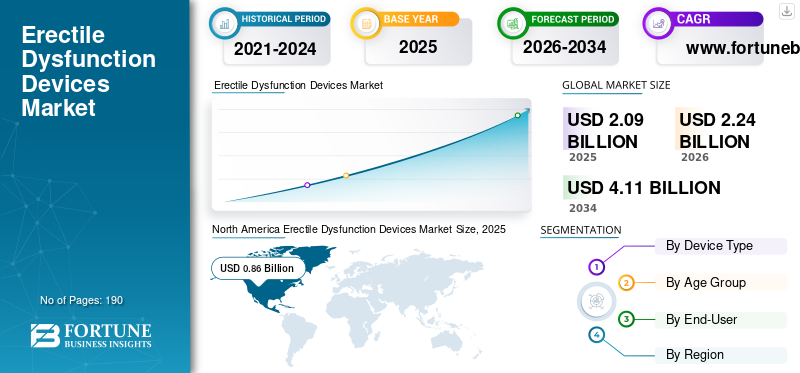
The global erectile dysfunction devices market size was valued at USD 2.09 billion in 2025. The market is projected to grow from USD 2.24 billion in 2026 to USD 4.11 billion by 2034, exhibiting a CAGR of 7.9% during the forecast period. North America dominated the global erectile dysfunction devices market with a market share of 41.15% in 2025.
Erectile Dysfunction (ED) devices are medical tools that help men achieve or maintain an erection when tablets don’t work well or are not preferred. These include Vacuum Erection Devices (VEDs), penile implants, and a few clinic-based device therapies. The market growth is attributed to rising prevalence of erectile dysfunction, aging population, and growing incidence of causes of erectile dysfunction, such as neurological disorders, diabetes, and heart problems. In addition, rising awareness about treatments for erectile dysfunction is also projected to have a positive impact on the market growth. Hospitals and urology clinics are also promoting recovery-focused care after prostate procedures, which supports device demand.
- For instance, according to data published by The Johns Hopkins University, in 2025, an estimated 322 million people suffer from erectile dysfunction across the globe.
In addition, key industry players, such as Boston Scientific Corporation, Coloplast, Rigicon, Inc., Zephyr Surgical Implants (ZSI), and Promedon operating in the market, are focusing on developing various innovative technologies to offer better products with improved accuracy and efficiency.
Download Free sample to learn more about this report.
Erectile Dysfunction Devices Market Key Takeaways
 Global Market Size & Forecast
- 2025 Market Size: USD 2.09 Billion
- 2026 Market Size: USD 2.24 Billion
- 2034 Forecast Market Size: USD 4.11 Billion
- CAGR: 7.9% from 2026–2034
 Market Share
- North America dominated the market with a 41.15% share in 2025.
- The Vacuum erection devices segment led the global market.
- The Hospitals segment is expected to account for 54.8% of the market in 2026.
 Key Regional Highlights
North America
North America reached USD 0.86 billion in 2025, accounting for 41.15% of the global market.
Asia Pacific
Asia Pacific is projected to reach USD 0.61 billion by 2026.
Europe
Europe is projected to reach USD 0.48 billion by 2026, growing at a 7.3% CAGR.
U.S
The U.S. market is projected to reach USD 0.78 billion by 2026.
Japan
The Japan market is projected to reach USD 0.11 billion by 2026.
Read More

ERECTILE DYSFUNCTION DEVICES MARKET TRENDS
Rising Emphasis on Smart Guidance and Patient-Friendly Designs is a Key Market Trend
The market is witnessing a rising preference for smart guidance and ergonomic designs, one of the prominent trends. Instead of selling only hardware, companies are also adding coaching, feedback, and structured guidance to improve the experience. In addition, technological developments in implants are also projected to support this trend.
- For instance, in September 2025, Himplant received FDA approval for its Himplant POV App, an AI‑based mobile application that will help patients visualize treatment outcomes.
Download Free sample to learn more about this report.
MARKET DYNAMICS
MARKET DRIVERS
Growing Preference for Non-Drug Options by Patients to Accelerate Market Growth
Growing preference for non-drug options by patients to accelerate the global erectile dysfunction devices market growth. Some patients avoid tablets due to side effects, health conditions, or drug interactions. Moreover, devices are a practical option as they can be used when needed, and some are part of recovery programs recommended by doctors. Over time, men also prefer solutions that feel more controlled and predictable.
MARKET RESTRAINTS
Hesitation, Discomfort, and Privacy Concerns Are Expected to Hamper Market Growth
A major restraint is that erectile dysfunction is a sensitive issue, and many users delay treatment. Moreover, some devices also feel awkward at first or take time to learn. If the user does not get proper instructions, they may stop using the device early. In addition, privacy concerns make some people avoid hospital visits or follow-ups, which reduces proper guidance and correct product selection. This slows adoption, especially in first-time users and in regions where stigma is still high.
MARKET OPPORTUNITIES
Hospital-led Rehab Programs and Better Reimbursement Policies to Offer Lucrative Market Growth Opportunities
A strong opportunity is expanding ED device use through hospital-led programs, especially for older patients and post-procedure recovery. When hospitals guide patients, device usage becomes more normal and consistent. In addition, favorable reimbursement policies are estimated to create a favorable environment for market growth.
- For instance, in September 2024, Ohh-Med Medical announced that a Vertica user in Germany received insurance reimbursement, indicating growing payer openness and creating an opportunity for wider adoption of ED devices through reimbursement support.
MARKET CHALLENGES
Quality Gaps and Confusing Choices Are Likely to Pose a Critical Challenge to Market Growth
A big challenge is the wide range of product quality in the market. Users often encounter many options online and may not know which are clinically appropriate. This creates confusion, poor selection, and low satisfaction. Moreover, in some segments, unverified or low-quality products can damage trust in the category as a whole. For companies, the challenge is to build credibility through clinical evidence, safer designs, and education so users understand what to expect and how to use devices correctly.
- For instance, in January 2024, the U.S. FDA issued a warning letter to a men’s health product company for marketing erectile dysfunction devices without proper regulatory clearance, highlighting ongoing challenges related to product quality, trust, and compliance in the ED devices market.
Segmentation Analysis
By Device Type
Emphasis on Non-invasive Method to Boost Vacuum Erection Devices Segment Growth
Based on the device type, the market is divided into vacuum erection devices, penile implants, Low-Intensity Shockwave Therapy (LiSWT) devices, penile constriction rings & tension systems, and others.
The vacuum erection devices segment is expected to account for the largest erectile dysfunction devices market share. Currently, there is a considerable demand for non-invasive methods for the treatment of erectile dysfunction, which is provided by the vacuum erection devices. Moreover, many users prefer them as a first step due to the lack of surgery and their convenience for use at home. They also appeal to older users who want a non-drug option. In addition, continual improvements in usability and guidance for these devices are projected to accelerate segment growth during the forecast period.
- For instance, in May 2024, Vacurect India announced the launch of its revolutionary vacuum erection device to restore sexual function and enhance intimacy for men across India.
The Low-Intensity Shockwave Therapy (LiSWT) devices segment is projected to rise with a CAGR of 8.7% over the forecast period.
To know how our report can help streamline your business, Speak to Analyst
By Age Group
High Occurrence of Chronic Conditions Amongst Population of Age 60 Years and More to Accelerate Segment Growth
Based on age group, the market is segmented into less than 40, 40-60 years, and more than 60 years.
In 2025, the more than 60 years segment dominated the global market. The growth is attributed to the substantial prevalence of erectile dysfunction in this age group, which is also associated with the occurrence of chronic conditions such as cardiac diseases and neurological disorders. In addition, many older patients prefer device-based options when tablets don’t work well, due to side effects, or are not suitable due to other medications.
The 40-60 years segment is anticipated to rise with a CAGR of 7.8% over the forecast period.
By End-User
Higher Volume of Patient Visits to Hospitals to Boost Segment Growth
Based on end-user, the market is segmented into hospitals, specialty clinics, and others.
In 2025, the hospitals segment held the highest market share. They are the main points in diagnosis, counseling, and treatment decision-making, especially for older patients and post-procedure recovery cases. Hospitals also influence which devices patients trust, and they provide training and follow-up, thereby improving outcomes compared with unsupervised use. In addition, the segment is set to hold a 54.8% share in 2026.
In addition, specialty clinics segment is projected to grow at a CAGR of 8.1% during the forecast period.
Erectile Dysfunction Devices Market Regional Outlook
By geography, the market is categorized into North America, Latin America, Europe, Asia Pacific, and the Middle East & Africa.
North America
North America Erectile Dysfunction Devices Market Size, 2025 (USD Billion)
To get more information on the regional analysis of this market, Download Free sample
North America held the dominant share in 2024, valued at USD 0.80 billion, and also maintained the leading share in 2025, with USD 0.86 billion. The market in North America is likely to grow due to increased awareness of available treatments for erectile dysfunction and the growing number of product approvals.
U.S. Erectile Dysfunction Devices Market
Based on North America’s strong impact and the U.S. dominance within the region, the U.S. market is expected to reach USD 0.78 billion in 2026, accounting for roughly 35.0% of global sales.
Asia Pacific
Asia Pacific is projected to reach USD 0.61 billion in 2026 and secure the position of the second-largest region in the market. Improving healthcare infrastructure, favorable reimbursement policies, and an aging population are also estimated to accelerate regional growth.
Japan Erectile Dysfunction Devices Market
The Japan market in 2026 is projected at around USD 0.11 billion, accounting for roughly 4.7% of global revenues.
China Erectile Dysfunction Devices Market
China’s market is likely to be one of the largest globally, with 2026 revenues projected at around USD 0.20 billion, representing about 9.0% of global sales.
India Erectile Dysfunction Devices Market
The India market in 2026 is estimated at around USD 0.13 billion, accounting for roughly 6.0% of global revenues.
Europe
Europe is projected to record a growth rate of 7.3% in the coming years, and reach a valuation of USD 0.48 billion by 2026. The region is expected to witness considerable market growth driven by rising investments in new product development and the growing incidence of erectile dysfunction.
U.K. Erectile Dysfunction Devices Market
The U.K. market in 2026 is estimated at around USD 0.08 billion, representing roughly 3.5% of global revenues.
Germany Erectile Dysfunction Devices Market
Germany’s market is projected to reach approximately USD 0.11 billion in 2026, equivalent to around 4.8% of global sales.
Latin America and the Middle East & Africa
The Latin America and the Middle East & Africa regions are expected to witness moderate market growth over the forecast period. The Latin America market is expected to be valued at USD 0.14 billion in 2026. In the Middle East & Africa, the GCC market is likely to reach USD 0.04 billion in 2026.
South Africa Erectile Dysfunction Devices Market
The South Africa market is projected to reach around USD 0.01 billion in 2026, representing roughly 0.66% of global revenues.
COMPETITIVE LANDSCAPE
Key Industry Players
Growing Number of Product Launches Coupled with Technological Advancements by Key Players to Boost Market Progress
The global erectile dysfunction devices market has a semi-consolidated structure, with prominent players including Boston Scientific Corporation, Coloplast, Rigicon, Inc., Zephyr Surgical Implants (ZSI), and Promedon. The significant global market share of these companies is due to various strategic activities, including massive investments and product approvals.
- For instance, in March 2021, Boston Scientific announced an agreement to acquire the Lumenis surgical business, expanding its urology-focused device and accessory portfolio.
Other notable players in the global market are Timm Medical Technologies, STORZ MEDICAL, DirexGroup, Medispec, and MTS Medical. These companies are anticipated to prioritize collaborations to increase their global market share during the forecast period.
LIST OF KEY ERECTILE DYSFUNCTION DEVICES COMPANIES PROFILED
- Boston Scientific Corporation (U.S.)
- Coloplast (Denmark)
- Rigicon, Inc. (U.S.)
- Zephyr Surgical Implants (ZSI) (Switzerland)
- Promedon (Argentina)
- Timm Medical Technologies (U.S.)
- STORZ MEDICAL (Switzerland)
- DirexGroup (Israel)
- Medispec (U.S.)
- MTS Medical (U.S.)
- Augusta Medical Systems (U.S.)
- SoftWave Tissue Regeneration Technologies (U.S.)
KEY INDUSTRY DEVELOPMENTS
- April 2025: Direx Group entered into a strategic partnership with Shanghai Taiyuan Life Science to expand its reach in the shockwave therapy market in China.
- April 2025: Endo launched a spatial computing injection simulator for Peyronie’s disease training, supporting urology specialist education.
- March 2025: Direx Group reported a collaboration with Royal Medical Center Abu Dhabi as part of its men’s health shockwave therapy expansion activity.
- June 2024: Ohh-Med Medical launched VerticaPlus with a mobile app featuring real-time feedback and guided support for ED treatment.
- November 2023: Rigicon published a large dataset summary highlighting safety outcomes for the Rigi10 malleable penile prosthesis implanted worldwide.
REPORT COVERAGE
The global erectile dysfunction devices market analysis includes a comprehensive study of the market size and forecast for all the market segments included in the report. It includes details on the market dynamics and trends expected to drive the market over the forecast period. It provides information on key aspects, including an overview of technological advancements, the regulatory environment, and product launches. Additionally, it details partnerships, mergers, and acquisitions, as well as key industry developments and investments by key regions. The global market research report also provides a depth competitive landscape with information on the market share and profiles of key operating players.
Request for Customization to gain extensive market insights.
Report Scope & Segmentation
| ATTRIBUTE | DETAILS |
| Study Period | 2021-2034 |
| Base Year | 2025 |
| Estimated Year | 2026 |
| Forecast Period | 2026-2034 |
| Historical Period | 2021-2024 |
| Growth Rate | CAGR of 7.9% from 2026-2034 |
| Unit | Value (USD Billion) |
| Segmentation | By Device Type, Age Group, End-User, and Region |
| By Device Type |
|
| By Age Group |
|
| By End-User |
|
| By Region |
|
Frequently Asked Questions
According to Fortune Business Insights, the global market value stood at USD 2.09 billion in 2025 and is projected to reach USD 4.11 billion by 2034.
In 2025, the North America market value stood at USD 0.86 billion.
The market is expected to exhibit a CAGR of 7.9% during the forecast period.
By device type, the vacuum erection devices segment led the market.
Rising emphasis on minimally invasive surgical procedures coupled with rising prevalence of erectile dysfunction are the key factors driving the market.
Boston Scientific Corporation, Coloplast, Rigicon, Inc., Zephyr Surgical Implants (ZSI), and Promedon are the major players in the global market.
North America dominated the market in 2025 with the largest share.



- 2021-2034
- 2025
- 2021-2024
- 190
Get 30-60 hrs Free Customization
Expand Regional and Country Coverage, Segments Analysis, Company Profiles, Competitive Benchmarking, and End-user Insights.













.webp)






Related Reports
-
US +1 833 909 2966 ( Toll Free )
-
Get In Touch With Us