Ethanol Vehicles Market Size, Share & Industry Analysis, By Vehicle Type (Passenger Cars, Commercial Vehicles, and Two-Wheelers & Three-Wheelers), By Propulsion (Ethanol Internal Combustion Engine (ICE) Vehicles and Ethanol Hybrid Electric Vehicles (HEVs)), By Engine Displacement (Below 1.5L, 1.5L–2.5L, and Above 2.5L), By Fuel Compatibility (Up to E20 Compatible Vehicles, E21-E85 Flexible Fuel Vehicles (FFVs), and Above E85 Dedicated Ethanol Vehicles), and Regional Forecast, 2026-2034
 Download Free Sample
(Offer valid till 31st Oct 2026)

Ethanol Vehicles Market Size and Future Outlook
 Listen to Audio Version
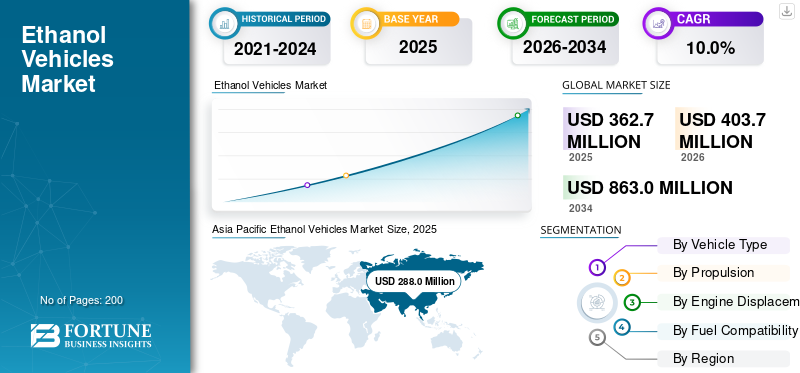
The global ethanol vehicles market size was valued at USD 362.7 million in 2025. The market is projected to grow from USD 403.7 million in 2026 to USD 863.0 million by 2034, exhibiting a CAGR of 10.0% during the forecast period. Asia Pacific dominated the ethanol vehicles market with a market share of 79.40% in 2025.
The global market for ethanol vehicles represents vehicles designed to operate on ethanol-blended fuels, including E10, E20, E85, and higher ethanol blends. These vehicles use specially calibrated internal combustion engines, fuel sensors, and ethanol-blended fuel systems that allow smooth operation with gasoline and ethanol mixtures. The market is closely linked to the fuel ethanol market, as vehicle adoption depends upon the ethanol availability, blending mandates, and fuel distribution infrastructure.
The industry is gaining importance as governments and automakers are looking for practical sustainable transportation solutions that can reduce petroleum dependency without requiring a complete shift to battery-electric mobility. Ethanol vehicles are used across passenger cars, SUVs, light commercial vehicles, fleet transport, public mobility, and agricultural sectors where ethanol supply is strong. Alternative fuel vehicles, renewable fuel vehicles, and biofuel-powered vehicles are getting traction as they support carbon emission reduction targets.
Future growth will be driven by rising ethanol demand, expanding ethanol production, volatile crude oil prices, and growing need for reducing greenhouse gas emissions for transport. India, Brazil, and U.S. are encouraging the adoption of ethanol through blending policies, fuel incentives, and infrastructure expansion. As transportation fuels diversify, ethanol vehicles are expected to serve as a practical bridge between conventional vehicles and electrified mobility.
The market will also benefit from advances in ethanol fuel technology, flex-fuel engine technology, and next-generation fuel vehicles that combine biofuels with hybrid systems. Key players such as Toyota Motor Corporation, Ford Motor Company, Volkswagen AG are investing in flex fuel vehicles, E85 fuel vehicles, and low-emission automobiles to strengthen their positions in the automotive biofuel industry, green mobility market, and broader clean energy transportation ecosystem.
Download Free sample to learn more about this report.
ETHANOL VEHICLES MARKET KEY TAKEAWAYS
 Market Size & Forecast
- 2025 Market Size: USD 362.7 million
- 2026 Market Size: USD 403.7 million
- 2034 Forecast Market Size: USD 863.0 million
- CAGR: 10.0% from 2026–2034
 Market Share
- The two-wheelers & three-wheelers segment is expected to grow at a CAGR of 10.6% over the forecast period.
- The ethanol HEVs segment is expected to grow at a CAGR of 15.4% over the forecast period.
- The above E85 dedicated ethanol vehicles segment is expected to grow at a CAGR of 9.3% over the forecast period.
 Key Regional Highlights
North America
North America is estimated to reach USD 13.80 million in 2026 and secure the position of the second-largest region in the market.
Europe
Europe is projected to record a growth rate of 6.0% in the coming years, and reach a valuation of USD 6.34 million by 2026.
Asia Pacific
Asia Pacific held the dominant ethanol vehicles market share in 2024, valuing at USD 240.4 million, and also maintained the leading share in 2025 with 288.0 million.
U.S.
The U.S. market can be analytically approximated at around USD 11.36 million in 2025, representing roughly 3.1% of global market.
Japan
Japan is also exploring cleaner transportation fuels. The region benefits from rising ethanol demand, compact vehicle adoption, and policy support for clean energy transportation.
Read More

ETHANOL VEHICLES MARKET TRENDS
Hybrid-Flex Platforms Are Becoming a Key Technology Trend in the Market
Automakers are combining ethanol compatibility with hybrid systems to improve fuel economy and reduce emissions. Hybrid-flex vehicles help overcome ethanol’s lower energy density while supporting reducing greenhouse gas emissions. This trend is especially relevant in Brazil and India, where ethanol supply is improving and electrification is still developing. Such vehicles strengthen the green mobility market by combining biofuel use with electrified efficiency.
- For instance, in March 2026, Volkswagen confirmed the Tukan as its first hybrid-flex vehicle for Brazil, using the MQB A0 platform.
MARKET DYNAMICS
MARKET DRIVERS
Download Free sample to learn more about this report.
Rising Ethanol Blending Policies to Accelerate Ethanol Vehicle Adoption
Government blending mandates are a major driver for the ethanol vehicles market growth. Policies supporting E10, E20, E85, and higher blends increase fuel availability and encourage automakers to design compatible vehicles. These mandates reduce oil import dependence, support farmers, and strengthen the overall fuel ethanol market. Furthermore, as the ethanol production expands, vehicle manufacturers gain confidence to commercialize flex fuel vehicles across high-growth regions.
- For instance, in August 2025, India achieved its 20% ethanol blending target ahead of 2030, supported by pricing reforms and expanded distillation capacity.
MARKET RESTRAINTS
Fuel-Efficiency Concerns to Limit Consumer Confidence in Higher Ethanol Blends, Hindering the Market Growth
Higher ethanol blends can reduce mileage because ethanol has lower energy density than gasoline. This may discourage some consumers from adopting biofuel-powered vehicles, especially in price-sensitive markets where running cost play a crucial role. Concerns related to compatibility, engine performance, and resale value can also slow the adoption of these vehicles. With the lack of clear awareness campaigns and transparent cost benefits, ethanol demand from vehicle users may grow slower than policy targets.
- For instance, in June 2026, India reportedly considered delaying movement beyond E20 due to compatibility issues and 1-2% mileage-loss concerns in existing vehicles.
MARKET OPPORTUNITIES
Emerging Ethanol Infrastructure Creates Strong Market Growth Opportunities
Expanding ethanol retail networks create major growth opportunities for automakers, fuel suppliers, and fleet operators. As more stations offer E20, E85, and higher blends, consumers gain confidence in alternative fuel vehicles and renewable fuel vehicles. This infrastructure growth supports clean energy transportation, reduces exposure to crude oil prices, and allows manufacturers to introduce next-generation fuel vehicles in regions seeking affordable decarbonization.
- For instance, in June 2026, India announced plans to expand E85 availability to nearly 5,000 retail fuel outlets by 2027.
MARKET CHALLENGES
Uneven Ethanol Fuel Availability to Restrict Wider Product Adoption
One of the major challenges faced in the market is the inconsistent availability of high-ethanol fuels across regions. Even when automakers offer ethanol-compatible vehicles, limited station coverage can reduce real-world usage. This affects E85 fuel vehicles and other high-blend models more strongly than E10 or E20 vehicles. Uneven infrastructure and absence of mature fuel distribution networks also makes fleet planning difficult and slows adoption of ethanol in markets.
- For instance, in July 2025, the U.S. AFDC noted E85 contains 51-83% ethanol and it dependency lies in geography, season, and fuel availability.
Segmentation Analysis
By Vehicle Type
Passenger Cars Dominate Due to High Ownership and Regular Consumption of Fuel Regularly
On the basis of vehicle type, the market is segmented into passenger cars, commercial vehicles, and two-wheelers & three-wheelers.
Passenger cars dominate the market because they represent the largest vehicle base and consume fuel regularly for personal mobility. Their high production volume helps automakers scale ethanol-compatible technology at lower cost. Rising urban mobility, E20 fuel rollout, and demand for eco-friendly vehicles is supporting the growth of this segment. Passenger cars also fit well with low-emission automobiles and mass-market fuel diversification strategies.
- For instance, in January 2025, Hyundai showcased the Creta Flex Fuel at Bharat Mobility Expo, supporting ethanol adoption in mainstream passenger vehicles.
The two-wheelers & three-wheelers segment is expected to grow at a CAGR of 10.6% over the forecast period.
To know how our report can help streamline your business, Speak to Analyst
By Propulsion
Ethanol ICE Vehicles Lead Due to Easy Compatibility with Existing Manufacturing Factories
On the basis of propulsion, the market is segmented into ethanol Internal Combustion Engine (ICE) vehicles and ethanol Hybrid Electric Vehicles (HEVs).
Ethanol internal combustion engine segment dominates as it uses familiar vehicle platforms and can be produced through limited changes to existing manufacturing factories. They are more affordable compared to complex electrified systems and are suitable for markets where charging infrastructure is weak. Ethanol ICE vehicles support usage of renewable fuels, lower petroleum dependence, and near-term carbon emission reduction while allowing automakers to retain conventional powertrain supply chains.
The ethanol HEVs segment is expected to grow at a CAGR of 15.4% over the forecast period.
By Engine Displacement
Wide Acceptance and Better Fuel Economy is Boosting the Below 1.5L’s Leading Position
On the basis of engine displacement, the market is segmented into below 1.5L, 1.5L-2.5L, and above 2.5L.
Below 1.5L engines dominate as compact passenger vehicles are widely used in Asia Pacific, South America, and price-sensitive urban markets. Smaller engines offer better fuel economy, lower ownership cost, and easier ethanol calibration. They support ethanol fuel technology adoption in mass-market vehicles while helping manufacturers meet emission norms and affordability requirements. This makes them suitable for high-volume transportation fuels transition.
- For instance, Fuel Economy (U.S. Department of Energy) listed Chevrolet Trax and Buick Envista FFVs with 1.2L engines compatible with gasoline and E85.
The 1.5L-2.5L segment is expected to grow at a CAGR of 9.4% over the forecast period.
By Fuel Compatibility
Easy Introduction and Less Technical Changes Required has Bolstered Up to E20 Vehicles to Be the Governing Segment
On the basis of fuel compatibility, the market is segmented into up to E20 compatible vehicles, E21-E85 Flexible Fuel Vehicles (FFVS), and above E85 dedicated ethanol vehicles.
Up to E20 compatible vehicles dominate as E20 fuel is easier to introduce through existing retail networks and requires fewer technical changes than E85 or E100 vehicles. Many governments first promote E10–E20 before moving to higher blends. This segment benefits from lower infrastructure risk, wider consumer acceptance, and growing ethanol-blended fuel systems in mass-market vehicles across emerging economies.
- For instance, in August 2025, India confirmed E20 blending had been achieved ahead of schedule, supported by ethanol pricing and feedstock reforms.
The above E85 dedicated ethanol vehicles segment is expected to grow at a CAGR of 9.3% over the forecast period.
Ethanol Vehicles Market Regional Outlook
By geography, the market is categorized into North America, Europe, Asia Pacific, South America and Middle East & Africa.
Asia Pacific
Asia Pacific Ethanol Vehicles Market Size, 2025 (USD Million)
To get more information on the regional analysis of this market, Download Free sample
Asia Pacific held the dominant ethanol vehicles market share in 2024, valuing at USD 240.4 million, and also maintained the leading share in 2025 with 288.0 million. This is attributed to rapid fuel-policy development, large vehicle sales, and strong government focus on reducing oil imports. India is a key growth engine, supported by E20 rollout, ethanol procurement reforms, and future high-blend fuel plans. Japan, Thailand, and China are also exploring cleaner transportation fuels. The region benefits from rising ethanol demand, compact vehicle adoption, and policy support for clean energy transportation.
- For instance, in April 2025, DHL Supply Chain announced a EUR 500 million (~USD 545 million) investment in Asia Pacific through 2030, including warehouse capacity, automation, robotics, and workforce expansion across key logistics hubs.
China Ethanol Vehicles Market
China’s market is projected to be one of the largest, with 2025 revenues reached around USD 25.24 million, representing roughly 7.0% of global market.
India Ethanol Vehicles Market
India market in 2025 is reached around USD 199.81 million, accounting for roughly 55.1% of global market revenues.
North America
North America is estimated to reach USD 13.80 million in 2026 and secure the position of the second-largest region in the market. North America will grow at a moderate pace, supported by U.S. ethanol production, renewable fuel standard policies, and existing E85 infrastructure. The U.S. market remains the regional center, with selected GM models still available as flex-fuel options. Growth also depends on fuel-price economics, station availability, and consumer interest in E85 fuel vehicles.
U.S. Ethanol Vehicles Market
Based on North America’s strong contribution and the U.S. dominance within the region, the U.S. market can be analytically approximated at around USD 11.36 million in 2025, representing roughly 3.1% of global market.
Europe
Europe is projected to record a growth rate of 6.0% in the coming years, and reach a valuation of USD 6.34 million by 2026. Europe will grow steadily as governments pursue sustainable transportation solutions and broader decarbonization strategies. Although battery-electric vehicles dominate policy attention, ethanol vehicles can support rural mobility, hybrid applications, and fuel diversification. The region’s focus on renewable fuels, lifecycle emissions, and cleaner liquid fuels may create opportunities for alternative fuel vehicles, especially where biofuel supply chains are well-established.
France Ethanol Vehicles Market
France market in 2025 was around USD 4.01 million, accounting for roughly 1.1% of global market revenues.
Sweden Ethanol Vehicles Market
Sweden market in 2025 was around USD 0.76 million, accounting for roughly 0.2% of global market revenues.
South America
South America is projected to record a growth rate of 8.1% in the coming years, and reach a valuation of USD 0.50 million by 2026. South America will remain a major region due to Brazil’s established ethanol ecosystem, strong consumer familiarity, and recognized flex-fuel vehicle base. Brazil continues to support hybrid-flex technology and biofuel policies. Regional growth will be supported by its automotive biofuel industry, sugarcane ethanol availability, and demand for renewable fuel vehicles.
Middle East & Africa
Middle East & Africa is projected to record a growth rate of 6.0% in the coming years, and reach a valuation of USD 6.34 million by 2026. Middle East & Africa will grow slowly from a smaller base. Limited ethanol infrastructure, fossil fuel dependence, and weaker biofuel policies are restraining the adoption in the market. However, selective countries may explore green mobility market opportunities through renewable fuel pilots, fleet modernization, and energy diversification strategies. Growth will depend on fuel supply development and supportive regulation.
COMPETITIVE LANDSCAPE
Key Industry Players
Automakers are Competing Through Biofuel Technology and Regional Expansion
The ethanol vehicles market is moderately competitive, with global and regional automakers focusing on engine compatibility, fuel efficiency, cost optimization, and localized product strategies. Companies such as Toyota, Volkswagen, Stellantis, General Motors, Ford, Honda, Hyundai, Tata Motors, Mahindra, Nissan, Renault, and BYD are developing ethanol-compatible models to match changing fuel policies and consumer expectations. Their strategies differ region-to-region. Brazil remains focused on mature flex-fuel platforms, India on promoting E20 and higher ethanol compatibility, and North America on continued support for selective E85-capable models.
Competitive advantage is increasingly built around flex-fuel engine technology, hybrid-flex systems, and the ability to adapt existing internal combustion engines for renewable fuels. Automakers are also working with governments, fuel suppliers, and ethanol producers to support fueling infrastructure and consumer awareness. This helps reduce market risk as ethanol vehicles require reliable fuel availability to achieve wider adoption.
Product localization is another major strategy being adopted by the key players. In Brazil, companies are developing hybrid-flex and plug-in hybrid-flex vehicles as consumers are already familiar with ethanol use. In India, automakers are testing ethanol-blended fuel systems and showcasing E85/E100 capable prototypes to prepare for future policies. In the U.S., manufacturers continue to offer selected E85 fuel vehicles, particularly in SUVs and pickups.
The market is also shaped by cost competition. Ethanol vehicles are easier to scale than full electric vehicles in many emerging markets as they can use existing manufacturing lines and fuel retail networks. This makes them attractive for eco-friendly vehicles, low-emission automobiles, and sustainable transportation solutions where charging infrastructure is still developing.
- For instance, in February 2025, Toyota India showcased a Prius Flexi-Fuel PHEV capable of using ethanol blends up to 100%, supporting cleaner hybrid mobility.
LIST OF KEY ETHANOL VEHICLES COMPANIES PROFILED
- Toyota Motor Corporation (Japan)
- Volkswagen AG (Germany)
- Stellantis N.V. (Netherlands)
- General Motors Company (U.S.)
- Ford Motor Company (U.S.)
- Honda Motor Co., Ltd. (Japan)
- Hyundai Motor Company (South Korea)
- Tata Motors Limited (India)
- Mahindra & Mahindra Limited (India)
- Nissan Motor Co., Ltd. (Japan)
- Renault Group (France)
- BYD Company Limited (China)
- Suzuki Motor Corporation (Japan)
- Fiat Automobiles (Italy)
- Chevrolet, General Motors Brand (U.S.)
KEY INDUSTRY DEVELOPMENTS
- June 2026: Maruti Suzuki launched the Wagon R Flex Fuel, described as India’s first mass-produced flex-fuel passenger car. The vehicle is engineered to operate on ethanol-petrol blends ranging from E20 to E100, enabling compatibility with future high-ethanol fuel programs. The launch aligns with India’s biofuel strategy, supports domestic ethanol consumption, and marks a significant step toward expanding flex-fuel mobility while reducing dependence on conventional fossil fuels.
- December 2025: Mahindra showcased an ethanol flex-fuel tractor engine at Agrovision Nagpur, designed to operate on ethanol and petrol blends.
- November 2025: Toyota Brazil deployed 70 locally produced hybrid-flex vehicles fueled only with ethanol for COP30 delegation transport.
- September 2025: Suzuki announced plans to launch flex-fuel vehicles in India during FY2025-26 under its technology strategy
- June 2025: Volkswagen Brazil’s sustainability report highlighted USD 3.3 billion investment and 16 new launches through 2028, including Total Flex products.
- January 2025: Toyota Brazil announced that cumulative sales of its hybrid-flex vehicles exceeded 90,000 units since the technology was introduced in 2019. The company also reported an 88% share of Brazil’s hybrid-flex vehicle segment in 2024, reinforcing its leadership in ethanol-electrified mobility. The milestone was supported by strong demand for models such as the Corolla and Corolla Cross Hybrid Flex, which combine electric propulsion with ethanol compatibility to reduce emissions and fuel consumption.
- November 2024: Fiat launched Bio-Hybrid technology in Brazil through Pulse and Fastback SUVs, combining electrification with ethanol-capable engines.
REPORT COVERAGE
The global ethanol vehicles market analysis provides an in-depth study of market size & forecast by all the market segments included in the report. It includes details on the market dynamics and market trends expected to drive the market in the forecast period. It offers information on the technological advancements, new product launches, key industry developments, and details on partnerships, mergers & acquisitions. The research report also encompasses detailed competitive landscape with information on the market share and profiles of key operating players.
Request for Customization to gain extensive market insights.
Report Scope & Segmentation
| ATTRIBUTE | DETAILS |
| Study Period | 2021-2034 |
| Base Year | 2025 |
| Estimated Year | 2026 |
| Forecast Period | 2026-2034 |
| Historical Period | 2021-2024 |
| Growth Rate | CAGR of 10.0% from 2026-2034 |
| Unit | Value (USD Million) |
| Segmentation | By Vehicle Type, Propulsion, Engine Displacement, and Region |
| By Vehicle Type |
|
| By Propulsion |
|
| By Engine Displacement |
|
| By Fuel Compatibility |
|
| By Region |
|
Frequently Asked Questions
Fortune Business Insights says that the global market value stood at USD 362.7 million in 2025 and is projected to reach USD 863.0 million by 2034.
In 2025, the market value stood at USD 288.0 million.
The market is expected to exhibit a CAGR of 10.0% during the forecast period.
Passenger cars led the market by vehicle type.
Rising ethanol blending policies is driving the global market growth.
Toyota Motor Corporation, Ford Motor Company, Volkswagen AG, and Honda Motor Company are some of the top players in the market.
Asia Pacific dominated the market in 2025.



- 2021-2034
- 2025
- 2021-2024
- 200
-
(Offer valid till 31st Oct 2026)
Get 30-60 hrs Free Customization
Expand Regional and Country Coverage, Segments Analysis, Company Profiles, Competitive Benchmarking, and End-user Insights.




















Related Reports
-
US +1 833 909 2966 ( Toll Free )
-
Get In Touch With Us