Exoskeleton Market Size, Share & Industry Analysis, By Mobility (Mobile, Fixed/Stationary), By Technology (Powered, Non-powered), By Extremity (Upper Body, Lower Body), By End-use (Healthcare, Military, Industry), and Regional Forecast, 2026-2034
 Download Free Sample
Exoskeleton Market Overview
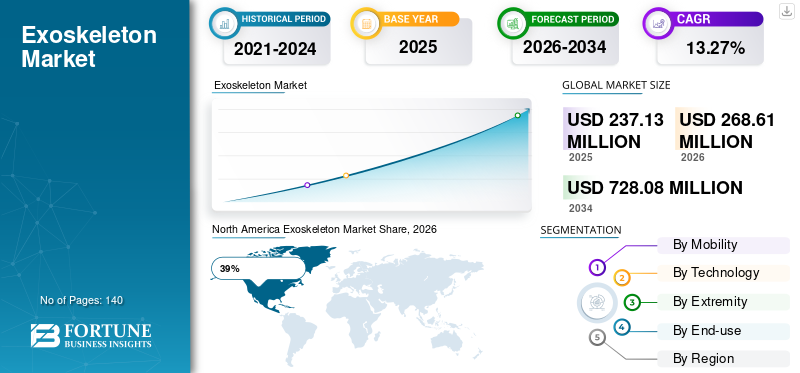
The exoskeleton market size was valued at USD 237.13 Million in 2025. The market is projected to grow from USD 268.61 Million in 2026 to USD 728.08 Million by 2034, exhibiting a CAGR of 13.27% during the forecast period.

The exoskeleton market is witnessing strong adoption across healthcare, industrial manufacturing, logistics, defense, and rehabilitation sectors as organizations focus on improving human performance, worker safety, and mobility assistance. Wearable robotic systems are increasingly being integrated into workplaces to reduce musculoskeletal injuries and support physically demanding tasks. The growing use of smart sensors, artificial intelligence, lightweight materials, and battery-efficient technologies is transforming the exoskeleton market landscape. Exoskeleton market analysis indicates rising demand for powered and non-powered solutions that enhance endurance, productivity, and workplace ergonomics. The Exoskeleton Industry Report highlights increasing partnerships between robotics developers, healthcare institutions, and industrial enterprises.
The United States remains a leading hub for exoskeleton innovation due to strong investments in robotics, rehabilitation technology, and defense modernization programs. Healthcare facilities are increasingly deploying robotic exoskeletons for stroke recovery, spinal cord injury rehabilitation, and mobility assistance. Industrial sectors including automotive manufacturing, warehousing, and construction are utilizing wearable support systems to reduce employee fatigue and workplace injuries.
The U.S. exoskeleton market Report also highlights growing participation from military research agencies focused on enhancing soldier endurance and load-carrying capacity. Advanced research infrastructure, established robotics companies, and favorable technology adoption rates continue to strengthen the country’s position within the global exoskeleton market.
Download Free sample to learn more about this report.
Exoskeleton Market Key Takeaways
 Global Market Size & Forecast
- 2025 Market Size: USD 237.13 Million
- 2026 Market Size: USD 268.61 Million
- 2034 Forecast Market Size: USD 728.08 Million
- CAGR: 13.27% from 2026-2034
 Market Share
- The market in North America dominated with a revenue share of 39% in 2025.
- Powered exoskeletons dominated with approximately 72% market share.
- Lower body exoskeletons dominated with approximately 59% market share.
 Key Regional Highlights
North America
North America dominated the market with a 39% share in 2025, supported by advanced healthcare, robotics, and industrial applications.
Europe
Europe accounted for 28% of the market, driven by increasing adoption of rehabilitation and workplace ergonomic technologies.
Asia-Pacific
Asia-Pacific held a 24% market share, supported by expanding healthcare infrastructure and industrial automation.
U.S.
The U.S. market is supported by strong investments in robotics, rehabilitation technologies, and military applications.
Japan
Japan accounted for 34% of the Asia-Pacific market, supported by advanced robotics capabilities and growing demand for mobility assistance technologies.
Read More

Exoskeleton Market Latest Trends
One of the most influential exoskeleton market trends is the integration of artificial intelligence and machine learning algorithms into wearable robotic systems. Modern exoskeletons can now analyze movement patterns in real time, enabling personalized support and improved motion assistance. This development is enhancing rehabilitation outcomes and improving user comfort across healthcare and industrial environments.
Download Free sample to learn more about this report.
Another major trend shaping the exoskeleton market outlook is the expansion of lightweight exosuits made from advanced composites and flexible materials. Manufacturers are focusing on reducing device weight while increasing durability and performance. Industrial organizations are increasingly adopting passive exoskeletons to reduce worker fatigue in repetitive tasks, while powered systems are gaining popularity in rehabilitation centers. Consumer-oriented mobility assistance devices are also emerging, creating new exoskeleton market opportunities across aging populations and outdoor mobility applications. Increased collaboration between robotics developers and healthcare providers continues to accelerate product innovation throughout the industry.
Exoskeleton Market Dynamics
DRIVER
Rising Demand for Workplace Safety and Mobility Assistance
The primary growth driver within the exoskeleton market is the increasing emphasis on workplace safety and human mobility enhancement. Industrial employers are facing growing concerns regarding repetitive strain injuries, worker fatigue, and productivity losses associated with physically demanding activities. Exoskeleton technologies provide a practical solution by supporting joints, muscles, and movement patterns during lifting, carrying, and repetitive work processes.
Healthcare institutions are also driving adoption due to increasing cases of stroke, spinal cord injuries, and age-related mobility disorders. Rehabilitation professionals are utilizing robotic exoskeletons to improve patient recovery and mobility outcomes. Military organizations continue to evaluate exoskeleton technologies for endurance enhancement and injury prevention. As businesses seek ergonomic solutions and healthcare providers pursue advanced rehabilitation methods, exoskeleton market growth remains strongly supported by expanding end-user demand. The exoskeleton market Research Report identifies workplace injury reduction and mobility improvement as major factors encouraging long-term adoption.
RESTRAINT
High Acquisition and Maintenance Costs
One of the most significant restraints affecting the exoskeleton market is the substantial cost associated with advanced wearable robotic systems. Powered exoskeletons require sophisticated hardware components, sensors, actuators, batteries, and software platforms, resulting in considerable procurement expenses. Many small and medium-sized organizations face budget limitations that restrict widespread implementation.
In healthcare settings, reimbursement limitations and funding challenges can delay adoption despite demonstrated clinical benefits. Ongoing maintenance requirements, software updates, battery replacements, and user training programs further increase total ownership costs. Industrial companies often require detailed return-on-investment assessments before deploying exoskeleton solutions across large workforces. These financial considerations continue to influence purchasing decisions and may slow market penetration in cost-sensitive sectors. Exoskeleton Industry Analysis indicates that affordability remains a key challenge for broader commercialization.
OPPORTUNITY
Expansion of Aging Population and Rehabilitation Demand
The growing global aging population presents substantial opportunities for the exoskeleton market. Older adults increasingly require mobility support technologies that enable independent living and enhanced physical activity. Exoskeleton systems designed for rehabilitation, gait assistance, and mobility improvement are becoming attractive solutions for healthcare providers and long-term care facilities.
Rehabilitation centers are expanding their use of robotic therapy platforms to address neurological conditions, musculoskeletal disorders, and post-surgical recovery programs. Technological improvements are enabling more comfortable and user-friendly devices, encouraging adoption among elderly users. Home-based rehabilitation solutions are also creating new revenue streams for manufacturers. Exoskeleton market forecast studies suggest that demographic shifts and rising healthcare requirements will generate significant growth opportunities for wearable robotic technologies over the coming years.
CHALLENGE
Regulatory Complexity and User Adaptation Barriers
Regulatory compliance and user adaptation remain major challenges within the exoskeleton market. Healthcare exoskeletons must satisfy stringent safety, performance, and certification requirements before entering clinical environments. These approval processes often require extensive testing, documentation, and validation activities, increasing development timelines.
User acceptance also presents challenges, particularly among first-time operators. Some workers and patients require substantial training to utilize exoskeleton systems effectively and safely. Concerns regarding comfort, battery duration, movement restrictions, and device weight may influence adoption decisions. Industrial employers must also address integration challenges within existing workflows. Exoskeleton market insights indicate that overcoming regulatory hurdles and improving user experience will remain critical priorities for manufacturers seeking wider market penetration.
Exoskeleton Market Segmentation
By Mobility
Mobile exoskeletons represent approximately 68% of the global exoskeleton market share due to their flexibility, portability, and broad application range. These systems are designed for active movement and can be used across healthcare, industrial, military, and personal mobility environments. Mobile exoskeletons are particularly valuable for rehabilitation programs because they allow patients to practice walking and mobility exercises in dynamic settings.
Industrial organizations increasingly deploy mobile systems to support workers engaged in lifting, carrying, and repetitive tasks. Military applications also benefit from portable designs that enhance endurance without limiting operational mobility. Exoskeleton market Research Report findings indicate that mobile systems continue to dominate demand due to their versatility and expanding use cases. Ongoing advancements in battery technology, lightweight materials, and sensor integration are further improving performance and user acceptance.
Fixed or stationary exoskeletons account for nearly 32% of the exoskeleton market. These systems are primarily used within controlled environments such as rehabilitation centers, hospitals, research laboratories, and specialized training facilities. Stationary exoskeletons provide precise movement assistance and monitoring capabilities, making them particularly effective for therapeutic applications.
Healthcare professionals frequently utilize stationary devices for rehabilitation programs targeting spinal cord injuries, stroke recovery, and neurological disorders. These systems often incorporate advanced monitoring technologies that enable clinicians to track patient progress and customize treatment plans. Exoskeleton market analysis shows continued demand for stationary solutions within clinical settings where precision and therapeutic effectiveness are prioritized over portability. Enhanced robotic control systems and integrated analytics are strengthening the value proposition of fixed exoskeleton platforms.
To know how our report can help streamline your business, Speak to Analyst
By Technology
Powered exoskeletons hold approximately 72% of the global exoskeleton market share due to their advanced functionality and ability to provide active movement assistance. These systems utilize motors, actuators, batteries, and intelligent control software to enhance user strength, endurance, and mobility. Powered exoskeletons are widely used in rehabilitation, industrial operations, and military applications.
Healthcare facilities rely heavily on powered systems for gait training and mobility restoration. Industrial organizations use these devices to reduce physical strain during repetitive tasks. Military programs continue exploring powered exoskeletons for load management and operational efficiency. Exoskeleton market growth is strongly influenced by advancements in powered technologies, particularly improvements in energy efficiency, motion sensing, and artificial intelligence capabilities.
Non-powered exoskeletons represent around 28% of the market and are increasingly popular in industrial environments due to their affordability and ease of use. These systems rely on mechanical structures, springs, and ergonomic designs rather than electronic components. They help redistribute physical loads and reduce muscular stress during repetitive activities.
Manufacturing facilities, logistics centers, and construction sites frequently deploy non-powered exoskeletons to improve worker safety and reduce fatigue. Lower acquisition costs and minimal maintenance requirements contribute to their growing popularity. Exoskeleton Industry Analysis indicates that non-powered systems remain attractive for organizations seeking practical ergonomic solutions without the complexity associated with powered robotic devices.
By Extremity
Upper body exoskeletons account for approximately 41% of the exoskeleton market share and are primarily utilized in industrial environments where overhead work and repetitive arm movements are common. These devices reduce shoulder, neck, and arm strain while improving worker comfort and productivity.
Automotive manufacturing, aerospace assembly, construction, and warehousing operations are key users of upper body systems. Companies are increasingly implementing wearable support solutions to address workplace injury concerns and enhance employee well-being. Exoskeleton market trends suggest rising adoption of ergonomic technologies as organizations prioritize occupational health and operational efficiency.
Lower body exoskeletons hold nearly 59% of the market and represent the dominant extremity segment. These systems are widely used in rehabilitation, mobility assistance, military operations, and industrial applications. Lower body devices assist walking, standing, lifting, and mobility restoration activities.
Healthcare institutions remain the largest users due to increasing demand for gait rehabilitation and mobility support. Military organizations also evaluate lower body exoskeletons to improve endurance and reduce injury risks. Exoskeleton market outlook studies indicate continued demand growth driven by aging populations, rehabilitation requirements, and mobility enhancement applications.
By End-use
Healthcare represents approximately 38% of the exoskeleton market share and remains the leading end-use segment. Hospitals, rehabilitation centers, and specialized therapy clinics increasingly utilize robotic exoskeletons to support patients recovering from neurological and musculoskeletal conditions.
Stroke rehabilitation, spinal cord injury treatment, and mobility restoration programs are major application areas. Healthcare providers recognize the benefits of robotic therapy in improving patient outcomes and supporting intensive rehabilitation protocols. Exoskeleton market opportunities within healthcare continue expanding as clinical evidence supports broader adoption of wearable robotic technologies.
Military applications account for roughly 22% of the exoskeleton market. Defense organizations are investing in wearable robotic systems designed to enhance endurance, reduce physical strain, and improve operational effectiveness. These technologies assist personnel carrying heavy equipment during demanding missions.
Research initiatives continue exploring battlefield applications, logistics support, and injury prevention strategies. Exoskeleton Industry Report findings indicate growing military interest in next-generation wearable technologies capable of enhancing soldier performance while reducing fatigue and musculoskeletal injuries.
Industrial applications contribute approximately 40% of the exoskeleton market share. Manufacturing, logistics, automotive production, construction, and warehousing sectors increasingly deploy wearable support systems to improve ergonomics and reduce workplace injuries.
Organizations are implementing exoskeletons as part of broader workplace safety initiatives. These solutions help employees perform physically demanding tasks more comfortably while supporting productivity goals. Exoskeleton market insights indicate strong future demand from industries focused on workforce protection and operational efficiency improvements.
Exoskeleton Market Regional Outlook
North America Exoskeleton Market Share, 2026 (%)
To get more information on the regional analysis of this market, Download Free sample
North America
North America remains the leading regional market with approximately 39% market share. The region benefits from advanced healthcare infrastructure, strong robotics research capabilities, and extensive defense investments. Healthcare providers actively deploy robotic rehabilitation systems for neurological recovery and mobility assistance programs.
Industrial organizations throughout the United States and Canada increasingly adopt exoskeleton technologies to address workplace injury concerns and improve operational efficiency. Manufacturing, logistics, aerospace, and construction sectors are key contributors to regional demand. The presence of leading exoskeleton developers, research institutions, and military modernization programs further supports market expansion. Exoskeleton market forecast assessments indicate sustained demand driven by technological innovation and growing awareness of ergonomic workplace solutions.
Europe
Europe accounts for nearly 28% of the global exoskeleton market share. The region benefits from strong occupational safety regulations, advanced healthcare systems, and increasing investment in robotics technologies. Industrial employers across manufacturing and automotive sectors are implementing wearable support systems to reduce employee fatigue and improve workplace ergonomics.
Rehabilitation centers and hospitals continue expanding the use of robotic mobility solutions for neurological therapy and recovery programs. Government initiatives supporting healthcare innovation and workplace safety further strengthen regional adoption. Exoskeleton market analysis highlights growing collaboration between robotics developers, healthcare providers, and industrial enterprises throughout Europe.
Germany Exoskeleton Market
Germany represents approximately 31% of the European exoskeleton market. The country’s strong manufacturing base, advanced engineering capabilities, and focus on Industry 4.0 initiatives support widespread adoption of wearable robotic technologies. Automotive manufacturers and industrial enterprises are increasingly implementing exoskeleton systems to improve worker productivity and reduce injury risks.
Healthcare institutions across Germany continue investing in robotic rehabilitation platforms for stroke recovery and mobility assistance. Research collaborations between universities, technology companies, and medical centers contribute to ongoing innovation. The German exoskeleton market Report highlights growing demand for ergonomic solutions that support workforce sustainability and operational excellence. Continued investment in automation and smart manufacturing technologies further enhances market opportunities.
United Kingdom Exoskeleton Market
The United Kingdom contributes approximately 22% of Europe’s exoskeleton market. Healthcare remains a major adoption sector, with rehabilitation facilities increasingly integrating robotic mobility technologies into treatment programs. Growing awareness of workplace injury prevention is also encouraging industrial implementation across logistics, construction, and manufacturing environments.
British research organizations and technology developers continue advancing wearable robotics innovation through collaborative projects and pilot programs. Defense-related applications are receiving increased attention as military organizations explore methods to enhance personnel performance and reduce physical strain. Exoskeleton market Research Report findings indicate expanding interest from both public and private sector stakeholders seeking productivity improvements and healthcare advancements.
Asia-Pacific
Asia-Pacific accounts for approximately 24% of the global exoskeleton market share and represents one of the fastest-evolving regions. Rapid industrialization, aging populations, and healthcare modernization initiatives are creating favorable conditions for adoption. Manufacturing facilities increasingly implement exoskeleton technologies to improve worker safety and operational efficiency.
Healthcare systems throughout the region are investing in robotic rehabilitation solutions to address growing mobility assistance needs. Government support for robotics development and smart manufacturing programs further stimulates innovation. Exoskeleton market growth within Asia-Pacific is supported by increasing awareness of wearable technologies and expanding industrial automation efforts.
Japan Exoskeleton Market
Japan represents approximately 34% of the Asia-Pacific exoskeleton market. The country’s aging population and advanced robotics expertise have positioned it as a global leader in wearable robotic innovation. Healthcare providers actively utilize exoskeleton systems for rehabilitation, elderly care, and mobility assistance applications.
Industrial organizations also deploy exoskeleton technologies to address labor shortages and reduce physical strain among workers. Strong collaboration between research institutions, healthcare providers, and technology companies continues driving innovation. Exoskeleton market insights suggest sustained demand as Japan pursues solutions that support workforce productivity and eldercare requirements.
China Exoskeleton Market
China contributes approximately 37% of the Asia-Pacific exoskeleton market. Rapid industrial expansion, increasing healthcare investments, and strong government support for advanced manufacturing technologies are driving adoption. Industrial facilities increasingly implement wearable support systems to improve worker safety and efficiency.
Healthcare institutions are also expanding rehabilitation services utilizing robotic mobility technologies. Domestic technology developers continue investing in research and product development to strengthen competitive positioning. Exoskeleton market opportunities within China remain significant as healthcare modernization and industrial automation initiatives continue advancing across the country.
Rest of World
Rest of World regions collectively account for approximately 9% of the global exoskeleton market share. Adoption is gradually increasing across Latin America, the Middle East, and Africa as awareness of wearable robotic technologies expands. Industrial sectors including mining, construction, and logistics are beginning to explore exoskeleton deployment for worker safety enhancement.
Healthcare institutions within emerging economies are also evaluating rehabilitation technologies that improve mobility outcomes and patient recovery processes. Although infrastructure limitations and budget constraints remain challenges, growing investment in healthcare modernization and occupational safety programs is supporting market development. Exoskeleton market outlook assessments indicate increasing long-term opportunities across developing regions.
List of Top Exoskeleton Companies
- Ekso Bionics
- Lockheed Martin Corporation
- SuitX
- Rex Bionics Plc.
- ReWalk Robotics
- DIH Medical
- German Bionic
- Sarcos Technology and Robotics Corporation
- Parker Hannifin Corporation
- Bionik Laboratories
Top Two Companies with Highest Market Share
- Ekso Bionics – 16%
- ReWalk Robotics – 13%
Exoskeleton Market Investment Analysis and Opportunities
Investment activity within the exoskeleton market continues to accelerate as healthcare providers, industrial enterprises, defense organizations, and venture capital firms recognize the long-term potential of wearable robotics. Funding is increasingly directed toward research programs focused on lightweight materials, artificial intelligence integration, battery optimization, and advanced motion control systems. Strategic partnerships between robotics developers and healthcare institutions are expanding commercialization opportunities.
Significant opportunities exist within rehabilitation, workplace ergonomics, eldercare, and industrial safety applications. Organizations are seeking technologies capable of reducing injury-related costs while improving workforce productivity. Emerging consumer mobility applications also present attractive investment prospects. Exoskeleton market opportunities continue expanding as technological improvements reduce operational limitations and improve accessibility. Investors increasingly view wearable robotics as a critical component of future healthcare and industrial transformation initiatives.
Exoskeleton Market New Product Development
Manufacturers are actively introducing next-generation exoskeleton solutions featuring improved mobility assistance, ergonomic design, and intelligent motion control capabilities. New product development efforts focus heavily on lightweight composite materials, adaptive software algorithms, and enhanced battery performance. These innovations are improving user comfort while extending operational duration.
Several companies are developing modular exoskeleton platforms that allow customization based on user requirements and industry applications. Artificial intelligence-enabled systems capable of predicting movement patterns and automatically adjusting assistance levels are becoming increasingly common. Exoskeleton market trends also highlight growing interest in consumer-oriented wearable robotics designed for outdoor mobility, recreational activities, and elderly support. Continuous innovation remains central to maintaining competitive differentiation within the evolving market landscape.
Exoskeleton Market Five Recent Developments (2023-2025)
- Ekso Bionics expanded rehabilitation-focused exoskeleton capabilities through enhanced software and therapy integration features.
- German Bionic introduced advanced AI-enabled industrial exoskeleton systems for logistics and warehouse operations.
- ReWalk Robotics strengthened mobility assistance solutions targeting neurological rehabilitation applications.
- Sarcos Technology and Robotics Corporation advanced wearable robotic platforms designed for industrial workforce support.
- Lockheed Martin Corporation continued development programs focused on military exoskeleton technologies for endurance enhancement and load management.
Report Coverage of Exoskeleton Market
The exoskeleton market Report provides comprehensive coverage of industry developments, competitive positioning, technological advancements, and strategic growth opportunities. The report evaluates key market segments including mobility, technology, extremity, and end-use categories. Detailed assessments of healthcare, industrial, and military applications provide valuable insights into evolving demand patterns.
Request for Customization to gain extensive market insights.
The exoskeleton market Research Report also examines regional performance across North America, Europe, Asia-Pacific, and Rest of World markets. Company profiling, product innovation analysis, investment trends, and emerging opportunities are included to support business decision-making. The report offers detailed exoskeleton market Insights regarding adoption drivers, operational challenges, and future growth prospects, helping stakeholders identify strategic opportunities throughout the wearable robotics industry.
Frequently Asked Questions
Fortune Business Insights says that the global Exoskeleton Market value stood at USD 237.13 million in 2025 and is projected to reach USD 728.08 million by 2034.
The market is expected to exhibit a CAGR of 13.27% during the forecast period of 2026-2034.
The powered exoskeletons segment dominated with approximately 72% market share, driven by its ability to provide active movement assistance across healthcare, industrial, and military applications.
Key players include Ekso Bionics, Lockheed Martin Corporation, SuitX, Rex Bionics Plc., ReWalk Robotics, and DIH Medical.
Major trends include the integration of artificial intelligence and machine learning into wearable robotic systems and growing adoption of lightweight exosuits using advanced composites and flexible materials. North America led the market with a 39% share.


- 2021-2034
- 2025
- 2021-2024
- 140
-

(Offer valid till 15th Oct 2026)
Get 30-60 hrs Free Customization
Expand Regional and Country Coverage, Segments Analysis, Company Profiles, Competitive Benchmarking, and End-user Insights.




















-
US +1 833 909 2966 ( Toll Free )
-
Get In Touch With Us