Facade Market Size, Share & Industry Analysis, By End-use (Commercial, Residential, Industrial), By Product (Ventilated, Non-Ventilated) and Regional Forecast, 2026-2034
 Download Free Sample

Facade Market Overview
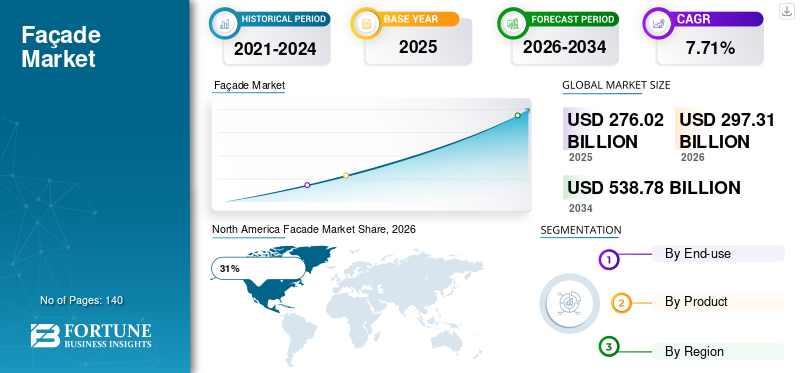
The facade market size was valued at USD 276.02 Billion in 2025. The market is projected to grow from USD 297.31 Billion in 2026 to USD 538.78 Billion by 2034, exhibiting a CAGR of 7.71% during the forecast period.

The facade market plays a critical role in modern construction by providing external building envelopes that improve aesthetics, energy efficiency, structural protection, and occupant comfort. Facade systems have evolved from simple exterior walls into technologically advanced building components integrating insulation, ventilation, weather resistance, and sustainability features. Growing urbanization, increasing investments in commercial infrastructure, and rising demand for energy-efficient buildings are supporting market expansion. Architects and developers are increasingly selecting advanced facade materials to meet environmental regulations and improve building performance. The facade market Report highlights growing adoption of innovative facade solutions across commercial, residential, and industrial construction projects worldwide.
Download Free sample to learn more about this report.
Facade Market Key Takeaways
 Global Market Size & Forecast
- 2025 Market Size: USD 104.45 Mi
- 2026 Market Size: USD 115.60 Million
- 2034 Forecast Market Size: USD 260.26 Million
- CAGR: 7.71% from 2026-2
 Market Share
- The market in North America dominated with a revenue share of 38% in 2025.
- The CT imaging segment accounted for approximately 58% of the market share.
- The death investigations segment accounted for approximately 54% of the market share.
 Key Regional Highlights
North America
North America held the largest regional share at 38% in 2025.
Europe
Europe accounted for 29% of the global market.
Asia-Pacific
Asia-Pacific represented 25% of the global market, supported by increasing adoption of advanced forensic imaging technologies.
U.S
The U.S. is a major market due to advanced forensic infrastructure and growing adoption of digital imaging technologies.
Japan
Japan accounted for 24% of the Asia-Pacific market, supported by advanced imaging capabilities and increasing use of non-invasive forensic investigations.
Read More

USA Facade Market Overview
The United States remains one of the most significant contributors to the facade market due to extensive construction activity, renovation projects, and growing emphasis on sustainable building design. Demand is driven by commercial skyscrapers, healthcare facilities, educational institutions, and residential developments requiring durable and visually appealing facade systems.
Building owners increasingly prioritize energy efficiency and long-term operational savings, encouraging adoption of high-performance facade materials. Modern facade technologies are being integrated into smart building projects throughout the country. The facade market Analysis indicates that green building certifications and stricter energy codes continue to encourage innovation and investment within the U.S. facade industry.
Facade Market Latest Trends
The facade market Trends indicate increasing demand for sustainable and energy-efficient building envelopes. Developers are investing in facade systems that improve thermal insulation, reduce energy consumption, and contribute to environmental compliance objectives. Advanced materials such as high-performance glass, aluminum composites, fiber cement panels, and engineered stone are becoming increasingly common in new construction projects.
Download Free sample to learn more about this report.
Another notable trend involves the integration of smart technologies into facade systems. Dynamic facades capable of adjusting to weather conditions, sunlight exposure, and building occupancy patterns are gaining popularity in commercial developments. Digital design technologies, including Building Information Modeling (BIM), are improving facade planning and installation efficiency. The facade market research report also identifies growing adoption of ventilated facade systems that enhance moisture control, building longevity, and energy performance while supporting contemporary architectural designs.
Facade Market Dynamics
Driver
Rising Demand for Energy-Efficient and Sustainable Buildings
The primary driver of the facade market Growth is the increasing focus on energy-efficient building construction. Governments, developers, and property owners are emphasizing sustainable design practices to reduce energy consumption and improve environmental performance. Modern facade systems contribute significantly to insulation, thermal management, and indoor climate control, making them essential components of sustainable buildings.
Commercial property developers are increasingly investing in advanced facade technologies to achieve green building certifications and improve operational efficiency. Residential projects are also incorporating innovative facade materials that provide better thermal performance and enhanced aesthetics. The facade market Industry Analysis shows that energy conservation regulations, urban development projects, and growing awareness regarding environmental sustainability continue to generate strong demand for high-performance facade systems globally.
Restraint
High Installation and Maintenance Costs
One of the primary restraints affecting the facade market is the relatively high cost associated with advanced facade systems. Premium materials, specialized engineering requirements, and skilled labor contribute significantly to project expenses. Building owners may hesitate to adopt sophisticated facade technologies when initial investment requirements exceed available budgets.
Maintenance costs can also present challenges, particularly for complex facade systems installed on high-rise buildings. Regular inspections, cleaning procedures, repairs, and replacement requirements increase lifecycle expenditures. Smaller construction projects often prioritize cost efficiency over advanced facade performance, limiting adoption in some market segments. The facade market Outlook indicates that cost considerations remain a key factor influencing purchasing decisions across both developed and emerging economies.
Opportunity
Expansion of Smart Building Infrastructure
A major opportunity in the facade market lies in the rapid development of smart buildings and intelligent urban infrastructure. Advanced facade systems are becoming integral components of connected buildings designed to optimize energy usage, occupant comfort, and operational efficiency.
Smart facades equipped with automated shading, responsive glazing, and environmental monitoring capabilities are attracting increasing interest from developers and property managers. Emerging economies are investing heavily in urban modernization projects, creating substantial opportunities for facade manufacturers. The facade market opportunities continue to expand as cities adopt sustainable construction strategies and property owners seek innovative solutions that improve long-term building performance and asset value.
Challenge
Compliance with Evolving Building Regulations
The facade market faces significant challenges associated with increasingly stringent building codes and safety requirements. Regulatory authorities continue updating standards related to fire resistance, structural integrity, energy performance, and environmental sustainability.
Manufacturers must invest heavily in research, testing, certification, and product development to ensure compliance across different regions. Failure to meet evolving regulations can delay projects and increase costs. Global suppliers often face additional complexity because building standards vary considerably between countries. The facade market Industry Report emphasizes that maintaining regulatory compliance while delivering innovative and cost-effective solutions remains a major challenge for industry participants.
Facade Market Segmentation
By End-use
The commercial segment accounts for approximately 46% of the facade market share. Commercial buildings including office towers, hotels, retail centers, airports, hospitals, and educational facilities require advanced facade systems that combine aesthetics, durability, and energy efficiency. Architects increasingly utilize innovative facade designs to create distinctive building identities while meeting sustainability objectives.
Demand is supported by urban development projects and increasing investments in premium commercial infrastructure. Building owners seek facade systems capable of reducing operational costs through improved insulation and climate control. The facade market forecast indicates continued growth in this segment as smart buildings and green construction initiatives gain momentum worldwide.
The residential segment represents approximately 34% of the facade market size. Homeowners and developers increasingly prioritize exterior materials that enhance property appearance, weather resistance, and energy performance. Facade systems are widely used in apartments, condominiums, luxury housing projects, and mixed-use developments.
Rising urban populations and growing interest in sustainable housing are encouraging adoption of advanced facade materials. Residential developers are utilizing ventilated systems, insulated panels, and decorative cladding solutions to improve market appeal and long-term building efficiency. The facade market insights highlight increasing demand for aesthetically attractive and environmentally responsible residential construction.
The industrial segment holds approximately 20% of the facade market share. Manufacturing facilities, warehouses, logistics centers, and industrial complexes require durable facade systems capable of withstanding demanding environmental conditions. Industrial users prioritize structural reliability, weather resistance, and low maintenance requirements.
Growing investments in manufacturing expansion and industrial infrastructure projects are driving demand. Modern industrial facilities increasingly incorporate facade technologies that improve energy efficiency and workplace comfort. The facade market research report identifies industrial construction as a stable source of long-term demand for high-performance facade solutions.
To know how our report can help streamline your business, Speak to Analyst
By Product
Ventilated facades account for approximately 58% of the facade market share. These systems create an air cavity between the building structure and external cladding, improving thermal performance and moisture management. Ventilated facades are widely used in commercial and high-rise residential projects where energy efficiency and building durability are critical priorities.
The segment benefits from increasing awareness regarding sustainable construction practices and lifecycle cost savings. Architects favor ventilated systems because they support design flexibility while enhancing environmental performance. The facade market Analysis indicates strong demand for ventilated facades across both new construction and renovation projects.
Non-ventilated facades represent approximately 42% of the facade market size. These systems are commonly utilized in projects where simplicity, cost efficiency, and straightforward installation are important considerations. Non-ventilated facades continue to maintain strong demand in residential and light commercial construction.
Advancements in materials and installation methods have improved performance characteristics, making non-ventilated systems increasingly competitive. Developers frequently select these solutions for projects requiring effective protection and attractive appearance without the complexity associated with ventilated systems. The facade market Growth remains supported by widespread application across diverse construction environments.
Facade Market Regional Outlook
North America Facade Market Share, 2026 (%)
To get more information on the regional analysis of this market, Download Free sample
North America
North America accounts for approximately 31% of the facade market share. The region benefits from extensive commercial construction activities, advanced building technologies, and strong adoption of energy-efficient construction materials. Developers and building owners increasingly prioritize facade systems that enhance insulation, reduce operational costs, and improve building sustainability. Renovation projects across aging commercial infrastructure further contribute to demand for modern facade solutions.
The facade market Report indicates that investments in smart buildings, healthcare facilities, educational campuses, and mixed-use developments continue to support regional growth. Sustainable construction initiatives and strict energy performance standards are encouraging widespread implementation of advanced facade technologies throughout North America.
Europe
Europe represents approximately 29% of the facade market share. The region is characterized by strong environmental regulations, advanced architectural standards, and significant adoption of sustainable construction practices. Facade systems are increasingly utilized to improve energy efficiency and comply with stringent building performance requirements.
Growing investment in urban redevelopment and green building projects continues to create opportunities for facade manufacturers. The facade market Industry Analysis identifies Europe as a major center for innovation in cladding systems, curtain walls, insulated facades, and advanced building envelope technologies.
Germany Facade Market
Germany accounts for approximately 28% of the European facade market. The country's construction sector emphasizes energy-efficient buildings, sustainable architecture, and technologically advanced building envelopes. Facade systems play a critical role in supporting Germany's focus on environmental performance and long-term building durability.
Commercial developments, industrial facilities, and residential modernization projects continue generating demand for innovative facade products. The facade market insights reveal that German developers increasingly prioritize facade solutions capable of reducing energy consumption while enhancing architectural aesthetics. Continued investment in infrastructure and sustainable urban development supports market expansion.
United Kingdom Facade Market
The United Kingdom contributes approximately 21% of the European facade market. Demand is supported by commercial office developments, residential high-rise projects, transportation infrastructure, and institutional construction activities. Building owners seek facade systems that provide energy efficiency, weather protection, and modern architectural appeal.
The country's growing emphasis on sustainable construction and building refurbishment projects creates opportunities for advanced facade technologies. The facade market forecast indicates increasing demand for high-performance cladding systems, curtain walls, and insulated building envelopes across major urban centers.
Asia-Pacific
Asia-Pacific accounts for approximately 33% of the facade market share. Rapid urbanization, large-scale infrastructure development, and growing construction investments support strong demand throughout the region. Governments and private developers are increasingly adopting advanced facade technologies to improve building efficiency and environmental performance.
Major cities across the region continue witnessing significant growth in commercial skyscrapers, residential complexes, transportation hubs, and industrial facilities. The facade market opportunities remain substantial as construction activity expands and demand for modern architectural solutions increases.
Japan Facade Market
Japan represents approximately 17% of the Asia-Pacific facade market. The country's advanced construction sector prioritizes quality, safety, energy efficiency, and innovative design. Facade systems are widely utilized in commercial buildings, residential towers, and public infrastructure projects.
Japanese developers emphasize durability and earthquake-resistant construction, creating demand for technically advanced facade materials. The facade market research report identifies strong interest in lightweight, sustainable, and energy-efficient facade technologies across the Japanese construction industry.
China Facade Market
China accounts for approximately 44% of the Asia-Pacific facade market. The country's extensive urban development activities and large-scale infrastructure investments generate significant demand for facade systems. Commercial towers, residential communities, industrial parks, and transportation facilities represent key application areas.
Government initiatives promoting energy-efficient construction and sustainable urban development support continued adoption of advanced facade materials. The facade market Growth in China remains supported by ongoing modernization projects and increasing emphasis on environmentally responsible building practices.
Rest of World
The Rest of World region accounts for approximately 7% of the facade market share. Growth is supported by expanding construction sectors across Latin America, the Middle East, and Africa. Urbanization, infrastructure investments, and rising awareness regarding energy-efficient buildings contribute to market development.
Developers increasingly incorporate modern facade systems into commercial, residential, and industrial projects to improve aesthetics and building performance. The facade market Outlook suggests continued opportunities as emerging economies expand construction activities and adopt advanced building technologies.
List of Top Facade Market Companies
- ROCKWOOL Ltd.
- Aluplex
- THE BOUYGUES GROUP
- Enclos Corp.
- EOS Framing Limited
- Saint-Gobain Group
- AFS International
- Kingspan Group
- Lindner Group
- Fundermax
- Josef Gartner GmbH
- HansenGroup
- HOCHTIEF Aktiengesellschaft
- National Enclosure Company
Top Two Companies with Highest Market Share
- Saint-Gobain Group – 13% market share
- Kingspan Group – 11% market share
Investment Analysis and Opportunities
Investment activity within the facade market is increasingly concentrated on sustainable construction materials, smart facade technologies, and energy-efficient building envelope systems. Investors recognize the growing role of facade solutions in reducing building energy consumption and supporting environmental objectives. Significant capital is being allocated toward manufacturing expansion, material innovation, and digital construction technologies.
opportunities are emerging from rapid urbanization, infrastructure modernization, and green building initiatives across both developed and developing economies. Commercial developers increasingly demand customized facade solutions that combine performance, aesthetics, and sustainability. The facade market opportunities are further strengthened by rising investments in smart cities, high-rise construction, and large-scale urban redevelopment projects. Companies capable of delivering advanced, environmentally compliant facade systems are expected to benefit from growing industry demand.
New Product Development
Innovation remains a major competitive factor within the facade market. Manufacturers are introducing lightweight facade panels, high-performance glazing systems, advanced insulation materials, and smart facade technologies designed to improve building efficiency and occupant comfort. Product development efforts increasingly focus on sustainability, durability, and lifecycle performance.
New facade solutions incorporate automated shading systems, photovoltaic integration, and responsive building envelope technologies. Manufacturers are also investing in recyclable materials and low-carbon production methods to align with environmental goals. The facade market Industry Report highlights ongoing development of modular facade systems that reduce installation time and improve project efficiency while maintaining architectural flexibility.
Five Recent Developments (2023-2025)
- Saint-Gobain expanded its sustainable facade materials portfolio for energy-efficient construction projects.
- Kingspan Group introduced advanced insulated facade solutions targeting commercial and industrial buildings.
- ROCKWOOL enhanced production capabilities for stone wool facade insulation systems.
- Lindner Group expanded facade engineering services for large-scale infrastructure developments.
- Enclos Corp. increased investment in high-performance curtain wall and building envelope technologies.
Report Coverage
This facade market Report provides a detailed assessment of market dynamics, trends, opportunities, challenges, competitive developments, and technological advancements influencing industry growth. The report evaluates demand across commercial, residential, and industrial sectors while examining the role of facade systems in modern construction projects.
Request for Customization to gain extensive market insights.
The study includes analysis of product categories such as ventilated and non-ventilated facade systems, along with regional assessments covering North America, Europe, Asia-Pacific, and Rest of World markets. The facade market research report further examines strategic developments, investment patterns, innovation activities, sustainability initiatives, and regulatory influences shaping future market conditions. Comprehensive company profiling and market share evaluation provide valuable business intelligence for manufacturers, investors, distributors, architects, and construction stakeholders.
Frequently Asked Questions
Fortune Business Insights says that the global market value stood at USD 276.02 billion in 2025 and is projected to reach USD 538.78 billion by 2034.
The market is expected to exhibit a CAGR of 7.71% during the forecast period of 2026-2034.
Commercial was the leading end-use segment, accounting for approximately 46% of the market, driven by demand for aesthetics, durability, and energy efficiency in commercial buildings.
Key players include ROCKWOOL Ltd., Aluplex, The Bouygues Group, Enclos Corp., Saint-Gobain Group, and Kingspan Group.
Major trends include growing demand for sustainable, energy-efficient facade systems and rising adoption of smart and ventilated facades; Asia-Pacific leads regionally with approximately 33% market share.


- 2021-2034
- 2025
- 2021-2024
- 140
-

(Offer valid till 31st Oct 2026)
Get 30-60 hrs Free Customization
Expand Regional and Country Coverage, Segments Analysis, Company Profiles, Competitive Benchmarking, and End-user Insights.





-
US +1 833 909 2966 ( Toll Free )
-
Get In Touch With Us