Face Steamer Market Size, Share & Industry Analysis, By Type (Nano Ionic Face Steamers, Ozone Facial Steamers, Herbal/Infusion Steamers, Hot & Cold Steamers, and Others), By Power Source (Electric (Corded), Battery Operated/Rechargeable, and USB-Powered Devices), By Portability (Tabletop/Compact Steamers, Handheld Steamers, and Floor-Standing Professional Steamers), By End User (Residential/Home Users, Beauty Salons, Dermatology Clinics, Spa & Wellness Centers, and Others), By Distribution Channel (Online/E-commerce and Offline), and Regional Forecast, 2026-2034
 Download Free Sample
(Offer valid till 30th Sep 2026)

Face Steamer Market Overview
 Listen to Audio Version
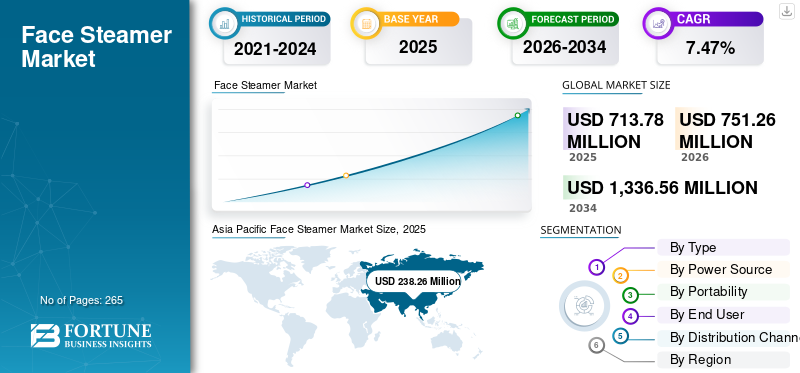
The global face steamer market size was valued at USD 713.78 million in 2025. The market is projected to grow from USD 751.26 million in 2026 to USD 1,336.56 million by 2034, exhibiting a CAGR of 7.47% during the forecast period. Asia Pacific dominated the face steamer market with a market share of 33.38% in 2025.
The market is growing rapidly, driven by rising consumer awareness and spending on skincare routines, higher disposable incomes, and the growing popularity of at-home beauty devices. As consumers seek cost-effective solutions to avoid hefty salon treatment prices, tools for facial treatments are gaining traction. Moreover, advancements in ozone and nano-ionic steamers, which help improve skin texture by imparting hydration and deep-cleaning, further uplift market growth. In addition, the influence of social media and dermatologists’ recommendations contributes to the product's popularity, driving further market expansion.
Major industry players include Conair Corporation, Kingdom Beauty, Philips N.V., Panasonic Corporation, and Vanity Planet. Market players are highly focused on innovating and diversifying product lineups, such as multifunctional or nano-ionic steamers, to enhance the user experience. Moreover, they’re forming collaborations and paid partnerships with social media influencers, expanding online presence, and launching travel-friendly, lightweight, and portable devices.
Download Free sample to learn more about this report.
Face Steamer Market Key Takeaways
 Global Market Size & Forecast
- 2025 Market Size: USD 713.78 million
- 2026 Market Size: USD 751.26 million
- 2034 Forecast Market Size: USD 1,336.56 million
- CAGR: 7.47% from 2026-2034
 Market Share
- Asia Pacific dominated the face steamer market with a 33.38% share in 2025.
- The herbal/infusion steamers segment is projected to grow at a CAGR of 7.66% during the forecast period.
- The USB-powered devices segment is expected to register the fastest CAGR of 8.89% during the forecast period.
 Key Regional Highlights
Asia Pacific
Asia Pacific accounted for USD 238.26 million in 2025, representing 33.38% of the global market.
North America
North America reached USD 201.36 million in 2025, making it the second-largest regional market.
Europe
Europe was valued at USD 166.31 million in 2025, accounting for 23.30% of the global market.
U.S.
The market reached USD 129.17 million in 2025, representing 18.10% of global sales.
Japan
The market was valued at USD 27.54 million in 2025, accounting for 3.86% of global revenue.
Read More

FACE STEAMER MARKET TRENDS
Rising Adoption of At-Home Skincare Devices Driven by Convenience and Cost Efficiency is a Growing Trend
The growing trend of at-home solutions is encouraging more consumers to invest in at-home skincare devices. The busy nature of today's lifestyle and the high costs of professional treatments are prompting people to seek personal beauty and skincare devices. The rise of social media culture, relatability with influencers, and easy access to online tutorials from dermatologists and skincare specialists on the benefits of facial steaming further boost product demand. Consequently, there is a growing need for premium, user-friendly face steamers that deliver salon-like treatments from the comfort of home.
MARKET DYNAMICS
MARKET DRIVERS
Download Free sample to learn more about this report.
Increasing Skincare Awareness and Focus on Personal Grooming to Accelerate Market Expansion
One of the primary factors driving the face steamer market is the growing awareness of the importance of skin health and hygiene. The increase in market sizing is due to rising pollution, acne, and early skin aging, prompting people to seek proper skincare. There is growing consumer access to knowledge about the importance of personal health, including skin, through social media platforms, beauty influencers, and online dermatologists. This is helping increase demand for facial steaming, as it not only provides benefits such as improved blood flow, open pores, and more effective skincare product absorption but also encourages more men and women across age groups to adopt steamers. Therefore, brands have been forced to expand their offerings with features such as adjustable steam settings, nano ionic steam technology, or aromatherapy integration, which are not only helping increase product appeal but also accelerating market growth.
MARKET RESTRAINTS
Risk of Skin Sensitivity and Limited Suitability across Skin Types Restrains Market Growth
Face steamers can cause skin sensitivity and irritation, acting as a key obstacle to the market. Overuse or improper use of steamers can lead to extreme dryness, redness, swelling, or damage to sensitive skin, which may deter customers from using them frequently. Moreover, some customers, particularly those with rosacea, should avoid using steamers on their faces. A lack of proper user guidance and awareness regarding the use of steamers further exacerbates this issue. This, in turn, causes some customers to refrain from using such steamers for face, slowing the market's growth.
MARKET OPPORTUNITIES
Expansion into Emerging Markets through Affordable and Portable Devices
Growing disposable income levels, combined with increased consumer spending on discretionary items, especially among the expanding middle class, create tremendous business growth opportunities for players in the market. The rise in urbanization and the increase in smartphone and e-commerce platform penetration in these markets are enabling easy access to personal care devices. Moreover, consumers are increasingly aware of personal care and skincare habits, encouraging them to invest in at-home solutions. Thus, businesses can capitalize on this opportunity by developing cost-effective face steamers and enhancing distribution channels.
MARKET CHALLENGES
Intense Market Competition and Product Differentiation Challenges
The market faces significant challenges due to the presence of many global and regional players in this industry. The face steamer market growth is also facing challenges due to low entry barriers and the availability of cheap alternatives, which are driving price wars. The market also witnesses low consumer brand loyalty, as there is little product differentiation in functionality. Therefore, companies are forced to spend more on innovation and marketing to make their brand stand out in the market.
Segmentation Analysis
By Type
Superior Skin Penetration and Advanced Technology to Drive Growth of Nano Ionic Type
The market is segmented by type into nano ionic face steamers, ozone facial steamers, herbal/infusion steamers, hot & cold steamers, and others.
The nano ionic face steamers segment led market growth due to its cutting-edge technology, which generates ultra-fine steam for deeper skin penetration, thereby improving hydration and the effectiveness of other skincare products. Since consumers spend heavily on moisturizers, sunscreens, serums, and a variety of creams, they seek solutions that aid better absorption of these products. Consequently, the demand for nano-ionic steamers is significantly higher than for conventional ozone or herbal steamers.
The herbal/infusion steamers segment is anticipated to grow at the second-fastest CAGR of 7.66% over the forecast period.
To know how our report can help streamline your business, Speak to Analyst
By Power Source
Consistent Performance and Higher Steam Output to Lead Growth of Electric (Corded) Segment
Based on power source, the market is divided into electric (corded), battery-operated/rechargeable, and USB-powered devices.
The electric (corded) drive market grew owing to its ability to deliver powerful as well as consistent steam output. Consumers favor these devices for their more effective deep cleansing and longer usage sessions as compared to other variants. Subsequently, they are preferred and widely accepted in both household and professional grade salon settings. Moreover, their relatively lower cost and reliability compared to advanced portable variants further support demand.
The USB-powered devices segment is anticipated to rise at the fastest CAGR of 8.89% over the forecast period.
By Portability
Convenience and Space Efficiency to Dominate Tabletop/Compact Steamers Segment
Based on portability, the market is divided into tabletop/compact steamers, handheld steamers, and floor-standing professional steamers.
The tabletop/compact steamers accounted for the majority of the face steamer market share due to their ease of use and practicality for everyday skincare routines. The devices are meant for home use and offer a perfect balance of performance and portability without taking up too much space. Therefore, they are highly popular among residential customers, as they are convenient and affordable. In addition, the device is more affordable than professional floor-standing units, which also contributes to its popularity.
The handheld steamers segment is anticipated to rise at the fastest CAGR of 8.11% over the forecast period.
By End User
Rising At-Home Skincare Trends Supplementing Growth of Residential/Home Users
End user segments the market into residential/home users, beauty salons, dermatology clinics, spa & wellness centers, and others.
Residential/home users dominated the market in terms of value share, driven by rising preference for at-home, salon-like, affordable skincare routines over professional as well as costly treatments. The busy, hectic schedules of working individuals and the high cost of salon visits have prompted consumers to invest in personal beauty devices such as face steamers. As a result, this has pushed product adoption among a vast consumer base seeking convenience and cost savings.
The spa & wellness centers are anticipated to grow at the fastest CAGR of 7.49% over the forecast period.
By Distribution Channel
Broader Product Assortments and Shopping Convenience to Drive Online/E-commerce Dominance
Based on distribution channels, the market is bifurcated into online/e-commerce and offline.
The online/e-commerce segment accounted for the largest share of global revenue. This high market share was driven by the channel's growing convenience and hassle-free shopping experiences. Using various e-commerce platforms, consumers can check out multiple product options, competitive pricing, discounts & offers, and easy access to reviews, which influence purchasing decisions. Online channels are also becoming the primary point of sale, particularly among tech-savvy and urban consumers, as a result of direct-to-consumer brand strategies and the rise of digital marketing, which are accelerating online product sales.
In addition, the offline segment is projected to grow at the second-fastest CAGR of 7.03% during the forecast period.
Face Steamer Market Regional Outlook
By region, the market is categorized into Europe, North America, Asia Pacific, South America, and the Middle East & Africa.
Asia Pacific
Asia Pacific Face Steamer Market Size, 2025 (USD Million)
To get more information on the regional analysis of this market, Download Free sample
The Asia Pacific region dominated the market at a CAGR of 33.38% and reached USD 238.26 million in 2025. Growing beauty consciousness, particularly among younger generations in the region's emerging markets, significantly drives market growth. Moreover, rising consumer spending power and the escalating influence of K-beauty trends have been boosting demand for at home skincare devices. Additionally, the rapid expansion of e-commerce platforms further enhances product accessibility across urban and semi-urban areas.
Japan Face Steamer Market
The Japanese market in 2025 was valued at USD 27.54 million, accounting for roughly 3.86% of global market revenues. The Japanese market is driven by high consumer demand for technologically advanced beauty devices and the country’s deeply rooted skincare culture.
China Face Steamer Market
China’s market in 2025 was valued at USD 64.93 million in revenues, representing roughly 9.10% of the global market sales.
India Face Steamer Market
The Indian market in 2025 was valued at USD 34.33 million, accounting for roughly 4.81% of global market revenues.
North America
North America has emerged as a key region. It is projected to grow at a CAGR of 7.58% in the coming years, with the second-highest market share among all regions, reaching a valuation of USD 201.36 million by 2025. The region’s growth is driven by continuous product development, such as multifunctional and non-ionic steamers, and by the strong presence of established brands, further augmenting market growth. Moreover, a more aware consumer base, supported by beauty influencers and dermatologists, boosts product adoption.
U.S. Face Steamer Market
Given North America’s strong contribution and the U.S.’s dominance in the region, the U.S. market reached USD 129.17 million in 2025, accounting for roughly 18.10% of global market sales.
Europe
Europe held the third-largest share in 2025, valued at USD 166.31 million and accounting for 23.30% of the global market. Europe’s market growth is bolstered by rising consumer demand for premium skincare products and advanced beauty tools, especially in countries such as Germany, France, and the U.K. Also, the region’s well-established beauty and personal care industry amplifies product demand, driving market growth.
U.K. Face Steamer Market
The U.K. market in 2025 reached USD 32.68 million, representing roughly 4.58% of global market revenues.
Germany Face Steamer Market
Germany’s market reached USD 29.45 million in 2025, equivalent to around 4.13% of global market sales.
South America and the Middle East & Africa
South America and the Middle East & Africa regions are expected to witness moderate growth in this market space during the forecast period. The South America market reached USD 60.60 million in 2025. The market in South America is influenced by the deeply penetrating social media reach and the broadening availability of affordable beauty devices through e-commerce platforms. In the Middle East & Africa, the GCC reached USD 21.22 million in 2025.
South Africa Face Steamer Market
The South African market reached USD 10.49 million in 2025, representing roughly 1.47% of the global market revenues.
COMPETITIVE LANDSCAPE
Key Industry Players
Competitive Pricing and Product Innovation Increases Competition Amongst Players
A moderate number of industry players characterizes the market for face steamers, yet faces stiff competition from regional and global brands that compete through product differentiation and price positioning. Brands are incorporating smart features, multi-functionality, and nano-ionic technology. Additionally, R&D efforts are focused on the compatibility of essential oils to enhance aromatherapy benefits and improve the consumer experience. Moreover, they emphasize brand building and expanding their online retail presence to cater to a large audience. Firms are investing in direct-to-consumer models and influencer marketing to improve visibility and market reach and sustain their competitive position.
LIST OF KEY FACE STEAMER COMPANIES PROFILED
- Panasonic Corporation (Japan)
- Conair Corporation (U.S.)
- Philips N.V. (Netherlands)
- Beurer GmbH (Germany)
- Revlon, Inc. (U.S.)
- Kingdom Beauty (U.S.)
- Vanity Planet (Hong Kong)
- Pure Daily Care (Taiwan)
- Dennis Gross Skincare (South Korea)
- Secura (China)
KEY INDUSTRY DEVELOPMENTS
- July 2025: Sharp Corporation, a prominent Japanese electronics manufacturer, partnered with a U.S.-based beauty tech startup to co-develop advanced at-home skincare devices, strengthening its position in Japan’s beauty device market.
- June 2025: Japan-based multinational electronics manufacturer Panasonic Corporation acquired a domestic laser device startup to fortify its at-home beauty device portfolio, enhancing innovation capabilities and expanding its personal care technology pipeline.
- May 2025: Panasonic Corporation expanded its premium beauty portfolio with nanoe technology-based devices, reinforcing its focus on moisture-rich ion technology across skincare and haircare
- January 2023: Panasonic Corporation unveiled the “Nano Facial Steamer Pro,” using nanotechnology to generate ultra-fine steam particles for improved skin hydration and product absorption, strengthening its premium product portfolio.
REPORT COVERAGE
The global facial steamer market research report includes a comprehensive study of the market & forecast by all the market segments covered. This qualitative and quantitative report includes details on the market dynamics and market trends expected to drive the market over the forecast period. It provides information on key aspects, including technological advancements, the regulatory environment, and product launches. Additionally, it details partnerships, mergers & acquisitions, and key industry developments, along with their regional prevalence. The global market research report also provides a detailed competitive landscape, including market share and profiles of key players.
Request for Customization to gain extensive market insights.
Report Scope & Segmentation
| ATTRIBUTE | DETAILS |
| Study Period | 2021-2034 |
| Base Year | 2025 |
| Estimated Year | 2026 |
| Forecast Period | 2026-2034 |
| Historical Period | 2021-2024 |
| Growth Rate | CAGR of 7.47% from 2026 to 2034 |
| Unit | Value (USD Million) |
| Segmentation | By Type, Power Source, Portability, End User, Distribution Channel, and Region |
| By Type |
|
| By Power Source |
|
| By Portability |
|
| By End User |
|
| By Distribution Channel |
|
| By Region |
|
Frequently Asked Questions
According to Fortune Business Insights, the global market value stood at USD 713.78 million in 2025 and is projected to reach USD 1,336.56 million by 2034.
In 2025, the market value stood at USD 238.26 million.
The market is expected to grow at a CAGR of 7.47% over the forecast period.
By type, the nano ionic segment leads the market.
The increasing consumer awareness of skincare routines, higher disposable incomes, and the rising popularity of at-home beauty devices drive market growth.
Conair Corporation, Kingdom Beauty, Philips N.V., Panasonic Corporation, and Vanity Planet are the major players in the global market.
Asia Pacific dominated the market in 2025.



- 2021-2034
- 2025
- 2021-2024
- 265
-
(Offer valid till 30th Sep 2026)
Get 30-60 hrs Free Customization
Expand Regional and Country Coverage, Segments Analysis, Company Profiles, Competitive Benchmarking, and End-user Insights.



















Related Reports
-
US +1 833 909 2966 ( Toll Free )
-
Get In Touch With Us