Factory Acceptance Testing (FAT) Services Market Size, Share & Industry Analysis, By Service Type (Mechanical FAT Services, Electrical FAT Services, Control & Automation FAT Services, and Integrated System FAT Services), By Delivery Mode (On-Site FAT and Remote / Virtual FAT), By End Use Industry (Oil & Gas, Power & Energy, Chemicals & Petrochemicals, Pharmaceuticals & Biotechnology, Water & Wastewater, Manufacturing, Food & Beverage, Mining & Metals, and Marine & Shipbuilding), and Regional Forecast, 2026 - 2034
 Download Free Sample
Factory Acceptance Testing (FAT) Services Market Size and Future Outlook
 Listen to Audio Version
The global Factory Acceptance Testing (FAT) services market size was valued at USD 2.47 billion in 2025. The market is projected to grow from USD 2.60 billion in 2026 to USD 4.22 billion by 2034, exhibiting a CAGR of 6.2% during the forecast period. Asia Pacific dominated the factory acceptance testing (FAT) services market with a market share of 36.44% in 2025.
Factory Acceptance Testing (FAT) Services refer to structured pre-shipment validation procedures conducted at the manufacturer’s facility to ensure that equipment or system components meet contractual and regulatory requirements before delivery. The factory acceptance testing FAT process includes a series of tests and comprehensive testing procedures to verify safety and performance, quality assurance standards, and ensuring product quality before shipment, prior to site acceptance test SAT activities. FAT services is witnessing steady growth driven by rising capital expenditure across energy, chemicals, pharmaceuticals, and advanced manufacturing, alongside increasing automation complexity. Growing emphasis on quality and reliability, structured FAT protocols, and standardized testing processes is reinforcing the need for pre-dispatch validation. As facilities adopt digitalized control environments, real time monitoring and advanced testing equipment are becoming critical to confirm products meet specifications and perform as expected. Improved coordination across global supply chains is further accelerating adoption of digitally enabled FAT methodologies.
- For instance, in March 2024, Siemens Digital Industries enhanced its virtual commissioning capabilities within its automation portfolio, enabling validation of control logic and system interlocks prior to physical deployment, thereby strengthening pre-dispatch testing efficiency and reducing on-site commissioning risk.
Siemens, Schneider Electric, ABB, Rockwell Automation, and Emerson are among the key players holding a significant share of the market. Strong automation engineering expertise, comprehensive portfolios spanning control systems, instrumentation, switchgear, and integrated plant solutions, along with sustained investments in digital twin and simulation technologies, underpin the competitive positioning of leading providers globally across energy, process, and manufacturing applications.
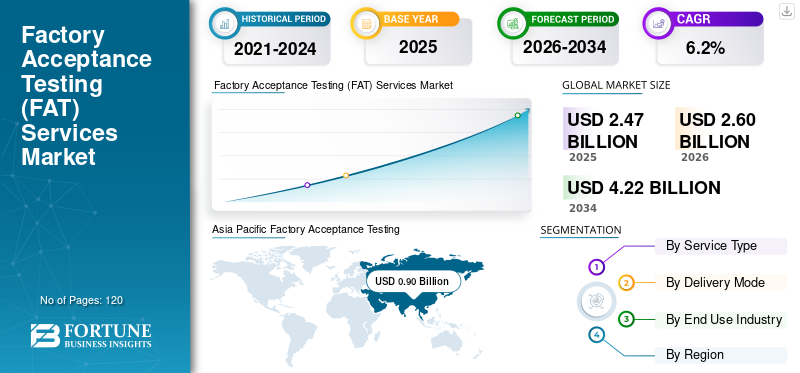
Download Free sample to learn more about this report.
Global Factory Acceptance Testing (FAT) Services Market KEY TAKEAWAYS
 Market Size & Forecast
- 2025 Market Size: USD 2.47 billion
- 2026 Market Size: USD 2.60 billion
- 2034 Forecast Market Size: USD 4.22 billion
- CAGR: 6.2% from 2026–2034
 Market Share
- Asia Pacific dominated the factory acceptance testing (FAT) services market with a 36.44% share in 2025.
- The control & automation FAT services segment accounted for the largest market share.
- The on-site FAT segment accounted for the largest market share.
 Key Regional Highlights
North America
The market was valued at USD 0.63 billion in 2025.
Europe
he market is supported by industrial modernization, renewable energy projects, digitalization.
Asia Pacific
The region dominated the market with a value of USD 0.96 billion in 2025.
U.S.
The market is projected to reach USD 0.52 billion in 2026.
Japan
The market is estimated to reach USD 0.10 billion in 2026.
Read More

FACTORY ACCEPTANCE TESTING SERVICES MARKET TRENDS
Increasing Adoption of Virtual Commissioning and Remote Witnessing across Industrial Projects Pose as Market Trend
Industrial projects are becoming more geographically distributed, with equipment manufactured in one region and deployed in another, increasing coordination complexity between OEMs, EPC contractors, and end users. At the same time, compressed project timelines and higher contractual performance obligations are placing greater emphasis on validating system functionality before shipment. As a result, manufacturers and system integrators are increasingly adopting virtual commissioning, digital simulation, and remote FAT witnessing to test control logic, safety interlocks, and communication protocols under simulated operating conditions. This shift allows stakeholders to identify integration issues earlier, reduce site rework, and improve first-time-right installation outcomes.
- For example, in November 2025, ABB introduced ACS880 Virtual DrivePlus, a Software-in-the-Loop simulation solution that enables high-fidelity drive behavior validation ahead of hardware availability, supporting earlier functional verification and reduced commissioning risk.
Download Free sample to learn more about this report.
MARKET DYNAMICS
MARKET DRIVERS
Expansion of Large-Scale Energy, Process, and Infrastructure Projects Increasing Demand for High-Complexity FAT Services
The expansion of energy, chemicals, power generation, pharmaceuticals, and large infrastructure projects is a key driver of the FAT services market. Modern industrial facilities increasingly rely on integrated automation systems, complex control architectures, high-capacity electrical assemblies, and safety-critical instrumentation that require structured pre-dispatch validation. Rising system complexity, higher uptime expectations, and stringent contractual performance guarantees are increasing the scope and depth of FAT procedures prior to shipment. In parallel, growing investment in renewable energy plants, LNG terminals, semiconductor fabs, and advanced manufacturing facilities is reinforcing demand for high-load, multi-system FAT environments capable of simulating real operating conditions. Replacement demand from brownfield upgrades and capacity expansion across emerging industrial regions is further sustaining steady FAT services consumption across both process and discrete manufacturing applications.
- For instance, in 2024, Rockwell Automation continued expanding its Virtual FAT (vFAT) capabilities for motor control centers and drive systems, enabling customers to remotely validate configurations and functional performance prior to shipment, supporting large industrial project execution.
MARKET RESTRAINTS
High Project Costs and Integration Complexity Limiting Advanced FAT Adoption
FAT services for complex industrial systems often require significant upfront investment in simulation environments, test benches, digital documentation systems, and skilled engineering resources. For multi-vendor automation projects, integration testing may involve coordination across control systems, instrumentation networks, power distribution units, and cybersecurity frameworks, increasing time and cost requirements. In certain mid-scale industrial projects, budget constraints and compressed timelines can limit the scope of comprehensive FAT execution, particularly where equipment suppliers and EPC contractors operate under cost-sensitive procurement models.
MARKET OPPORTUNITIES
Rising Retrofit and Brownfield Automation Upgrades Creating New FAT Service Opportunities
FAT services demand is increasingly expanding beyond greenfield installations toward brownfield upgrades and modernization projects across aging industrial facilities. Many legacy plants are undergoing automation retrofits, control system migrations, and electrical infrastructure upgrades to improve safety, cybersecurity, and operational efficiency. These modernization programs require structured validation of new PLCs, DCS platforms, instrumentation loops, and interlock configurations prior to integration with existing assets. This trend is creating opportunities for service providers offering modular FAT environments, digital simulation tools, and hybrid on-site/remote testing models that support phased upgrades with minimal operational disruption. Growing emphasis on extending asset life, improving system reliability, and meeting updated regulatory standards is supporting steady retrofit-driven Factory Acceptance Testing (FAT) services market growth across mature industrial economies.
- For instance, in 2025, Schneider Electric highlighted expanded digital commissioning and EcoStruxure-enabled testing workflows designed to support modernization of existing industrial automation systems, improving validation efficiency prior to plant deployment.
MARKET CHALLENGES
Increasing System Complexity and Cybersecurity Requirements Elevating FAT Execution Risks
Rising integration of advanced control systems, industrial communication networks, and cybersecurity frameworks is increasing the technical complexity of such services. Modern industrial environments often require validation of multi-layered control logic, safety instrumented systems, redundant architectures, and secure remote connectivity protocols. Ensuring interoperability between equipment from different vendors while maintaining compliance with safety and cybersecurity standards adds complexity to pre-dispatch testing workflows. Furthermore, limited availability of skilled automation engineers and evolving regulatory expectations can extend FAT timelines and increase execution risk. Balancing comprehensive validation requirements with project schedule constraints remains a key operational challenge for service providers and industrial operators.
Segmentation Analysis
By Service Type
Increasing Automation Density and System Interoperability Driving Dominance of Control & Automation FAT Services
Based on service type, the market is segmented into mechanical FAT services, electrical FAT services, control & automation FAT services, and integrated system FAT services.
Control & automation FAT services account for the largest share of the global market due to rising complexity of industrial control architectures and the growing need to validate PLC programming, distributed control systems (DCS), safety instrumented systems (SIS), and industrial communication networks before shipment. As industrial facilities integrate advanced automation platforms, digital control layers, and cybersecurity frameworks, structured verification of logic sequences, alarm configurations, interlocks, and I/O mapping has become critical to reducing commissioning delays and performance risks. Increasing deployment of digital twins, model-based engineering, and software simulation tools is further reinforcing the dominance of Control & Automation FAT Services across energy, chemicals, pharmaceuticals, and semiconductor manufacturing projects.
- For instance, in September 2024, Schneider Electric expanded its EcoStruxure™ Automation Expert capabilities to support model-based engineering and advanced system validation workflows, enabling more comprehensive pre-deployment testing of distributed automation architectures.
Integrated system FAT services are projected to witness significant growth, registering a CAGR of approximately 7.8%, driven by increasing demand for synchronized validation of mechanical, electrical, and automation subsystems within complex turnkey projects. As EPC contracts place greater emphasis on performance guarantees and end-to-end accountability, full-system FAT environments that replicate real operating conditions are becoming essential to ensure interoperability, safety compliance, and seamless site commissioning.
To know how our report can help streamline your business, Speak to Analyst
By Delivery Mode
Rising Project Complexity and Global Supply Chains Sustaining Dominance of On-Site FAT
Based on delivery mode, the market is segmented into on-site FAT and remote/virtual FAT.
On-site FAT accounts for the largest share of the global market due to its critical role in validating complex mechanical assemblies, high-voltage electrical panels, and integrated automation systems under direct client supervision. Large-scale industrial projects particularly in oil & gas, power generation, chemicals, and heavy manufacturing often require physical inspection, live functional testing, and formal sign-off procedures at the manufacturer’s facility before shipment. Regulatory compliance requirements, contractual performance guarantees, and multi-vendor system integration further reinforce the continued dominance of on-site witnessing, especially for safety-critical and high-capital equipment.
- For instance, in October 2024, Emerson highlighted continued execution of collaborative on-site Factory Acceptance Testing workflows within its DeltaV™ project lifecycle services, supporting direct customer validation of control systems and integrated process solutions prior to deployment.
Remote/virtual FAT is projected to witness the fastest growth, registering a CAGR of approximately 8.5%, driven by increasing adoption of secure digital collaboration platforms, cloud-based documentation systems, and simulation-driven validation tools. As industrial projects become more globally distributed, remote witnessing enables stakeholders to participate in testing without travel constraints, reducing project timelines and overall execution costs.
By End Use Industry
Expansion of Energy and Process Industries Driving Strong Adoption of FAT Services
Based on end use industry, the market is segmented into oil & gas, power & energy, chemicals & petrochemicals, pharmaceuticals & biotechnology, water & wastewater, manufacturing, food & beverage, mining & metals, and marine & shipbuilding.
Oil & gas accounts for the largest Factory Acceptance Testing (FAT) services market share due to the high capital intensity, safety-critical operations, and complex multi-system integration requirements associated with upstream, midstream, and downstream facilities. Refining units, LNG terminals, offshore platforms, and petrochemical complexes require rigorous validation of control systems, Safety Instrumented Systems (SIS), electrical distribution panels, and integrated mechanical assemblies prior to shipment. Stringent regulatory compliance, hazardous-area certifications, and performance guarantees further reinforce the importance of structured FAT execution across large-scale energy projects.
Pharmaceuticals & biotechnology is projected to witness the highest growth, registering a CAGR of approximately 8.3%, driven by rising investments in biomanufacturing facilities, vaccine production plants, and advanced drug development infrastructure. Strict regulatory validation standards, including GMP compliance and data integrity requirements, are increasing the scope of FAT procedures for process skids, cleanroom automation systems, and batch control platforms.
Factory Acceptance Testing Services Market Regional Outlook
By region, the market is categorized into Europe, North America, Asia Pacific, South America, and the Middle East & Africa.
North America
The North America market accounted for over USD 0.63 billion in revenue in 2025, supported by strong demand from oil & gas, power generation, pharmaceuticals, chemicals, and advanced manufacturing sectors. The region benefits from a high concentration of large-scale industrial facilities, mature automation infrastructure, and well-established engineering and EPC ecosystems. Ongoing investments in LNG terminals, renewable energy projects, semiconductor fabrication plants, and industrial modernization initiatives are sustaining demand for comprehensive pre-dispatch validation services across the U.S., Canada, and Mexico. In addition, stringent safety regulations, cybersecurity compliance requirements, and performance guarantee obligations are reinforcing the importance of structured FAT services prior to equipment shipment across North America.
U.S. Factory Acceptance Testing Services Market
The U.S. is projected to dominate the North American market with revenue of approximately USD 0.52 billion in 2026, driven by its large installed base of energy infrastructure, process industries, pharmaceutical manufacturing, and high-value automation systems. Strong demand from LNG expansions, power grid modernization, semiconductor manufacturing investments, and industrial reshoring initiatives supports market leadership. The presence of major automation providers, system integrators, and EPC contractors, along with advanced manufacturing capabilities and digital engineering adoption, further strengthens domestic demand for FAT services. In addition, increasing focus on cybersecurity validation, safety instrumented systems testing, and integrated system verification in brownfield upgrades continues to drive structured and documentation-intensive FAT execution across U.S. industrial facilities.
Europe
The European FAT services market is supported by strong demand from automotive manufacturing, industrial automation, renewable energy projects, chemicals, and pharmaceutical industries. The region’s emphasis on operational safety, digitalization, energy efficiency, and compliance with stringent regulatory frameworks is driving greater adoption of structured pre-dispatch validation procedures for mechanical, electrical, and automation systems. Increasing deployment of advanced control architectures, safety instrumented systems, and integrated power distribution solutions is expanding the scope of FAT execution across industrial facilities. Ongoing investments in industrial modernization, energy transition projects, and smart manufacturing initiatives across Germany, France, Italy, Netherlands, and the Nordic countries are further contributing to steady demand for comprehensive and digitally enabled FAT services across Europe.
U.K. Factory Acceptance Testing Services Market
The U.K. market in 2026 is estimated at around USD 0.08 billion, representing roughly 2.9% of global revenues.
Germany Factory Acceptance Testing Services Market
Germany’s market is projected to reach approximately USD 0.14 billion in 2026, equivalent to around 5.6% of global sales.
Asia Pacific
Asia Pacific Factory Acceptance Testing (FAT) Services Market Size, 2025 (USD Billion)
To get more information on the regional analysis of this market, Download Free sample
Asia Pacific remains the fastest-growing market, generating revenue of USD 0.96 billion in 2025 globally. Within the region, China and Japan are projected to reach approximately USD 0.40 billion and USD 0.10 billion, respectively, by 2026. Market growth is driven by the high concentration of energy projects, semiconductor manufacturing, chemical production, pharmaceuticals, and large-scale industrial automation deployments across China, Japan, South Korea, India, Taiwan, and ASEAN countries. Rapid expansion of LNG terminals, renewable energy plants, semiconductor fabrication facilities, and advanced manufacturing hubs is driving significant demand for structured pre-dispatch validation of mechanical assemblies, electrical systems, and automation architectures. In addition, government-led investments in industrial modernization, domestic manufacturing capability, and infrastructure expansion continue to reinforce Asia Pacific’s leadership in global consumption.
China Factory Acceptance Testing Services Market
China’s market is projected to remain the dominant in the Asia Pacific region, with 2026 revenues estimated at around USD 0.40 billion, representing roughly 15.4% of global sales.
Japan Factory Acceptance Testing Services Market
The Japan market in 2026 is estimated at around USD 0.10 billion, accounting for roughly 4.0% of the global market.
India Factory Acceptance Testing Services Market
The India market in 2026 is estimated at around USD 0.14 billion, accounting for roughly 5.4% of global revenues.
Middle East & Africa
The Middle East & Africa market is driven by increasing industrial diversification and large-scale energy and infrastructure investments across the region. Government-led programs aimed at expanding downstream petrochemicals, power generation, renewable energy, water desalination, and industrial manufacturing are supporting steady demand for structured pre-dispatch validation services. Major oil & gas expansions, LNG developments, and grid modernization initiatives require comprehensive testing of control systems, electrical panels, safety instrumented systems, and integrated mechanical assemblies prior to deployment. Ongoing construction of industrial zones, mining facilities, and utility-scale energy projects is creating new opportunities for advanced automation validation and system-level FAT execution, particularly across GCC countries and South Africa.
GCC Factory Acceptance Testing Services Market
The GCC market is projected to reach around USD 0.14 billion in 2026, representing roughly 5.2% of the global market.
South America
The South America market is supported by rising investments in oil & gas development, mining expansion, power generation, and gradual modernization of industrial facilities, particularly in countries such as Brazil and Argentina. While large-scale advanced automation manufacturing remains comparatively limited, steady demand from upstream energy projects, mineral processing plants, utilities, and infrastructure developments is sustaining Factory Acceptance Testing (FAT) Services consumption across the region.
Brazil Factory Acceptance Testing Services Market
The Brazil market is projected to reach around USD 0.08 billion in 2026, representing roughly 3.0% of the global market.
COMPETITIVE LANDSCAPE
Key Industry Players
Focus on Digital Validation Capabilities and Integrated Automation Solutions to Scale FAT Services Adoption
The FAT services market is moderately consolidated, characterized by the presence of leading global automation providers and system integrators offering broad portfolios spanning control systems, instrumentation, electrical distribution solutions, safety systems, and integrated plant architectures. Key players such as Siemens, Schneider Electric, ABB, Rockwell Automation, and Emerson are focusing on expanding digital engineering capabilities and lifecycle service offerings to strengthen their competitive positions. Product and service development efforts are increasingly centered on virtual commissioning, simulation-driven validation, cybersecurity compliance testing, and end-to-end system interoperability across complex industrial environments.
Leading providers are also enhancing their competitive advantage through integrated project lifecycle services, remote witnessing capabilities, digital documentation platforms, and long-term modernization support. Strategic collaboration with EPC contractors, OEMs, and industrial end users is being leveraged to secure long-term engagement across oil & gas, power generation, pharmaceuticals, chemicals, and advanced manufacturing sectors.
- For instance, in November 2025, ABB introduced ACS880 Virtual DrivePlus, a software-in-the-loop simulation solution enabling drive system validation prior to hardware deployment, strengthening digital pre-commissioning and Factory Acceptance Testing workflows.
LIST OF KEY FACTORY ACCEPTANCE TESTING SERVICES COMPANIES PROFILED
- Siemens AG (Germany)
- Schneider Electric (France)
- ABB Ltd. (Switzerland)
- Rockwell Automation (U.S)
- Emerson Electric Co. (U.S.)
- Honeywell International Inc. (U.S.)
- Yokogawa Electric Corporation (Japan)
- Mitsubishi Electric Corporation (Japan)
- Hitachi Energy Ltd. (Switzerland)
- General Electric (U.S.)
KEY INDUSTRY DEVELOPMENTS
- February 2026: Rockwell Automation announced expanded deployment of its Emulate3D™ digital twin and simulation platform across large industrial projects, supporting virtual commissioning and advanced control system validation to reduce commissioning timelines and improve pre-shipment testing efficiency.
- January 2026: Emerson launched DeltaV™ version 16 LTS, an enhanced Distributed Control System (DCS) release featuring software-defined automation capabilities, improved operational intelligence, and strengthened cybersecurity features enabling deeper system validation and enhanced control testing prior to deployment in complex industrial environments.
- January 2026: Schneider Electric expanded its EcoStruxure™ Automation Expert platform with enhanced model-based engineering and system interoperability capabilities, enabling improved end-to-end validation of distributed automation architectures prior to plant commissioning, strengthening structured FAT execution for multi-vendor environments.
- November 2025: ABB introduced ACS880 Virtual DrivePlus, a Software-in-the-Loop (SIL) simulation solution enabling high-fidelity validation of drive systems before hardware availability. The platform supports advanced virtual commissioning and strengthens digital Factory Acceptance Testing (FAT) workflows by allowing earlier system verification and reduced on-site commissioning risks.
- March 2025: Siemens completed its acquisition of Altair Engineering, significantly expanding its industrial simulation and digital twin capabilities within the Siemens Xcelerator portfolio.
REPORT COVERAGE
The global market analysis includes a comprehensive study of the market size & forecast by all the market segments included in the report. It includes details on the market dynamics and market trends expected to drive the market over the forecast period. It provides information on key aspects, including an overview of technological advancements, the regulatory environment, and product launches. Additionally, it details partnerships, mergers & acquisitions, as well as key industry developments and prevalence by key regions. The global market research report also provides a depth competitive landscape with information on the market share and profiles of key operating players.
Request for Customization to gain extensive market insights.
Report Scope & Segmentation
| ATTRIBUTE | DETAILS |
| Study Period | 2021-2034 |
| Base Year | 2025 |
| Estimated Year | 2026 |
| Forecast Period | 2026-2034 |
| Historical Period | 2021-2024 |
| Growth Rate | CAGR of 6.2% from 2026-2034 |
| Unit | Value (USD Billion) |
| Segmentation | By Service Type, Delivery Mode, End Use Industry and Region |
| By Service Type |
|
| By Delivery Mode |
|
| By End Use Industry |
|
| By Region |
|
Frequently Asked Questions
According to Fortune Business Insights, the global market value stood at USD 2.47 billion in 2025 and is projected to reach USD 4.22 billion by 2034.
In 2025, the market value stood at USD 0.63 billion.
The market is expected to exhibit a CAGR of 6.2% during the forecast period.
By end use industry, the pharmaceuticals & biotechnology are expected to dominate the market.
The rising automation complexity, stricter regulatory compliance, integrated control systems, and the need to minimize commissioning risks are driving FAT demand.
Siemens AG, Schneider Electric, ABB Ltd., Rockwell Automation, and Emerson Electric Co. are the major players in the global market.
Asia Pacific dominated the market in 2025.



- 2021-2034
- 2025
- 2021-2024
- 120
Get 30-60 hrs Free Customization
Expand Regional and Country Coverage, Segments Analysis, Company Profiles, Competitive Benchmarking, and End-user Insights.











Related Reports
-
US +1 833 909 2966 ( Toll Free )
-
Get In Touch With Us