Bicycle Market Size, Share & Industry Analysis, By Technology (Conventional and Electric), By Type (Mountain, Road, Hybrid, Cargo, and Others), By End User (Men, Women, and Kids), By Design (Folding and Regular), By Distribution Channel (Offline and Online), and Regional Forecast, 2026–2034
 Download Free Sample
(Offer valid till 15th Oct 2026)

Bicycle Market Size and Future Outlook
 Listen to Audio Version
The global bicycle market size was valued at USD 33.87 billion in 2025. The market is projected to grow from USD 35.83 billion in 2026 to USD 52.19 billion by 2034, exhibiting a CAGR of 4.8% during the forecast period. Europe dominated the bicycle market with a market share of 42.89% in 2025.
A bicycle is a human-powered or electric-assisted two-wheeled vehicle with pedals, handlebars, and a frame, used for transportation, recreation, fitness, and sport, offering an efficient and environmentally friendly mobility solution. Market growth is driven by rising demand, technological advancements, increasing urbanization, supportive government policies, evolving consumer preferences, expanding applications, and investments in innovation, infrastructure, and sustainability across industries and regions.
Major players in the market include Giant Bicycles, Pon Holdings, Trek Bicycle Corporation, Specialized Bicycle Components, Merida Industry, and Accell Group, competing through product innovation, e-bike development, strong branding, and global distribution expansion.
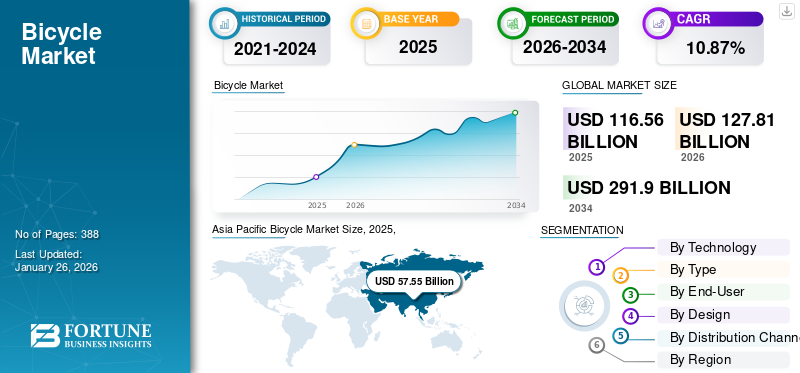
Download Free sample to learn more about this report.
Bicycle Market Key Takeaways
 Market Size & Forecast
- 2025 Market Size: USD 33.87 Billion
- 2026 Market Size: USD 35.83 Billion
- 2034 Forecast Market Size: USD 52.19 Billion
- CAGR: 4.8% from 2026–2034
 Market Share
- Europe dominated the bicycle market with a 42.89% share in 2025.
- The conventional segment accounted for a 54.88% market share in 2026.
- The offline distribution channel held a 65.20% market share in 2026.
 Key Regional Highlights
Europe
Europe generated USD 14.53 billion in 2025 and remained the largest regional market.
Asia Pacific
Asia Pacific held the second-largest market share in 2025, supported by strong demand in China and India.
North America
North America is projected to record the fastest regional CAGR of 5.7% during the forecast period.
U.S.
The bicycle market is projected to reach USD 3.86 billion in 2026, accounting for 11.4% of global revenue.
Japan
The bicycle market is projected to reach USD 0.42 billion in 2026, representing 1.2% of global revenue.
Read More

BICYCLE MARKET TRENDS
Rising Adoption of E-Bikes is the Ongoing Trend
E-bikes continue to gain popularity due to their convenience and eco-friendliness. Advances in battery technology have made them more efficient and affordable. Furthermore, the higher operating and maintenance costs of gasoline vehicles have led to a shift in preference toward electric bikes for everyday commutes, which pushes the bicycle market growth. E-bikes are increasingly being used for bike sharing programs and transportation, especially in urban areas with traffic congestion and limited parking. Their ability to travel longer distances without requiring frequent breaks and the option to bypass traffic make electric bikes a viable alternative to cars, public transportation, or traditional bikes for daily commuting. Moreover, government incentives such as tax benefits and subsidies for purchasing e-bikes are anticipated to fuel demand in the coming years.
Major manufacturers are also investing in connected e-bike platforms that allow users to track riding data, battery levels, and maintenance schedules via mobile apps. This increased technological sophistication is redefining the competitive landscape of the global market, in line with consumer demand for smart and sustainable urban mobility solutions.
- For Instance, in March 2025, GIANT and Siemens announced their collaboration. GIANT will join Siemens this year at Hannover Messe 2025 to showcase the next generation of performance E-Bikes and Road Bikes, and the role that Siemens’ technologies have played in their development.
Increasing Adoption of Smart & Connected Bicycles will Drive Market Growth
Increasing adoption of smart and connected bikes is emerging as one of the key market trends, driven by advancements in digital technologies and growing consumer demand for enhanced riding experiences. Modern bicycles are increasingly equipped with IoT-enabled features such as GPS tracking, real-time performance monitoring, navigation systems, and mobile app connectivity. These features provide users with data on speed, distance, battery status, and route optimization, improving convenience and usability. The integration of digital technologies is particularly appealing to tech-savvy consumers, thereby accelerating adoption in developed markets.
This trend is further supported by the rising importance of safety and security features in urban environments. Smart bicycles now incorporate advanced functionalities such as anti-theft systems, remote locking, geofencing, and crash detection alerts. For instance, in 2025, several leading manufacturers introduced connected e-bikes with built-in tracking and emergency alert systems, addressing growing concerns around theft and rider safety in cities. These innovations are enhancing consumer confidence and encouraging wider adoption, particularly for daily commuting purposes.
- For instance, in December 2025, Electric cycle manufacturer EMotorad launched the T-Rex Smart, the country’s first e-cycle equipped with both Bluetooth and GPS connectivity. Positioned as its flagship model, the T-Rex Smart aims to combine everyday convenience with advanced safety features for both adults and younger riders.
MARKET DYNAMICS
MARKET DRIVERS
Download Free sample to learn more about this report.
Increasing Government’s Focus on Building Cycling Infrastructure to Augment Market Growth
Increasing government focus on developing cycling infrastructure is emerging as a key driver for market growth. As urban congestion, environmental concerns, and public health awareness intensify, governments across developed and emerging economies are prioritizing cycling as a sustainable mode of transportation. Investments in dedicated bike lanes, cycling highways, and integrated urban mobility systems are creating a supportive ecosystem that encourages bicycle adoption for both commuting and recreational activity purposes. In developed regions such as Europe and North America, large-scale infrastructure initiatives are significantly boosting usage.
- For instance, in January 2026, Paris reinforced its cycling expansion agenda following pro-cycling political momentum, accelerating investments under its national bicycle plan. The city continues to add extensive bike lanes and promote e-bike adoption, strengthening urban mobility and boosting demand for cycling infrastructure.
MARKET RESTRAINTS
Availability of Alternative Transport Solutions May Hamper Market Growth
Availability of alternative transport options and solutions is a key restraining factor impacting the market growth. Consumers today have access to a wide range of mobility options, including motorcycles, scooters, public transportation, ride-hailing services, and emerging micro-mobility solutions such as electric scooters. These alternatives often provide greater convenience, speed, and comfort, particularly for longer distances or in regions with inadequate cycling infrastructure. As a result, bicycles may be perceived as less practical for daily commuting, especially in urban environments with time-sensitive travel needs. From a consumer perspective, factors such as comfort, weather protection, and ease of use also favor alternative transport modes. Motorized options require less physical effort and are often better suited for long-distance travel or adverse weather conditions.
- For instance, in countries with extreme climates, such as Canada or parts of the Middle East, consumers are more inclined toward enclosed or motorized transport solutions. This reduces the frequency of usage and impacts overall demand, particularly in non-recreational segments.
MARKET OPPORTUNITIES
Growth of Bike-sharing Programs to Present Growth Opportunities
Growth of bike-sharing programs is emerging as a significant market opportunity, driven by increasing urbanization and the requirement for cost-effective, sustainable mobility solutions. Governments and private operators across major cities are expanding bike-sharing networks to reduce traffic congestion and carbon emissions. These systems provide convenient, short-distance transportation options, making bicycles more accessible to a wider population without the need for ownership. This shift is particularly impactful in densely populated urban areas where first- and last-mile connectivity remains a critical challenge. The expansion of dockless and app-based bike-sharing platforms has further accelerated adoption by enhancing user convenience and operational efficiency.
- In 2025, cities such as Paris, New York, and Beijing will continue to scale their bike-sharing fleets, integrating them with public transportation systems. Vélib’ Métropole, the self-service bicycle-sharing system in the Greater Paris area, operates a fleet of approximately 20,000 bicycles. The service has heavily invested in electrification to support urban mobility, with electric bikes (blue bikes) accounting for roughly 40% of the active fleet.
MARKET CHALLENGES
Supply Chain Volatility Challenges Market Growth
A key challenge in the market is supply chain volatility, particularly in sourcing components such as semiconductors, batteries, and drivetrain systems. Fluctuating raw material prices and logistics disruptions increase production costs and lead times. Additionally, intense price competition and the presence of low-cost manufacturers put pressure on margins. Demand variability, especially post-pandemic normalization, further creates inventory imbalances, making it difficult for manufacturers and retailers to align production with actual bicycle market demand.
Segmentation Analysis
By Technology
Conventional Segment Takes the Lead Due to Affordability, Widespread Availability, and Strong Demand
Based on technology, the market is segmented into conventional and electric.
The conventional segment is projected to dominate the market with a share of 54.88% in 2026. The growth of the segment is driven by affordability, widespread availability, and strong demand in developing regions where cost-sensitive consumers prefer non-electric mobility. Established supply chains, low maintenance requirements, and minimal regulatory constraints further support adoption, particularly for commuting, fitness, and recreational purposes, ensuring steady but moderate expansion across mature and emerging markets globally.
The electric segment is estimated to register the fastest-growing CAGR of 7.8% over the forecast period. The Electric segment is experiencing rapid expansion due to rising urbanization, increasing fuel costs, and growing environmental awareness, driving demand for sustainable mobility solutions.
- In April 2022, Hero Cycles announced the establishment of a new e-cycle assembly line in Manchester to manufacture IoT-enabled electric and conventional bicycles for the U.K. and European markets. As part of a USD 190 million investment, the initiative is aimed at enhancing localized production capabilities, driving innovation, and strengthening the company’s position in the growing sustainable mobility market.
By Type
Increasing Demand for Flexible Mobility Solutions Drives Hybrid Segment Growth
By type, the market is segmented into mountain, road, hybrid, cargo, and others.
The hybrid segment is expected to lead the market, contributing 32.70% globally in 2026. The demand for the segment is driven by increasing demand for versatile bicycles suitable for both urban commuting and recreational use. Consumers are increasingly preferring flexible mobility solutions offering comfort, ease of use, and adaptability. Product innovations focused on ergonomics and multifunctionality are further supporting widespread adoption across diverse consumer groups globally over the forecast period.
The cargo segment is estimated to register the fastest-growing CAGR of 9.8% over the forecast period. The segment growth is driven by increasing demand for sustainable last-mile delivery solutions, particularly in urban areas.
- In December 2025, Tern announced that its electric cargo bikes used in New York City delivery fleets surpassed one million miles, supporting over 13 million annual deliveries. Deployed since 2021, these bikes demonstrate high durability, efficiency, and reliability under intensive urban conditions, highlighting their viability as cost-effective and sustainable alternatives to traditional delivery vehicles.
To know how our report can help streamline your business, Speak to Analyst
By End User
High Participation in Cycling for Commuting, Fitness, and Sports Activities Fuels Men Segment Growth
Based on end user, the market is segmented into men, women, and kids.
The men segment will account for 45.89% market share in 2026. The segment is driven by high participation in cycling for commuting, fitness, and sports activities. Increasing awareness of health and wellness, along with growing adoption of cycles for daily transportation, is supporting demand. Strong product availability across price ranges and performance categories further enhances adoption among a broad male consumer base globally.
The women segment is estimated to witness the fastest-growing CAGR of 6.1% over the forecast period. The segment is experiencing strong growth due to increasing female participation in cycling activities across fitness, commuting, and leisure segments. Rising awareness regarding health benefits, along with supportive initiatives promoting women in sports, is driving adoption. Product innovations focusing on comfort, lightweight frames, and ergonomic designs are further accelerating market expansion globally.
By Design
Regular Segment Dominates Market Due to Its Affordability and Simplicity in Design
Based on design, the market is segmented into regular and folding.
The regular segment holds the largest share in the market. The segment is driven by widespread adoption for daily commuting, fitness, and recreational purposes. Its affordability, simplicity in design, and strong availability across global markets support consistent demand. Established manufacturing ecosystems and extensive distribution networks further strengthen its position, making it a preferred choice among a broad consumer base globally.
The folding segment is estimated to register the fastest-growing CAGR of 11.2% over the forecast period. The segment is experiencing rapid growth due to increasing urbanization and demand for compact, space-efficient mobility solutions. Rising use in multimodal transportation, along with convenience in storage and portability, is driving adoption.
- In April 2025, Brompton marked its 50th anniversary with new product launches, including the G Line all-terrain folding bike and a 12-speed C Line model, alongside expansion of retail stores in the U.S. The company also continued investing in R&D and e-bikes, aiming to broaden its customer base and strengthen global market presence.
By Distribution Channel
Consumer Preference for Physical Product Inspection Fuels Offline Segment Expansion
By distribution channel, the market is segmented into offline and online.
The offline segment is expected to account for 65.20% of the market in 2026. The segment growth is driven by strong consumer preference for physical product inspection and personalized purchasing experiences. Availability of expert guidance, immediate product access, and after-sales services through specialty stores and dealerships supports demand. Established retail networks and brand-authorized outlets further strengthen consumer trust and sustain steady sales across global markets.
The online segment is estimated to grow at the fastest-growing CAGR of 10.2% over the forecast period. The online segment is experiencing rapid growth due to increasing digitalization and rising consumer preference for convenient purchasing options. Expansion of e-commerce platforms, availability of a wide product range, and competitive pricing are driving adoption. Enhanced logistics, doorstep delivery, and easy comparison of products further support the growth of online sales globally.
Bicycle Market Regional Outlook
By geography, the market is categorized into Europe, North America, Asia Pacific, South America, and the Middle East & Africa.
Europe
Europe Bicycle Market Size, 2025 (USD Billion)
To get more information on the regional analysis of this market, Download Free sample
The European region holds the largest share of the market. The regional market is driven by a strong cycling culture and widespread use of bikes for daily commuting. Government policies promoting low-emission mobility, well-developed cycling infrastructure, and high adoption of sustainable transportation solutions are key growth drivers. Increasing demand for eco-friendly mobility and the strong presence of leading bicycle manufacturers further support market expansion across the region.
- In February 2023, Pon.Bike announced the construction of a new manufacturing facility in Kėdainiai, Lithuania, with an annual capacity of 450,000 units. The plant will produce bikes for brands such as Gazelle, Kalkhoff, Focus, and Urban Arrow, strengthening Pon’s European manufacturing footprint and supporting expansion through advanced assembly and logistics capabilities.
Germany Bicycle Market
The German market in 2026 is estimated at around USD 5.54 billion, accounting for roughly 16.4% of global revenues. Growth is driven by strong cycling infrastructure, high e-bike penetration, and favorable environmental regulations.
U.K. Bicycle Market
The U.K. market in 2026 is estimated at around USD 1.21 billion, accounting for roughly 3.6% of global revenues. The U.K. market is supported by government cycling initiatives, urban congestion, and increasing health-conscious consumers’ behavior.
Asia Pacific
Asia Pacific held the second-largest share in 2025. The regional market growth is driven by large population bases, increasing urban congestion, and rising demand for affordable transportation solutions. Countries such as China and India witness strong demand for both conventional and electric bicycles. Government initiatives supporting e-mobility and local manufacturing also boost growth. Additionally, growing middle-class income levels and expanding delivery and logistics sectors are increasing the use of cycles for commercial and personal applications.
- In March 2025, GIANT partnered with Siemens at Hannover Messe to showcase next-generation e-bikes and road bikes developed using Siemens’ Xcelerator software. The collaboration highlights digital engineering in bike design, featuring models such as the Trance X Advanced E+ Elite 0 and Trinity Advanced SL 0 with advanced carbon frames, integrated systems, and improved aerodynamics.
China Bicycle Market
The China market in 2026 is estimated at around USD 6.85 billion, accounting for roughly 20.2% of global revenues. China's growth is driven by strong e-bike adoption, urban mobility demand, government support, and large-scale manufacturing capabilities.
Japan Bicycle Market
The Japan market in 2026 is estimated at around USD 0.42 billion, accounting for roughly 1.2% of global revenues. Growth is supported by aging population needs, compact urban commuting, and steady demand for high-quality bicycles.
India Bicycle Market
The India market in 2026 is estimated at around USD 1.45 billion, accounting for roughly 4.3% of global revenues. The Indian market is fueled by rising urbanization, affordability, an expanding middle class, and increasing use of delivery services.
North America
The North America region is estimated to propel the fastest-growing CAGR of 5.7% over the forecast period. The regional market is driven by the increasing adoption of bicycles for fitness, recreation, and urban commuting. Growing health awareness, supportive cycling infrastructure, and government initiatives promoting sustainable transportation are contributing to demand. Rising participation in cycling events and expanding e-bike adoption further support market growth across the region over the forecast period.
- In March 2026, Trek unveiled a new cross-country prototype bike featuring a 115 mm suspension platform, reflecting evolving demands of more technical XC racing. Developed with rider input and advanced carbon flex-stay design, the prototype serves as a testing platform for future models, highlighting Trek’s focus on performance innovation and real-world product development.
U.S. Bicycle Market
The U.S. market in 2026 is estimated at around USD 3.86 billion, accounting for roughly 11.4% of global revenues. Country growth is driven by recreational cycling trends, e-bike adoption, and expanding outdoor fitness culture.
South America
The market in South America is driven by increasing urbanization and the need for cost-effective transportation alternatives. Economic constraints encourage consumers to opt for bicycles over motorized vehicles. Government initiatives promoting cycling infrastructure and eco-friendly mobility further support growth. Additionally, rising awareness of health and fitness, along with expanding urban delivery services, contributes to increased adoption across major cities in the region.
- In November 2025, Paraguay launched the Train Trails project to develop South America’s longest bike path by repurposing unused railway corridors. The initiative focuses on promoting sustainable mobility, boosting eco-tourism, and enhancing regional connectivity. The project is expected to support local economies, encourage cycling culture, and position Paraguay as a key destination for long-distance biking enthusiasts across the continent.
Middle East & Africa
Growth in the Middle East & Africa market is supported by increasing urban development and the gradual adoption of sustainable mobility solutions. Rising health awareness and recreational cycling trends, particularly in urban centers, contribute to demand. Government investments in smart city projects and cycling infrastructure are also emerging growth drivers. Additionally, the affordability and low maintenance costs of cycles make them attractive in several African countries facing economic constraints.
- In March 2026, Dubai’s Roads and Transport Authority announced the development of 13 new cycling tracks as part of a 162 km expansion plan. The initiative aims to promote sustainable mobility, enhance urban connectivity, and encourage healthier lifestyles. The project supports Dubai’s vision of becoming a bicycle-friendly city while improving infrastructure for both recreational and commuter cyclists.
COMPETITIVE LANDSCAPE
Key Industry Players
Innovation, Branding, and Expansion Drives Competitive Edge
The global bicycle market is highly fragmented, with competition driven by innovation, branding, and expansion. Giant Bicycles, Pon Holdings, and Trek Bicycle Corporation lead through manufacturing scale, multi-brand strategies, and premium positioning. Other players such as Specialized Bicycle Components, Inc., Merida, and Accell focus on e-bike innovation and regional strength, while Hero Cycles emphasizes cost leadership. Overall, companies compete through electrification, product differentiation, and supply chain optimization, targeting growing urban mobility demand and expanding global distribution networks.
LIST OF KEY BICYCLE COMPANIES PROFILED
- Pon Holdings B.V. (Netherlands)
- Trek Bicycle Corporation (U.S.)
- Accell Group N.V. (Netherlands)
- Giant Bicycles (Taiwan)
- Merida Industry Co., Ltd. (Taiwan)
- Specialized Bicycle Components, Inc. (U.S.)
- Orbea S. Coop. (Spain)
- Hero Cycles Ltd. (India)
- Brompton Bicycle Ltd. (U.K.)
- Mobility Holdings, Ltd. (Tern) (Taiwan)
KEY INDUSTRY DEVELOPMENTS
- July 2026: New Pedego Holdings launched the Pedego Ridge Rider 2 and Pedego Latch 2 as the first models in its Pedego 2.0 lineup, supported by a redesigned supply chain and five-year limited warranty. The strategic objective was to expand premium e-bike availability through dealer channels. Technologies involved included electric drive systems, lithium-ion batteries, UL-certified components, integrated controls, and connected bicycle systems.
- April 2026: DAHON TECH launched the LUNDEN GR, a 20-inch tri-fold bicycle incorporating its proprietary DAHON-V Tech for compact urban and mixed-terrain mobility. The strategic objective was to improve portability while retaining riding performance. Technologies involved included tri-fold frame engineering, structural stiffness optimization, compact drivetrain integration, folding mechanisms, and lightweight bicycle architecture for urban mobility applications.
- April 2026: woom bikes launched woom Exchange, an official branded resale marketplace developed with Archive to extend the usable life of its children's bicycles. The strategic objective was to support product longevity and reduce material waste. Capabilities involved included digital resale infrastructure, product lifecycle management, online marketplace technology, inventory tracking, and circular bicycle commerce.
- March 2026: Giant introduced the updated Propel aero road bike and Liv’s EnviLiv, delivering improved performance through system-level enhancements. The Propel SL variant achieves 18.4 watts of efficiency gains, driven by refinements in cockpit, wheels, and tires rather than major frame redesigns.
- January 2026: Orbea launched the Rallon RS trail bike featuring an integrated RS system connecting motor, suspension, and components, powered by a TQ HPR40 motor (200W, 40Nm), real-time data sharing, advanced Fox eNEO suspension control, and a modular battery system enhancing climbing efficiency and downhill performance.
- July 2025: Trek announced a shift to low-emission aluminum across its bicycle brands, impacting over 1,000,000 bikes annually. By sourcing aluminum from renewable-powered and recycled materials, the company aims to reduce carbon emissions and meet climate goals ahead of schedule, marking one of the cycling industry’s most significant sustainability initiatives.
- January 2025: Hero Cycles announced plans to invest nearly USD 1 billion to expand its global operations and manufacturing capabilities. The investment will focus on scaling production, strengthening international presence, and advancing technology development, including electric mobility solutions, positioning the company to capture growing demand in global bicycle and sustainable mobility markets.
- February 2024: Specialized Bicycle Components, Inc. signed a partnership with the UCI Mountain Bike World Championships Valais 2025 as an official sponsor. The collaboration aims to promote cycling through innovation, support elite competition, and encourage participation among youth and women, reinforcing Specialized’s commitment to advancing the sport and strengthening its presence in global cycling events.
REPORT COVERAGE
The global bicycle market analysis provides an in-depth study of the market size & forecast by all the market segments included in the market report. It includes details on the market dynamics and trends expected to drive the market over the forecast period. It offers information on technological advancements, new product launches, key automotive industry developments, and details on partnerships, mergers, and acquisitions. The market report scope also encompasses a detailed competitive landscape with information on the market share and profiles of key operating players.
Request for Customization to gain extensive market insights.
Report Scope & Segmentation
| ATTRIBUTE | DETAILS |
| Study Period | 2021-2034 |
| Base Year | 2025 |
| Estimated Year | 2026 |
| Forecast Period | 2026-2034 |
| Historical Period | 2021-2024 |
| Growth Rate | CAGR of 4.8% from 2026-2034 |
| Unit | Value (USD Billion) |
| Segmentation | By Technology, By Type, By End User, By Design, By Distribution Channel, and By Region |
| By Technology |
|
| By Type |
|
| By End User |
|
| By Design |
|
| By Distribution Channel |
|
| By Region |
|
Frequently Asked Questions
Fortune Business Insights says that the global market value stood at USD 33.87 billion in 2025 and is projected to reach USD 52.19 billion by 2034.
In 2025, the Asia Pacific market value stood at USD 14.53 billion.
The market is expected to exhibit a CAGR of 4.8% during the forecast period of 2026-2034.
The hybrid segment leads the market in terms of type.
Increasing governments focus on building cycling infrastructure to augment market growth
Major players in the market include Giant Bicycles, Pon Holdings, Trek Bicycle Corporation, Specialized Bicycle Components, Merida Industry, and Accell Group.
Europe holds the largest share of the market.



- 2021-2034
- 2025
- 2021-2024
- 650
-
(Offer valid till 15th Oct 2026)
Get 30-60 hrs Free Customization
Expand Regional and Country Coverage, Segments Analysis, Company Profiles, Competitive Benchmarking, and End-user Insights.




















-
US +1 833 909 2966 ( Toll Free )
-
Get In Touch With Us