Cargo e-bike Market Size, Share & Industry Analysis, By Vehicle Type (Two Wheeler and Three Wheeler), By Application (Personal and Commercial), By Sales Channel (Online and Offline), and Regional Forecast, 2026-2034
 Download Free Sample
(Offer valid till 15th Oct 2026)

KEY MARKET INSIGHTS
 Listen to Audio Version
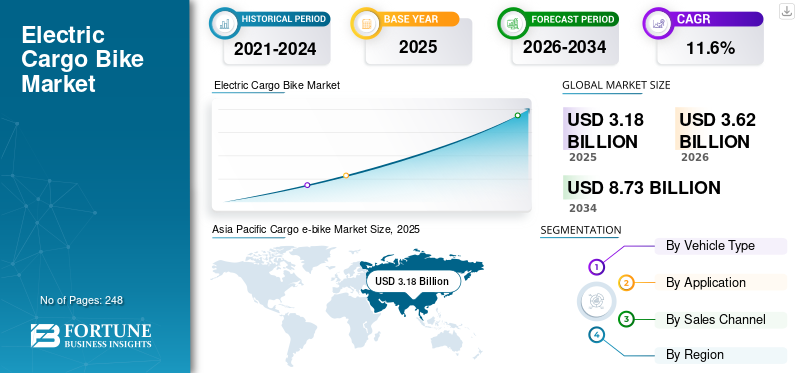
The global cargo e-bike market size was valued at USD 3.18 billion in 2025. The market is projected to grow from USD 3.62 billion in 2026 to USD 8.73 billion by 2034, exhibiting a CAGR of 11.6% during the forecast period.
The global market has emerged as a dynamic segment within the broader electric vehicle industry, fueled by the increasing need for sustainable cargo transportation solutions in urban centers. As cities become more congested and the demand for efficient last-mile delivery solutions rises, cargo electric bikes present an attractive alternative to traditional delivery vehicles. One of the primary drivers of growth in the industry is the increasing awareness of climate change and the push for greener alternatives to conventional transportation. Around the world, cities are implementing stricter regulations on emissions, creating a favorable environment for electric vehicles. These bikes help reduce carbon footprints significantly, offering an eco-friendly solution to transport goods without contributing to air pollution.
The global e-cargo bikes market size is led by a mix of established bicycle manufacturers and specialized urban mobility companies that combine strong brand equity, advanced engineering, and expanding distribution networks. Riese and Muller is widely regarded as a premium leader due to its high-quality German engineering, customizable cargo platforms (such as Load and Packster models), and strong presence across Europe and North America. Tern Bicycles is another key player, known for compact yet high-capacity models such as the GSD and HSD, which appeal to both families and commercial users, supported by a broad international dealer network. Urban Arrow (owned by Pon Holdings) has a dominant position in urban family and last-mile delivery segments, benefiting from Pon’s scale, supply chain strength, and fleet partnerships. Rad Power Bikes has captured significant share in North America by offering competitively priced, direct-to-consumer cargo-based e-bikes with strong value-for-money positioning.
Download Free sample to learn more about this report.
CARGO E-BIKE MARKET KEY TAKEAWAYS
 Market Size & Forecast
- 2025 Market Size: USD 3.18 billion
- 2026 Market Size: USD 3.62 billion
- 2034 Forecast Market Size: USD 8.73 billion
- CAGR: 11.6% from 2026–2034
 Market Share
- Asia Pacific is expected to dominate the cargo e-bike market during the forecast period.
- The Two-Wheeler segment held the largest share of 71.04% in 2025.
- The Commercial segment dominated the market in 2025.
 Key Regional Highlights
North America
North America is expanding steadily due to rising demand for sustainable logistics and e-commerce growth.
Europe
Europe is the fastest-growing region, supported by government incentives and strong cycling infrastructure.
Asia Pacific
Asia Pacific leads the market due to rapid urbanization and strong demand for last-mile delivery solutions.
U.S.
The market is growing due to urban congestion, rising fuel costs, and increasing adoption of eco-friendly delivery solutions.
Japan
The market is growing steadily at a CAGR of 8.5%, driven by compact urban mobility needs and an aging population.
Read More

Cargo e-bike Market Trends
Increasing E-commerce and Last-Mile Delivery to Fuel Market Growth
The rise of e-commerce and the corresponding demand for efficient last-mile delivery solutions are significantly driving the cargo e-bike market growth. As more consumers opt to shop online, the logistics of delivering goods directly to customers’ doorstep have had to evolve swiftly to meet expectations for speed and convenience. The last mile, which refers to the final leg of the delivery journey, is considered the most complex and costly part of the supply chain.
According to the ISB (Bharti Institute of Public Policy), India's online shopper base is expected to become the second largest in the world by 2030, driven by the rapid growth of major platforms such as Amazon, Blinkit, and Zomato, along with the rise of ONDC. This growth is projected to encompass nearly 500-600 million shoppers, supported by millions of vendors.
These e-bikes are exceptionally well-suited for urban environments characterized by navigating narrow streets, limited parking spaces, and high-density neighborhoods. Their compact design allows efficient deliveries while reducing the need for larger, gas-powered vehicles that contribute to traffic congestion and urban pollution. As municipalities increasingly impose restrictions on fossil fuel-powered vehicles, especially within city centers, cargo bikes are emerging as a desirable solution for businesses seeking to comply with environmentally friendly regulations.
Market Dynamics
Market Drivers
Download Free sample to learn more about this report.
Urbanization and Traffic Congestion to Boost Market Growth
Urbanization and traffic congestion are pivotal drivers of the market, propelling its adoption as a practical solution to modern urban challenges. As more people migrate to cities in search of opportunities, the resulting population density places immense pressure on existing transportation systems, often leading to severe traffic congestion and elevated levels of air pollution.
For instance, in 2024, Amazon inaugurated its first micromobility hub in Norfolk at its delivery station in Norwich. This hub now features a fleet of bikes that will deliver thousands of packages weekly to Amazon customers, reducing the reliance on traditional delivery vans in city centers, thereby enhancing air quality and alleviating congestion. Norwich is now among over 40 cities in the U.K. and Europe that host Amazon's micromobility hubs, which support both cargo e-bike and pedestrian deliveries. As part of a USD 406 million investment aimed at electrifying and decarbonizing the U.K. transportation network, Amazon projects that its fleet of cargo electric bikes and walkers are projected to make millions of deliveries to customers across the U.K. each year.
MARKET RESTRAINTS
Range Anxiety and Limited Charging Infrastructures to Restrain Market Growth
Range anxiety refers to the apprehension that users may feel about the battery life of their cargo e-bikes, particularly when planning longer trips or making extended delivery distances. For many users, especially businesses that rely on these bikes for logistics, there is a worry that the available battery capacity may not be sufficient to complete their routes without requiring a recharge. This concern can deter potential buyers, leading them to opt for more conventional transportation methods that do not face such limitations.
Furthermore, the necessity for accessible and efficient charging infrastructure exacerbates this issue. In many urban areas, charging stations for electric vehicles, including cargo bikes, are still limited and often not conveniently located. Users may find themselves in situations where they cannot charge their bikes in a timely manner, severely restricting their operational flexibility. Additionally, the time required to recharge batteries can pose a significant challenge. Longer charging times may disrupt business operations or personal schedules. Consequently, without the development of more advanced battery technologies and a robust network of charging stations, the market faces critical hurdles in addressing these concerns, affecting its adoption and overall growth within the transportation sector.
Market Opportunities
Sustainability and Eco-friendliness to Present a Significant Opportunity for Manufacturers
Sustainability and eco-friendliness represent a significant growth for cargo electric bike manufacturers, driven by the heightened awareness of environmental issues among consumers and businesses. As urban congestion and pollution levels escalate, there is a growing demand for transportation solutions that help minimize carbon footprints and reduce reliance on traditional fossil fuel-powered vehicles for urban logistics and last-mile delivery. By promoting their products as eco-friendly alternatives, manufacturers can appeal to environmentally conscious consumers, municipalities, and businesses aiming to implement sustainable practices. Additionally, as governments worldwide introduce incentives and regulations to support green transportation, manufacturers positioned as sustainability leaders can benefit from increased demand, favorable policies, and potential subsidies. Ultimately, the focus on sustainability strengthens the marketability of cargo e-bikes and aligns with global efforts to combat climate change. This makes it a compelling opportunity for manufacturers to innovate and thrive in an increasingly eco-aware marketplace.
Segmentation Analysis
By Vehicle Type
Increase in Demand For Eco-Friendly Rides Boosted Two-wheeler Segment Growth
By vehicle type, the market is segmented into two wheeler and three wheeler.
The two wheeler segment held the largest cargo e-bike market share of 71.04% in 2025, driven by its inherent advantages in urban logistics and transportation. Two-wheeled cargo-based e-bikes, which offer a combination of maneuverability and efficiency, are particularly well-suited for navigating congested city environments where traditional delivery vehicles may struggle to operate effectively. Their smaller footprint enables easier parking and access to narrow alleyways, making them ideal for last-mile deliveries. As urban populations continue to grow and the demand for eco-friendly delivery options rises, two-wheeled cargo electric bikes are well-positioned to maintain their market dominance, providing an agile and efficient alternative to conventional vehicles.
The three wheeler segment has recorded the fastest growth rate within the market, driven by factors that enhance its appeal, particularly for commercial applications. These bikes offer stability, cargo capacity, and alignment with sustainability trends has positioned the three-wheeler segment as a key driver of growth within the sector. The segment is anticipated to grow at a 8.8% CAGR over the forecast period.
To know how our report can help streamline your business, Speak to Analyst
By Application
Commercial Segment Expected to Lead in Market primarily due to Cost-efficiency
By application, the market is classified into personal and commercial.
The commercial segment dominated the market in 2025. Cargo e-bikes present a cost-effective alternative to traditional delivery vehicles such as vans or trucks, primarily due to their significantly lower operational expenses. The most prominent savings come from reduced fuel costs, as electric bikes rely on electricity rather than gasoline or diesel, leading to substantial reductions in fuel expenditure. Furthermore, many urban areas are implementing congestion charges or emissions fees to combat environmental issues, and cargo electric bikes are often exempt from these charges, offering businesses an additional financial incentive. This combination of fuel savings, maintenance efficiency, and exemption from urban fees makes such e-bikes an increasingly attractive option for companies seeking to streamline their logistics and reduce overhead costs. The segment is anticipated to grow at 9.3% CAGR during the forecast period
The personal segment is expected to show the fastest growth in the market. Personal cargo-based e-bikes are designed for transporting goods and can also be used for recreational purposes, family outings, or commuting. As more individuals prioritize health and fitness, cargo electric bikes offer a way to engage in physical activity while enjoying the benefits of electric assist. This dual appeal of fitness and convenience can drive personal adoption rates. The segment is anticipated to grow at 8.1% CAGR during the forecast period
By Sales Channel
Online Segment to Gain Traction within Market Owing to its Convenience
By sales channel, the market is categorized into online and offline.
The online segment is poised to dominate the market, driven by a key preference for convenience and efficiency. Customers are increasingly seeking the ease of purchasing such cargo-based e-bikes from the comfort of their own homes. Enhanced delivery options, including direct-to-door shipping and easy returns, further add to the appeal of purchasing cargo electric bikes online. As consumers become more accustomed to shopping digitally, the online segment is expected to capture a significant share of the market, serving personal and commercial demand. The segment is emerging as the fastest growing segment with 9.5% CAGR during the forecast period.
The offline segment of the market is projected to experience a significant CAGR as consumers increasingly seek personalized experiences and hands-on evaluations before making a purchase. Physical retail locations allow potential buyers to test ride various models, feel the quality, and receive expert advice from knowledgeable staff, which can enhance customer confidence in their decision. The segment is anticipated to grow at 7.5% CAGR during the forecast period.
CARGO E-BIKE REGIONAL OUTLOOK
By region, the market is categorized into North America, Europe, Asia Pacific, and the rest of the world.
Asia Pacific
Asia Pacific Cargo e-bike Market Size, 2025 (USD Billion)
To get more information on the regional analysis of this market, Download Free sample
The Asia Pacific region is anticipated to dominate the market due to rapid urbanization in countries such as China, India, and Japan. This has resulted in increasing traffic congestion and a growing demand for sustainable transportation solutions, making cargo electric bikes an attractive option for both businesses and consumers. Government initiatives promoting green mobility and stricter emissions regulations are further fueling the adoption of electric vehicles, including cargo bikes. Additionally, the region has a rich culture of cycling and a burgeoning logistics and delivery sector, particularly in last-mile delivery services, which significantly contributes to the demand. The combination of economic growth, supportive policies, and a growing consumer base positions the Asia Pacific region as a leader in the market.
China Cargo e-Bike Market
China represents the largest volume market for electric two and three-wheelers globally, and such e-bikes are widely used for urban logistics and last-mile delivery. Growth is driven by the rapid expansion of e-commerce, food delivery platforms, and cost-efficient urban transport solutions. Domestic manufacturers dominate the market with competitively priced models and strong local distribution networks. However, regulatory tightening around battery safety and vehicle standards is reshaping product specifications. China holds the highest market share of 45.2% in the Asia Pacific region.
Japan Cargo e-Bike Market
Japan’s market is comparatively smaller but steadily growing, supported by compact urban infrastructure and an aging population seeking practical mobility solutions. Family-oriented electric assist bicycles with child-carrying capability are particularly popular. High product quality, safety standards, and strong domestic brands characterize the market. Growth is gradual, driven more by lifestyle adoption than commercial fleet expansion. The country is expected to grow at 8.5% CAGR during the forecast period.
India Cargo e-Bike Market
India’s market is emerging, fueled by rapid growth in e-commerce, hyperlocal delivery, and government support for electric mobility. Start-ups and local OEMs are introducing affordable cargo electric bikes targeted at gig workers and small businesses. Price sensitivity and infrastructure limitations influence adoption rates. However, strong long-term potential exists due to urbanization, rising fuel costs, and sustainability initiatives. The country is reported as the fastest growing at 9.5% CAGR during the forecast period.
Europe
Europe is expected to emerge as the fastest-growing region in the market, driven by strong governmental support, robust infrastructure, and increasing environmental awareness among consumers. Many European countries are implementing progressive policies to promote sustainable transportation, including incentives for electric vehicle adoption and substantial investments in cycling infrastructure. Additionally, urban areas are adopting stringent emissions regulations, encouraging logistics companies and individuals to turn to cargo electric bikes as a practical and eco-friendly solution for last-mile delivery.
Germany Cargo e-Bike Market
Germany is one of the most mature and fastest-growing markets in Europe, driven by strong environmental awareness and supportive government subsidies. Cargo electric bikes are widely adopted for family transport as well as last-mile logistics by SMEs and large delivery fleets. The presence of leading manufacturers such as Riese & Müller and Urban Arrow strengthens domestic production and innovation. High purchasing power and well-developed cycling infrastructure further support sustained demand. The country is the fastest growing at 8.8% CAGR during the forecast period.
U.K. Cargo e-Bike Market
The U.K. market is expanding steadily, supported by urban congestion policies, low-emission zones, and growing e-commerce activity. Adoption is particularly strong in London and other major cities where businesses are shifting toward sustainable delivery models. Government incentives and pilot programs for cargo bike logistics are encouraging commercial uptake. However, infrastructure limitations and higher upfront costs still moderate broader consumer penetration. The country is the fastest growing at 7.5% CAGR during the forecast period.
North America
In North America, robust economic activity, particularly in sectors such as logistics, transportation, and e-commerce, is fueling the need for efficient delivery solutions, including cargo electric bikes. The rising emphasis on expedited freight delivery services is directly linked to increasing interest in sustainable transportation alternatives, facilitating the growth of the market.
U.S. Cargo e-Bike Market
The U.S. sector is witnessing substantial expansion as cities embrace eco-friendly mobility alternatives. This growth stems from urban density challenges, escalating energy prices, and heightened environmental awareness among both individual consumers and commercial enterprises seeking cost-effective delivery methods. Federal and local government support for sustainable transport initiatives, coupled with improved cycling infrastructure development, is accelerating market adoption. Delivery companies, households, and small enterprises are increasingly turning to cargo electric bikes as practical solutions for navigating crowded metropolitan areas while reducing their carbon footprint. The U.S. holds the highest market share of 41.5% in the North America region.
Rest of the World
The rest of the world, encompassing South America and the Middle East & Africa, is projected to experience significant CAGR in the coming years. As these regions advance economically and invest in modernizing logistics infrastructure, the market is anticipated to grow substantially, meeting the evolving needs of various industries. The rest of the world is anticipated to grow at a healthy CAGR of 10.4% during the forecast period.
Competitive Landscape
Key Industry Players
Rad Power Bikes dominates Market Due to their Feature-loaded Bikes and Excellent Customer Service
Rad Power Bikes is one of the largest electric bike brands in North America, known for its versatile range of electric bicycles, including cargo models. The company’s RadWagon line of cargo electric bikes is designed for families and small businesses, prioritizing affordability, durability, and a user-friendly experience. Rad Power Bikes emphasizes practicality and strong customer support, making them a favorite choice among everyday users.
When analyzing the competitive landscape of the market, it becomes evident that the market is highly fragmented. This fragmentation is largely attributed to the diverse array of component manufacturers that contribute to the assembly of cargo e-bikes. These include manufacturers of electric motors, batteries, and frame suppliers of accessories and specialized features, which allow a wide variety of product configurations. The presence of non-dominant companies creates a competitive environment, allowing numerous brands to strengthen their product portfolio. This variety fosters innovation, as manufacturers strive to differentiate their products with unique features, designs, and technologies. Smaller, niche players can cater to specific consumer preferences or market segments, further contributing to the diversity within the market.
LIST OF KEY CARGO E-BIKE COMPANIES PROFILED
- Rad Power Bikes Inc. (U.S.)
- Renault Trucks (France)
- VikeBike India Pvt Ltd (India)
- eBikeGo (India)
- Jinhua Jobo Technology Co.,Ltd (China)
- Hero Lectro E-Cycles (India)
- Smart Urban Mobility B.V. (Netherlands)
- Cervelo (U.S.)
- Yuba Bicycles LLC (U.S.)
- Butchers & Bicycles (Denmark)
KEY INDUSTRY DEVELOPMENTS
- March 2025: Tern launched its third-generation GSD cargo electric bike, featuring notable enhancements aimed at boosting utility, safety, and convenience. As a brand recognized for pioneering the compact cargo bike segment, Tern continues to advance its offerings with this new model, which provides better handling, increased load capacity, and enhanced safety features.
- March 2025: Oxford City Council in partnership with Velocity Cycle Couriers initiated a 12-week trial providing same-day and next-day zero-emission deliveries via cargo e-bike for businesses located in Oxford’s ring road. Following positive feedback from participating businesses, the trial was extended twice, and has now decided to extend the partnership for another year, lasting until February 28, 2026.
- October 2024: Sheffield-based BB-EV (Busy Bee EV Ltd) introduced its new e-cargo bikes to address the increasing demand for sustainable urban transportation. The company highlights that the e-cargo bike is engineered for all-weather use and features a variety of interchangeable cargo pod options. It serves as an eco-friendly solution for last-mile deliveries and is specifically designed to meet the needs of large-scale B2B customers, including couriers, parcel services, and major retailers.
- October 2024: ZADD Bikes, a start-up based in Chandigarh, introduced its inaugural electric cargo bicycle in India, named the 'Utility Hauler.' This electric bicycle is specifically designed for last-mile delivery and presents a variety of practical applications.
- October 2024: Optima Cycles, a manufacturer of e-bikes and cargo e-bikes, has announced its acquisition of Dolly, a well-regarded and innovative cargo electric bike brand. This strategic move allows Optima Cycles, which is recognized for its Dutch ID and Lovens brands, to bolster its presence in the rapidly expanding market, paving the way for new growth opportunities.
- August 2024: Xylo Technologies Ltd., a technology-driven company focused on advanced innovative technologies, announced today that Revoltz Ltd, in which Charging Robotics, Inc., a Delaware corporation listed on the OTC Market and 67% owned by Xylo, holds a 19.9% stake, has introduced a new three-wheeled cargo e-bike specifically designed for the European and U.K. markets.
- July 2024: CleverTec Systems partnered with Queclink Wireless Solutions to create an integrated fleet and video telematics solution specifically designed for cargo e-bikes. This collaboration aims to provide a customized technology solution that addresses the increasing demands for road safety and performance as the adoption of e-bikes in the last-mile delivery sector continues to grow.
- September 2023: Maxion Wheels, the world's leading wheel manufacturer, announced a partnership with German cargo e-bike producer Antric. As the exclusive wheel supplier for Antric’s four-wheeled heavy cargo bike, the Antric One, Maxion Wheels created a cost-effective steel wheel solution tailored for urban logistics.
REPORT COVERAGE
The global cargo e-bike market research report provides a detailed market analysis and focuses on key aspects such as leading companies, vehicle type, application, and sale channel. Besides this, the report offers insights into the latest market trends and highlights key industry developments. In addition to the factors mentioned above, the report encompasses several factors that have contributed to the growth of the market in recent years.
Request for Customization to gain extensive market insights.
Report Scope & Segmentation
| ATTRIBUTE | DETAILS |
| Study Period | 2021-2034 |
| Base Year | 2025 |
| Estimated Year | 2026 |
| Forecast Period | 2026-2034 |
| Historical Period | 2021-2024 |
| Growth Rate | CAGR of 11.6% from 2026 to 2034 |
| Unit | Value (USD Billion) and Volume (Units) |
|
Segmentation |
By Vehicle Type
By Application
By Sales Channel
By Region
|
Frequently Asked Questions
Fortune Business Insights says that the market was valued at USD 3.18 billion in 2025 and is projected to reach USD 8.73 billion by 2034.
The market is expected to register a CAGR of 11.6% during the forecast period.
The increasing demand for efficient logistics operations is predicted to drive the global market growth.
Asia Pacific is anticipated to lead the market.
Rad Power Bikes Inc. (U.S.), Renault Trucks (France), VikeBike India Pvt Ltd (India), eBikeGo (India), and Jinhua Jobo Technology Co., Ltd (China) are the key players in the market.
China dominated the global market.


- 2021-2034
- 2025
- 2021-2024
- 248
-
(Offer valid till 15th Oct 2026)
Get 30-60 hrs Free Customization
Expand Regional and Country Coverage, Segments Analysis, Company Profiles, Competitive Benchmarking, and End-user Insights.




















Related Reports
-
US +1 833 909 2966 ( Toll Free )
-
Get In Touch With Us