Electric Motor Market Size, Share & Industry Analysis, By Motor Type (Radial Induction Motors, Radial Permanent Magnet Motors, Switched Reluctance Motors, DC Motors, and Others), By Voltage (Up to 1 kV, 1kV to 35 kV, and Above 35 kV), By Power Output (Up to 0.75 kW, 0.75 kW – 7.5 kW, 7.5 kW – 75 kW, 75 kW – 375 kW, and Above 375 kW), By Application (Industrial, HVAC, Automotive & Transportation, Consumer Appliances, Energy & Power, Oil and Gas, Mining & Metals, and Others), and Regional Forecast, 2026-2034
 Download Free Sample
(Offer valid till 15th Oct 2026)

Electric Motor Market Size and Future Outlook
 Listen to Audio Version
The global electric motor market size was valued at USD 161.29 billion in 2025 and is projected to grow from USD 176.49 billion in 2026 to USD 319.70 billion by 2034, exhibiting a CAGR of 7.71% during the forecast period. Asia Pacific dominated the electric motor market with a market share of 47.25% in 2025.
Electric motors are electromechanical devices that convert electrical energy into mechanical motion and serve as the core power source for a wide range of industrial, commercial, transportation, and consumer applications. In industrial environments, energy efficient electric motors drive pumps, compressors, conveyors, machine tools, fans, blowers, mixers, and automated production equipment, making them essential for manufacturing and process operations.
The increasing adoption of automated production systems is a major driver for the market’s growth. Manufacturers are investing in robotics, automated material handling, precision machining, and digitally controlled production lines to improve throughput, reduce downtime, and maintain product quality. These systems rely heavily on high-performance motors capable of precise speed, torque, and motion control. The growing deployment of smart factories, automated warehouses, and process-control equipment across industries such as automotive, electronics, chemicals, food processing, and logistics is increasing the requirement for advanced motor solutions integrated with sensors and drive technologies.
- For instance, in March 2025, Siemens AG expanded its industrial automation portfolio by introducing next-generation high efficiency electric motors designed for digitally connected manufacturing environments. The motors were engineered to integrate seamlessly with variable frequency drives and industrial IoT platforms, enabling real-time performance monitoring, predictive maintenance, and optimized energy consumption. The development aims at supporting smart factory initiatives across automotive, food processing, and process industries.
Some of the leading companies include ABB Ltd., Siemens AG, WEG S.A., and Nidec Corporation, among others. ABB Ltd. is one of the world's leading manufacturers of industrial electric motors, offering a comprehensive portfolio of low, medium, and high-voltage motors for applications across manufacturing, mining, oil & gas, power generation, water treatment, marine, and process industries. The company specializes in energy-efficient motor technologies, including IE3, IE4, and IE5 efficiency-class motors, designed to reduce energy consumption and improve operational reliability.
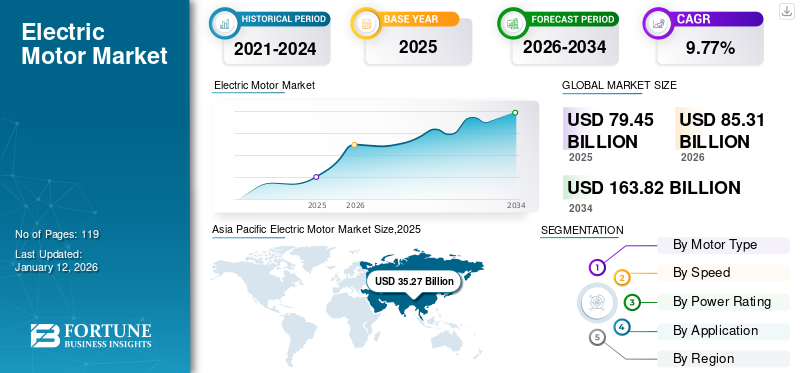
Download Free sample to learn more about this report.
Electric Motor Market Key Takeaways
 Global Market Size & Forecast
- 2025 Market Size: USD 161.29 billion
- 2026 Market Size: USD 176.49 billion
- 2034 Forecast Market Size: USD 319.70 billion
- CAGR: 7.71% from 2026–2034
 Market Share
- Asia Pacific dominated the electric motor market with a 47.25% share in 2025.
- The up to 1 kV segment held the largest market share, accounting for 68.42% in 2025.
- The radial induction motors segment led the market with a 54.16% share in 2025.
 Key Regional Highlights
Asia Pacific
Asia Pacific led the global market with a valuation of USD 76.01 billion in 2025.
North America
North America was valued at USD 34.75 billion in 2025 and is projected to reach USD 37.69 billion in 2026.
Europe
Europe was valued at USD 30.13 billion in 2025 and is expected to grow at a 7.44% CAGR during the forecast period.
U.S.
U.S. The market was analytically approximated at USD 30.11 billion in 2025.
Japan
Japan The market was analytically approximated at USD 7.05 billion in 2025.
Read More

ELECTRIC MOTOR MARKET TRENDS
Shift toward Ultra-Premium Efficiency Motors (IE4 and IE5) is the Key Market Trend
A major trend shaping the electric motor market is the accelerated adoption of IE4 and IE5 ultra-premium efficiency motors across manufacturing, mining, water treatment, chemicals, and heating, ventilation, and air conditioning (HVAC) applications. Industrial operators are increasingly focusing on lifecycle energy costs rather than upfront equipment expenditure, as electricity consumption accounts for the majority of a motor's operating cost. Furthermore, the International Energy Agency (IEA) Energy Efficiency reported that 62 countries had implemented minimum energy performance standards (MEPS) for electric motors in 2022, significantly expanding the market for premium-efficiency products. Also, the IEA 4E Electric Motor Systems Annex Policy Brief, 2025 states that electric motor systems account for approximately 53% of global electricity consumption and nearly 72% of industrial electricity use, making energy-efficient motor deployment a strategic priority for governments and industrial operators worldwide.
MARKET DYNAMICS
MARKET DRIVERS
Download Free sample to learn more about this report.
Expansion of Electrified Industrial Infrastructure and Process Modernization Drives Market Growth
The growing modernization of industrial infrastructure is a key driver for the electric motor market growth. Industries are increasingly replacing hydraulic, pneumatic, and mechanically driven systems with electrically powered equipment to improve operational precision, reduce maintenance requirements, and enhance process controllability. This transition is particularly evident in sectors such as water and wastewater treatment, food processing, pharmaceuticals, chemicals, metals, and advanced manufacturing, where continuous operations demand reliable motion systems. The electric motors are responsible for the majority of mechanical energy used across industrial facilities, making them indispensable to productivity improvements and operational efficiency programs.
In addition, the rapid expansion of industrial heat pumps, electric compressors, automated conveyor systems, and precision manufacturing equipment is increasing demand for specialized motor technologies. The United Nations Industrial Development Organization (UNIDO) highlights that digital manufacturing and industrial electrification investments are accelerating across emerging economies as manufacturers seek higher output quality and lower operating costs. Also, stricter environmental regulations are encouraging industries to replace aging equipment with high-efficiency motor systems capable of reducing energy losses.
MARKET RESTRAINTS
Volatility in Raw Material Prices to Hamper Market Demand
Fluctuations in the prices of key raw materials, particularly copper and electrical steel, represent a significant restraint for the electric motor market share. Copper is extensively used in motor windings due to its high electrical conductivity, while electrical steel is essential for stators and rotors that determine motor efficiency and performance. Price volatility in these materials creates uncertainty in manufacturing costs, making it difficult for motor producers to maintain stable pricing and profit margins. Additionally, the energy costs, trade restrictions, and supply disruptions have contributed to fluctuations in electrical steel availability and pricing. These cost pressures can delay purchasing decisions, increase capital expenditure for applications, and limit the adoption of advanced motor technologies in price-sensitive industrial sectors.
MARKET OPPORTUNITIES
Rising Electric Vehicle Production and Electrification of Transportation to Create New Opportunities
The accelerating shift toward electric mobility presents a major opportunity for the electric motor market. Electric motors are the core propulsion component in battery electric vehicles (BEVs), plug-in hybrid electric vehicles (PHEVs), electric buses, electric trucks, and two- and three-wheelers. Beyond traction motors, EVs utilize numerous auxiliary motors for thermal management systems, electric power steering, braking systems, battery cooling, and cabin comfort functions. Thus, an increase in demand for electric vehicles has led to a rise in electric motor sales.
According to the International Energy Agency (IEA), Global EV Outlook 2025, global electric vehicle sales exceeded 17 million units in 2024, representing strong year-over-year growth and significantly expanding demand for high-performance motor technologies. Furthermore, the International Organization of Motor Vehicle Manufacturers (OICA), 2025 highlights increasing investments in vehicle electrification across North America, Europe, China, India, Japan, and South Korea. As automakers focus on extending driving range, improving power density, and reducing vehicle weight, demand is growing for advanced permanent magnet, induction, and axial-flux motors.
MARKET CHALLENGES
Shortage of Skilled Maintenance and Motor System Optimization Expertise
A growing challenge in the electric motor market is the shortage of skilled personnel capable of installing, maintaining, and optimizing modern motor systems. Today's industrial motors are increasingly integrated with variable frequency drives (VFDs), sensors, condition-monitoring platforms, and digital control systems, requiring expertise beyond conventional electrical maintenance. Many manufacturing facilities, utilities, and process industries face difficulties in recruiting technicians and engineers with specialized knowledge of motor diagnostics, energy optimization, and predictive maintenance.
Segmentation Analysis
By Motor Type
Radial Induction Motors Lead Due to Proven Reliability
Based on motor type, the market is classified into radial induction motors, radial permanent magnet motors, switched reluctance motors, DC motors, and others.
The radial induction motors are further classified into squirrel cage motors and slip ring motors. The radial permanent magnet motors are further classified into surface-mounted permanent motors and interior permanent motors. The DC motors are further classified into brushless DC motors and brushed DC motors.
In 2025, radial induction motors dominated the market share, accounting for 54.16% of the market. This growth is majorly attributed to their robust design, cost-effectiveness, and widespread compatibility with industrial equipment. These motors are extensively used in pumps, compressors, fans, conveyors, machine tools, and HVAC systems, where continuous operation and dependable performance are critical. Their simple construction minimizes maintenance requirements while delivering high operational efficiency across a broad range of power ratings. Radial induction motors are also well-suited for harsh industrial environments due to their durability and ability to withstand variable load conditions.
The radial permanent magnet motors segment is expected to grow at a CAGR of 8.60% over the forecast period.
To know how our report can help streamline your business, Speak to Analyst
By Voltage
Up to 1 kV Voltage Dominates Owing to Wide Industrial Usage
Based on voltage, the market is classified into Up to 1 kV, 1 kV to 35 kV, and above 35 kV.
In 2025, the up to 1 kV segment dominated the global market by holding a 68.42% market share. The up to 1 kV voltage range is widely deployed across industrial, commercial, and infrastructure applications. Low-voltage motors are widely used in pumps, fans, compressors, conveyors, HVAC systems, packaging equipment, and material handling operations. Additionally, the rapid growth of manufacturing facilities, commercial buildings, water treatment plants, and automated warehouses has strengthened demand for low-voltage motor systems. Their availability across a broad power range and suitability for variable frequency drive (VFD) integration further enhance their adoption.
The 1 kV to 35 kV segment is expected to grow at the highest CAGR of 7.09% over the estimated timeframe.
By Power Output
0.75 kW – 7.5 kW Power Output Range Benefits the Most from Energy Efficiency Upgrades
On the basis of power output, the market is classified into up to 0.75 kW, 0.75 kW – 7.5 kW, 7.5 kW – 75 kW, 75 kW – 375 kW, and above 375 kW.
In 2025, the 0.75 kW – 7.5 kW segment dominated by accounting for 31.04% of market share. Motors within this range account for a significant share of installed motor fleets and are commonly operated for long durations, making them ideal candidates for replacement with high-efficiency IE3, IE4, and IE5 models. Facility operators often prioritize upgrades in this category due to the relatively short payback period achieved through electricity savings.
The up to 0.75 kW is expected to grow at a CAGR of 28.61% during the forecast timeframe.
By Application
Industrial Sector Dominates as it Requires Continuous Motor-Driven Operations.
On the basis of application, the market is classified into industrial, HVAC, automotive & transportation, consumer appliances, energy & power, oil and gas, mining & metals, and others.
The industrial sector is further classified into pumps, compressors & fans, manufacturing machinery, and conveyors & material handling. The energy & power sector is further classified into power generation and renewables. The oil & gas sector is further classified into upstream, midstream, and downstream. Industrial facilities rely extensively on electric motors to power critical equipment such as pumps, compressors, conveyors, crushers, mixers, fans, blowers, machine tools, and production lines.
In 2025, the industrial segment was the leading application and held a market share of 36.24%. Unlike commercial or residential applications, industrial motors often operate continuously under demanding conditions, resulting in significantly higher motor consumption and replacement demand. Additionally, the growing adoption of advanced manufacturing technologies, industrial robotics, and digitally controlled machinery is increasing the need for high-performance motor systems.
The automotive & transportation sector is expected to grow at a CAGR of 9.00% over the estimated period.
Electric Motor Market Regional Outlook
By geography, the market is categorized into North America, Europe, Asia Pacific, Latin America, and the Middle East & Africa.
North America
Asia Pacific Electric Motor Market Size, 2025 (USD Billion)
To get more information on the regional analysis of this market, Download Free sample
North America was valued at USD 34.75 billion in 2025, and is estimated to achieve USD 37.69 billion in 2026. The region has displayed rapid expansion of utility-scale solar and wind projects across the U.S. and Canada. Growing renewable penetration in California, Texas, and Alberta has increased grid congestion and renewable curtailment, driving investments in battery energy storage systems (BESS), transmission upgrades, and grid flexibility solutions.
U.S. Electric Motor Market
Based on North America’s strong contribution and the U.S.’ dominance within the region, the U.S. market can be analytically approximated at around USD 30.11 billion in 2025, accounting for roughly 18.67% of the global market.
Europe
Europe accounted for the third-highest market share with a valuation of USD 30.13 billion in 2025 and is projected to record a growth rate of 7.44% in the coming years. The region’s market is shaped by the modernization of chemical, pharmaceutical, and food-processing facilities, where manufacturers are investing in high-efficiency motor systems to support decarbonization and energy-management objectives.
Germany Electric Motor Market
Germany captured USD 8.00 billion in 2025 and is estimated at USD 8.84 billion for 2026, representing roughly 4.96% of the global revenues. The country's expanding heat pump production industry and ongoing investments in smart manufacturing facilities are driving demand for high-efficiency motor technologies across industrial applications.
Asia Pacific
Asia Pacific accounts for the highest market share and reached USD 76.01 billion in 2025. India and China accounted for USD 9.82 billion and 34.08 USD billion, respectively, in 2025.
Asia Pacific represents the largest manufacturing hub for electric motors, supported by extensive production of industrial machinery, consumer appliances, electric vehicles, and electronics across China, Japan, South Korea, and India. The region is also witnessing significant investments in battery manufacturing, semiconductor fabrication, and industrial parks, creating strong demand for these motors.
India Electric Motor Market
India accounted for approximately 6.09% of the global revenues in 2025 driven by the rapid expansion of domestic manufacturing under industrial development initiatives, along with increasing investments in electric vehicle production, metro rail projects, and water infrastructure.
China Electric Motor Market
China represented roughly 21.13% of the global market in 2025.
Japan Electric Motor Market
The Japanese market in 2025 approximated at around USD 7.05 billion, accounting for 4.37% of global revenues.
Latin America
Latin America is expected to witness moderate growth and hit USD 13.42 billion in 2025while witnessing increasing demand for electric motors from the mining, pulp & paper, food processing, and water management sectors, particularly in Brazil, Chile, and Mexico.
Brazil Electric Motor Market
Brazil's market is projected to be around USD 5.08 billion in 2025, representing roughly 3.15% of the global market.
Middle East & Africa
The Middle East & Africa is expected to witness significant growth during the forecast period and hit USD 6.98 billion in 2025. The region’s growth is supported by investments in desalination plants, oil & gas processing facilities, and mining projects, which require large-scale deployment of high-power electric motors for pumping, compression, and material handling applications.
GCC Electric Motor Market
The GCC’s market size was at USD 3.13 billion in 2025, representing roughly 1.94% of the global market.
COMPETITIVE LANDSCAPE
Key Industry Players
Major Players are expanding their Market Share via Partnerships, Business Expansion, and Technological Advancements
The global market holds a consolidated market structure, constituting prominent players such as ABB Ltd., Siemens AG, WEG S.A., and Nidec Corporation, among others. Companies are adopting targeted growth strategies focused on strengthening their product portfolio, technical capability, expanding manufacturing presence, and other areas.
- For instance, in February 2026, ABB expanded its digital motor portfolio by introducing advanced condition-monitoring capabilities across its industrial motor range. The upgrade enabled real-time diagnostics, asset health tracking, and predictive maintenance for process industries, mining, and utilities. ABB focused on helping operators reduce unplanned downtime and improve energy performance through data-driven maintenance strategies.
Other key players include Regal Rexnord Corporation, Mitsubishi Electric Corporation, and Toshiba Corporation. These companies are expected to prioritize new product launches and collaborations to increase their global market share.
LIST OF KEY ELECTRIC MOTOR COMPANIES PROFILED
- ABB Ltd. (Switzerland)
- Siemens AG (Germany)
- WEG S.A. (Brazil)
- Nidec Corporation (Japan)
- Regal Rexnord Corporation (U.S.)
- Mitsubishi Electric Corporation (Japan)
- Toshiba Corporation (Japan)
- Hitachi Industrial Equipment Systems (Japan)
- TECO Electric & Machinery Co., Ltd. (Taiwan)
- Johnson Electric Holdings Ltd. (China)
- Bosch Rexroth AG (Germany)
- Brook Crompton (U.K.)
- SEW-EURODRIVE GmbH & Co KG (Germany)
- Hyundai Electric & Energy Systems Co., Ltd. (South Korea)
KEY INDUSTRY DEVELOPMENTS
- June 2026: Bosch Rexroth launched intelligent motor-drive solutions designed to improve productivity in highly automated manufacturing facilities. The system incorporates advanced diagnostics, connectivity features, and machine optimization tools to support Industry 4.0 By enabling greater process visibility and operational efficiency, Bosch Rexroth strengthened its industrial automation portfolio.
- April 2026: Nidec introduced next-generation industrial motor technologies focused on improving power density, compactness, and operational efficiency. The development targets robotics, automated manufacturing systems, and industrial machinery applications requiring high-performance motion control.
- March 2026: Siemens launched an enhanced generation of SIMOTICS motors optimized for digital manufacturing environments. The motors featured improved connectivity, higher efficiency levels, and seamless integration with industrial automation platforms. Designed for automotive, electronics, and advanced manufacturing facilities, the new solutions support precision control and operational flexibility.
- March 2026: Toshiba introduced a new series of industrial motors engineered for heavy-duty applications in energy, infrastructure, and manufacturing sectors. The motors feature enhanced thermal management, improved durability, and advanced monitoring functions to support predictive maintenance programs.
- January 2026: WEG announced an expansion of its industrial motor production capacity to support growing demand from infrastructure, mining, and manufacturing sectors. The investment includes automation upgrades, advanced testing facilities, and expanded production lines for high-efficiency motors.
REPORT COVERAGE
The global electric motor market analysis provides an in-depth study of the market size & forecast by all segments. It includes details on the market dynamics and the trends expected to drive the market in the forecast period. It offers information on the technological advancements, new product launches, key industry developments, and details on partnerships, mergers & acquisitions. The research report also encompasses a detailed competitive landscape with information on the market share and profiles of key operating players.
Request for Customization to gain extensive market insights.
Report Scope & Segmentation
| ATTRIBUTE | DETAILS |
| Study Period | 2021-2034 |
| Base Year | 2025 |
| Estimated Year | 2026 |
| Forecast Period | 2026-2034 |
| Historical Period | 2021-2024 |
| Growth Rate | CAGR of 7.71% from 2026 to 2034 |
| Unit | Value (USD Billion) |
| Segmentation | By Motor Type, Voltage, Power Output, Application, and Region |
| By Motor Type |
|
| By Voltage |
|
| By Power Output |
|
| By Application |
|
| By Geography |
|
Frequently Asked Questions
Fortune Business Insights says that the global market value stood at USD 161.29 billion in 2025 and is projected to reach USD 319.70 billion by 2034.
In 2025, Asia Pacific’s market value stood at USD 76.01 billion.
The market is expected to exhibit a CAGR of 7.71% during the forecast period of 2026-2034.
The radial induction motor segment led the market by motor type.
Rising industrial automation, expansion of electric vehicle manufacturing, and increasing deployment of energy-efficient motor systems are key factors driving the market.
ABB Ltd., Siemens AG, and WEG S.A. are some of the prominent players in the market.
Asia Pacific dominated the market in 2025 in terms of share.
Increasing electrification of transportation, expansion of data centers, and semiconductor facilities are expected to accelerate electric motor adoption.



- 2021-2034
- 2025
- 2021-2024
- 205
-
(Offer valid till 15th Oct 2026)
Get 30-60 hrs Free Customization
Expand Regional and Country Coverage, Segments Analysis, Company Profiles, Competitive Benchmarking, and End-user Insights.



















Related Reports
-
US +1 833 909 2966 ( Toll Free )
-
Get In Touch With Us